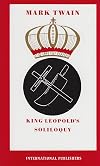
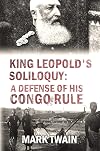
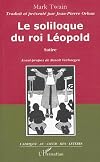
King Leopold's Soliloquy
by Mark Twain 
On This Page
Description
Twain's biting satire on the gruesome Belgian reign over the Congo. Rarely included in Twain collections.Tags
Recommendations

























Member Reviews
Beginning in the 19th century, King Leopold II of Belgium set himself up as individual private owner and absolute sovereign of the Congo Free State and proceeded to rape it of ivory and rubber and, worse, to annihilate the population through forced labor, starvation, and outright murder. Estimates of the genocide instigated at the command of this single individual range from 2,000,000 to 10,000,000 human beings, as much as 50 percent of the entire population. Of those who survived, a great proportion were left mutilated, as the chopping off of hands was the standard punishment for almost any infraction.
Little is remembered of these horrors outside of a few history courses and books. Even less is remembered about the acquiescence in the show more situation by many of the so-called civilized nations, most prominently the United States, Germany, Great Britain, and France. Only the relentless work of missionaries and humanitarians who spread the word to the world's peoples over many years ultimately resulted in the end of Leopold's reign of terror, though Belgium itself continued to control the Congolese colony for many years.
In a nearly-forgotten work, the great American writer known as Mark Twain created a scathing indictment of Leopold II, in the form of an imaginary speech by the king in which he denounces his critics and explains that he only did what God wanted, since if God had not wanted these atrocities, he would not have allowed a monarch by divine right to perpetrate them. Like much of Twain's darkest works, KING LEOPOLD'S SOLILOQUY is bitter satire, as worthy of Twain as of his even more bitter contemporary, Ambrose Bierce. It is a brief read, but a powerful and devastating one. That Leopold II is no longer remembered as a historical heavy fully competent to stand alongside Hitler and Pol Pot is a reminder of George Santayana's warning, "Those who cannot remember the past are condemned to repeat it." show less
Little is remembered of these horrors outside of a few history courses and books. Even less is remembered about the acquiescence in the show more situation by many of the so-called civilized nations, most prominently the United States, Germany, Great Britain, and France. Only the relentless work of missionaries and humanitarians who spread the word to the world's peoples over many years ultimately resulted in the end of Leopold's reign of terror, though Belgium itself continued to control the Congolese colony for many years.
In a nearly-forgotten work, the great American writer known as Mark Twain created a scathing indictment of Leopold II, in the form of an imaginary speech by the king in which he denounces his critics and explains that he only did what God wanted, since if God had not wanted these atrocities, he would not have allowed a monarch by divine right to perpetrate them. Like much of Twain's darkest works, KING LEOPOLD'S SOLILOQUY is bitter satire, as worthy of Twain as of his even more bitter contemporary, Ambrose Bierce. It is a brief read, but a powerful and devastating one. That Leopold II is no longer remembered as a historical heavy fully competent to stand alongside Hitler and Pol Pot is a reminder of George Santayana's warning, "Those who cannot remember the past are condemned to repeat it." show less
Ratings
Members
- Recently Added By
Lists

The Story of the World: Activity Book Four: The Modern Age
333 works; 2 members
Author Information

2,781+ Works 209,906 Members
Mark Twain was born Samuel L. Clemens in Florida, Missouri on November 30, 1835. He worked as a printer, and then became a steamboat pilot. He traveled throughout the West, writing humorous sketches for newspapers. In 1865, he wrote the short story, The Celebrated Jumping Frog of Calaveras County, which was very well received. He then began a show more career as a humorous travel writer and lecturer, publishing The Innocents Abroad in 1869, Roughing It in 1872, and, Gilded Age in 1873, which was co-authored with Charles Dudley Warner. His best-known works are The Adventures of Tom Sawyer, Mississippi Writing: Life on the Mississippi, and The Adventures of Huckleberry Finn. He died of a heart attack on April 21, 1910. (Bowker Author Biography) show less
Mark Twain has a Legacy Library. Legacy libraries are the personal libraries of famous readers, entered by LibraryThing members from the Legacy Libraries group.
Common Knowledge
- Original publication date
- 1905
- People/Characters
- Leopold II, King of the Belgians
- Important places
- Congo; Congo Free State
Classifications
Statistics
- Members
- 138
- Popularity
- 238,008
- Reviews
- 1
- Rating
- (4.03)
- Languages
- 5 — Dutch, English, French, German, Italian
- Media
- Paper, Ebook
- ISBNs
- 9
- ASINs
- 8