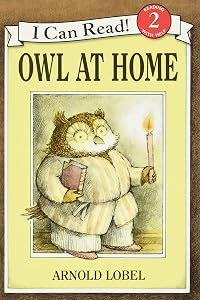
Owl at Home
by Arnold Lobel
On This Page
Description
Relates five adventures of Owl.Tags
Recommendations


Member Reviews
Arnold Lobel's "Owl at Home" is comprised of several short chapters, each its own story, about Owl's escapades in his cozy little home. In the first, Owl invites winter into his house to warm by the fire and winter quickly freezes it, prompting Owl to make him leave. In the following story, Owl sees bumps at the bottom of his bed and begins to fear them, not realizing they are his own feet. Next, Owl makes tea out of his own tears. In another story, Owl keeps running up and down the staircase is in his home, trying to be in two places at once. Lastly, Owl goes for a night walk in the woods and becomes convinced his new friend "moon" has followed him home.
Each is a short, easy-to-read, and charming tale of the child-like owl. He is a show more character who can easily be described as "special." He sees the world differently, and everything is somehow magical or mysterious. Although adults may chuckle at Owl's silliness, children will undoubtedly relate to his worldview. The chapter concerning Owl's fear of his own feet is especially telling of the character. Lobel writes with mostly short, "easy" words, but his sentences are more complex than the traditional "see Jane run" style of early readers. In addition, because each chapter is a separate story, children can read only one at a time and feel a sense of accomplishment and closure. I would recommend this book for children ages 4-8, who are beginning to read on their own. show less
Each is a short, easy-to-read, and charming tale of the child-like owl. He is a show more character who can easily be described as "special." He sees the world differently, and everything is somehow magical or mysterious. Although adults may chuckle at Owl's silliness, children will undoubtedly relate to his worldview. The chapter concerning Owl's fear of his own feet is especially telling of the character. Lobel writes with mostly short, "easy" words, but his sentences are more complex than the traditional "see Jane run" style of early readers. In addition, because each chapter is a separate story, children can read only one at a time and feel a sense of accomplishment and closure. I would recommend this book for children ages 4-8, who are beginning to read on their own. show less
2018: Oh gosh. How have I never read this yet? I mean, welcoming winter and being scared of the two bumps near the bottom of your bed are bemusing enough, and I don't know if Lobel or Frank Asch did the moon as friend & follower better, and upstairs/ downstairs is classic... but, erm, "Tearwater Tea?!" Wtf? Deep, man.
---
2023: Reread. Even better this time. Thank you.
---
2024: Reread. I mean, we know right off the bat that this is a different sort of owl. Not so wise, you see. At night he's supposed to be hunting, and he is supposed to sleep during the day. Is he just foolish, or is he an iconoclast? Are these stories just funny, or are they surreal & philosophical? I dunno; I just know that I never get tired of them.
---
2023: Reread. Even better this time. Thank you.
---
2024: Reread. I mean, we know right off the bat that this is a different sort of owl. Not so wise, you see. At night he's supposed to be hunting, and he is supposed to sleep during the day. Is he just foolish, or is he an iconoclast? Are these stories just funny, or are they surreal & philosophical? I dunno; I just know that I never get tired of them.
This book is sad at times because Owl doesn't have any friends and doesn't have anyone to talk to. He lets the winter wind in, tries to be in two places at once and then scares himself with his feet under his covers. This is a good book for kids to read though because some kids may be able to relate with this book and how Owl is feeling. Owl walks outside because he gets tired of being inside and he sees the moon. The moon follows him almost home and Owl gets mad at the moon and tells it to go away because it can't come in. Owl gets in bed and he sees a light shining through his window and realizes that the moon was a good friend and followed him home.
An easy reader by one of my favorite children's authors, and one my children enjoy very much as well. Owl is silly and doesn't always have good ideas (like being afraid of the bumps his feet make under his covers, or trying to be two places in once by racing up and downstairs). Nevertheless, some stories have some depth and make good conversation starters, like the sad things that cause Owl to cry).
This book is about an owl and has five different stories about him. Each story faced the Owl with a challenging obstacle, but in the end he was always able to face that challenge and figure out what was best for him. Although it seemed very challenging and almost impossible for the Owl to figure out a solution, he did.
I recommend this book to a 2-3 grade classroom. I think this is a great book to show to kids to help them understand bad and unfortunate things happen to everyone. And in the end we can always find a solution to make the situation feel much better. I think this book is really encouraging for a younger read.
I recommend this book to a 2-3 grade classroom. I think this is a great book to show to kids to help them understand bad and unfortunate things happen to everyone. And in the end we can always find a solution to make the situation feel much better. I think this book is really encouraging for a younger read.
Lobel's great stories make even an owl in pajamas who is scared of bumps in the bed very endearing.
Somehow I missed this one when my son was little, but upon the recommendation of my mother-in-law, who had the privilege of being read this book by her granddaughter (my niece), I picked it up recently. Lovely. Arnold Lobel never disappoints, but Owl is such an endearing character, and these stories are full of juicy thoughts for lucky kids (and grown-ups too!) to absorb.
Members
- Recently Added By
Lists

Honey For a Child's Heart
1,152 works; 25 members

Geek Dad Read to Your Kids List
79 works; 4 members

Brightly Beaming Curriculum Books
281 works; 8 members
Ambleside Books
459 works; 18 members

CCE 1000 Good Books List
1,033 works; 12 members

Sonlight Books
1,487 works; 25 members

Under The Chinaberry Tree
194 works; 1 member

Books Read in 2017
4,249 works; 129 members

Books Read in 2022
5,226 works; 112 members

Early Picture Books
467 works; 9 members

Recommended Reading List
219 works; 1 member

Favorite Picture Books
479 works; 160 members

Written and Illustrated By
805 works; 1 member

Read Aloud Revival
108 works; 4 members
Author Information

101+ Works 74,324 Members
Arnold Stark Lobel (May 22, 1933-December 4, 1987) was a popular American author of children's books. Among his most popular books are those of the Frog and Toad series, and Mouse Soup, which won the Garden State Children's Book Award from the New Jersey Library Association. Lobel won the 1981 Caldecott Medal for his book, Fables. Lobel also show more illustrated the works of other authors. A notable example is Sam the Minuteman by Nathaniel Benchley, which was first published in 1969. He was born in Los Angeles, California. When he graduated from art school, he married Anita Kempler, who also achieved fame as a children's book author and illustrator. Lobel died ion December 4,1987 due to complications arising from AIDS. He was 54 years old. (Bowker Author Biography) show less
Some Editions
Awards and Honors
Awards
Notable Lists
Series
Belongs to Publisher Series
I Can Read! (Level 2)
Work Relationships
Is contained in
Has as a reference guide/companion
Common Knowledge
- Canonical title
- Owl at Home
- Original title
- Owl at Home
- Original publication date
- 1975
- Dedication
- For Grandma
- First words
- Owl was at home.
- Last words
- (Click to show. Warning: May contain spoilers.)Owl did not feel sad at all.
- Original language*
- Engels
*Some information comes from Common Knowledge in other languages. Click "Edit" for more information.
Classifications
Statistics
- Members
- 4,552
- Popularity
- 3,226
- Reviews
- 50
- Rating
- (4.19)
- Languages
- 13 — Armenian, Catalan, Chinese, Czech, Dutch, English, Finnish, French, German, Italian, Japanese, Spanish, Swedish
- Media
- Paper, Audiobook, Ebook
- ISBNs
- 61
- UPCs
- 1
- ASINs
- 21