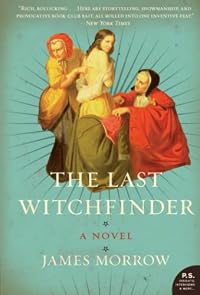
The Last Witchfinder
by James Morrow
On This Page
Description
Jennet Stearne's father hangs witches for a living in Restoration England. But when she witnesses the unjust and horrifying execution of her beloved aunt Isobel, the precocious child decides to make it her life's mission to bring down the Parliamentary Witchcraft Act. Armed with little save the power of reason, and determined to see justice prevail, Jennet hurls herself into a series of picaresque adventures traveling from King William's Britain to the fledgling American Colonies to an show more uncharted island in the Caribbean, braving West Indies pirates, Algonquin Indian captors, the machinations of the Salem Witch Court, and the sensuous love of a young Ben Franklin. For Jennet cannot and must not rest until she has put the last witchfinder out of business." show lessTags
Recommendations





Member Reviews
Morrow has tangled often with religion and its sins, so you'd expect he has a lot to say about the history of witch hunting. He spares no punches when describing both the scale of witching hunting in England and the US, and just how horrible it was. But there is much going on in this novel to carry the reader along through the darknss. The novel is written by the soul of Newton's Principia Mathematica. It turns out some books are so real they take on a life of their own, and often turn to possessing authors to write more books. The hero of the story is the daughter of an English witch-finder. Her lifelong quest is to end the practice by creating a grand proof that witches can't exist, based on Newtonian scientific principles. The novel show more includes a series of classic historical story forms, from a child's life in England, to capture by Indians in America, to castaways on a remote island, to a brief time with pirates, and finally an extended witch trial. Newton, Robert Hooke, Benjamin Franklin, and various other characters play important roles. The story is fantastic though not fantasy. I loved it.
Highly recommended. show less
Highly recommended. show less
James Morrow's The Last Witchfinder (William Morrow, 2006) is, without question, one of the most enjoyable novels I've read this year. A bit fantastical, it offers a nice escape from the bonds of traditional literature through a fascinating narrative structure that I was delighted to see employed effectively (done poorly, this book would easily have been a horrendous mess).
The novel, you see, is written by Newton's Principia Mathematica, who occasionally breaks into the narrative to offer super-textual commentary (such as a very funny explanation of how it is that existing books, not human authors, create new works of literature and prose ... and Hallmark cards) - think Fforde plus Eco with a hint of Borges and a healthy dash of Neal show more Stephenson.
At the core of the novel's main plot is Jennet Stearne, daughter and sister to witchfinders, niece to a woman wrongly executed as a witch whose dying wish was that Jennet disprove the supernatural basis of those events people interpreted as sorcery. A task easier said than done, but our heroine accepts the challenge. Naturally, the path is neither short nor smooth.
With appearances from Isaac Newton, Ben Franklin, Baron Montesquieu, Abigail Williams of Salem infamy and other characters factual and fictional, The Last Witchfinder is a rollicking book-trip through the eighteenth-century world where rationality and revelation duked it out (just as the Principia and his archnemesis the Malleus Maleficarum engage in a tangential final proxy-battle in the streets of New York).
You've got to read it to believe it. Aside from a few minor anachronisms, Morrow (er, sorry, Principia) has penned a fine tale.
http://philobiblos.blogspot.com/2007/09/book-review-last-witchfinder.html show less
The novel, you see, is written by Newton's Principia Mathematica, who occasionally breaks into the narrative to offer super-textual commentary (such as a very funny explanation of how it is that existing books, not human authors, create new works of literature and prose ... and Hallmark cards) - think Fforde plus Eco with a hint of Borges and a healthy dash of Neal show more Stephenson.
At the core of the novel's main plot is Jennet Stearne, daughter and sister to witchfinders, niece to a woman wrongly executed as a witch whose dying wish was that Jennet disprove the supernatural basis of those events people interpreted as sorcery. A task easier said than done, but our heroine accepts the challenge. Naturally, the path is neither short nor smooth.
With appearances from Isaac Newton, Ben Franklin, Baron Montesquieu, Abigail Williams of Salem infamy and other characters factual and fictional, The Last Witchfinder is a rollicking book-trip through the eighteenth-century world where rationality and revelation duked it out (just as the Principia and his archnemesis the Malleus Maleficarum engage in a tangential final proxy-battle in the streets of New York).
You've got to read it to believe it. Aside from a few minor anachronisms, Morrow (er, sorry, Principia) has penned a fine tale.
http://philobiblos.blogspot.com/2007/09/book-review-last-witchfinder.html show less
This book can only be described as historical fantasy. Morrow uses the horrific history of witch finding from England to America through the character of Jennet Stearne who spends her life trying to come up with a grand argument that would legally undermine witchfinders, the livelihood of her father and brother. Along the way, she is abducted by Algonquin Indians, shipwrecked with Ben Franklin, and accused of witchcraft herself. The narrator is Newton's Principia Mathematica, the text that Jennet used for her argument, and in the interludes, the book describes its battle against the Malleus Maleficarum, the witch hunting handbook. Here's where fantasy really takes over. The writing was rich and evocative, often ironic, and sometimes show more just fun. show less
If you are looking for a book about a tragic mistake costing a woman her life, a community ganging up on a few unusual women, a pseudohistorical explanation for mass hallucinations, or a condemnation of witches, keep looking.
This book is for fans of Setterfield's "The Thirteenth Tale" or "Bellman & Black", or Kostova's "The Historian", or Borges or Calvino or Eco or Garcia Marquez. If you want to know why you can never find a copy of the Principia Mathematica at your local used bookshop, despite the fact that the book was a vector that pushed both science and its place in Western life in a new direction (can't argue that, no matter how you feel about the beginning of the "Enlightenment" or trigonometry), and what happens when someone show more with a calling meets an immovable bureaucracy, or a smart woman meets an old superstition, or a book falls desperately in love with one of its first students, you have found a new friend. A delightful weekend's romp through the turbulent mid-17th century in England and its North American colonies, tantalizing bibliometaphysics, funny literary injokes, magical confluences of story with history, and put-your-finger-in-the-book and stare-thoughtfully-at-something epiphanies. I'll meet you there. show less
This book is for fans of Setterfield's "The Thirteenth Tale" or "Bellman & Black", or Kostova's "The Historian", or Borges or Calvino or Eco or Garcia Marquez. If you want to know why you can never find a copy of the Principia Mathematica at your local used bookshop, despite the fact that the book was a vector that pushed both science and its place in Western life in a new direction (can't argue that, no matter how you feel about the beginning of the "Enlightenment" or trigonometry), and what happens when someone show more with a calling meets an immovable bureaucracy, or a smart woman meets an old superstition, or a book falls desperately in love with one of its first students, you have found a new friend. A delightful weekend's romp through the turbulent mid-17th century in England and its North American colonies, tantalizing bibliometaphysics, funny literary injokes, magical confluences of story with history, and put-your-finger-in-the-book and stare-thoughtfully-at-something epiphanies. I'll meet you there. show less
For rebellion is as the sin of witchcraft.
- 1 Samuel 15.23
In The Last Witchfinder, James Morrow has created an interesting amalgam of historical fiction, fantasy, and scientific treatise. Morrow is obviously a skilled writer, and manages to pull this witches’ brew off quite well. The story is interesting and at times arresting, and Morrow has important things to say about superstition and reason, religion and science. I called the book a fantasy, but it does not in fact contain any speculative elements, it being more an inspired alternate history in which several historical personages make their appearances, including Isaac Newton, Benjamin Franklin, and the Baron de Montesquieu. It works surprisingly well, especially considering its show more length. Morrow does sometimes become a bit forceful in his arguments, which could be construed as polemical. But I enjoyed the story immensely, and found myself agreeing with most of Morrow’s standpoints on the dichotomy of faith and reason. Perhaps the book could have done with some more pruning, but it is such an interesting picaresque adventure, combining the physical with the metaphysical, that it would be shrewish of me to find too much fault with Morrow’s exuberance.
I could try to summarise the plot, but it presents certain difficulties, not least of which is that it seems completely absurd and unworkable in précis. Any story that contains burning-at-the-stake, a foetus-carnival, living-with-American-Indians, Robinson-Crusoe-marooning, and lots of sex, would be difficult to make sense of in synopsis. Despite this, I should mention that the story is set in the late 17th century, and follows the adventures of Jennet Stearne, the child of a witchfinder, who rebels against the practice after the immolation of her aunt. She becomes a natural philosopher, or quasi-scientist, hell-bent on disproving the existence of witchcraft, demons, and all the paraphernalia that goes with such hokum.
The novel’s framing device was quite original: Morrow has Jennet’s story narrated by a book, namely Newton’s Principia Mathematica, which is in a heated battle with the Malleus Maleficarum, or “The Hammer of the Witches”. This device did not always work for me: the Principia sometimes makes Morrow’s arguments for him too forcefully, and, because the book writes as though from modern times (i.e. the 21st century), it felt like it was making anachronistic comments quite often. But Morrow also reveals fascinating facts in these vignettes, so I feel a bit ambivalent about them.
The novel is also a bildungsroman in which Jennet’s development from precocious child to self-sufficient woman is depicted. Jennet is a strong female character, but Morrow does not fall into the trap of making her invulnerable or inhuman. Although initially a bit of a bluestocking, Jennet learns about the practical side of life during her time in America, especially when she is abducted by Algonquin Indians. Morrow walks a fine line when depicting his Indians, avoiding both the noble savage and, well, savage savage stereotypes. That said, this part of the novel seemed a bit inconsequential, and its inclusion only really made sense towards the end.
The final witch-trial of Jennet Stearne is probably the best scene of the novel. How could it be otherwise, with Montesquieu defending Jennet and Ben Franklin writing up the court reports? Morrow paints a searing picture of the practice of witch-finding, which was, to all intents and purposes, a form of genocide mostly aimed at old, vulnerable women, although men and children were not always safe. The Salem-trails, which make an appearance earlier in the novel, make it clear how this type of hysteria could sweep a community, leading to the deaths of many innocent (that is, innocent of witchcraft) people. Jennet’s trail is another miscarriage of justice, but it eventually has a salutary effect on later practices. And as for Jennet herself, well, you will just have to read the book for yourself to discover what happens…
The Last Witchfinder was tremendously enjoyable, a veritable romp through history and philosophy. It has its problems, but Morrow’s humanity and exuberance make up for most of these. Quite hilarious at times, it satisfied me no end. show less
- 1 Samuel 15.23
In The Last Witchfinder, James Morrow has created an interesting amalgam of historical fiction, fantasy, and scientific treatise. Morrow is obviously a skilled writer, and manages to pull this witches’ brew off quite well. The story is interesting and at times arresting, and Morrow has important things to say about superstition and reason, religion and science. I called the book a fantasy, but it does not in fact contain any speculative elements, it being more an inspired alternate history in which several historical personages make their appearances, including Isaac Newton, Benjamin Franklin, and the Baron de Montesquieu. It works surprisingly well, especially considering its show more length. Morrow does sometimes become a bit forceful in his arguments, which could be construed as polemical. But I enjoyed the story immensely, and found myself agreeing with most of Morrow’s standpoints on the dichotomy of faith and reason. Perhaps the book could have done with some more pruning, but it is such an interesting picaresque adventure, combining the physical with the metaphysical, that it would be shrewish of me to find too much fault with Morrow’s exuberance.
I could try to summarise the plot, but it presents certain difficulties, not least of which is that it seems completely absurd and unworkable in précis. Any story that contains burning-at-the-stake, a foetus-carnival, living-with-American-Indians, Robinson-Crusoe-marooning, and lots of sex, would be difficult to make sense of in synopsis. Despite this, I should mention that the story is set in the late 17th century, and follows the adventures of Jennet Stearne, the child of a witchfinder, who rebels against the practice after the immolation of her aunt. She becomes a natural philosopher, or quasi-scientist, hell-bent on disproving the existence of witchcraft, demons, and all the paraphernalia that goes with such hokum.
The novel’s framing device was quite original: Morrow has Jennet’s story narrated by a book, namely Newton’s Principia Mathematica, which is in a heated battle with the Malleus Maleficarum, or “The Hammer of the Witches”. This device did not always work for me: the Principia sometimes makes Morrow’s arguments for him too forcefully, and, because the book writes as though from modern times (i.e. the 21st century), it felt like it was making anachronistic comments quite often. But Morrow also reveals fascinating facts in these vignettes, so I feel a bit ambivalent about them.
The novel is also a bildungsroman in which Jennet’s development from precocious child to self-sufficient woman is depicted. Jennet is a strong female character, but Morrow does not fall into the trap of making her invulnerable or inhuman. Although initially a bit of a bluestocking, Jennet learns about the practical side of life during her time in America, especially when she is abducted by Algonquin Indians. Morrow walks a fine line when depicting his Indians, avoiding both the noble savage and, well, savage savage stereotypes. That said, this part of the novel seemed a bit inconsequential, and its inclusion only really made sense towards the end.
The final witch-trial of Jennet Stearne is probably the best scene of the novel. How could it be otherwise, with Montesquieu defending Jennet and Ben Franklin writing up the court reports? Morrow paints a searing picture of the practice of witch-finding, which was, to all intents and purposes, a form of genocide mostly aimed at old, vulnerable women, although men and children were not always safe. The Salem-trails, which make an appearance earlier in the novel, make it clear how this type of hysteria could sweep a community, leading to the deaths of many innocent (that is, innocent of witchcraft) people. Jennet’s trail is another miscarriage of justice, but it eventually has a salutary effect on later practices. And as for Jennet herself, well, you will just have to read the book for yourself to discover what happens…
The Last Witchfinder was tremendously enjoyable, a veritable romp through history and philosophy. It has its problems, but Morrow’s humanity and exuberance make up for most of these. Quite hilarious at times, it satisfied me no end. show less
The Last Witchfinder is about a spunky skeptic and natural scientist named Jennet Stearne. After her favorite aunt is executed for witchcraft, Jennet makes it her mission to disprove the idea of sorcery once and for all via scientific proof.
But disproving witchcraft is not a simple and scientific matter; every obstacle that Jennet runs into is because she is challenging the religious faith of her community. And people (particularly Puritans) are generally very unyielding when you cross their religion. The conflict set up is not exactly religion versus reason, but a willingness to learn and examine things versus stubbornly keeping your blinders on in the face of opposition. This level of fanaticism impedes honest science, so it's harmful show more to society and beneficial to nobody. Even after Jennet lays out a scientific disproof before a court:
"they'd understood nothing of what she'd meant by Nature's laws. Instead they'd found...a woman so impious and arrogant that she'd routinely attempted to make Heaven's fire submit to her will." show less
But disproving witchcraft is not a simple and scientific matter; every obstacle that Jennet runs into is because she is challenging the religious faith of her community. And people (particularly Puritans) are generally very unyielding when you cross their religion. The conflict set up is not exactly religion versus reason, but a willingness to learn and examine things versus stubbornly keeping your blinders on in the face of opposition. This level of fanaticism impedes honest science, so it's harmful show more to society and beneficial to nobody. Even after Jennet lays out a scientific disproof before a court:
"they'd understood nothing of what she'd meant by Nature's laws. Instead they'd found...a woman so impious and arrogant that she'd routinely attempted to make Heaven's fire submit to her will." show less
From the back:
"Jennet Stearn's father hangs witches for a living in Restoration England. But when she witnesses the unjust and horrifying execution of her beloved aunt Isabel, the precocious child decides to make it her life's mission to bring down the Parliamentary Witchcraft Act. Armed with little save the power of reason, and determined to see justice prevail, Jennet hurls herself into a series of picaresque adventures--traveling from King William's Britain to the fledgling American Colonies to an uncharted island in the Caribbean, braving West Indies pirates, Algonquin Indian captors, the machinations of the Salem Witch Court, and the sensuous love of a young Ben Franklin. For Jennet cannot and must not rest until she had put the show more last witchfinder out of business."
My review:
This is not your ordinary historical fiction. James Morrow uses the story of Jennet Stearne to explore the the clash of Reason and Revelation whose battles are still going on in our own times. Jennet is an appealing character whose single-minded devotion to eliminating witchfinding causes her pain and gives her power. I particularly liked the device of using a book's "voice" (Newton's Principia Mathematica) to introduce and comment on the story. Morrow writes with confidence and elegance. Highly recommend this book. show less
"Jennet Stearn's father hangs witches for a living in Restoration England. But when she witnesses the unjust and horrifying execution of her beloved aunt Isabel, the precocious child decides to make it her life's mission to bring down the Parliamentary Witchcraft Act. Armed with little save the power of reason, and determined to see justice prevail, Jennet hurls herself into a series of picaresque adventures--traveling from King William's Britain to the fledgling American Colonies to an uncharted island in the Caribbean, braving West Indies pirates, Algonquin Indian captors, the machinations of the Salem Witch Court, and the sensuous love of a young Ben Franklin. For Jennet cannot and must not rest until she had put the show more last witchfinder out of business."
My review:
This is not your ordinary historical fiction. James Morrow uses the story of Jennet Stearne to explore the the clash of Reason and Revelation whose battles are still going on in our own times. Jennet is an appealing character whose single-minded devotion to eliminating witchfinding causes her pain and gives her power. I particularly liked the device of using a book's "voice" (Newton's Principia Mathematica) to introduce and comment on the story. Morrow writes with confidence and elegance. Highly recommend this book. show less
Members
- Recently Added By
Lists

Recommend the 20 best books you've read in the last five years
2,167 works; 606 members

Top Five Books of 2018
802 works; 265 members

Witch Hunts
30 works; 7 members

Authors from the United States
245 works; 3 members

Books Read in 2018
4,360 works; 110 members
Author Information

68+ Works 7,964 Members
Awards and Honors
Common Knowledge
- Canonical title
- The Last Witchfinder
- Original publication date
- 2006
- People/Characters
- Jennet Stearne; Benjamin Franklin; Abigail Williams; Isobel Mowbray; Walter Stearne; Isaac Newton (show all 7); Barnaby Cavendish
- Important places
- Pennsylvania, USA; Philadelphia, Pennsylvania, USA; Caribbean; Salem, Massachusetts, USA; England, UK
- Important events
- Salem witch trials
- Epigraph
- If the Judge wishes to find out whether she is endowed with a
witch's power of preserving silence, let him take not whether she
is able to shed tears when standing in his presence, or when being
tortured. For we are ... (show all)taught both by the words of worthy men of
old and by our own experience that this is a most certain sign, and
it has been found that even if she be urged and exhorted by solemn
conjurations to shed tears, if she be a witch she will not be able to
weep: although she will assume a tearful aspect and smear her
cheeks and eyes with spittle to make it appear that she is weeping;
wherefore she must be closely watched by the attendants.
Heinrich Krämer and James Sprenger
Malleus Maleficaru, A.D. 1486
Part III, Question XV (Excerpt)
Then came out of the House a grave, tall Man carrying his Holy
Writ before the supposed Wizard as solemnly as the Sword-bearer
of London before the Lord Mayor; the Wizard was first put in the
Scale, and over him was ... (show all)read a Chapter out of the Books of Moses,
and then the Bible was put in the other Scale, which, being kept
down before, was immediately let go; but, to great Surprise of
the Spectators, Flesh and Bones came down plump, and out-
weighted the good Book by abundance. After the same Manner, the
others were served, and their lumps of Mortality severally were
too heavy for Moses and all the Prophets and Apostles.
Benjamin Franklin
"A Witch-Trial at Mount-Holly"
The Pennsylvania Gazette
October 22, 1730 - Dedication
- TO THE MEMORY OF
Ann Hyson Smith - First words
- Introducing Out Heroine, Jennet Stearne, Whose
Father Hunts Witches, Whose Aunt Seeks Wisdom, and
Whose Soul Desires an Object It Cannot Name
May I speak candidly, fleshling, one rational creatur... (show all)e to another, myself a book and you a reader? - Last words
- (Click to show. Warning: May contain spoilers.)It's just one of those secrets of the universe.
- Blurbers
- Crowley, John; Straub, Peter; Stephenson, Neal
Classifications
- Genres
- Fiction and Literature, General Fiction, Historical Fiction, Fantasy
- DDC/MDS
- 813.54 — Literature & rhetoric American literature in English American fiction in English 1900-1999 1945-1999
- LCC
- PS3563 .O876 .L37 — Language and Literature American literature American literature Individual authors 1961-
- BISAC
Statistics
- Members
- 1,074
- Popularity
- 23,704
- Reviews
- 49
- Rating
- (3.71)
- Languages
- English, French
- Media
- Paper, Ebook
- ISBNs
- 11
- ASINs
- 6