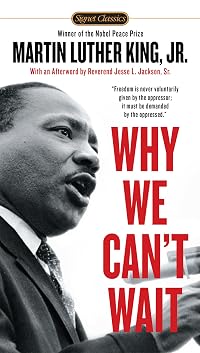
Why We Can't Wait
by Martin Luther King, Jr.
On This Page
Description
Overview: Dr. King's best-selling account of the civil rights movement in Birmingham during the spring and summer of 1963. Often applauded as Dr. Martin Luther King, Jr.'s most incisive and eloquent book, Why We Can't Wait recounts the Birmingham campaign in vivid detail, while underscoring why 1963 was such a crucial year for the civil rights movement. During this time, Birmingham, Alabama, was perhaps the most racially segregated city in the United States, but the campaign launched by Fred show more Shuttlesworth, King, and others demonstrated to the world the power of nonviolent direct action. King examines the history of the civil rights struggle and the tasks that future generations must accomplish to bring about full equality. The book also includes the extraordinary "Letter from Birmingham Jail," which King wrote in April of 1963. show lessTags
Recommendations





Member Reviews
Unfortunately, Martin Luther King’s legacy is often distilled into being a person who gave great speeches and advocated for a colorblind society. What’s missing in that simplistic view is his genius at organizing, his tactical brilliance, and his ability to create a vision that everyone could see. This book goes into all of that, in his own words. That helps as his actions aren’t being filtered or interpreted by someone else. King provides a great snapshot—almost like a historian—of 1963 and how the world was focusing their attentions after the assassination of President Kennedy. The main focus is on the actions in Birmingham and his ability to create a form of economic and racial justice for the people there. He also show more backtracks and provides a great deal of strategies—be it Biblical teachings, Gandhi, or his own understanding of America’s inhumane caste system. With social injustice still happening around the world, this book is important for anyone who has dedicated themselves to creating positive change. show less
Following what he had done in Montgomery a few years prior, here's MLK applying his remedy to Birmingham, probably then one of the most segregated cities in the USA. Led by 'Bull Connor', a vile White supremacist, here was a town indeed where, between 1957 and 1963, 17 bomb attacks against Black churches and civil rights campaigners went unpunished, a bastion of the racist/ segregationist South, yet that will become the symbol of a non-violent revolution.
It's astounding to think that African-Americans were still subjected to such a racial yoke, especially at a time when, in the rest of the world, Black people were in the process of earning their independence from their past colonial powers. The hypocrisy of the government might have show more been truly angering; the clock being constantly set back by some States utterly frustrating; and so it was no wonder, of course, that it had reached such a boiling point. And indeed, who doesn't have the images still burnt into their minds, that of racism exploding onto their screens thanks to TV, which was then a relatively new media? Protesters attacked by police dogs and sprayed with water canons, women beaten up to the ground, children even as young as 6 being put under arrest... The horror will set in motion a whole process that will ultimately lead to the signing of the Civil Right Act.
It's astounding, too, to think that such violence and hatred are not so far back in time. Still in Birmingham, 1963 will end up by the bombing of a church (killing four little girls), the murder of a boy and by the police in broad daylight, while another boy will be killed by a racist mob, with the authorities having no care for these three cases. Hopeless? Not so much.
Birmingham, again, was indeed where the racial question exploded into the face of a country still having its head buried in the sand, where the brutality of racism was fully exposed, and where, despite all such violence, a case was made in favour of non-violent action to serve a cause. As always with MLK, here's more than a book -it's a privilege. The privilege to hear about it all from one of the key actors to such events.
Engrossing, moving, and deeply humanistic. show less
It's astounding to think that African-Americans were still subjected to such a racial yoke, especially at a time when, in the rest of the world, Black people were in the process of earning their independence from their past colonial powers. The hypocrisy of the government might have show more been truly angering; the clock being constantly set back by some States utterly frustrating; and so it was no wonder, of course, that it had reached such a boiling point. And indeed, who doesn't have the images still burnt into their minds, that of racism exploding onto their screens thanks to TV, which was then a relatively new media? Protesters attacked by police dogs and sprayed with water canons, women beaten up to the ground, children even as young as 6 being put under arrest... The horror will set in motion a whole process that will ultimately lead to the signing of the Civil Right Act.
It's astounding, too, to think that such violence and hatred are not so far back in time. Still in Birmingham, 1963 will end up by the bombing of a church (killing four little girls), the murder of a boy and by the police in broad daylight, while another boy will be killed by a racist mob, with the authorities having no care for these three cases. Hopeless? Not so much.
Birmingham, again, was indeed where the racial question exploded into the face of a country still having its head buried in the sand, where the brutality of racism was fully exposed, and where, despite all such violence, a case was made in favour of non-violent action to serve a cause. As always with MLK, here's more than a book -it's a privilege. The privilege to hear about it all from one of the key actors to such events.
Engrossing, moving, and deeply humanistic. show less
What’s important to remember when considering King’s legacy is that his vision of social justice changed in the late 60s to an economics of raising up the poor of all races. He knew that racial animosity would continue as long as the middle class could be convinced that the poor, minorities and immigrants should be derided and and scapegoated. The last thirty years have seen the economic hierarchy become even more skewed towards the 1%, who have grabbed the reins of political power through their proxies in the Republican Party.
Dr. King’s words are gems – Profound. Written with the eloquence of Shakespeare and the timeliness of today’s headlines. This book dispels the mythical, classroom teachings that tout the Civil Rights Movement of the 1960s, as an accidental occurrence – shedding light on the intricate plans, tactics and maneuvers of dedicates individuals and groups who understood the gravity of the mission: None are free, until all are free.
Squelching racial bigotry and “Jim Crow” laws was the widely viewed aim of the mission – but Civil Rights are the Basic Rights – Human Rights. These are the rights that so many (including Dr. Martin Luther King Jr.) sacrificed and died to give to all disenfranchised people, everywhere...SMILE!!!
Squelching racial bigotry and “Jim Crow” laws was the widely viewed aim of the mission – but Civil Rights are the Basic Rights – Human Rights. These are the rights that so many (including Dr. Martin Luther King Jr.) sacrificed and died to give to all disenfranchised people, everywhere...SMILE!!!
Why we can’t wait is Martin Luther King’s essay on the civil rights movement and the events of 1963, a pivotal year in the struggle, the year of the Birmingham protests and the year of the march on Washington when Dr. King told us “I have a dream.” When I first read the book in college, the events were fresh. Re-reading the book many years later, I am still impressed by the writing of Dr. King and his message is as relevant today as it was then.
The book explains why the movement decided to focus on Birmingham, perhaps the most oppressive city in Alabama for minorities, and the strategies of nonviolent protest. Included in the book is the “Letter from Birmingham Jail” which is a reply to clergy in Birmingham who asked for show more moderation. Dr. King explains why that time was now to change America and moderation was no longer acceptable. The events of 1963 led to political action by Lyndon Johnson and other members of Congress. Dr. King then goes on to explain why affirmative action (as we call it today) is necessary and desirable.
The author and TV host Glenn Beck holds Martin Luther King Jr. as one of the great men of the 20th century. Whether you agree with Beck or not, take his advice in reading original source materials from Dr. King himself, not what someone else has written about him. On the subject of civil rights, this book is a good place to start. show less
The book explains why the movement decided to focus on Birmingham, perhaps the most oppressive city in Alabama for minorities, and the strategies of nonviolent protest. Included in the book is the “Letter from Birmingham Jail” which is a reply to clergy in Birmingham who asked for show more moderation. Dr. King explains why that time was now to change America and moderation was no longer acceptable. The events of 1963 led to political action by Lyndon Johnson and other members of Congress. Dr. King then goes on to explain why affirmative action (as we call it today) is necessary and desirable.
The author and TV host Glenn Beck holds Martin Luther King Jr. as one of the great men of the 20th century. Whether you agree with Beck or not, take his advice in reading original source materials from Dr. King himself, not what someone else has written about him. On the subject of civil rights, this book is a good place to start. show less
This book is about the life of people being a different color. It's starts off talking about the Emancipation of Proclamation when black people or bi-racial freedom. But in 1950-1963 African Americans were segregated from all white. They were not allowed to go to the same stores or any other places were white people were allowed to go and it was always like that for a very long time but then a man named Dr. Martin Luther King Jr. showed up. He was a man who didn't believe in segregation and he would take march's and he gave his famous I have a dream speech. Many people believed in Martin and not everybody did because of the things that he was doing they used to be illegal back then so he was put in jail for the "wrong" thing s that he show more was doing. Eventually he was let out of jail and a couple years later in Memphis Tennessee he was assassinated on the balcony of his motel in 1968. In 2011 in Washington D.C they made a statue of him for the wonderful thing he did. show less
Members
- Recently Added By
Lists

Modern Library 100 Best Nonfiction Books
100 works; 8 members

Black Authors
384 works; 32 members

1960s
281 works; 16 members

Mustich's 1000 Books to Read Before You Die: A Life Changing List
1,001 works; 20 members

Schomburg Centennial Reading List
100 works; 4 members
Author Information

158+ Works 13,398 Members
Martin Luther King, Jr. was born on January 15, 1929 into a middle-class black family in Atlanta, Georgia. He received a degree from Morehouse College. While there his early concerns for social justice for African Americans were deepened by reading Henry David Thoreau's essay "Civil Disobedience." He enrolled in Crozer Theological Seminary and show more there became acquainted with the Social Gospel movement and the works of its chief spokesman, Walter Rauschenbusch. Mohandas Gandhi's practice of nonviolent resistance (ahimsaahimsa) later became a tactic for transforming love into social change. After seminary, he postponed his ministry vocation by first earning a doctorate at Boston University School of Theology. There he discovered the works of Reinhold Niebuhr and was especially struck by Niebuhr's insistence that the powerless must somehow gain power if they are to achieve what is theirs by right. In the Montgomery bus boycott, it was by economic clout that African Americans broke down the walls separating the races, for without African American riders, the city's transportation system nearly collapsed. The bus boycott took place in 1954, the year King and his bride, Coretta Scott, went to Montgomery, where he had been called to serve as pastor of the Dexter Avenue Baptist Church. Following the boycott, he founded the Southern Christian Leadership Conference (SCLC) to coordinate civil rights organizations. Working through African American churches, activists led demonstrations all over the South and drew attention, through television and newspaper reports, to the fact that nonviolent demonstrations by blacks were being suppressed violently by white police and state troopers. The federal government was finally forced to intervene and pass legislation protecting the right of African Americans to vote and desegregating public accommodations. For his nonviolent activism, King received the Nobel Peace Prize in 1964. While organizing a "poor people's campaign" to persuade Congress to take action against poverty, King accepted an invitation to visit Memphis, Tennessee, where sanitation workers were on strike. There, on April 4, 1968, he was gunned down while standing on the balcony of his hotel. (Bowker Author Biography) show less
Some Editions
Awards and Honors
Series
Belongs to Publisher Series
Signet (P2476)
Work Relationships
Common Knowledge
- Canonical title
- Why We Can't Wait
- Original publication date
- 1964
- Original language
- English
Classifications
- Genres
- Nonfiction, Politics and Government, General Nonfiction, History
- DDC/MDS
- 305.86073 — Society, government, & culture Social sciences, sociology & anthropology Social group - Age, Gender, Ethnicity Ethnic and national groups People who speak, or whose ancestors spoke, Spanish, Portuguese, Galician
- LCC
- E185.61 .K54 — History of the United States United States Elements in the population Afro-Americans Status and development since emancipation
- BISAC
Statistics
- Members
- 1,771
- Popularity
- 12,432
- Reviews
- 8
- Rating
- (4.42)
- Languages
- 7 — Dutch, English, Finnish, French, German, Spanish, Swedish
- Media
- Paper, Audiobook, Ebook
- ISBNs
- 29
- UPCs
- 1
- ASINs
- 28