On This Page
Description
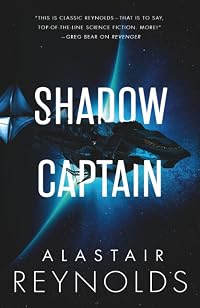
The gripping sequel to the Locus award winning science fiction adventure, Revenger, tells a story of obsession and betrayal as two sisters hunt for the greatest treasure in the universe. Adrana and Fura Ness have finally been reunited, but both have changed beyond recognition. Once desperate for adventure, now Adrana is haunted by her enslavement on the feared pirate Bosa Sennen's ship. And rumors of Bosa Sennen's hidden cache of treasure have ensnared her sister, Fura, into single-minded show more obsession. Neither is safe; because the galaxy wants Bosa Sennen dead and they don't care if she's already been killed. They'll happily take whoever is flying her ship. Shadow Captain is a desperate story of cursed ships, vengeful corporations, and alien artifacts, of daring escapes and wealth beyond imagining ... and of betrayal. show lessTags
Recommendations






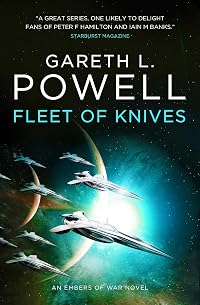
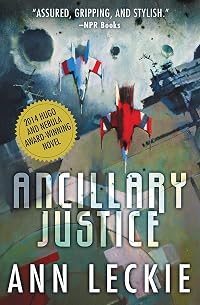
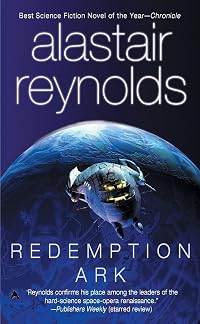
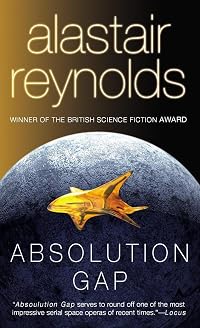






Member Reviews
This is a truly entertaining sequel to "Revenger," intelligent and compelling from the start. I like that this world Reynolds has created here is a very "lived-in" one, banged up around the edges with socioeconomic inequality, industrial junk cast about, and dialogue rife with idiom and slang (like real people use); really, there is a "Firefly" vibe to the 'verse here, and characters that also seem real and dynamic. The action is quick, there's no dumbing-down going on, and it's really hard to put this down.
I'm giving SC 4 stars rather than 5 because, unlike R, it can't work as a stand-alone novel and because it dwells a bit too long in an unsavory and limited gangster-run place, slowing down the movement so characteristic of R. It IS a show more Book Two, with a cheeky cliffhanger ending, but doesn't suffer from middle-book syndrome, and it most definitely answers lingering questions clarifying matters of history and of the nature of the worldlets comprising the Configuration.
This is a damned fine summer read. show less
I'm giving SC 4 stars rather than 5 because, unlike R, it can't work as a stand-alone novel and because it dwells a bit too long in an unsavory and limited gangster-run place, slowing down the movement so characteristic of R. It IS a show more Book Two, with a cheeky cliffhanger ending, but doesn't suffer from middle-book syndrome, and it most definitely answers lingering questions clarifying matters of history and of the nature of the worldlets comprising the Configuration.
This is a damned fine summer read. show less
The second book of the trilogy starts where the first ended - with Arafura (now going under the name Fura) and Adrana in command of the ex-pirate ship and still hoping that they have a chance at a normal life. The narrator also shifts - the second book is told by Adrana and that changes both the perspective and what we know about the world. The big problem for the two sisters is that the ship they got is recognizable and that noone believes anything coming from that ship - the pirate had used all tricks and lies so no matter what they say, they are considered to be the pirate herself.
And still they try - using only baubles (the dead rocks which contain treasure and can only be reached in certain times) and stay away from other ships show more and worlds, trying to find a way to convince the world that they are innocent. But of course thing go from bad to worse - while they try not to kill a ship that is shooting at them they manage to destroy another one and they need to land on a world for provisions and to take care of a wounded crewmate. They even manage to get tangled with zombie-like creatures and a lot of old technology. And just because that's how luck usually works, they even manage to destroy the economy of the whole universe while trying to find the pirate's treasure.
The language and the topics are still YA enough for this to count as YA but the novel reads a lot more adult than the first - even if the sisters had grown less than a year, they are different people after what they lived through. And while they travel and are chased by everyone, some more information is revealed about the universe they live in - some of it known to them from before, some of it being learned together with the reader.
It is a middle book in a trilogy and as such it cannot stand on its own - it needs the first one to be understood and it leaves so many open questions that it is obvious that an additional book is needed. show less
And still they try - using only baubles (the dead rocks which contain treasure and can only be reached in certain times) and stay away from other ships show more and worlds, trying to find a way to convince the world that they are innocent. But of course thing go from bad to worse - while they try not to kill a ship that is shooting at them they manage to destroy another one and they need to land on a world for provisions and to take care of a wounded crewmate. They even manage to get tangled with zombie-like creatures and a lot of old technology. And just because that's how luck usually works, they even manage to destroy the economy of the whole universe while trying to find the pirate's treasure.
The language and the topics are still YA enough for this to count as YA but the novel reads a lot more adult than the first - even if the sisters had grown less than a year, they are different people after what they lived through. And while they travel and are chased by everyone, some more information is revealed about the universe they live in - some of it known to them from before, some of it being learned together with the reader.
It is a middle book in a trilogy and as such it cannot stand on its own - it needs the first one to be understood and it leaves so many open questions that it is obvious that an additional book is needed. show less
A regular page turner, as I'd hope for in a sequel to [b:Revenger|28962452|Revenger (Revenger, #1)|Alastair Reynolds|https://i.gr-assets.com/images/S/compressed.photo.goodreads.com/books/1465442536l/28962452._SY75_.jpg|49189920]. This is filled with tense plotting, big ideas, and cool science, as I always expect from Reynolds. A lot of it is about trust: how do you gain or keep someone's trust if you are keeping secrets from them and they know that? What do you do if they only way you'll get a chance to earn someone's trust is to deceive them? Wonderful stuff.
When I read the first book in this series, I pegged it as (rather mature) young-adult fiction, but I'm less confident about that judgement after this book.
When I read the first book in this series, I pegged it as (rather mature) young-adult fiction, but I'm less confident about that judgement after this book.
On the plus side, this book and this series has a fascinating setting, interesting characters, and some plausible-seeming science. On the minus side, this sequel's characters just didn't sparkle like the premiere novel, nor did the plot and pace seem as well wrought. Not too sure if I'll continue with the series (even though a week ago I was talking it up to friends).
I find it strange that the debate whether YA is any good is so often cast in either/or terms. I read all kinds of things - newspapers, YA, folk tales of all kinds, romance, crime, SF, fantasy, nature writing, history, biography, serious contemporary fiction, classics, books for beginner readers. Oh, the emotional pull of Dogger...My enjoyment of YA etc does not make me incapable of reading, appreciating and criticising serious literature. I also question what seems to be a general idea that reading, say, Alastair Reynolds is fine and dandy and nothing wrong with that sort of escapism, while reading YA or romance is silly and OMG the death of intelligence and all that is good and beautiful in the world. Take that into films - an action show more film is no more adult than “Divergent” or “The Hunger Games”, except maybe there's more fuck, in both sense of the word. There's a gender division inherent in this that could do with more exploration.
it seems to be demonstrably untrue that “The Fault In Our Stars” is a more serious novel than Sabbath's Theatre, American Pastoral, or Atomised, which are novels about middle aged men struggling with sex, death and failure. They are serious about "urgent issues", if we mean social issues by that. Being serious is a curb on popularity: if it wasn't, John Rawls would outsell “The Hunger Games”, wouldn't he? But the real issue with the leap of logic that this piece makes actually occurs within genres. The Divergent trilogy, which is a terrible piece of trash, has never been nominated for a Hugo or a Nebula, yet outsells the books that do. Am I, as someone with a passing interest in science fiction, to understand that Divergent is more serious in every way that matters than the novels that do? What is it about the current malaise in literature (literary circles, now) that makes it so disengaged from the reality, while simplistic evil/good YA novels do a better job of answering them (note, not a good job, simply a better one).
Also, about adult reality: perhaps we should look elsewhere for our good pieces?
Forget canon, labels and themes thrown at kids ex cathedra. Read with them, look at the language, techniques, syntax, metaphor, nuance etc, and they will soon enough work out the themes themselves. There are no themes without the language that both contains and express them. Invest teaching time in deep reading and the rest of the wretched business will fall into place. Including the almighty prescribed themes.
Is Reynolds writing Dark SF disguised as YA SF? I think young adults need to encounter a variety of portrayals of hardship as it broadens their own base of experience. It is essential...Teenagers are the perfect age for dark fiction. Their questing minds, whether socially, academically or personally are a natural fit for discovering the worst of human nature. They do it themselves anyway, without prompting. Teenagers are primed to dissect the world around them in their search for self, for identity, and yes, shockingly, knowledge. Totally agree with the author of this piece. Using dark fiction, whether highbrow or not (depends upon your interpretation) is a perfect springboard for discussion of serious ideas with teens. And if they have a reading bent at all they'll devour it. Teenagers are often far more intelligent, perceptive and receptive than many adults credit them.
When I was a teenager I found nothing more offensive than teachers thinking I couldn't handle something. So did I magically understand something once I turn 18? When I was in 7th grade I was reading "Lolita" in English class and my teacher told me that I should be reading something more age appropriate. She also used the word perverse to describe the book. Well I'm sorry but the point of "Lolita" is to examine the thoughts and feelings of someone who is, yes perverse but also complex and unreliable. Books are supposed to be thought provoking and make you feel different things and that's exactly what dark fiction does.
A lot of YA SF is indeed one-note single-issue off-the-shelf dystopias of the kind we seem to think 'speak' to people, but in sales and market share an awful lot are precisely the steampunk you we were slagging off last time around. Doesn't that speak to its readers too? Look at any list of bestsellers for 1914, 1894, 1924... how many are remembered, or read now? Just because something sold well doesn't give in intrinsic merit. (Neither does it preclude it from having anything beyond a good publicity campaign).
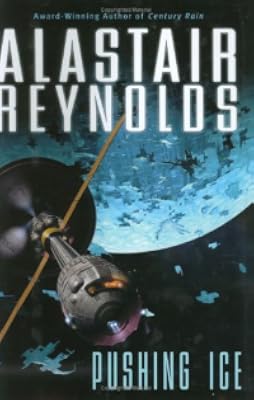
The phenomenon of half-finished bestsellers gathering dust on shelves didn't start with Stephen Hawking. I'm better off reading outstanding YA Dark SF the way Reynolds is doing. I'm sick and tired of the industry (not just in-genre) having plenty of pigeon-holed writers, creating the same thing again and again, trapped in the literary equivalent of a market segment. Writing is art of creation but they're worrying about breaking a publishing formula. They're in a cul-de-sac. Not so with Reynolds. Once again, after "Revenger" which I also liked a lot, "Shadow Captain" was able to capture the sense of wonderment I remember having as a teenager reading this kind of stuff. I also like some of his hard stuff ("Pushing Ice", etc.), but ‘Revenger’, and "Shadow Captain" in contrast, although lighter and more digestible, are still very solid YA SF. It’s testament to Reynolds’ writing chops for varying his style whilst holding down a solid narrative and portraying interesting and engaging characters like the Ness Sisters.
NB: To fully enjoy this novel you've got to put on your YA hat, otherwise it won't work. show less
it seems to be demonstrably untrue that “The Fault In Our Stars” is a more serious novel than Sabbath's Theatre, American Pastoral, or Atomised, which are novels about middle aged men struggling with sex, death and failure. They are serious about "urgent issues", if we mean social issues by that. Being serious is a curb on popularity: if it wasn't, John Rawls would outsell “The Hunger Games”, wouldn't he? But the real issue with the leap of logic that this piece makes actually occurs within genres. The Divergent trilogy, which is a terrible piece of trash, has never been nominated for a Hugo or a Nebula, yet outsells the books that do. Am I, as someone with a passing interest in science fiction, to understand that Divergent is more serious in every way that matters than the novels that do? What is it about the current malaise in literature (literary circles, now) that makes it so disengaged from the reality, while simplistic evil/good YA novels do a better job of answering them (note, not a good job, simply a better one).
Also, about adult reality: perhaps we should look elsewhere for our good pieces?
Forget canon, labels and themes thrown at kids ex cathedra. Read with them, look at the language, techniques, syntax, metaphor, nuance etc, and they will soon enough work out the themes themselves. There are no themes without the language that both contains and express them. Invest teaching time in deep reading and the rest of the wretched business will fall into place. Including the almighty prescribed themes.
Is Reynolds writing Dark SF disguised as YA SF? I think young adults need to encounter a variety of portrayals of hardship as it broadens their own base of experience. It is essential...Teenagers are the perfect age for dark fiction. Their questing minds, whether socially, academically or personally are a natural fit for discovering the worst of human nature. They do it themselves anyway, without prompting. Teenagers are primed to dissect the world around them in their search for self, for identity, and yes, shockingly, knowledge. Totally agree with the author of this piece. Using dark fiction, whether highbrow or not (depends upon your interpretation) is a perfect springboard for discussion of serious ideas with teens. And if they have a reading bent at all they'll devour it. Teenagers are often far more intelligent, perceptive and receptive than many adults credit them.
When I was a teenager I found nothing more offensive than teachers thinking I couldn't handle something. So did I magically understand something once I turn 18? When I was in 7th grade I was reading "Lolita" in English class and my teacher told me that I should be reading something more age appropriate. She also used the word perverse to describe the book. Well I'm sorry but the point of "Lolita" is to examine the thoughts and feelings of someone who is, yes perverse but also complex and unreliable. Books are supposed to be thought provoking and make you feel different things and that's exactly what dark fiction does.
A lot of YA SF is indeed one-note single-issue off-the-shelf dystopias of the kind we seem to think 'speak' to people, but in sales and market share an awful lot are precisely the steampunk you we were slagging off last time around. Doesn't that speak to its readers too? Look at any list of bestsellers for 1914, 1894, 1924... how many are remembered, or read now? Just because something sold well doesn't give in intrinsic merit. (Neither does it preclude it from having anything beyond a good publicity campaign).
The phenomenon of half-finished bestsellers gathering dust on shelves didn't start with Stephen Hawking. I'm better off reading outstanding YA Dark SF the way Reynolds is doing. I'm sick and tired of the industry (not just in-genre) having plenty of pigeon-holed writers, creating the same thing again and again, trapped in the literary equivalent of a market segment. Writing is art of creation but they're worrying about breaking a publishing formula. They're in a cul-de-sac. Not so with Reynolds. Once again, after "Revenger" which I also liked a lot, "Shadow Captain" was able to capture the sense of wonderment I remember having as a teenager reading this kind of stuff. I also like some of his hard stuff ("Pushing Ice", etc.), but ‘Revenger’, and "Shadow Captain" in contrast, although lighter and more digestible, are still very solid YA SF. It’s testament to Reynolds’ writing chops for varying his style whilst holding down a solid narrative and portraying interesting and engaging characters like the Ness Sisters.
NB: To fully enjoy this novel you've got to put on your YA hat, otherwise it won't work. show less
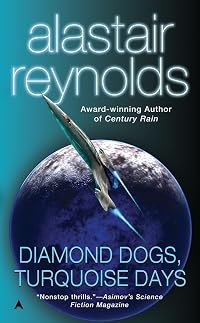
This is the sequel to last year’s Revenger, Reynolds’s first attempt at YA fiction. And, to be honest, other than the fact the two protagonists – one of which is the narrator – are teenage girls, it doesn’t much read like YA. The story is set in, I think, the Solar system many many millennia hence. The planets have been broken up into hundreds of thousands of worldlets, many of which have black holes at their cores to provide gravity. There have been successive waves of civilisation in the system, although no one knows what causes them to die off or be re-ignited. There are aliens present, semi-integrated into society, but apparently no FTL, so no real explanation of where they come from. And there are lots of alien artefacts show more – it is, in fact, the hunt for alien artefacts on uninhabited worldlets, some of which are protected by forcefields which periodically turn off, and which are know as “baubles”, which drives the plot of the trilogy. In Revenger, teenage sisters Adrana and Fura Ness joined the crew of a spaceship hunting for artefacts. They are “bone readers”, which means they can connect telepathically to hardware, still functioning, in giant alien skulls, and which are used by spaceships as a form of FTL communications. By the end of Revenger, Adrana and Fura have beaten dread pirate Bosa Sennen and taken her ships. In Shadow Captain, they need to find a way to let everyone know that Sennen is dead and the two sisters have no plans to follow in her footsteps. Unfortunately, they get involved with a gangster on a minor “wheelworld” while trying to resupply, and end up in no better a situation than when the book began. Along the way, Reynolds introduces a pair of mysteries which are likely to form the plot of the final book of the trilogy – the aforementioned waves of civilisation, and the possibility there may have been many more abortive waves; and the likely existence of some planetary object which swings into occupied space at intervals and wreaks havoc. There’s a distinctive flavour to Revenger and Shadow Captain, a sort of Dickensian steampunk aesthetic, which is appealing – although it does slip in a few places, where some technology exists without anything seemingly underpinning it. And the baubles are pretty damn cool. Reynolds has used something similar before, in Diamond Dogs, and it’s an idea that has always appealed to me (see John Morressy’s Under a Calculating Star and the movie Galaxy of Terror). The third book, currently titled Bone Silence, is due in January next year. I plan to buy a copy. show less
Definitely a mid-series book, in that the plot never quite feels urgent, as more setting up happens. However it's also lost the YA feel from the first one, which I didn't re-read, and was perhaps a mistake as there's little explanation of the universe, and it took a while for me to remember the details.
The Ness sisters and their small crew are just getting to grips with their new sun-jammer after deposing the former owner at some cost to themselves and their personalities. They descide they need more supplies and so choose the non-piratical option, despite their ship's reputation, and attempt to dock at an outer world to trade, they are after all somewhat rich with their enemy's spoils and can afford less good deals. However not show more everything goes according to plan, for a start the world is more desolate than they'd hoped, and then they find that it's been in somewhat of a coup since the last records and the current rules is more despot than lawful trader. But as one of their crew is injured in an accident before they arrive they have little other option, and choose to disguise themselves as best they can rather than explain their ownership of one of the most notorious ships in known space.
There's an initial foray to a bauble, which seems to have no purpose. I'm not sure why the initial quarter of the book is taken up with what's basically a non-event. The rest of their time at the whizzy-wheel world is a lot darker than would be usual for a YA science fiction, which is how the series started. It's not quite chasm city, but the setting isn't that far off, it's just the most of the violence occurs off-screen and these charcaters are somewhat remorseful about it and try to minimize any harms they do. It's fun and once you're past the initial Bauble, the plot moves along quickly enough that you don't really realise just how simplistic some of the characters are, and how they agree to suggestions far too readily. In some books this would be a naive charm, but it doesn't work in a dark(ish) SF setting.
The hard-sf theme remains with careful consideration of how light-sail work and their intrinsic advantages and problems, especially when compared with other propulsion systems. I'm less convinced by the Ghostie and volition weapons, and Reynolds doens't get a free pass by just waving them off as 'alien'.
Worth reading, and a good introduction to his writing, but perhaps not his best. I will be reading the rest of the series, as there's obviously a greater plan than just the adventures of the Ness sisters, and I'm very curious to find out what's behind the rest of the world-building. show less
The Ness sisters and their small crew are just getting to grips with their new sun-jammer after deposing the former owner at some cost to themselves and their personalities. They descide they need more supplies and so choose the non-piratical option, despite their ship's reputation, and attempt to dock at an outer world to trade, they are after all somewhat rich with their enemy's spoils and can afford less good deals. However not show more everything goes according to plan, for a start the world is more desolate than they'd hoped, and then they find that it's been in somewhat of a coup since the last records and the current rules is more despot than lawful trader. But as one of their crew is injured in an accident before they arrive they have little other option, and choose to disguise themselves as best they can rather than explain their ownership of one of the most notorious ships in known space.
There's an initial foray to a bauble, which seems to have no purpose. I'm not sure why the initial quarter of the book is taken up with what's basically a non-event. The rest of their time at the whizzy-wheel world is a lot darker than would be usual for a YA science fiction, which is how the series started. It's not quite chasm city, but the setting isn't that far off, it's just the most of the violence occurs off-screen and these charcaters are somewhat remorseful about it and try to minimize any harms they do. It's fun and once you're past the initial Bauble, the plot moves along quickly enough that you don't really realise just how simplistic some of the characters are, and how they agree to suggestions far too readily. In some books this would be a naive charm, but it doesn't work in a dark(ish) SF setting.
The hard-sf theme remains with careful consideration of how light-sail work and their intrinsic advantages and problems, especially when compared with other propulsion systems. I'm less convinced by the Ghostie and volition weapons, and Reynolds doens't get a free pass by just waving them off as 'alien'.
Worth reading, and a good introduction to his writing, but perhaps not his best. I will be reading the rest of the series, as there's obviously a greater plan than just the adventures of the Ness sisters, and I'm very curious to find out what's behind the rest of the world-building. show less
Members
- Recently Added By
Lists

2020 Hugo Eligible Novels
71 works; 12 members

Isaac Arthur’s Book Recommendations
98 works; 3 members
Author Information

141+ Works 39,979 Members
Some Editions
Awards and Honors
Awards
Series

Common Knowledge
- Canonical title
- Shadow Captain
- Alternate titles
- Revealer (working title) (working title)
- Original publication date
- 2019-01-10
- People/Characters
- Fura Ness; Adrana Ness
- Dedication
- To Mum, with continued love and gratitude.
- First words
- "Tell me what you think you saw."
- Last words
- (Click to show. Warning: May contain spoilers.)But not before I'd given his question all the careful consideration it merited.
- Publisher's editor
- Redfearn, Gillian; Hvide, Brit
- Blurbers
- Bear, Greg
Classifications
Statistics
- Members
- 480
- Popularity
- 63,094
- Reviews
- 21
- Rating
- (3.51)
- Languages
- English, Finnish
- Media
- Paper, Audiobook, Ebook
- ISBNs
- 11
- ASINs
- 4