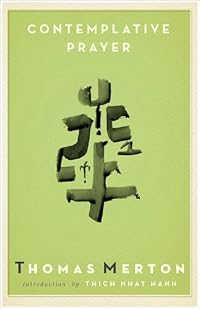
Contemplative Prayer
by Thomas Merton
On This Page
Description
In this classic text, Thomas Merton offers valuable guidance for prayer. He brings together a wealth of meditative and mystical influences–from John of the Cross to Eastern desert monasticism–to create a spiritual path for today. Most important, he shows how the peace contacted through meditation should not be sought in order to evade the problems of contemporary life, but can instead be directed back out into the world to affect positive change. Contemplative Prayer is one of the most show more well-known works of spirituality of the last one hundred years, and it is a must-read for all seeking to live a life of purpose in today’s world. In a moving and profound introduction, Thich Nhat Hanh offers his personal recollections of Merton and compares the contemplative traditions of East and West. show lessTags
Recommendations














Member Reviews
Merton is one godly man. I’ve read many books on prayer that have left a vague aftertaste of unlived academia. Contemplative Prayer, on the other hand, is a book of personal experience informed by a brilliant mind.
This is not a book for beginners. It would have been almost worthless to me back in Seminary when I was more interested in being correct than communicating with God. Even now, there were many times during Contemplative Prayer where I felt like I’m just beginning my journey with God in prayer. In God, there are always deeper places to journey.
One of the highlights of this book was his recurring use of St. John of the Cross’ Dark Night. Merton constantly reminds us that real contemplation is not focused on the effects of show more prayer. There are times in prayer when we feel no divine consolations. Many times contemplation is a journey through the desert.
If you’re serious about and committed to a life-long journey of contemplative prayer, Merton’s a wise and reliable spiritual adviser. show less
This is not a book for beginners. It would have been almost worthless to me back in Seminary when I was more interested in being correct than communicating with God. Even now, there were many times during Contemplative Prayer where I felt like I’m just beginning my journey with God in prayer. In God, there are always deeper places to journey.
One of the highlights of this book was his recurring use of St. John of the Cross’ Dark Night. Merton constantly reminds us that real contemplation is not focused on the effects of show more prayer. There are times in prayer when we feel no divine consolations. Many times contemplation is a journey through the desert.
If you’re serious about and committed to a life-long journey of contemplative prayer, Merton’s a wise and reliable spiritual adviser. show less
Thomas Merton's final book is a contemplation of contemplative prayer. It's primarily written to monks, but could be useful for anyone interested in deepening his or her understanding of prayer.
I was at a bit of a disadvantage being neither a monk nor a Catholic nor very clear yet on what "contemplative prayer" means in practice. Merton's advice is still very practical, and I like the emphasis he gives on the fact that what's learned in silence and solitude should translate into visible action and love of fellow men. I wrote down several quotes to mull over further and would read it again in the future.
I was at a bit of a disadvantage being neither a monk nor a Catholic nor very clear yet on what "contemplative prayer" means in practice. Merton's advice is still very practical, and I like the emphasis he gives on the fact that what's learned in silence and solitude should translate into visible action and love of fellow men. I wrote down several quotes to mull over further and would read it again in the future.
A sad farewell to a great voice. It was even better the second time. These essays, put together after his death, lack the editing and integration he might have done but nonetheless bring a modern voice to an ancient tradition. He gives much to savor and ponder.
A series of meditations by Merton regarding the life of contemplative prayer.
The author spends time discussing some of the mechanics of the contemplative prayer life, explores some of its historical figures, and speaks of the challenges of the false self attempting to use contemplative prayer to justify its own ends, as well as the challenges of maintaining balance in a contemplative position.
Worth consideration and reflection.
The author spends time discussing some of the mechanics of the contemplative prayer life, explores some of its historical figures, and speaks of the challenges of the false self attempting to use contemplative prayer to justify its own ends, as well as the challenges of maintaining balance in a contemplative position.
Worth consideration and reflection.
In this classic text, Thomas Merton offers valuable guidance for prayer. He brings together a wealth of meditative and mystical influences–from John of the Cross to Eastern desert monasticism–to create a spiritual path for today. Most important, he shows how the peace contacted through meditation should not be sought in order to evade the problems of contemporary life, but can instead be directed back out into the world to affect positive change.
Contemplative Prayer is one of the most well-known works of spirituality of the last one hundred years, and it is a must-read for all seeking to live a life of purpose in today’s world.
Contemplative Prayer is one of the most well-known works of spirituality of the last one hundred years, and it is a must-read for all seeking to live a life of purpose in today’s world.
Read from March 13 to April 03, 2014, read count: 1
There are concepts in this book that can be used by people in any tradition. It's not my favorite of the book of Thomas Merton which I've read, but I'm glad I read it. I'll probably re-read it later, after reading some of his earlier stuff. I think this is one of his latter works.
There are concepts in this book that can be used by people in any tradition. It's not my favorite of the book of Thomas Merton which I've read, but I'm glad I read it. I'll probably re-read it later, after reading some of his earlier stuff. I think this is one of his latter works.
profound - catholic contemplative prayer === sufiism, mysticism, zen Buddhism. truth universal
Members
- Recently Added By
Author Information

396+ Works 38,008 Members
Born in France, Thomas Merton was the son of an American artist and poet and her New Zealander husband, a painter. Merton lost both parents before he had finished high school, and his younger brother was killed in World War II. Something of the ephemeral character of human endeavor marked all his works, deepening the pathos of his writings and show more drawing him close to Eastern, especially Buddhist, forms of monasticism. After an initial education in the United States, France, and England, he completed his undergraduate degree at Columbia University. His parents, nominally friends, had given him little religious guidance, and in 1938, he converted to Roman Catholicism. The following year he received an M.A. from Columbia University and in 1941, he entered Gethsemani Abbey in Kentucky, where he remained until a short time before his death. His working life was spent as a Trappist monk. At Gethsemani, he wrote his famous autobiography, "The Seven Storey Mountain" (1948); there he labored and prayed through the days and years of a constant regimen that began with daily prayer at 2:00 a.m. As his contemplative life developed, he still maintained contact with the outside world, his many books and articles increasing steadily as the years went by. Reading them, it is hard to think of him as only a "guilty bystander," to use the title of one of his many collections of essays. He was vehement in his opposition to the Vietnam War, to the nuclear arms race, to racial oppression. Having received permission to leave his monastery, he went on a journey to confer with mystics of the Hindu and Buddhist traditions. He was accidentally electrocuted in a hotel in Bangkok, Thailand, on December 10, 1968. (Bowker Author Biography) show less
Some Editions
Series
Belongs to Publisher Series
Common Knowledge
- Canonical title
- Contemplative Prayer
- Original title
- The Climate of Monastic Prayer
- Original publication date
- 1969
- People/Characters
- Bernard of Clairvaux; Thomas Merton; Jacob; Gregory I, ca. 540-604; Francis de Sales; Garcia de Cisneros (show all 8); Galileo Galilei; St. Paul
- Important places
- Celles, Hainaut, Belgium; Cluny, Bourgogne-Franche-Comté, France; Carthage (Tunis, Tunisia); Ruthenia; Silesia; South America (show all 7); Latin America
- Important events
- Douay–Rheims Bible (1582)
- Epigraph
- He who walks in darkness, to whom no light appears, let him trust in the name of Yahweh, let him rely upon his God. - Isaiah 50:10
I will give them a heart to understand that I am Yahweh, and they shall be my people and I will be their God when they return to me with all their heart. - Jeremiah 24:7 - First words
- I first met Thomas Merton in 1966. It is hard to describe his face in words, to write down exactly what he was like. He was filled with human warmth. (From Intro by Thich Nhat Hanh, Duras, France, December, 1995)
- Quotations
- It is precisely the function of meditation, in the sense in which we speak of it here, to bring us to this attitude of awareness and receptivity. It also gives us strength and hope, along with a deep awareness of the value o... (show all)f interior silence in which the mystery of God's love is made clear to us.
- Last words
- (Click to show. Warning: May contain spoilers.)Without true, deep contemplative aspirations, without a total love for God and an uncompromising thirst for his truth, religion tends in the end to become an opiate.
- Original language
- English
- Disambiguation notice
- Originally published as The Climate of Monastic Prayer in 1969.
Classifications
- Genres
- Religion & Spirituality, Nonfiction, General Nonfiction
- DDC/MDS
- 248.34 — Religion Christian practice & observance Christian experience, practice, life Prayer and private worship Contemplation and Meditation
- LCC
- BV4813 .M43 — Philosophy, Psychology and Religion Practical Theology Practical Theology Practical religion. The Christian life Works of meditation and devotion
- BISAC
Statistics
- Members
- 1,637
- Popularity
- 13,672
- Reviews
- 9
- Rating
- (3.93)
- Languages
- 7 — Czech, Dutch, English, Italian, Polish, Portuguese, Spanish
- Media
- Paper, Audiobook, Ebook
- ISBNs
- 21
- ASINs
- 19