Permafrost
by Alastair Reynolds
On This Page
Description
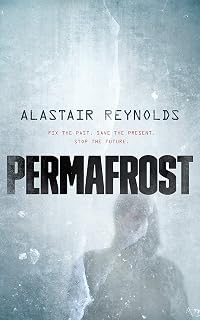
Fix the past. Save the present. Stop the future. Master of science fiction Alastair Reynolds unfolds a time-traveling climate fiction adventure in Permafrost. 2080: at a remote site on the edge of the Arctic Circle, a group of scientists, engineers and physicians gather to gamble humanity's future on one last-ditch experiment. Their goal: to make a tiny alteration to the past, averting a global catastrophe while at the same time leaving recorded history intact. To make the experiment work, show more they just need one last recruit: an ageing schoolteacher whose late mother was the foremost expert on the mathematics of paradox. 2028: a young woman goes into surgery for routine brain surgery. In the days following her operation, she begins to hear another voice in her head... an unwanted presence which seems to have a will, and a purpose, all of its own - one that will disrupt her life entirely. The only choice left to her is a simple one. Does she resist ... or become a collaborator? show lessTags
Recommendations










Member Reviews
I picked up a copy of this at the SF-Bokhandeln in Stockholm while meeting up with family over on a visit to Sweden. It’s not Reynold’s usual fare, but a near-future time travel story. The human race is pretty much over, killed off by its appalling lack of husbandry of its environment (that’s pollution, Global Warming, germ warfare, hunting to extinction, etc, etc), but a group in Russia have perfected time travel and send someone back into the past to make enough of a change to allow humanity a small chance at survival. It’s not actual physical time travel – which means it’s at least free of the risible technobollocks in Avengers: Endgame – but the consciousness of the tempunaut is sent back to occupy the mind of a person show more of the target period. (A similar conceit, I believe to Michael Bishop’s No Enemy But Time.) Of course, as is ever the way, nothing goes as planned, and protagonist Valentina must race across Russia to deliver the maguffin, only to learn how the future has changed when she returns to it. I thought Permafrost pretty good, but I wasn’t entirely sure why it was set in Russia, or what the setting brought to the story, other than, well, the title. Reynolds has never had much luck with the Hugos, but given that Permafrost was published by Hugo darlings Tor.com then perhaps he stands a chance next year. show less
Reynolds, Alastair. Permafrost. Tor, 2019.
In Permafrost, Alastair Reynolds has abandoned his epic far-future space opera milieu for a tight, tense near-future time travel story. By 2080, a cascade of environmental and biological disasters have rendered the planet almost sterile. The few survivors in a Russian scientific team figure that humanity is in its last generation. But there may be hope in the past. The plan is to implant the consciousness of someone from 2080 in the brain of a person in 2030 to move a cache of hybrid seeds to a location they know will survive 50 years. Reynolds takes his quantum theory and the grandfather paradox seriously, and so his scientists routinely use grandfather as a verb—as in, you are getting a lot show more of paradox noise because you are grandfathering. You cannot travel into the past unless time machines exist in the past—and Reynold’s has a nice fix for this, which I won’t spoil. His time traveler and her host are well developed characters, and the action at the end will make your heart race. I would have nominated this one for a Hugo, but I guess they figured two good time travel stories in the novella category as all the market would bear. show less
In Permafrost, Alastair Reynolds has abandoned his epic far-future space opera milieu for a tight, tense near-future time travel story. By 2080, a cascade of environmental and biological disasters have rendered the planet almost sterile. The few survivors in a Russian scientific team figure that humanity is in its last generation. But there may be hope in the past. The plan is to implant the consciousness of someone from 2080 in the brain of a person in 2030 to move a cache of hybrid seeds to a location they know will survive 50 years. Reynolds takes his quantum theory and the grandfather paradox seriously, and so his scientists routinely use grandfather as a verb—as in, you are getting a lot show more of paradox noise because you are grandfathering. You cannot travel into the past unless time machines exist in the past—and Reynold’s has a nice fix for this, which I won’t spoil. His time traveler and her host are well developed characters, and the action at the end will make your heart race. I would have nominated this one for a Hugo, but I guess they figured two good time travel stories in the novella category as all the market would bear. show less
It’s the year 2080 and life on earth is all but gone, the soils sterile, the oceans empty. First to go were the insects, then green plants, marine life, all life; only a final dwindling generation of humans are left, half-starved and living on the last of the stored foods. So a project has taken shape, a single desperate attempt to save the day: the idea of Permafrost is to reach back through time more than half a century and retrieve the contents of one of the many seed-banks which still existed back in the 2020s, underground vaults dotted around the globe where the planet’s plant life, in effect, was being preserved. Something else that no longer exists by 2080 is countries (ahhh, if only… Much as I’d love a real-life time show more machine, “no countries” might actually do us a lot more good) and the only large-scale organisation left is World Health. They it is who are running the time-project from a base on the frozen rim of the Arctic Ocean where the great Siberian river Yenisei runs out into the sea.
Permafrost is tricky to follow early on; there are scenes involving the same characters and locations, but in different decades, before it’s really clear where (or when) any of them belong, and I read the thing through twice over. Also, the kind of time travel involved is unusual—no simple Time Machines or Time Tunnels here, but (full marks to the author) something more ingenious and less direct. It’s well worth the effort though as this is a very good read, particularly if, like me, you have a soft spot for time-travel stories anyway.
Admittedly there are (or may be…perhaps) a couple of inconsistencies in the structure: that fly for instance, for anyone who’s read it already, and those crows. Like many time-travel novels though, this one involves circles in time with events looping back around to alter themselves, and here time almost seems to have a mind of its own, gently shifting and settling to its simplest possible state to smooth away such paradoxes—even your memory of them. Which left me sitting here after my reread wondering if it had been exactly the same book second time around, or had altered in the meantime. I’ll never know. show less
Permafrost is tricky to follow early on; there are scenes involving the same characters and locations, but in different decades, before it’s really clear where (or when) any of them belong, and I read the thing through twice over. Also, the kind of time travel involved is unusual—no simple Time Machines or Time Tunnels here, but (full marks to the author) something more ingenious and less direct. It’s well worth the effort though as this is a very good read, particularly if, like me, you have a soft spot for time-travel stories anyway.
Admittedly there are (or may be…perhaps) a couple of inconsistencies in the structure: that fly for instance, for anyone who’s read it already, and those crows. Like many time-travel novels though, this one involves circles in time with events looping back around to alter themselves, and here time almost seems to have a mind of its own, gently shifting and settling to its simplest possible state to smooth away such paradoxes—even your memory of them. Which left me sitting here after my reread wondering if it had been exactly the same book second time around, or had altered in the meantime. I’ll never know. show less
"There’s a final generation now, after World Health brought in the forced sterilisation programs. It was a kindness, not to bring more children into the world. I teach them, those last children. But they won’t have anything to grow into."
Sound like 2020?
~2082. Scientists mucking around with bioweaponry have released a nightmare that will mean the end of human life. It starts with the animalitos who live in the soil, and keep it fertile and are the means of decomposition. Dying, soil can no longer produce crops. Then, insects above ground die, so now the birds have no food. Who eats the birds? Moving up the food chain, all flora and fauna of the planet are meeting their death, and humans are no exception. A radical experiment, aided show more by the "Brothers, four AI machines named for the Karamazovs, and using second-hand MRIs scrounged from hospitals, will attempt a form of time travel to bring some genetically-modified seeds that will grow in sterile soil, to the future.
“Paradox,” Margaret said. “Black and white. Either present or absent. If you don’t observe, paradox hides its claws. If you attempt to observe, it kills you—metaphorically, mostly.”
A creative treatment for a time travel book to say the least, I enjoyed reading this novella. show less
Sound like 2020?
~2082. Scientists mucking around with bioweaponry have released a nightmare that will mean the end of human life. It starts with the animalitos who live in the soil, and keep it fertile and are the means of decomposition. Dying, soil can no longer produce crops. Then, insects above ground die, so now the birds have no food. Who eats the birds? Moving up the food chain, all flora and fauna of the planet are meeting their death, and humans are no exception. A radical experiment, aided show more by the "Brothers, four AI machines named for the Karamazovs, and using second-hand MRIs scrounged from hospitals, will attempt a form of time travel to bring some genetically-modified seeds that will grow in sterile soil, to the future.
“Paradox,” Margaret said. “Black and white. Either present or absent. If you don’t observe, paradox hides its claws. If you attempt to observe, it kills you—metaphorically, mostly.”
A creative treatment for a time travel book to say the least, I enjoyed reading this novella. show less
Alastair Reynolds is better known for writing galaxy-spanning space operas. So what's he doing writing a time-travelling, climate-change novel? As it turns out, he's done rather well. One of Reynold's consistencies is that he makes the science in his novels believable; even when he's invented parts of it. We follow the desperate attempts of a group of scientists, engineers and physicians to send people back in time so that a disastrous future might be avoided. The technology is, of course, untested and has already claimed the mind of at least one of the travellers. While this may sound like a stock-standard scenario for a science fiction story, and it does, Reynold's skill as a storyteller elevates it from the mundane. Reynold's show more narrative jumps between different time periods. He makes use of this to dispense breadcrumbs of information which begin making sense the further the novel progresses. As mentioned earlier, Reynolds makes the science believable. His ideas regarding time travel and the possible outcomes are no exception. Reynolds keeps the story's pace up by telling it through the eyes of his protagonist, Valentina Lidova. As events begin changing in across time periods, Valentina begins to ask questions. My only complaint is that I wish the book had been longer but, only because I was enjoying the ride and did not want it to finish. If you're a fan of Alastair Reynolds, I'm sure you'll like this one. And if you've not read any Reynolds, Permafrost isn't a bad place to start. show less
My thoughts:
I picked up Permafrost from the library's "new books" section, mainly because the title intrigued me. When I saw that it involved time travel, I added it to my burgeoning pile of library check-outs.
(I walk into the library, fully intending to return one book--Meredith, remember that long TBR list from Netgalley!--and walk out with twenty-three more books. Just in case all the books on Netgalley are duds. Or I get through all the NG books lightning-fast. Or a solar flare kills the internet and I must resort to reading print books. One can rationalize all manner of irrational things, especially when it involves books.)
Time travel has been on my mind in recent weeks. (Blame Avengers: Endgame and my daughter, for making me a show more Marvel fan against my will.) Thus Alastair Reynolds' Permafrost ended up on my reading list.
I'm glad it did.
Why did I enjoy this book?
1. Permafrost grabbed me and never let go.
The opening intrigued me.
2. The Valentina-Tatiana relationship is powerful.
Valentina has to gain sensorimotor dominance over the host. She doesn't expect to communicate with her, much less develop a caring relationship with this young troubled woman.
Once Valentina "drops" into Tatiana, she realizes Tatiana is frightened. Who wouldn't be? But she's torn: while she doesn't want to confuse the woman, Valentina has work to do. She's got to get those seeds and get them back to Director Cho. Complicating matters is that she knows Tatiana's future, and it's bleak.
Tatiana, for her part, has issues with Valentina's presence in her mind. (Who wouldn't?) Once she hears V's explanation, she sees clearly that it will not be like "nothing ever happened." Valentina and company don't--or refuse to--see this.
For me, the women's developing relationship is one of the major highlights of the story. Neither are standard-issue superheroes. No superpowers. No cool weapons. Tatiana's recovering from a stroke. Valentina's an 71-year-old school teacher. Yet they learn to work together to save the world. It may also save them as people, bringing healing to both wounded women.
3. The science is well-explained.
I know little about the science of time travel, though I've heard that scientists have made molecules travel through time. Here, Reynolds' use of time travel makes sense. While I had to reread a few parts to understand the not-entirely paradoxical paradoxes of his time-travelling system, he didn't make it overly complicated. It also did not bog down the story.
For die-hard SF fans, Permafrost may or may not satisfy your scientific leanings. Some reviewers on Goodreads were dissatisfied with this aspect of the book. Others commented that it was refreshing to read a "true" science fiction novel without all the "fantasy fluff."
4. The ending didn't disappoint me.
No spoilers. Let's just say that it was emotionally satisfying.
Bottom line:
This is a great novel. Even if you don't enjoy science fiction, give it a try. Hey, it's novella length, so it won't gobble up all your reading time! show less
I picked up Permafrost from the library's "new books" section, mainly because the title intrigued me. When I saw that it involved time travel, I added it to my burgeoning pile of library check-outs.
(I walk into the library, fully intending to return one book--Meredith, remember that long TBR list from Netgalley!--and walk out with twenty-three more books. Just in case all the books on Netgalley are duds. Or I get through all the NG books lightning-fast. Or a solar flare kills the internet and I must resort to reading print books. One can rationalize all manner of irrational things, especially when it involves books.)
Time travel has been on my mind in recent weeks. (Blame Avengers: Endgame and my daughter, for making me a show more Marvel fan against my will.) Thus Alastair Reynolds' Permafrost ended up on my reading list.
I'm glad it did.
Why did I enjoy this book?
1. Permafrost grabbed me and never let go.
The opening intrigued me.
After I shot Vikram we put our things in the car and drove to the airstrip. (1)What? The narrator just shot someone. Why? What happened? Who is Vikram? By the end of the second page, I was hooked:
I thought of Vikram, of how he'd followed me out into the field beyond the farm, fully aware of what was coming. I'd taken the artificial larynx with me, just in case there was something he wanted to say at the end. But when I offered it to him he only shook his head, his cataract-clouded eyes seeming to look right through me, (...)This grabbed my attention and my emotions. Obviously the narrator (later revealed as Valentina-in-Tatiana's body) and Antti care about Vikram enough to give him a decent burial. Why did they have to kill him? Why would he need an artificial larynx to speak? I didn't get answers until much later. When I did, it broke my heart.
Afterward, Antti had come out with a spade. We couldn't just leave Vikram lying there in the field.
It hadn't taken long to bury him.
'One of us had to do it,' I answered now, wondering if a speck on my sleeve was blood or just dirt from the field" (2)
2. The Valentina-Tatiana relationship is powerful.
Valentina has to gain sensorimotor dominance over the host. She doesn't expect to communicate with her, much less develop a caring relationship with this young troubled woman.
Once Valentina "drops" into Tatiana, she realizes Tatiana is frightened. Who wouldn't be? But she's torn: while she doesn't want to confuse the woman, Valentina has work to do. She's got to get those seeds and get them back to Director Cho. Complicating matters is that she knows Tatiana's future, and it's bleak.
Tatiana, for her part, has issues with Valentina's presence in her mind. (Who wouldn't?) Once she hears V's explanation, she sees clearly that it will not be like "nothing ever happened." Valentina and company don't--or refuse to--see this.
For me, the women's developing relationship is one of the major highlights of the story. Neither are standard-issue superheroes. No superpowers. No cool weapons. Tatiana's recovering from a stroke. Valentina's an 71-year-old school teacher. Yet they learn to work together to save the world. It may also save them as people, bringing healing to both wounded women.
3. The science is well-explained.
I know little about the science of time travel, though I've heard that scientists have made molecules travel through time. Here, Reynolds' use of time travel makes sense. While I had to reread a few parts to understand the not-entirely paradoxical paradoxes of his time-travelling system, he didn't make it overly complicated. It also did not bog down the story.
For die-hard SF fans, Permafrost may or may not satisfy your scientific leanings. Some reviewers on Goodreads were dissatisfied with this aspect of the book. Others commented that it was refreshing to read a "true" science fiction novel without all the "fantasy fluff."
4. The ending didn't disappoint me.
No spoilers. Let's just say that it was emotionally satisfying.
Bottom line:
This is a great novel. Even if you don't enjoy science fiction, give it a try. Hey, it's novella length, so it won't gobble up all your reading time! show less
“After I shot Vikram we put things in the car and drove to the airstrip. Antti was nervous the whole way, knuckles white on the steering wheel, tendons standing out in his neck, eyes searching the road ahead of us.”
From those opening words to the closing lines, this is a fast-paced time travel adventure with a zeitgeisty environmental theme, plus characters you care about (a 71-year old schoolteacher as the heroine!) and who care about others.
Most intriguingly, the method of time travel is fundamentally different from any I’ve encountered before, on page or screen:are there any other stories that do NOT involve the time traveller's body going backwards or forwards in time?
Permafrost is the name of a mission to save the world: a show more “retrocausal experiment”. More specifically, in 2080, life on earth is coming to an end because of the Scouring, “an environmental and biological cascade”. The aim is to go back to 2028, find enough of the most robust and resistant seeds, and make sure they are stored in the safest seedbanks.
Image: Entrance to Svalbard Global Seed Vault (Source)
The story includes espionage, artificial intelligences, chases and escapes, a shooting, an icelocked aircraft carrier, a possible double-agent, mercy killing, Russia, MRI scanners with secret powers, a slightly slapstick knife fight, a deadline, mind control or madness, an artificial larynx, consideration of ends and means, and kidnap.
It even addresses the elephant in the room of any time travel story:
“Paradox is inherent in any time-travelling system. But it is containable… treatable. We have learned that there are classes of paradox, layers of paradox.”
That said, the jumping around and consequent name changing is sometimes tricky to keep track of, but it’s worth it.
Quotes
• “Time wasn’t a river… and it wasn’t a circuit-diagram. Nor was it a tree with multiple branches. It was a block structure, more like a crystal lattice than any of those old dead-end paradigms… There were no alternate histories, no branches where the Roman empire never fell or the dinosaurs were never wiped out. Just that single lattice, a single fixed structure. We were in it, embedded in its matrix. But the lattice wasn’t static. There were flaws in it… Those stresses could give way suddenly or propagate a long way from their initial positions.”
• “Time as a solid, glacial structure, groaning to itself as the defects propagated through its frozen matrix, yet essentially fixed, immutable, persistent, enduring… Time as a self-reinforcing structure.”
• “Where is my consciousness now?”
Image: “Search for Enlightenment” by Simon Gudgeon and photographed by @guillaumelemay (Source)
More
• Alastair Reynolds has a PhD in astrophysics and worked for the European Space Agency before becoming a full time sci-fi author. He’s best known as a master of space opera, especially his Revelation Space series.
• His novels are very cinematographic, but their length may be one reason why none have been filmed yet. However, a couple of his short stories were adapted for the first series of the excellent and very varied Netflix show, Love, Death & Robots, and this could make an excellent feature film.
• This short novel (or is it a long novella?) is very different from the other Reynolds I’ve read, and which I’ve reviewed on GR, HERE.
• If time travel is more your thing, I have reviewed books by various authors on a GR shelf, HERE.
Image: “Great oaks from little acorns grow” was drummed into me as a child (as a literal truth and a metaphor). It fits this story, as does rice growing in dry soil, in the photo. (Source) show less
From those opening words to the closing lines, this is a fast-paced time travel adventure with a zeitgeisty environmental theme, plus characters you care about (a 71-year old schoolteacher as the heroine!) and who care about others.
Most intriguingly, the method of time travel is fundamentally different from any I’ve encountered before, on page or screen:
Permafrost is the name of a mission to save the world: a show more “retrocausal experiment”. More specifically, in 2080, life on earth is coming to an end because of the Scouring, “an environmental and biological cascade”. The aim is to go back to 2028, find enough of the most robust and resistant seeds, and make sure they are stored in the safest seedbanks.
Image: Entrance to Svalbard Global Seed Vault (Source)
The story includes espionage, artificial intelligences, chases and escapes, a shooting, an icelocked aircraft carrier, a possible double-agent, mercy killing, Russia, MRI scanners with secret powers, a slightly slapstick knife fight, a deadline, mind control or madness, an artificial larynx, consideration of ends and means, and kidnap.
It even addresses the elephant in the room of any time travel story:
“Paradox is inherent in any time-travelling system. But it is containable… treatable. We have learned that there are classes of paradox, layers of paradox.”
That said, the jumping around and consequent name changing is sometimes tricky to keep track of, but it’s worth it.
Quotes
• “Time wasn’t a river… and it wasn’t a circuit-diagram. Nor was it a tree with multiple branches. It was a block structure, more like a crystal lattice than any of those old dead-end paradigms… There were no alternate histories, no branches where the Roman empire never fell or the dinosaurs were never wiped out. Just that single lattice, a single fixed structure. We were in it, embedded in its matrix. But the lattice wasn’t static. There were flaws in it… Those stresses could give way suddenly or propagate a long way from their initial positions.”
• “Time as a solid, glacial structure, groaning to itself as the defects propagated through its frozen matrix, yet essentially fixed, immutable, persistent, enduring… Time as a self-reinforcing structure.”
• “Where is my consciousness now?”
Image: “Search for Enlightenment” by Simon Gudgeon and photographed by @guillaumelemay (Source)
More
• Alastair Reynolds has a PhD in astrophysics and worked for the European Space Agency before becoming a full time sci-fi author. He’s best known as a master of space opera, especially his Revelation Space series.
• His novels are very cinematographic, but their length may be one reason why none have been filmed yet. However, a couple of his short stories were adapted for the first series of the excellent and very varied Netflix show, Love, Death & Robots, and this could make an excellent feature film.
• This short novel (or is it a long novella?) is very different from the other Reynolds I’ve read, and which I’ve reviewed on GR, HERE.
• If time travel is more your thing, I have reviewed books by various authors on a GR shelf, HERE.
Image: “Great oaks from little acorns grow” was drummed into me as a child (as a literal truth and a metaphor). It fits this story, as does rice growing in dry soil, in the photo. (Source) show less
Members
- Recently Added By
Lists

2020 Hugo Eligible Novellas
36 works; 7 members

Arctic novels
35 works; 5 members

Books Read in 2020
4,379 works; 124 members

SFF standalone novellas with female protagonists
101 works; 4 members
Author Information

141+ Works 40,077 Members
Some Editions
Awards and Honors
Awards
Work Relationships
Is contained in
Common Knowledge
- Original publication date
- 2019-03-19
- People/Characters
- Valentina Lidova; Tatiana Dinova; Luba Lidova; Leo Cho
- First words
- After I shot Vikram we put our things in the car and drove to the airstrip.
- Last words
- (Click to show. Warning: May contain spoilers.)"I'm here, " I said.
- Publisher's editor
- Strahan, Jonathan
Classifications
Statistics
- Members
- 442
- Popularity
- 69,430
- Reviews
- 24
- Rating
- (3.62)
- Languages
- English, Finnish, Italian
- Media
- Paper, Audiobook, Ebook
- ISBNs
- 5
- ASINs
- 3