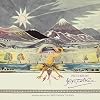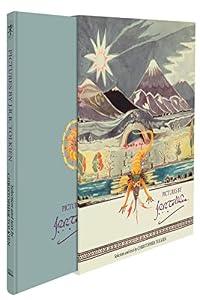
Pictures by J.R.R. Tolkien
by J. R. R. Tolkien
On This Page
Description
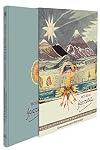
"This collection of pictures, now reissued after almost 30 years, confirms J.R.R. Tolkien's considerable talent as an artist. It provides a unique and fascinating insight into his visual conception of many of the places and characters familiar to readers of The Hobbit, The Lord of the Rings, and The Silmarillion. Examples of his art range from delicate watercolours depicting Rivendell, The Forest of Lothlórien, Smaug, and Old Man Willow, to drawings and sketches of Moria Gate and Minas show more Tirith. Together they form a comprehensive collection of Tolkien's own illustrations for his most popular books. Also included are many of his beautiful designs showing patterns of flowers and trees, friezes, tapestries and heraldic devices associated with the world of Middle-earth. In their variety and scope they provide abundant visual evidence of the richness of his imagination. This enchanting gallery was personally selected by Christopher Tolkien, who through detailed notes on the sources for each picture provides a unique and revealing insight into the artistic vision of his father, J.R.R. Tolkien"--Slipcase. show lessTags
Recommendations







Member Reviews
This originally appeared at The Irresponsible Reader.
---
WHY THIS BOOK TODAY?
Last Spring, I read Lashaan Balasingam talk about this book at Roars and Echoes and put it on a wish list instantly. I was given a copy of it last year, but aside from glancing through it then, I hadn't taken the time to really sit down with it. But with Hobbit Day yesterday, I made time Saturday to do just that—so I could post about it today (and maybe add this and some other things to a recurring thing like I do with Towel Day).
You should really see what Lashaan had to say about it, not only does he do a (typically) better job of it than I'm about to, but he liked it a lot more than I did.
WHAT'S PICTURES BY J.R.R. TOLKEIN ABOUT?
Well, it's pictures drawn by show more Tolkein in his spare time—when he wasn't teaching, creating new languages, writing epic fantasies, or smoking his pipe (well, he probably did both of those at the same time).
The Publisher describes it this way:
With Christopher Tolkien as your guide, take a tour through this colorful gallery of enchanting art by J.R.R. Tolkien, as published originally in the first groundbreaking Tolkien Calendars of the 1970s.
This collection of pictures, with a text by Christopher Tolkien, now reissued after almost thirty years, confirms J.R.R. Tolkien's considerable talent as an artist. It provides fascinating insight into his visual conception of many of the places and events familiar to readers of The Hobbit, The Lord of the Rings, and The Silmarillion.
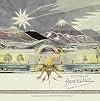
Examples of his art range from delicate watercolors depicting Rivendell, the Forest of Lothlorien, Smaug, and Old Man Willow, to drawings and sketches of Moria Gate and Minas Tirith. Together they form a comprehensive collection of Tolkien's own illustrations for his most popular books.
Also included are many of his beautiful designs showing patterns of flowers and trees, friezes, tapestries, and heraldic devices associated with the world of Middle-earth. In their variety and scope, they provide abundant visual evidence of the richness of his imagination.
This enchanting gallery was personally selected by Christopher Tolkien who, through detailed notes on the sources for each picture, provides unique insight into the artistic vision of his father, J.R.R. Tolkien.
HOW'S THE WRITING?
Well, it's pretty bland. It's just straightforward descriptions of the pictures, where it came from, where it was originally published—who added color (sometimes), and so on.
It's not bad, it's not good—it's just there. And that's good enough, this isn't supposed to be about Christopher Tolkien's wordsmithery—this is about the pictures.
HOW'S THE ART?
Well, I think it's clear why we think of Tolkien as a writer, scholar, and storyteller and not a visual artist. Don't get me wrong—I can't hold a candle to his drawing. But it's nothing stellar.
But it does deliver the flavor of Middle Earth and its denizens in a way the books can't quite manage (or does manage, in a different way). You get a real sense of the scope and scale of the world. It's clear that Jackson and his team spent some time with Tolkien's art and drew a lot from it—and you can see why they'd want to (beyond just trying for authenticity). I did like it—and could easily spend time studying the details.
Lashaan's post has a couple of samples if you're curious. But honestly, if you're basing getting your hands on this book on the quality of the art, you might be missing the point. (still, check out the samples to get a feel for it)
If you want great fantasy art, may I suggest starting with Larry Elmore, Chris McGrath, or Isabeau Backhaus? But there's something about seeing it from the hand of the creator, you know?
SO, WHAT DID I THINK ABOUT PICTURES BY J.R.R. TOLKIEN?
As a book, it's...fine. As a collection of pictures, it's...nice enough. As a way to get to know a different side of Tolkien and how his brain, his creativity, and his personality worked? It's pretty cool. I'd love to see sketches, drawings, and even paintings by other authors to get inside their heads (okay, no one wants inside Thomas Harris' mind, but you know what I'm saying. Keep the visuals for Hannibal and the rest locked away.)
Am I glad that I own this? Yes. Am I glad that I finally got around to taking it out of its slipcase and really worked through it? You bet. Am I just a little underwhelmed by the whole thing? Yup.
But I will return to flip through it and pour over the contents repeatedly. show less
---
WHY THIS BOOK TODAY?
Last Spring, I read Lashaan Balasingam talk about this book at Roars and Echoes and put it on a wish list instantly. I was given a copy of it last year, but aside from glancing through it then, I hadn't taken the time to really sit down with it. But with Hobbit Day yesterday, I made time Saturday to do just that—so I could post about it today (and maybe add this and some other things to a recurring thing like I do with Towel Day).
You should really see what Lashaan had to say about it, not only does he do a (typically) better job of it than I'm about to, but he liked it a lot more than I did.
WHAT'S PICTURES BY J.R.R. TOLKEIN ABOUT?
Well, it's pictures drawn by show more Tolkein in his spare time—when he wasn't teaching, creating new languages, writing epic fantasies, or smoking his pipe (well, he probably did both of those at the same time).
The Publisher describes it this way:
With Christopher Tolkien as your guide, take a tour through this colorful gallery of enchanting art by J.R.R. Tolkien, as published originally in the first groundbreaking Tolkien Calendars of the 1970s.
This collection of pictures, with a text by Christopher Tolkien, now reissued after almost thirty years, confirms J.R.R. Tolkien's considerable talent as an artist. It provides fascinating insight into his visual conception of many of the places and events familiar to readers of The Hobbit, The Lord of the Rings, and The Silmarillion.
Examples of his art range from delicate watercolors depicting Rivendell, the Forest of Lothlorien, Smaug, and Old Man Willow, to drawings and sketches of Moria Gate and Minas Tirith. Together they form a comprehensive collection of Tolkien's own illustrations for his most popular books.
Also included are many of his beautiful designs showing patterns of flowers and trees, friezes, tapestries, and heraldic devices associated with the world of Middle-earth. In their variety and scope, they provide abundant visual evidence of the richness of his imagination.
This enchanting gallery was personally selected by Christopher Tolkien who, through detailed notes on the sources for each picture, provides unique insight into the artistic vision of his father, J.R.R. Tolkien.
HOW'S THE WRITING?
Well, it's pretty bland. It's just straightforward descriptions of the pictures, where it came from, where it was originally published—who added color (sometimes), and so on.
It's not bad, it's not good—it's just there. And that's good enough, this isn't supposed to be about Christopher Tolkien's wordsmithery—this is about the pictures.
HOW'S THE ART?
Well, I think it's clear why we think of Tolkien as a writer, scholar, and storyteller and not a visual artist. Don't get me wrong—I can't hold a candle to his drawing. But it's nothing stellar.
But it does deliver the flavor of Middle Earth and its denizens in a way the books can't quite manage (or does manage, in a different way). You get a real sense of the scope and scale of the world. It's clear that Jackson and his team spent some time with Tolkien's art and drew a lot from it—and you can see why they'd want to (beyond just trying for authenticity). I did like it—and could easily spend time studying the details.
Lashaan's post has a couple of samples if you're curious. But honestly, if you're basing getting your hands on this book on the quality of the art, you might be missing the point. (still, check out the samples to get a feel for it)
If you want great fantasy art, may I suggest starting with Larry Elmore, Chris McGrath, or Isabeau Backhaus? But there's something about seeing it from the hand of the creator, you know?
SO, WHAT DID I THINK ABOUT PICTURES BY J.R.R. TOLKIEN?
As a book, it's...fine. As a collection of pictures, it's...nice enough. As a way to get to know a different side of Tolkien and how his brain, his creativity, and his personality worked? It's pretty cool. I'd love to see sketches, drawings, and even paintings by other authors to get inside their heads (okay, no one wants inside Thomas Harris' mind, but you know what I'm saying. Keep the visuals for Hannibal and the rest locked away.)
Am I glad that I own this? Yes. Am I glad that I finally got around to taking it out of its slipcase and really worked through it? You bet. Am I just a little underwhelmed by the whole thing? Yup.
But I will return to flip through it and pour over the contents repeatedly. show less
Yet more money making from CT, exploiting his father's legacy doing minimal work himself. This is a collection of JRRT's own drawings and other illustrations taken together without any text from the accompanying stories which you're supposed to know.
It is interesting to see some of the thoughts that JRRT had of the scenes that he wrote. It's not always clear which way around the artistic inspiration happened. He has a unique style.
It is interesting to see some of the thoughts that JRRT had of the scenes that he wrote. It's not always clear which way around the artistic inspiration happened. He has a unique style.
Lovely reproductions of a variety of Tolkien's illustrations. Primarily I wanted to see color versions of his heraldry symbols which my husband and I are having tattooed (nerd alert) for our 10th wedding anniversary. I might want to buy this one.
The pictures were absolutely wonderful, but I think I expected more from the text.
Ratings
Members
- Recently Added By
Author Information

589+ Works 511,036 Members
A writer of fantasies, Tolkien, a professor of language and literature at Oxford University, was always intrigued by early English and the imaginative use of language. In his greatest story, the trilogy The Lord of the Rings (1954--56), Tolkien invented a language with vocabulary, grammar, syntax, even poetry of its own. Though readers have show more created various possible allegorical interpretations, Tolkien has said: "It is not about anything but itself. (Certainly it has no allegorical intentions, general, particular or topical, moral, religious or political.)" In The Adventures of Tom Bombadil (1962), Tolkien tells the story of the "master of wood, water, and hill," a jolly teller of tales and singer of songs, one of the multitude of characters in his romance, saga, epic, or fairy tales about his country of the Hobbits. Tolkien was also a formidable medieval scholar, as evidenced by his work, Beowulf: The Monster and the Critics (1936) and his edition of Anciene Wisse: English Text of the Anciene Riwle. Among his works published posthumously, are The Legend of Sigurd and Gudrún and The Fall of Arthur, which was edited by his son, Christopher. In 2013, his title, TheHobbit (Movie Tie-In) made The New York Times Best Seller List. (Bowker Author Biography) show less
All Editions
Some Editions
Awards and Honors
Notable Lists
Common Knowledge
- Original publication date
- 1979
- Important places
- Middle-earth
- First words
- The primary purpose of this book is to collect together all the pictures (paintings, drawings, designs) by J. R. R. Tolkien which were published in a series of six Calendars from 1973 to 1979, with a gap in 1975.
- Disambiguation notice
- Copyright of the First American Edition is held by George Allen Unwin & Publishers, 1979, in Britain.
Classifications
Statistics
- Members
- 671
- Popularity
- 42,662
- Reviews
- 4
- Rating
- (4.49)
- Languages
- 5 — English, Finnish, French, Italian, Spanish
- Media
- Paper
- ISBNs
- 16
- ASINs
- 3