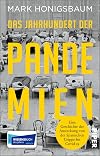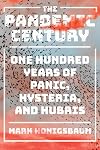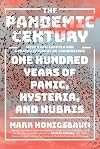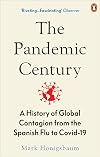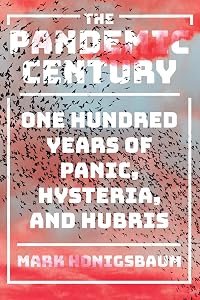
The Pandemic Century: One Hundred Years of Panic, Hysteria, and Hubris
by Mark Honigsbaum
On This Page
Description
Chronicles the last century of scientific struggle against deadly contagious disease--from the 1918 Spanish influenza pandemic to the recent SARS, Ebola and Zika epidemics--examining related epidemiological mysteries and the role of disease in exacerbating world conflicts. Ever since the 1918 Spanish influenza pandemic, scientists have dreamed of preventing catastrophic outbreaks of infectious disease. Yet despite a century of medical progress, viral and bacterial disasters continue to take show more us by surprise, inciting panic and dominating news cycles. From the Spanish flu to the 1924 outbreak of pneumonic plague in Los Angeles to the 1930 "parrot fever" pandemic, through the more recent SARS, Ebola, and Zika epidemics, the last one hundred years have been marked by a succession of unanticipated pandemic alarms. In The Pandemic Century, a lively account of scares both infamous and less known, Mark Honigsbaum combines reportage with the history of science and medical sociology to artfully reconstruct epidemiological mysteries and the ecology of infectious diseases. We meet dedicated disease detectives, obstructive or incompetent public health officials, and brilliant scientists often blinded by their own knowledge of bacteria and viruses. We also see how fear of disease often exacerbates racial, religious, and ethnic tensions--even though, as the epidemiologists Malik Peiris and Yi Guan write, "'nature' remains the greatest bioterrorist threat of all." Like man-eating sharks, predatory pathogens are always present in nature, waiting to strike; when one is seemingly vanquished, others appear in its place. These pandemics remind us of the limits of scientific knowledge, as well as the role that human behavior and technologies play in the emergence and spread of microbial diseases. -- !c From publisher's description. show lessTags
Recommendations






Member Reviews
I’ve read a lot of pandemic and infectious diseases books over the last two years, and I have to say that The Pandemic Century is right at the top of the list. What it doesn’t cover in breadth of diseases, it covers in great depth and detail. It’s interesting in the way it combines the science and the public reactions to various outbreaks.
The book opens with the Spanish flu, but it’s the later chapters that really grabbed my interest, simply because they haven’t been covered in other books. There’s the outbreak of plague in California followed by psittacosis and Legionnaire’s disease. (I did not know the story on how it got the name). The other chapters are devoted to more recent and well-known epidemics and pandemics, show more such as Ebola, SARS, Zika and HIV/AIDS. The chapter on Zika was very interesting because I don’t think it’s been covered in as much detail elsewhere. As is customary with pandemic books these days, this edition (2020) mentions COVID-19 in its early stages. It’s quite encouraging to see how far science has come since then, in terms of research on the disease, vaccines and treatments.
What really sets The Pandemic Century apart is the level of research and detail. If you’re that kind of person, you can entertain friends and family with interesting facts about the diseases and treatment (e.g., Ebola is more likely to cause hiccups than other haemorrhagic diseases, why you should avoid nebulisers with aerosolised disease). The breakthroughs in research as well as the missteps are also well documented, as is the public response to ‘parrot fever’ and the ‘Philly killer’. It can be quite dramatic as the scenario unfolds, but I found this was toned down a lot with the more recent diseases. My only complaint was that my copy has tiny print, so while it was easy to carry round, it was at times difficult to read for long periods. (Although, I did drop the book during chapters to find out more about the diseases – a sure sign of a piqued interest!) This will satisfy the need to read about these diseases in more depth, in an engaging, easy to read fashion.
http://samstillreading.wordpress.com show less
The book opens with the Spanish flu, but it’s the later chapters that really grabbed my interest, simply because they haven’t been covered in other books. There’s the outbreak of plague in California followed by psittacosis and Legionnaire’s disease. (I did not know the story on how it got the name). The other chapters are devoted to more recent and well-known epidemics and pandemics, show more such as Ebola, SARS, Zika and HIV/AIDS. The chapter on Zika was very interesting because I don’t think it’s been covered in as much detail elsewhere. As is customary with pandemic books these days, this edition (2020) mentions COVID-19 in its early stages. It’s quite encouraging to see how far science has come since then, in terms of research on the disease, vaccines and treatments.
What really sets The Pandemic Century apart is the level of research and detail. If you’re that kind of person, you can entertain friends and family with interesting facts about the diseases and treatment (e.g., Ebola is more likely to cause hiccups than other haemorrhagic diseases, why you should avoid nebulisers with aerosolised disease). The breakthroughs in research as well as the missteps are also well documented, as is the public response to ‘parrot fever’ and the ‘Philly killer’. It can be quite dramatic as the scenario unfolds, but I found this was toned down a lot with the more recent diseases. My only complaint was that my copy has tiny print, so while it was easy to carry round, it was at times difficult to read for long periods. (Although, I did drop the book during chapters to find out more about the diseases – a sure sign of a piqued interest!) This will satisfy the need to read about these diseases in more depth, in an engaging, easy to read fashion.
http://samstillreading.wordpress.com show less
This book takes an historical look at pandemics, starting with the Spanish Flu and ending with the Zika virus outbreak in 2015. I'm told a later version of the book has been released with a chapter on the current COVID-19 pandemic. I really enjoyed this book. I learned a lot. I didn't know there was a plague outbreak in L.A. in 1924 and had never heard of parrot fever. I also liked reading about the AIDS and SARS pandemics, which I remember well...it gave me a new perspective.
What I struggled with was the author's use of scientific and medical terminology without defining the terms. I spent a fair bit of time on Google while reading some sections. But, all in all, I thought it worth the effort.
The book is, on one hand, terrifying. We show more learn to deal with one pandemic only to fall prey to another. As humans continue to encroach on wildlife habitats, it seems we will unleash more viruses. And throughout history, we have politicians denying the existence of pandemics and people who refuse to modify behaviours to reduce risk.
On the other hand, the book was comforting. We have survived past pandemics, and we will continue to do so. The dedication of medical researchers -- their intelligence, perseverance and courage --- has always been amazing. show less
What I struggled with was the author's use of scientific and medical terminology without defining the terms. I spent a fair bit of time on Google while reading some sections. But, all in all, I thought it worth the effort.
The book is, on one hand, terrifying. We show more learn to deal with one pandemic only to fall prey to another. As humans continue to encroach on wildlife habitats, it seems we will unleash more viruses. And throughout history, we have politicians denying the existence of pandemics and people who refuse to modify behaviours to reduce risk.
On the other hand, the book was comforting. We have survived past pandemics, and we will continue to do so. The dedication of medical researchers -- their intelligence, perseverance and courage --- has always been amazing. show less
From the Spanish Flu of 1917 onwards to the Zika outbreak of 2015, humanity has been wracked by a series of pandemics. In this book Honigsbaum considers each in turn and relates the people and the research that contained them. First published in 2019 the final summary is chilling in its prediction of another global pandemic and the reasons why - this was written before the Covid-19 situation and yet is completely accurate in its logic.
I thoroughly enjoyed this book. Even if we were not going through a global pandemic now, the science and stories are amazing. The section on the discovery of coronaviruses is apt and the idea that pandemics are spread because of increased travel is explained clearly. Although I suspect that a certain show more amount of knowledge of biology is needed to understand the details this is still an erudite and intelligent book show less
I thoroughly enjoyed this book. Even if we were not going through a global pandemic now, the science and stories are amazing. The section on the discovery of coronaviruses is apt and the idea that pandemics are spread because of increased travel is explained clearly. Although I suspect that a certain show more amount of knowledge of biology is needed to understand the details this is still an erudite and intelligent book show less
Pretty good.
It was a good COVID read, though that was too recent to be covered. There are several stories of outbreaks that were made worse by officials under reacting, but none that I recall where over-reactions caused much harm.
COVID seems to be producing a strange over reaction. Lots of countries are restricting lots of things, but hanging back from the sort of draconian measures China used to snuff out COVID there. In the US, it seems to be the worst of both. We will hit 500,000 dead soon, and at the same time millions are out of work, kids seem to be mostly out of school, and people have missed out on countless opportunities. I was reading this as the vaccines were rolling out, but not yet having major impacts. Now, several show more months into vaccination the daily death rate in America is still triple digits, but far lower than it had been and with every expectation of tapering off over time.
In the grand sweep of history, the COVID years aren't going to seem like much to fuss about. The economy is still surprisingly good. People are dying, but even in America we have a long way to go before deaths equal even 1% of population. On the human level, you only live once. If you didn't go on your bucket list travel adventure in 2020 or 2021 because of COVID, it could turn out that you never will go. There is a cost to that. How does one really compare that to five years taken off the life of an older American? I don't think there is satisfactory math there, but society does need to give some weight to the impacts on people who did no, and were unlikely to, get sick. I have a feeling that some of the protective measures are going to stick. I'd like those to be the ones that are most helpful and least harmful. Unfortunately, there is some public health theater going on and I don't think we'll be left with the best.
How could we get public health officials to be more effective? There is a lot of sub-optimal reaction to the various outbreaks, but no system to hold anyone accountable. show less
It was a good COVID read, though that was too recent to be covered. There are several stories of outbreaks that were made worse by officials under reacting, but none that I recall where over-reactions caused much harm.
COVID seems to be producing a strange over reaction. Lots of countries are restricting lots of things, but hanging back from the sort of draconian measures China used to snuff out COVID there. In the US, it seems to be the worst of both. We will hit 500,000 dead soon, and at the same time millions are out of work, kids seem to be mostly out of school, and people have missed out on countless opportunities. I was reading this as the vaccines were rolling out, but not yet having major impacts. Now, several show more months into vaccination the daily death rate in America is still triple digits, but far lower than it had been and with every expectation of tapering off over time.
In the grand sweep of history, the COVID years aren't going to seem like much to fuss about. The economy is still surprisingly good. People are dying, but even in America we have a long way to go before deaths equal even 1% of population. On the human level, you only live once. If you didn't go on your bucket list travel adventure in 2020 or 2021 because of COVID, it could turn out that you never will go. There is a cost to that. How does one really compare that to five years taken off the life of an older American? I don't think there is satisfactory math there, but society does need to give some weight to the impacts on people who did no, and were unlikely to, get sick. I have a feeling that some of the protective measures are going to stick. I'd like those to be the ones that are most helpful and least harmful. Unfortunately, there is some public health theater going on and I don't think we'll be left with the best.
How could we get public health officials to be more effective? There is a lot of sub-optimal reaction to the various outbreaks, but no system to hold anyone accountable. show less
The 2020 edition includes the beginning of the Covid 19 pandemic.
Ratings
Members
- Recently Added By
Author Information

5 Works 532 Members
Mark Honigsbaum is a medical historian, journalist, and author of five books, including The Fever Trail: In Search of the Cure for Malaria. He is currently a lecturer at City University of London.
Awards and Honors
Awards
Common Knowledge
- Original title
- The Pandemic century. A History of Global Contagion from Spanish Flu to Covid-19
- Dedication
- For Mary-Lee
- First words
- Sharks never attack bathers in the temperate waters of the North Atlantic.
- Last words
- (Click to show. Warning: May contain spoilers.)As we look to the next one hundred years of infectious disease outbreaks, let us hope that is one prognostication that turns out to be true.
- Blurbers
- Farrar, Jeremy; Heymann, David L.; Markel, Howard
Classifications
- Genres
- Nonfiction, General Nonfiction, History, Science & Nature
- DDC/MDS
- 614.4 — Applied science & technology Medicine & health Epidemics, Poisons, Alternative Medicine Incidence of and public measures to prevent disease
- LCC
- RA650.5 — Medicine Public aspects of medicine Public aspects of medicine Public health. Hygiene. Preventive medicine Epidemics. Epidemiology. Quarantine. Disinfection
- BISAC
Statistics
- Members
- 249
- Popularity
- 130,067
- Reviews
- 5
- Rating
- (3.89)
- Languages
- English, German, Portuguese
- Media
- Paper, Audiobook, Ebook
- ISBNs
- 13
- ASINs
- 4