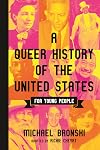
A Queer History of the United States for Young People
by Richie Chevat
On This Page
Description
Named one of the Best Nonfiction Books of 2019 by School Library JournalQueer history didn’t start with Stonewall. This book explores how LGBTQ people have always been a part of our national identity, contributing to the country and culture for over 400 years.
It is crucial for lesbian, gay, bisexual, transgender, and queer youth to know their history. But this history is not easy to find since it’s rarely taught in schools or commemorated in other ways. A Queer History of the United show more States for Young People corrects this and demonstrates that LGBTQ people have long been vital to shaping our understanding of what America is today.
Through engrossing narratives, letters, drawings, poems, and more, the book encourages young readers, of all identities, to feel pride at the accomplishments of the LGBTQ people who came before them and to use history as a guide to the future. The stories he shares include those of
* Indigenous tribes who embraced same-sex relationships and a multiplicity of gender identities.
* Emily Dickinson, brilliant nineteenth-century poet who wrote about her desire for women.
* Gladys Bentley, Harlem blues singer who challenged restrictive cross-dressing laws in the 1920s.
* Bayard Rustin, Dr. Martin Luther King Jr.’s close friend, civil rights organizer, and an openly gay man.
* Sylvia Rivera, cofounder of STAR, the first transgender activist group in the US in 1970.
* Kiyoshi Kuromiya, civil rights and antiwar activist who fought for people living with AIDS.
* Jamie Nabozny, activist who took his LGBTQ school bullying case to the Supreme Court.
* Aidan DeStefano, teen who brought a federal court case for trans-inclusive bathroom policies.
* And many more!
With over 60 illustrations and photos, a glossary, and a corresponding curriculum, A Queer History of the United States for Young People will be vital for teachers who want to introduce a new perspective to America’s story. show less
Tags
Recommendations









Member Reviews
This book literally put me in a reading slump and at this point I can't finish it. Just the thought of going back to it exhausts me. Nothing in the first 50 pages really stuck out to me as good and so much of it was a problem. Obviously, the biggest and most unsurmountable problem for me was the lack of and dismissal of asexuality and aromanticism. As an aroace woman, seeing asexuality and aromanticism included in a general queer history is obviously gonna be incredibly important to me and the fact that they were completely left out and except for the one moment when they were dismissed as a phase, left a horrible taste in my mouth for this book and I just can't handle trying to go back to it. Literally the only inclusion of asexuality show more in the entire book (aromanticism isn't mentioned even once) is an entry in the glossary at the back of the book which not only uses scare quotes around the word asexuality, but also claims that "asexuality is a temporary feeling." My very permanent asexuality is gonna become a very permanent boot in someone's ass for writing that bullshit.
Beyond the aroace problem, this book used really exclusionist language, which, again, is super frustrating to see in a book about queer history. They continually used the phrase "men and women" rather than just saying "people," even after they finally acknowledged nonbinary identities. The short definitions of the main identities in the LGBT acronym included in the introduction were very lacking and simplistic. There was a throwaway line at the end of the bisexual section kind of acknowledging pansexuality without acknowledging the nuance of why individuals choose to use one term over the other. Intersexuality isn't really mentioned at all. Nonbinary identities are glossed over at best.
From the little that I was able to stomach reading, I just could not ever recommend this to anyone, let alone young people who are starting to figure out their identities and have questions about what options there are available to them. The language was too simplistic and infantalizing - news flash! young people aren't dumb and are in fact capable of understanding a lot of nuance, especially in regards to identity and talking down to them is not going to gain you any readers. The dismissal of so many different queer identities and their roles in American history was infuriating and again does such a major disservice to readers. I was so excited when I first heard about this book but it ended up being just an absolutely abysmal book that I am genuinely gutted to have read.
I do find myself wondering how much of the problems I had with this book were the fault of the author and how much was the fault of the adaptor. I'm sure my problem with the authors talking down to the audience was the fault of the adapter, but did the original have similar problems with the exclusionist language and the absence of so many queer identities or was that a problem of adapting it for young people? I probably will try to read the original at some point very far in the future when I can forget this super shitty edition. show less
Beyond the aroace problem, this book used really exclusionist language, which, again, is super frustrating to see in a book about queer history. They continually used the phrase "men and women" rather than just saying "people," even after they finally acknowledged nonbinary identities. The short definitions of the main identities in the LGBT acronym included in the introduction were very lacking and simplistic. There was a throwaway line at the end of the bisexual section kind of acknowledging pansexuality without acknowledging the nuance of why individuals choose to use one term over the other. Intersexuality isn't really mentioned at all. Nonbinary identities are glossed over at best.
From the little that I was able to stomach reading, I just could not ever recommend this to anyone, let alone young people who are starting to figure out their identities and have questions about what options there are available to them. The language was too simplistic and infantalizing - news flash! young people aren't dumb and are in fact capable of understanding a lot of nuance, especially in regards to identity and talking down to them is not going to gain you any readers. The dismissal of so many different queer identities and their roles in American history was infuriating and again does such a major disservice to readers. I was so excited when I first heard about this book but it ended up being just an absolutely abysmal book that I am genuinely gutted to have read.
I do find myself wondering how much of the problems I had with this book were the fault of the author and how much was the fault of the adaptor. I'm sure my problem with the authors talking down to the audience was the fault of the adapter, but did the original have similar problems with the exclusionist language and the absence of so many queer identities or was that a problem of adapting it for young people? I probably will try to read the original at some point very far in the future when I can forget this super shitty edition. show less
 This review was written for LibraryThing Early Reviewers.
Oh what a mess of a book. As other reviews have noted, there's a great deal of confusion around language in this book--it doesn't seem to know what to do with trans people in general, conflating trans-ness with sexuality in some parts and separating it with others (which theoretically I'd be fine with except for the inconsistency of it all--it feels more like a mistake than a political move.)
I think my biggest beef with it all (beyond yknow the nationalism of tying up queer history with US history and in particular with American myths about ourselves, which I think we should be questioning, but it also like makes sense given the title,) is the inconsistency overall in methodology with regards to whether or not we can call someone from show more the past "gay" or "trans." The authors (and I'm unclear how much of this is the original text itself or the way it's been adjusted for "young people" (more on that later)) lay out that we can't do this, which is of course a valid way of approaching queer history, but then in the actual chapters there's a lot of flopping back and forth on whether or not we can claim a history from these people. As an example, when talking about Emily Dickinson, the text reads "However she may have thought of herself, Emily Dickinson was certainly a woman who loved other women." It all feels very like trying to have your cake and eat it too, and while I understand the tension--to offer youth a history grounded in an awareness of the way that our ideas about sex and sexuality have changed over time--I don't think this is a good way of approaching it (and I think settling a history in individuals is also a bad way of going about it, but yknow here we are I guess.)
The other issue I have is who this book is aimed at. I assumed (and picked up the book based on the idea that) this book is aimed at young teens, maybe ages 12+. The book itself seems to indicate it's aimed at people in their late teens and early twenties--not in terms of how the language is written (I still thought it was aimed at 12 year olds reading it!) but with an actual phrasing that comes late in the text. And while I wouldn't discourage an 18 year old from reading this book (I wouldn't discourage anyone from reading anything!) I think you can probably read a much better queer history book for adults and get a better sense of the history.
Overall this was most disappointing because young people deserve better than this! I haven't yet found a good replacement (and I might have to write it >.>) but I wouldn't recommend this, especially as the first contact a person might have with queer history. show less
I think my biggest beef with it all (beyond yknow the nationalism of tying up queer history with US history and in particular with American myths about ourselves, which I think we should be questioning, but it also like makes sense given the title,) is the inconsistency overall in methodology with regards to whether or not we can call someone from show more the past "gay" or "trans." The authors (and I'm unclear how much of this is the original text itself or the way it's been adjusted for "young people" (more on that later)) lay out that we can't do this, which is of course a valid way of approaching queer history, but then in the actual chapters there's a lot of flopping back and forth on whether or not we can claim a history from these people. As an example, when talking about Emily Dickinson, the text reads "However she may have thought of herself, Emily Dickinson was certainly a woman who loved other women." It all feels very like trying to have your cake and eat it too, and while I understand the tension--to offer youth a history grounded in an awareness of the way that our ideas about sex and sexuality have changed over time--I don't think this is a good way of approaching it (and I think settling a history in individuals is also a bad way of going about it, but yknow here we are I guess.)
The other issue I have is who this book is aimed at. I assumed (and picked up the book based on the idea that) this book is aimed at young teens, maybe ages 12+. The book itself seems to indicate it's aimed at people in their late teens and early twenties--not in terms of how the language is written (I still thought it was aimed at 12 year olds reading it!) but with an actual phrasing that comes late in the text. And while I wouldn't discourage an 18 year old from reading this book (I wouldn't discourage anyone from reading anything!) I think you can probably read a much better queer history book for adults and get a better sense of the history.
Overall this was most disappointing because young people deserve better than this! I haven't yet found a good replacement (and I might have to write it >.>) but I wouldn't recommend this, especially as the first contact a person might have with queer history. show less
This is a great idea for a book and it is a terrific effort to provide young people with info on LGBTQ persons throughout American history. The author, Bronshi is well qualified to write this book and his knowledge and understanding of the topic is apparent. I particularly liked that he first provides an overview and then offers individual biographies of men and women who were LGBTQ throughout history and made a difference in American culture and society.
If you know a youngster who is struggling with his or her sexuality or sexual identity this is a good place to start reading for them and can lead to important discussions. If you are heterosexual and want to know more about the LGBTQ community this is a good book for you. Hopefully, show more libraries and bookstores across America will carry a copy of this very interesting and informative book! show less
If you know a youngster who is struggling with his or her sexuality or sexual identity this is a good place to start reading for them and can lead to important discussions. If you are heterosexual and want to know more about the LGBTQ community this is a good book for you. Hopefully, show more libraries and bookstores across America will carry a copy of this very interesting and informative book! show less
This review was written for LibraryThing Early Reviewers.A review of this interesting little book needs to lead off with a couple of disclaimers. First off, this isn't really a "queer history," per se -- rather, it's mostly a series of 30-odd vignettes about noteworthy folks in American history who (probably, at least) happened to be queer. Secondly, the book professes to be "for young people" ... and while the essays serve as a great Queer History primer for anyone who's middle school-age or above, it's written in a style that would make the subject interesting and accessible to many adults, as well.
The biographical vignette themselves are balanced and straightforward, and accurate as far as I can tell. The subject-matter balance isn't perfect, due in part to the way sexuality was known and show more expressed over time -- more people of letters in the earlier years, and more social and political activists in later years. Most of the individual stories are pretty intriguing, though, and the format makes it easy to pick up the book during a few spare minutes, and read one free-standing story at a time. When you're made it through them all, it would be hard not to capture the main message of the volume -- that queer folks have been an integral part of our society and culture from the beginning.
For that, this book gets five stars from me. Reading some of the other reviews, I honestly think it's a little sad and misguided that some other folks see this book as exclusionary and insufficient. I disagree with that view pretty strongly, and it reminds me that in this social-media age, it's pretty much impossible to write or do *anything* without pissing at least someone off. But so it goes. show less
The biographical vignette themselves are balanced and straightforward, and accurate as far as I can tell. The subject-matter balance isn't perfect, due in part to the way sexuality was known and show more expressed over time -- more people of letters in the earlier years, and more social and political activists in later years. Most of the individual stories are pretty intriguing, though, and the format makes it easy to pick up the book during a few spare minutes, and read one free-standing story at a time. When you're made it through them all, it would be hard not to capture the main message of the volume -- that queer folks have been an integral part of our society and culture from the beginning.
For that, this book gets five stars from me. Reading some of the other reviews, I honestly think it's a little sad and misguided that some other folks see this book as exclusionary and insufficient. I disagree with that view pretty strongly, and it reminds me that in this social-media age, it's pretty much impossible to write or do *anything* without pissing at least someone off. But so it goes. show less
This review was written for LibraryThing Early Reviewers.A Queer History of the United States for Young People, published in 2019 by Beacon Press, is an adaptation by Richie Chevat of Michael Bronski's 2011 Stonewall Book Award-winning work A Queer History of the United States. Not having read Bronski's original work, I'm uncertain if some of the flaws that exist in Chevat's adaptation are simply carried over from the source material, but I suspect that may be case in at least some instances — essentially, A Queer History of the United States for Young People has not been adapted or updated enough to reflect more recent developments in the conversations surrounding queer identities. Though to be fair, this is and will always be something of a moving target and difficult to successfully show more achieve.
For a work that rightfully emphasizes the importance of language and careful use of words and terminology, A Queer History of the United States for Young Pepole frustratingly does not always follow those professed ideals. As a result, the book is not nearly as inclusive as it could, needs, or intends to be. For example, some of the definitions used are incomplete, lacking in necessary nuance, or are quite simply wrong (e.g. "transgender" is not a term meaning a person who is attracted to another person of the same sex). A Queer History of the United States for Young People handles some queer identities fairly well — in particular those of gay men and lesbians — but it sometimes struggles with conveying a thorough understanding other marginalized groups, especially people who are gender-nonconforming, asexual, or have more fluid or liminal identities.
Even so, A Queer History of the United States for Young People, while at times infuriating, also has its good points and its intentions are certainly commendable. The writing is approachable and accessible, offering biographical sketches of more than thirty notable queer figures in United States history from the 1500s through the 2000s. I loved learning about these people and the historical context of their lives. I was previously aware of some of the figures chosen to be featured in the book while other I was encountering for the first time — people I look forward to learning even more about. While I wouldn't hand A Queer History of the United States for Young People to a reader without some caveats or the intention to incorporate it into a larger conversation, the work does have the potential to be a great starting place (an emphasis on starting place) for discovering how queer history is United States history. show less
For a work that rightfully emphasizes the importance of language and careful use of words and terminology, A Queer History of the United States for Young Pepole frustratingly does not always follow those professed ideals. As a result, the book is not nearly as inclusive as it could, needs, or intends to be. For example, some of the definitions used are incomplete, lacking in necessary nuance, or are quite simply wrong (e.g. "transgender" is not a term meaning a person who is attracted to another person of the same sex). A Queer History of the United States for Young People handles some queer identities fairly well — in particular those of gay men and lesbians — but it sometimes struggles with conveying a thorough understanding other marginalized groups, especially people who are gender-nonconforming, asexual, or have more fluid or liminal identities.
Even so, A Queer History of the United States for Young People, while at times infuriating, also has its good points and its intentions are certainly commendable. The writing is approachable and accessible, offering biographical sketches of more than thirty notable queer figures in United States history from the 1500s through the 2000s. I loved learning about these people and the historical context of their lives. I was previously aware of some of the figures chosen to be featured in the book while other I was encountering for the first time — people I look forward to learning even more about. While I wouldn't hand A Queer History of the United States for Young People to a reader without some caveats or the intention to incorporate it into a larger conversation, the work does have the potential to be a great starting place (an emphasis on starting place) for discovering how queer history is United States history. show less
This review was written for LibraryThing Early Reviewers.An adaptation for teens of the adult title A Queer History of the United States (2011).
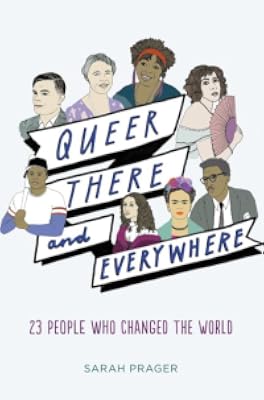
Divided into thematic sections, the text filters LGBTQIA+ history through key figures in each era from the 1500s to the present. Alongside watershed moments like the 1969 Stonewall uprising and the HIV/AIDS crisis of the 1980s and 1990s, the text brings to light less well-known people, places, and events: the 1625 free love colony of Merrymount, transgender Civil War hero Albert D.J. Cashier, and the 1951 founding of the Mattachine Society, to name a few. Throughout, the author and adapter take care to use accurate pronouns and avoid imposing contemporary terminology onto historical figures. In some cases, they quote primary sources to speculate about show more same-sex relationships while also reminding readers of past cultural differences in expressing strong affection between friends. Black-and-white illustrations or photos augment each chapter. Though it lacks the teen appeal and personable, conversational style of Sarah Prager’s Queer, There, and Everywhere (2017), this textbook-level survey contains a surprising amount of depth. However, the mention of transgender movements and activism—in particular, contemporary issues—runs on the slim side. Whereas chapters are devoted to over 30 ethnically diverse gay, lesbian, bisexual, or queer figures, some trans pioneers such as Christine Jorgensen and Holly Woodlawn are reduced to short sidebars.
Though not the most balanced, an enlightening look back for the queer future. (glossary, photo credits, bibliography, index) (Nonfiction. 14-18)
-Kirkus Review show less
Divided into thematic sections, the text filters LGBTQIA+ history through key figures in each era from the 1500s to the present. Alongside watershed moments like the 1969 Stonewall uprising and the HIV/AIDS crisis of the 1980s and 1990s, the text brings to light less well-known people, places, and events: the 1625 free love colony of Merrymount, transgender Civil War hero Albert D.J. Cashier, and the 1951 founding of the Mattachine Society, to name a few. Throughout, the author and adapter take care to use accurate pronouns and avoid imposing contemporary terminology onto historical figures. In some cases, they quote primary sources to speculate about show more same-sex relationships while also reminding readers of past cultural differences in expressing strong affection between friends. Black-and-white illustrations or photos augment each chapter. Though it lacks the teen appeal and personable, conversational style of Sarah Prager’s Queer, There, and Everywhere (2017), this textbook-level survey contains a surprising amount of depth. However, the mention of transgender movements and activism—in particular, contemporary issues—runs on the slim side. Whereas chapters are devoted to over 30 ethnically diverse gay, lesbian, bisexual, or queer figures, some trans pioneers such as Christine Jorgensen and Holly Woodlawn are reduced to short sidebars.
Though not the most balanced, an enlightening look back for the queer future. (glossary, photo credits, bibliography, index) (Nonfiction. 14-18)
-Kirkus Review show less
I'm honestly conflicted about this book. On the one hand, any information about the LGBTQ community and his history is welcome, especially when hate crimes are on the rise, and I did learn about some people I'd never heard of. On the other hand, this is far from a comprehensive history -- it's really a collection of short biographies, interspersed with background -- which is quite different from the book it's supposedly adapted from. I also take issues with some of the definitions (when your own book talks about the importance of using precise language, you better use it yourself), and the text in general feels oversimplified. I'm currently reading DK's The Feminism Book, and that work proves you can explain big ideas clearly and show more concisely without talking down to your readers. I'm going to steer away from any other works by this particular adapter in the future. show less
This review was written for LibraryThing Early Reviewers.Members
- Recently Added By
Lists

Youth: Sexuality & Gender
119 works; 1 member
Author Information
27+ Works 1,588 Members
Richie Chevat is an author and adapter of books. His works include the Ghostwriter Mysteries, Magic School Bus activity books, and The Marbles Book and the Marbles. (Bowker Author Biography)
Awards and Honors
Distinctions
Notable Lists
Series
Belongs to Publisher Series
Work Relationships
Is an adaptation of
Common Knowledge
- Canonical title
- A Queer History of the United States for Young People
- Important places
- USA
- Original language
- English
Classifications
- Genres
- Nonfiction, LGBTQ+, Tween, Kids, Teen
- DDC/MDS
- 306.76 — Society, government, & culture Social sciences, sociology & anthropology Social Behavior - Dating, Marriage, Divorce Sexual relations Sexual orientation, transgender identity, intersexuality
- LCC
- HQ76.3 .U5 .B6965 — Social sciences The family. Marriage, Women and Sexuality The Family. Marriage. Women Sexual life Homosexuality. Lesbianism
- BISAC
Statistics
- Members
- 297
- Popularity
- 108,363
- Reviews
- 12
- Rating
- (3.64)
- Languages
- English
- Media
- Paper, Ebook
- ISBNs
- 5
- ASINs
- 1