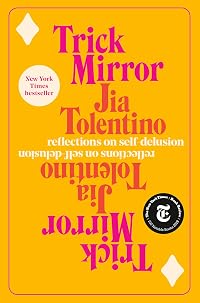
Trick Mirror: Reflections on Self-Delusion
by Jia Tolentino
On This Page
Description
NEW YORK TIMES BESTSELLER * "From The New Yorker's beloved cultural critic comes a bold, unflinching collection of essays about self-deception, examining everything from scammer culture to reality television."--Esquire "A whip-smart, challenging book."--Zadie Smith * "Jia Tolentino could be the Joan Didion of our time."--Vulture FINALIST FOR THE NATIONAL BOOK CRITICS CIRCLE'S JOHN LEONARD PRIZE FOR BEST FIRST BOOK * NAMED ONE OF THE TEN BEST BOOKS OF THE YEAR BY THE NEW YORK PUBLIC show more LIBRARY AND HARVARD CRIMSON AND ONE OF THE BEST BOOKS OF THE YEAR BY The New York Times Book Review * Time * Chicago Tribune * The Washington Post * NPR * Variety * Esquire * Vox * Elle * Glamour * GQ * Good Housekeeping * The Paris Review * Paste * Town & Country * BookPage * Kirkus Reviews * BookRiot * Shelf Awareness Jia Tolentino is a peerless voice of her generation, tackling the conflicts, contradictions, and sea changes that define us and our time. Now, in this dazzling collection of nine entirely original essays, written with a rare combination of give and sharpness, wit and fearlessness, she delves into the forces that warp our vision, demonstrating an unparalleled stylistic potency and critical dexterity. Trick Mirror is an enlightening, unforgettable trip through the river of self-delusion that surges just beneath the surface of our lives. This is a book about the incentives that shape us, and about how hard it is to see ourselves clearly through a culture that revolves around the self. In each essay, Tolentino writes about a cultural prism: the rise of the nightmare social internet; the advent of scamming as the definitive millennial ethos; the literary heroine's journey from brave to blank to bitter; the punitive dream of optimization, which insists that everything, including our bodies, should become more efficient and beautiful until we die. Gleaming with Tolentino's sense of humor and capacity to elucidate the impossibly complex in an instant, and marked by her desire to treat the reader with profound honesty, Trick Mirror is an instant classic of the worst decade yet. FINALIST FOR THE PEN/DIAMONSTEIN-SPIELVOGEL AWARD FOR THE ART OF THE ESSAY show lessTags
Recommendations






Member Reviews
So good I read it twice. You'll likely have heard of -- or lived through -- at least some of the stories that the authors talks about here: she touches on FyreFest and DJ Screw and describes her experiences on drugs, at weddings, and, perhaps most surprisingly, on a reality TV show. Mostly, she spends a lot of time online. Some readers might complain that Tolentino talks about herself altogether too much, but I think that she's doing more than navel-gazing here. She's able to instrumentalize her experiences -- at yoga class, on Twitter, at work -- and mold them into useful and entertainingly readable critiques of modern life. These are big ideas delivered in a tone so unforced, so readable that it verges on the conversational. And it show more isn't that she trusts her opinions or her instincts implicitly. It's no accident that the subtitle of this one is "reflections on self-delusions." The author seems to have an intimate knowledge of her own personality and her own place in society, but that doesn't keep her from questioning herself or her motives. That sets her apart from the average essayist with an MFA and a book contract.
Tolentino's something of a historian of the recent past: she has lived through or peripherally participated in many of the mini-movements she describes here. When she chooses to go further back, she has a keen eye for describing how the roles and difficult choices faced by women of each time period she describes have -- or, more probably, haven't changed. She seems to espouse a feminist viewpoint whose implications, by their very nature, encompass male experience as well. She seems, at certain points, to be less specifically concerned with how injustice affects women than how these particular injustices make life increasingly unlivable for everyone. A pervasive lack of the ability to give or withhold consent, or even know when consent has been assumed by societal structures far larger than the individual seems to be Tolentino's through-line here. "Trick Mirror" offers few easy solutions and, honestly, this seems fitting enough. In the book first essay, the author points out that the internet has made it easier to express an opinion and more difficult, in certain ways, to effect real change or take concrete actions that might improve specific situations. But, somehow, I didn't find this in the least depressing. One of Tolentino's unvoiced assumptions is that one way of improving the world is learning to see it clearly. This small collection of essays seems a valuable contribution to that project. In a certain sense, "Trick Mirror" can't help but being a very "right now" -- or perhaps "right then"? -- book. But I suspect that it'll still seem insightful ten, twenty, or perhaps fifty years from now. One to read. show less
Tolentino's something of a historian of the recent past: she has lived through or peripherally participated in many of the mini-movements she describes here. When she chooses to go further back, she has a keen eye for describing how the roles and difficult choices faced by women of each time period she describes have -- or, more probably, haven't changed. She seems to espouse a feminist viewpoint whose implications, by their very nature, encompass male experience as well. She seems, at certain points, to be less specifically concerned with how injustice affects women than how these particular injustices make life increasingly unlivable for everyone. A pervasive lack of the ability to give or withhold consent, or even know when consent has been assumed by societal structures far larger than the individual seems to be Tolentino's through-line here. "Trick Mirror" offers few easy solutions and, honestly, this seems fitting enough. In the book first essay, the author points out that the internet has made it easier to express an opinion and more difficult, in certain ways, to effect real change or take concrete actions that might improve specific situations. But, somehow, I didn't find this in the least depressing. One of Tolentino's unvoiced assumptions is that one way of improving the world is learning to see it clearly. This small collection of essays seems a valuable contribution to that project. In a certain sense, "Trick Mirror" can't help but being a very "right now" -- or perhaps "right then"? -- book. But I suspect that it'll still seem insightful ten, twenty, or perhaps fifty years from now. One to read. show less
A fascinating collection of essays, looking at modern forms of self-delusion. The writing is often personal, and while that might alienate some (I've read reviews elsewhere saying that the reader couldn't relate to the writer as much as they wished) I think it adds an extra dimension to the point being relayed. The essay on the various scams that are central to modern America is one of the strongest, and if you aren't angry when you come to the end of that piece you haven't been paying attention.
Collection of nine essays about modern society and its numerous issues written from the perspective of a member of the millennial generation. Tolentino employs many popular culture references, so the book seems like a time capsule of living in the 2010s. There are essays about Houston’s hip hop scene, reality television, the prevalence of scamming, roles of women in literature, the commoditization of beauty, changing views on marriage, and more.
Each essay begins with a memory that is used as a starting point to explore larger related societal issues. My personal favorite is the scathing indictment of social media and its deleterious effects on our world – this is a topic I can get behind and am glad someone else is calling show more attention to it. The essays express the author’s opinions expressed through a feminist lens. It is not intended to be scientific.
I wish she had expressed more about what to do about these problems. It is more of an effort to raise awareness than provide solutions. Admittedly, it would be extremely difficult to solve these issues – if they had easy solutions, they would have already been accomplished.
I enjoyed the author’s writing style, which includes a good amount of self-deprecating humor. It helped me understand a way of seeing the world from a millennial point of view. While I did not necessarily agree with some of her sweeping statements, I found it thought-provoking and worth reading. It would make an excellent selection for a book club. There is a lot to discuss here. show less
Each essay begins with a memory that is used as a starting point to explore larger related societal issues. My personal favorite is the scathing indictment of social media and its deleterious effects on our world – this is a topic I can get behind and am glad someone else is calling show more attention to it. The essays express the author’s opinions expressed through a feminist lens. It is not intended to be scientific.
I wish she had expressed more about what to do about these problems. It is more of an effort to raise awareness than provide solutions. Admittedly, it would be extremely difficult to solve these issues – if they had easy solutions, they would have already been accomplished.
I enjoyed the author’s writing style, which includes a good amount of self-deprecating humor. It helped me understand a way of seeing the world from a millennial point of view. While I did not necessarily agree with some of her sweeping statements, I found it thought-provoking and worth reading. It would make an excellent selection for a book club. There is a lot to discuss here. show less
Pitch perfect blending of the personal and cultural. These essays feel comprehensive in their treatment of the subject matter, without ever being dry. I read it an essay at a time and came away satisfied from every one. I can easily imagine dipping back into this one.
The rise of Online as its own distinct space for writing, thinking, and living has presented as many challenges for writers as opportunities, in purely literary terms. It's often difficult for a lot of writers to use the weird, performative, enchanting-but-dispiriting nature of the internet as a platform for self-discovery without shading into navel-gazing. Is posting an inherently interesting act, or, equally plausibly, is it just a big waste of time that has an even lower probability of being interesting to hear about than someone's dreams? Tolentino neatly threads the dangerous needle of using the internet directly as a subject, managing to be in it but not of it, and never coming across as too self-absorbed even when she's trying to show more place her own life in the context of a world which often doesn't make any sense at all. She has a lot more to talk about than just the internet's effect on discourse and self-image, but whether she's discussing reality TV, Millennial-vintage scams, drugs and religion, or the many questions posed to contemporary feminism, she exactly captures that sense of coming up with a bunch of neat epiphanies and relating them to other people, with the resultant burst of pleasure when your thoughts finally strike a chord with someone else.
For me these essays seemed to group themselves into 2 loose clusters. One focuses on her personal life story. "The I in Internet" is a thoughtful analysis of why exactly the internet, which theoretically could be a nonstop delight to use, instead so frequently feels awful to use, particularly for writers like her who both hate and yet depend on it (as she says, "first, how the internet is built to distend our sense of identity; second, how it encourages us to overvalue our opinions; third, how it maximizes our sense of opposition; fourth, how it cheapens our understanding of solidarity; and, finally, how it destroys our sense of scale."). "Reality TV Me" is both a rumination on her experience on one of those amazing trashy early-2000s reality TV shows, in hindsight one of our most enduring cultural innovations, and also a discussion of how your own view of yourself can be warped by exposure to the lure of celebrity. "Ecstacy" is about growing up in the hothouse environment of Houston evangelical Protestantism, surrounded by sex, drugs, and chopped and screwed hip hop, and what that's done to her own personal sense of enlightenment and creativity. "The Story of a Generation in Seven Scams" uses the peculiarly Millennial scam of FyreFest, which she appeared in a documentary on, as a particularly emblematic example of how young people's lives have been warped by an entire culture of scams: predatory banks in the financial crisis, onerous student debt for useless degrees, duplicitous social media and its emphasis on obsessive self-presentation, "girlboss" corporate feminism, openly fraudulent companies like Juicero or Theranos, "disruption" and the gig economy's creation of a new precariat, and of course Donald Trump, who if history is in any way just will eventually be as eponymous for scamming as Elbridge Gerry is for unfair redistricting.
The other essay constellation focuses on various facets of feminism in the modern era. "Always Be Optimizing" is about how capitalism intersects with the beauty arms race, as in the phenomenon of expensive, regimented fitness programs like barre, and the always-tricky politics of sex-positivity; I was frequently reminded of Virginia Postrel's excellent book Glamour. "Pure Heroines" explores the struggles of identifying with female characters in literature, with a particular focus on children's literature (I think one of the first things I ever read from her was her wonderful review of Gordon Korman's oeuvre in Jezebel; she has a real gift for putting into words exactly what makes certain books stick in your mind through the years). "The Cult of the Difficult Woman" tackles the profound ambivalence many women (and men too) feel about criticizing terrible women in a culture where misogyny is still potent; I was reminded of Molly Ivins' spectacular takedown of Camille Paglia in her piece "I Am the Cosmos". "I Thee Dread" involves her own complicated feelings about not being married to her long-term boyfriend, but her melange of sentiments will be very familiar to anyone who's been in a perfectly happy long-term relationship and had to field "so, when's the big day questions?", which of course are typically directed to women. The final essay, "We Come from Old Virginia", puts Sabrina Erdely's fraudulent Rolling Stone campus rape story at UVa, her alma mater, in the context of a culture of sexual assault which is all too real, and how it's possible for scumbags like Brett Kavanaugh to sail through life without any consequences at all while at the same time countless women face nothing but bad options for dealing with their own experiences in a society which treats each false accusation as the equal of countless accusations which never got made.
In the Introduction she mentions a throwaway line she once wrote that what women often seem to want from feminist websites is a "trick mirror that carries the illusion of flawlessness as well as the self-flagellating option of constantly finding fault." No one's perfect, but not an inch of the extra space she uses in these essays goes to waste. show less
For me these essays seemed to group themselves into 2 loose clusters. One focuses on her personal life story. "The I in Internet" is a thoughtful analysis of why exactly the internet, which theoretically could be a nonstop delight to use, instead so frequently feels awful to use, particularly for writers like her who both hate and yet depend on it (as she says, "first, how the internet is built to distend our sense of identity; second, how it encourages us to overvalue our opinions; third, how it maximizes our sense of opposition; fourth, how it cheapens our understanding of solidarity; and, finally, how it destroys our sense of scale."). "Reality TV Me" is both a rumination on her experience on one of those amazing trashy early-2000s reality TV shows, in hindsight one of our most enduring cultural innovations, and also a discussion of how your own view of yourself can be warped by exposure to the lure of celebrity. "Ecstacy" is about growing up in the hothouse environment of Houston evangelical Protestantism, surrounded by sex, drugs, and chopped and screwed hip hop, and what that's done to her own personal sense of enlightenment and creativity. "The Story of a Generation in Seven Scams" uses the peculiarly Millennial scam of FyreFest, which she appeared in a documentary on, as a particularly emblematic example of how young people's lives have been warped by an entire culture of scams: predatory banks in the financial crisis, onerous student debt for useless degrees, duplicitous social media and its emphasis on obsessive self-presentation, "girlboss" corporate feminism, openly fraudulent companies like Juicero or Theranos, "disruption" and the gig economy's creation of a new precariat, and of course Donald Trump, who if history is in any way just will eventually be as eponymous for scamming as Elbridge Gerry is for unfair redistricting.
The other essay constellation focuses on various facets of feminism in the modern era. "Always Be Optimizing" is about how capitalism intersects with the beauty arms race, as in the phenomenon of expensive, regimented fitness programs like barre, and the always-tricky politics of sex-positivity; I was frequently reminded of Virginia Postrel's excellent book Glamour. "Pure Heroines" explores the struggles of identifying with female characters in literature, with a particular focus on children's literature (I think one of the first things I ever read from her was her wonderful review of Gordon Korman's oeuvre in Jezebel; she has a real gift for putting into words exactly what makes certain books stick in your mind through the years). "The Cult of the Difficult Woman" tackles the profound ambivalence many women (and men too) feel about criticizing terrible women in a culture where misogyny is still potent; I was reminded of Molly Ivins' spectacular takedown of Camille Paglia in her piece "I Am the Cosmos". "I Thee Dread" involves her own complicated feelings about not being married to her long-term boyfriend, but her melange of sentiments will be very familiar to anyone who's been in a perfectly happy long-term relationship and had to field "so, when's the big day questions?", which of course are typically directed to women. The final essay, "We Come from Old Virginia", puts Sabrina Erdely's fraudulent Rolling Stone campus rape story at UVa, her alma mater, in the context of a culture of sexual assault which is all too real, and how it's possible for scumbags like Brett Kavanaugh to sail through life without any consequences at all while at the same time countless women face nothing but bad options for dealing with their own experiences in a society which treats each false accusation as the equal of countless accusations which never got made.
In the Introduction she mentions a throwaway line she once wrote that what women often seem to want from feminist websites is a "trick mirror that carries the illusion of flawlessness as well as the self-flagellating option of constantly finding fault." No one's perfect, but not an inch of the extra space she uses in these essays goes to waste. show less
Rambling (not necessarily a criticism) essays about millennial life and the ways in which existing systems, especially patriarchy, entrap us because even resistance constitutes engagement that might keep the old structures alive. (E.g., “as women have attempted to use #YesAllWomen and #MeToo to regain control of a narrative, these hashtags have at least partially reified the thing they’re trying to eradicate: the way that womanhood can feel like a story of loss of control. They have made feminist solidarity and shared vulnerability seem inextricable.”) A lot of the book is about the internet, which has allegedly heightened the risk that everything becomes personal/identity-based and not primarily political. Some of it is annoying show more to old folks like me (“In the five years since my graduation, feminism had become a dominant cultural perspective”—sure, fine, whatever), but many of the observations are sharp.
I was a fan of this bit, as part of a discussion of the effects of clothing on how we behave: “athleisure frames the female body as a financial asset: an object that requires an initial investment and is divisible into smaller assets—the breasts, the abs, the butt—all of which are expected to appreciate in value, to continually bring back investor returns. Brutally expensive, with its thick disciplinary straps and taut peekaboo exposures, athleisure can be viewed as a sort of late-capitalist fetishwear: it is what you buy when you are compulsively gratified by the prospect of increasing your body’s performance on the market.” Tolentino, discussing scammers from Fyre to Trump, admits that “my own career has depended to some significant extent on feminism being monetizable. As a result, I live very close to this scam category, perhaps even inside.” Much of the story she tells is, sadly, pretty relatable: thinking herself immune from sexism because she was young and talented, then later on realizing that her UVa campus was fucked up—among other things, she got roofied and considered herself lucky that it made her violently ill, and also every Valentine’s day “flyers blanketed the campus with Jefferson and his slave Sally Hemings depicted in cameo silhouette, and the cutesy slogan “TJ [heart]s Sally” below that.”
In an essay on difficult women, Tolentino discusses, among other things, the double bind of criticizing conservative women: sexism works on them too, and yet, “if you stripped away the sexism, you would still be left with Kellyanne Conway,” very worthy of condemnation. “Moreover, if you make the self-presentation of a White House spokesperson off-limits on principle, then you lose the ability to articulate the way she does her job.” Although it’s her job, she’s skeptical of “adjudicating inequality through cultural criticism,” which allows people like Ivanka Trump to claim feminist allyship (though not racial justice allyship, which seems important). It’s true that conservatives have learned to weaponize accusations of insufficient feminism, but I’m not sure that liberals did that (Tolentino thinks we taught them how) or that bad faith is avoidable in any particular way by progressives; it just has to be fought. Overall, a lot of wheat and a lot of chaff in here. show less
I was a fan of this bit, as part of a discussion of the effects of clothing on how we behave: “athleisure frames the female body as a financial asset: an object that requires an initial investment and is divisible into smaller assets—the breasts, the abs, the butt—all of which are expected to appreciate in value, to continually bring back investor returns. Brutally expensive, with its thick disciplinary straps and taut peekaboo exposures, athleisure can be viewed as a sort of late-capitalist fetishwear: it is what you buy when you are compulsively gratified by the prospect of increasing your body’s performance on the market.” Tolentino, discussing scammers from Fyre to Trump, admits that “my own career has depended to some significant extent on feminism being monetizable. As a result, I live very close to this scam category, perhaps even inside.” Much of the story she tells is, sadly, pretty relatable: thinking herself immune from sexism because she was young and talented, then later on realizing that her UVa campus was fucked up—among other things, she got roofied and considered herself lucky that it made her violently ill, and also every Valentine’s day “flyers blanketed the campus with Jefferson and his slave Sally Hemings depicted in cameo silhouette, and the cutesy slogan “TJ [heart]s Sally” below that.”
In an essay on difficult women, Tolentino discusses, among other things, the double bind of criticizing conservative women: sexism works on them too, and yet, “if you stripped away the sexism, you would still be left with Kellyanne Conway,” very worthy of condemnation. “Moreover, if you make the self-presentation of a White House spokesperson off-limits on principle, then you lose the ability to articulate the way she does her job.” Although it’s her job, she’s skeptical of “adjudicating inequality through cultural criticism,” which allows people like Ivanka Trump to claim feminist allyship (though not racial justice allyship, which seems important). It’s true that conservatives have learned to weaponize accusations of insufficient feminism, but I’m not sure that liberals did that (Tolentino thinks we taught them how) or that bad faith is avoidable in any particular way by progressives; it just has to be fought. Overall, a lot of wheat and a lot of chaff in here. show less
Members
- Recently Added By
Lists

Books Read in 2019
4,052 works; 110 members

Books recommended by Barack Obama
295 works; 28 members

sad girl books
41 works; 2 members

sad girl books
51 works; 3 members

Barack Obama's Favorite Books of 2019
19 works; 3 members

el
1,139 works; 1 member
Author Information

3+ Works 1,783 Members
Some Editions
Awards and Honors
Awards
Distinctions
The Guardian Book of the Day (2019-08-02)
Common Knowledge
- Canonical title
- Trick Mirror: Reflections on Self-Delusion
- Original publication date
- 2019-08-06
- Dedication
- For my parents
- First words
- I wrote this book between the spring of 2017 and the fall of 2018—a period during which American identity, culture, technology, politics, and discourse seemed to coalesce into an unbearable supernova of perpetually escalati... (show all)ng conflict, a stretch of time when daily experience seemed both like a stopped elevator and an endless state-fair ride, when many of us regularly found ourselves thinking that everything had gotten as bad as we could possibly imagine, after which, of course, things always got worse.
- Last words
- (Click to show. Warning: May contain spoilers.)Here, as in so many other things, the “thee” that I dread may have been the “I” all along.
- Publisher's editor
- Greenberg, Ben
- Original language
- English
- Canonical DDC/MDS
- 973.93
- Canonical LCC
- E169.T63
Classifications
Statistics
- Members
- 1,744
- Popularity
- 12,647
- Reviews
- 46
- Rating
- (3.81)
- Languages
- 9 — Dutch, English, French, German, Italian, Spanish, Swedish, Turkish, Portuguese (Portugal)
- Media
- Paper, Audiobook, Ebook
- ISBNs
- 22
- ASINs
- 7