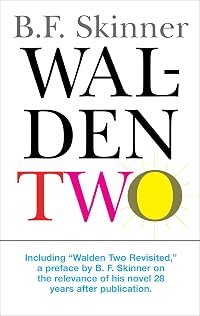
Walden Two
by B. F. Skinner
On This Page
Description
This fictional outline of a modern utopia has been a center of controversy ever since its publication in 1948. Set in the United States, it pictures a society in which human problems are solved by a scientific technology of human conduct. It is now widely recognized that great changes must be made in the American way of life. Not only can we not face the rest of the world while consuming and polluting as we do, we cannot for long face ourselves while acknowledging the violence and chaos in show more which we live. The choice is clear: either we do nothing and allow a miserable and probably catastrophic future to overtake us, or we use our knowledge about human behavior to create a social environment in which we shall live productive and creative lives and do so without jeopardizing the chances that those who follow us will be able to do the same. -Back cover. show lessTags
Recommendations
























Member Recommendations

Cecrow Non-essential background reading, but excellent in its own right.
11
Member Reviews
The operant conditioning chamber (also known as the Skinner box) created by B. F. Skinner would be enough to assure fame for the American psychologist, behaviorist, author, inventor, and social philosopher. This renaissance man is also a novelist. Having recently read Walden, I decided to take on this “controversial novel”. Technocrats of an apparently unexciting alternative 40s American decide on a lark to visit a self-sustaining commune, Walden Two. The productivity and happiness of citizens in this community is far greater than in the outside world because the residents practice scientific social planning and use operant conditioning in raising their children. Walden Two, like Henry David Thoreau, champions a lifestyle that does show more not support war or foster competition and social strife. It encourages a lifestyle of minimal consumption, rich social relationships, personal happiness, satisfying work and leisure. Unlike thorough, the community is not about one man’s solitude or a rejection of modern technology. Quite the opposite. (In 1967, Kat Kinkade founded the Twin Oaks Community, using Walden Two as a blueprint. The community still exists and continues to use the Planner-Manager system and other aspects described in Skinner's book.) Rather than "Walden Two", I think this book would be better named "The Republic Two", since the scale and approach has more to do with The Republic. As Will Durant says in The Story of Philosophy, "...policies should be administered by officials specifically prepared for the purpose, than by men who stumble out of commerce or manufacturing into political office without any training in the arts of is statesmanship." Skinner's Planner-Managers are more akin to the Philosopher-King guardians of Plato than Thoreau's self-sufficient loner.
The visiting group seems split in their opinions and a friendly fascism of the founder seems darker in this outburst on refuting the value of historical context:
"Are you saying that you gain no perspective-I mean, no detached
opinion-from a sense of history?"
"I mean that and more. Nothing confuses our evaluation of the present more than a sense of history-unless it's a sense of destiny. Your Hitlers are the men who use history to real advantage. It's exactly what they need. It obfuscates every attempt to get a clear appreciation of the present.
"Race, family, ancestor worship-these are the handmaidens of history, and we should have learned to beware of them by now. What we give our young people in Walden Two is a grasp of the current forces which a culture must deal with. None of your myths, none of your heroes-no history, no destiny-simply the Now! The present is the thing. It's the only thing we can deal
with, anyway, in a scientific way. But we've got a long way from the dictator.
Some parts of the founder’s philosophy seem calculated to offend some, such as finding autocratic powers in turning the other cheek:
"No, accident. Jesus discovered one principle because it had immediate consequences, and he got another thrown in for good measure.”
I began to see light.
"You mean the principle of love your enemies'?'' I
said.
"Exactly! To 'do good to those who despitefully use you' has two unrelated consequences. You gain the peace of mind we talked about the other day. Let the stronger man push you around-at least you avoid the torture of your own rage. That's the immediate consequence. What an astonishing discovery it must have been to find that in the long run you could control the stronger man in the same way!"
There is a hopefully benevolent paternalism here,
"The question is: Can men live in freedom and peace? And the answer is: Yes, if we can build a social structure which will satisfy the needs of everyone and in which everyone will want to observe the supporting code. But so far this has 'been achieved only in Walden Two. Your ruthless accusations to the contrary, Mr. Castle, this is the freest place on earth. And it is free precisely because we make no use of force or the threat of force. Every bit of our research, from the nursery through the psychological management of our adult membership, is directed toward that end-to exploit every alternative to forcible control. By skillful planning, by a wise choice of techniques we increase the feeling of freedom.
"It's not planning which infringes upon freedom, but planning which uses force. A sense of freedom was practically unknown in the planned society of Nazi Germany, because the planners made a fantastic use of force and the threat of force.
"No, Mr. Castle, when a science of behavior has once been achieved, there's no alternative to a planned society. We can't leave mankind to an accidental or biased control. But by using the principle of positive reinforcement-carefully avoiding force or the threat of force-we can preserve a personal sense of freedom."
Still, even Utopia needs its sheep. The practical commune is a subculture, needing larger culture to survive not really even an alternative culture or model for society at large.
"Suppose we need experts. Why not elect them?"
“For a very simple reason. The people are in no position to evaluate experts. And elected experts are never able to act as they think best. They can't experiment. The amateur doesn't appreciate the need for experimentation. He wants his expert to know. And he's utterly incapable of sustaining the period of doubt during which an experiment works itself out. The experts must either disguise their experiments and pretend to know the outcome in advance or stop experimenting altogether and struggle to maintain the status quo."
Skinner’s vision is an improved democracy at a time when Socialism held broad appeal (Looking Backward: 2000-1887 is referred to, along with other Utopian works):
"The government of Walden Two," he continued, "has the virtues of democracy, but none of the defects. It's much closer to the theory or intent of democracy than the actual practice in America today. The will of the people is carefully ascertained. We have no election campaigns
to falsify issues or obscure them with emotional appeals, but a careful study of the satisfaction of the membership is made. Every member has a direct channel through which he may protest to the Managers or even the Planners. And these protests are taken as seriously as the pilot of an airplane takes a sputtering engine…
Ultimately, this is a controlled experiment, and an experiment of control that is both complete and gentle:
"What is love,,' he said, with a shrug, "except another name for the use of positive reinforcement?"
it Or vice versa," I said.
Definitely, a thought-provoking work and an interesting way to present a community blueprint. show less
The visiting group seems split in their opinions and a friendly fascism of the founder seems darker in this outburst on refuting the value of historical context:
"Are you saying that you gain no perspective-I mean, no detached
opinion-from a sense of history?"
"I mean that and more. Nothing confuses our evaluation of the present more than a sense of history-unless it's a sense of destiny. Your Hitlers are the men who use history to real advantage. It's exactly what they need. It obfuscates every attempt to get a clear appreciation of the present.
"Race, family, ancestor worship-these are the handmaidens of history, and we should have learned to beware of them by now. What we give our young people in Walden Two is a grasp of the current forces which a culture must deal with. None of your myths, none of your heroes-no history, no destiny-simply the Now! The present is the thing. It's the only thing we can deal
with, anyway, in a scientific way. But we've got a long way from the dictator.
Some parts of the founder’s philosophy seem calculated to offend some, such as finding autocratic powers in turning the other cheek:
"No, accident. Jesus discovered one principle because it had immediate consequences, and he got another thrown in for good measure.”
I began to see light.
"You mean the principle of love your enemies'?'' I
said.
"Exactly! To 'do good to those who despitefully use you' has two unrelated consequences. You gain the peace of mind we talked about the other day. Let the stronger man push you around-at least you avoid the torture of your own rage. That's the immediate consequence. What an astonishing discovery it must have been to find that in the long run you could control the stronger man in the same way!"
There is a hopefully benevolent paternalism here,
"The question is: Can men live in freedom and peace? And the answer is: Yes, if we can build a social structure which will satisfy the needs of everyone and in which everyone will want to observe the supporting code. But so far this has 'been achieved only in Walden Two. Your ruthless accusations to the contrary, Mr. Castle, this is the freest place on earth. And it is free precisely because we make no use of force or the threat of force. Every bit of our research, from the nursery through the psychological management of our adult membership, is directed toward that end-to exploit every alternative to forcible control. By skillful planning, by a wise choice of techniques we increase the feeling of freedom.
"It's not planning which infringes upon freedom, but planning which uses force. A sense of freedom was practically unknown in the planned society of Nazi Germany, because the planners made a fantastic use of force and the threat of force.
"No, Mr. Castle, when a science of behavior has once been achieved, there's no alternative to a planned society. We can't leave mankind to an accidental or biased control. But by using the principle of positive reinforcement-carefully avoiding force or the threat of force-we can preserve a personal sense of freedom."
Still, even Utopia needs its sheep. The practical commune is a subculture, needing larger culture to survive not really even an alternative culture or model for society at large.
"Suppose we need experts. Why not elect them?"
“For a very simple reason. The people are in no position to evaluate experts. And elected experts are never able to act as they think best. They can't experiment. The amateur doesn't appreciate the need for experimentation. He wants his expert to know. And he's utterly incapable of sustaining the period of doubt during which an experiment works itself out. The experts must either disguise their experiments and pretend to know the outcome in advance or stop experimenting altogether and struggle to maintain the status quo."
Skinner’s vision is an improved democracy at a time when Socialism held broad appeal (Looking Backward: 2000-1887 is referred to, along with other Utopian works):
"The government of Walden Two," he continued, "has the virtues of democracy, but none of the defects. It's much closer to the theory or intent of democracy than the actual practice in America today. The will of the people is carefully ascertained. We have no election campaigns
to falsify issues or obscure them with emotional appeals, but a careful study of the satisfaction of the membership is made. Every member has a direct channel through which he may protest to the Managers or even the Planners. And these protests are taken as seriously as the pilot of an airplane takes a sputtering engine…
Ultimately, this is a controlled experiment, and an experiment of control that is both complete and gentle:
"What is love,,' he said, with a shrug, "except another name for the use of positive reinforcement?"
it Or vice versa," I said.
Definitely, a thought-provoking work and an interesting way to present a community blueprint. show less
This book has two target audiences, really, and the quality varies strongly depending on where you fall.
As a fiction reader, this book falls short in so many, many ways. Characters are merely loudspeakers for the author, going so far as to be named after him. Most characters, while having distinct viewpoints and personalities, are one-dimensional. There is no discernible plot whatsoever. And I mean none. The plot is the same as a virtual tour on an apartment website. As this is a novel of a utopia, the flavor is bland. Everything is perfect for the residents of Walden Two. You almost resent them. I was bored, despite the brisk pace.
As a behavior analyst, this novel is almost pornographic. This novel is Skinner's dreamworld, a perfect show more application of successful behavior analysis to a voluntary community of a variety of educated persons. Its moving. Its beautiful. It is almost overwhelmingly optimistic and positive. It even supplies research ideas.
If you are a behavior analyst, you've probably read this already.
If you are someone with a passing interest in aba and an open mind, give it a whirl.
For anyone else, please, stay away. For your own sake. show less
As a fiction reader, this book falls short in so many, many ways. Characters are merely loudspeakers for the author, going so far as to be named after him. Most characters, while having distinct viewpoints and personalities, are one-dimensional. There is no discernible plot whatsoever. And I mean none. The plot is the same as a virtual tour on an apartment website. As this is a novel of a utopia, the flavor is bland. Everything is perfect for the residents of Walden Two. You almost resent them. I was bored, despite the brisk pace.
As a behavior analyst, this novel is almost pornographic. This novel is Skinner's dreamworld, a perfect show more application of successful behavior analysis to a voluntary community of a variety of educated persons. Its moving. Its beautiful. It is almost overwhelmingly optimistic and positive. It even supplies research ideas.
If you are a behavior analyst, you've probably read this already.
If you are someone with a passing interest in aba and an open mind, give it a whirl.
For anyone else, please, stay away. For your own sake. show less
Hai que recoñecer que engancha e algúns temas de organización da comunidade como o reparto das cargas de traballo, o deseño dos obxectos cotiáns e as implicacións do deseño arquitectónico dan pé a reflexión. Polo resto non deixa de ser unha noveliña máis ou menos aquelada que xira en torno ao prometedor potencial de cambio do conductismo que foi xa desbotado/superado.
A behavioral psychologist imagines a utopia based on principles of positive reinforcement and training people to act in a way that benefits the community. Professor Burris narrates for us when he and some friends visit his old colleague Frazier, the founder of Walden Two. Each character is on varying levels of acceptance, as Frazier expounds on his Utopia; Castle, in particular, remains a determined skeptic, while Burris finds himself mediating between Castle and Frazier.
I was rather disappointed by this book. It was a fictional way of promoting Skinner's ideas, and there's no story outside of that, only Frazier promoting while Castle digs his heels in further. I remain unconvinced that it could work, and found myself getting annoyed show more that ultimately Frazier's reasoning was, "Well, you see it working before you" as he led his charges around Walden Two, when I don't know of any such successful community. Also, Skinner is a strict behaviorist and doesn't give much credence to the "nature" or genetic side of psychology. show less
I was rather disappointed by this book. It was a fictional way of promoting Skinner's ideas, and there's no story outside of that, only Frazier promoting while Castle digs his heels in further. I remain unconvinced that it could work, and found myself getting annoyed show more that ultimately Frazier's reasoning was, "Well, you see it working before you" as he led his charges around Walden Two, when I don't know of any such successful community. Also, Skinner is a strict behaviorist and doesn't give much credence to the "nature" or genetic side of psychology. show less
This novel is the exploration of what might happen if a group of people chose to take Thoreau's advice and learn to live like he did - minimalistic and off the land. The thoughtful and contemplative ideas raised in the book contain references to Veblem's Theory of the Leisure Class, child-raising, Malthus on birth-control, identification in psychology to do with childhood aspirations (wanting to be like father or mother).
I liked the way the two university professors investigating the new community had contrasting opinions - the philosopher reasons where the psychologist experiments.
Burrhus Frederic Skinner incorporates his own ideas into the novel by questioning the living practices, the personal initiative, the techniques and show more engineering practices used to shape the behaviour of the community. The principle of positive reinforcement in a non-competitive culture to achieve a personal sense of freedom. The science of behaviour. "Experimentation with life - could anything be more fascinating?"
Trying to discover the original nature of man; basic psychological characteristics of human behaviour, inherited characteristics, the possibility of modifying them, a science of behaviour. The hunch is to develop techniques of psychological control to discover and cultivate special abilities - better artists, better craftsmen, better behaviourists.
Bibliographical references of Morris' News From Nowhere, Thomas Mann's The Magic Mountain, Bellamy's Looking Backward, and of course Walden by Thoreau. show less
I liked the way the two university professors investigating the new community had contrasting opinions - the philosopher reasons where the psychologist experiments.
Burrhus Frederic Skinner incorporates his own ideas into the novel by questioning the living practices, the personal initiative, the techniques and show more engineering practices used to shape the behaviour of the community. The principle of positive reinforcement in a non-competitive culture to achieve a personal sense of freedom. The science of behaviour. "Experimentation with life - could anything be more fascinating?"
Trying to discover the original nature of man; basic psychological characteristics of human behaviour, inherited characteristics, the possibility of modifying them, a science of behaviour. The hunch is to develop techniques of psychological control to discover and cultivate special abilities - better artists, better craftsmen, better behaviourists.
Bibliographical references of Morris' News From Nowhere, Thomas Mann's The Magic Mountain, Bellamy's Looking Backward, and of course Walden by Thoreau. show less
B. F. Skinner's classic about a modern utopia, run according to scientific theories of behaviorism, is an appalling account of how fragile modern concepts of human rights and individuality can be in the face of some theories about the best way to organize society for the maximum efficiency. But it is certainly fascinating reading, and should be perused if only so the reader can gather ammunition against the arguments of the behaviorists.
A bit of a dry read, like many books that focus more on the development of the setting than the characters, but an interesting book nonetheless.
Members
- Recently Added By
Lists

New York Public Library's Books of the Century - All
170 works; 14 members

Books You Read During High School (For School)
301 works; 52 members

Best of American Literature
146 works; 9 members

Recommendations for Ezra
12 works; 1 member

Política - Clásicos
164 works; 2 members

Books Cited in Blueprint by Nicholas Christakis
261 works; 1 member
Author Information

55+ Works 4,938 Members
B. F. Skinner, an American behavioral psychologist, is known for his many contributions to learning theory. His Behavior of Organisms (1938) reports his experiments with the study of reflexes. Walden Two (1949), a utopian novel, describes a planned community in which positive rather than negative reinforcers serve to maintain appropriate behavior; show more the novel stimulated the founding of some experimental communities. In Beyond Freedom and Dignity (1971), Skinner attempted to show that only what he called a technology of behavior could save democracy from the many individual and social problems that plague it. (An early example of this technology is the so-called Skinner box for conditioning a human child.) A teacher at Harvard University from 1948 until his retirement, Skinner was for some the model of the objective scientist, for others the epitome of the heartless behaviorist who would turn people into automatons. (Bowker Author Biography) show less
Some Editions
Awards and Honors
Series
Belongs to Publisher Series
Meulenhoff editie (289)
Work Relationships
Is replied to in
Has as a student's study guide
Common Knowledge
- Canonical title
- Walden Two
- Original title
- Walden Two
- Alternate titles
- Walden Two reissued: including ‘Walden Two revisited'
- Original publication date
- 1948 (Walden Two Original Edition) (Walden Two Original Edition); 1976 (Reissued) (Reissued)
- Dedication
- To
W.A.S AND
G.B.S. - First words
- He turned up one day in the doorway of my office.
- Last words
- (Click to show. Warning: May contain spoilers.)All was right with the world.
- Original language
- English
Classifications
Statistics
- Members
- 2,313
- Popularity
- 8,600
- Reviews
- 27
- Rating
- (3.30)
- Languages
- 6 — Dutch, English, French, German, Portuguese, Spanish
- Media
- Paper, Audiobook, Ebook
- ISBNs
- 25
- ASINs
- 35