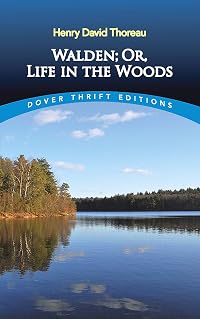
Walden; or, Life in the Woods
by Henry David Thoreau
On This Page
Description
In 1845 Henry David Thoreau, one of the principal New England Transcendentalists, left the town for the country. Beside the lake of Walden, he built himself a log cabin and returned to nature, to observe and reflect while surviving on eight dollars a year. From this experience emerged one of the great classics of American literature, a deeply personal reaction against the commercialism and materialism that he saw as the main impulses of mid-19th century America.Tags
Recommendations





















Member Recommendations





Member Reviews
I vacillated as I read this. I was often engrossed in Thoreau's twin urges—to simplicity, and to presence in each moment within nature. But I was repelled by his twin delusions—that the poorer a person is, the happier he must be, and that Thoreau himself was aware of the One True Way to live. He spends an awful lot of time disparaging the common actions & manners of virtually every human being other than himself. And over & over again he valorizes poverty, in a way that makes one doubt he's ever actually experienced it.
But after all, those are mostly just faults in the author's voice, and they're more than outweighed by the moments of clarity and presence that suffuse the book. I remembered a lot of the quotes, of course—"In show more wildness is the preservation of the world", "If you have built castles in the air...", "If a man does not keep pace with his companions, perhaps it is because he hears a different drummer", etc.—but to come across them again in context was to encounter them as new. There's a richness and texture to Thoreau's philosophy that's really quite gorgeous. I was glad to spend time there. show less
But after all, those are mostly just faults in the author's voice, and they're more than outweighed by the moments of clarity and presence that suffuse the book. I remembered a lot of the quotes, of course—"In show more wildness is the preservation of the world", "If you have built castles in the air...", "If a man does not keep pace with his companions, perhaps it is because he hears a different drummer", etc.—but to come across them again in context was to encounter them as new. There's a richness and texture to Thoreau's philosophy that's really quite gorgeous. I was glad to spend time there. show less
I'm a bit ambivalent on this one. Though I really liked pieces and I think Thoreau has a great writing style, I did also find it rather lengthy at times. The descriptions of the environment of Walden pond are beautiful, but they can become a bit much, for instance when he writes several times, multiple pages about how clear the water in the pond is...
Though the novel has been an important inspiration for some philosophers, and I appreciate it's importance and the novelty of Thoreau's ideas at the time the book was written, I have to say I don't find his ideas very convincing.
I think Thoreau doesn't realise that he might live a 'primitive' life quite easily when he has a civilized world surrounding him, but that this would not be show more possible if everybody would follow the lifestyle he promotes. For instance, he hires oxen and a plough to plough his fields, he borrows tools, he gets his clothing from the village... If everybody would live like he does though, these things wouldn't be possible.
Also, he feels that poor people should be happy to live a simple life, but he doesn't seem to understand that poverty means hardship and despair, and that a simple life isn't much fun when you're starving. Likewise, he doesn't take into account that some people have wives and children they need to provide for.
Besides, Thoreau comes across as an incredibly arrogant and patronizing man, who seems to think he is the only person whose intellect is advanced enough to see the truth and to really understand the world. He just looks down upon everybody, and I found this really annoying and insulting.
The copy I have also contained the essay 'Civil Disobedience', which leaves me with the same feeling.
It's rather easy to boast of not paying your taxes, if you don't actually need to spend time in jail for it because your family pays up for you. And it's also rather easy to say you don't need the state and are therefore not going to pay, if you can benefit from the state by living in it, even without paying. I am presuming that Thoreau does appreciate having roads and railroads, a police force and firemen, and all other commodities the State provides; if everybody would act the way he does, then all these things would disappear, and I wonder if that really is what he wants... show less
Though the novel has been an important inspiration for some philosophers, and I appreciate it's importance and the novelty of Thoreau's ideas at the time the book was written, I have to say I don't find his ideas very convincing.
I think Thoreau doesn't realise that he might live a 'primitive' life quite easily when he has a civilized world surrounding him, but that this would not be show more possible if everybody would follow the lifestyle he promotes. For instance, he hires oxen and a plough to plough his fields, he borrows tools, he gets his clothing from the village... If everybody would live like he does though, these things wouldn't be possible.
Also, he feels that poor people should be happy to live a simple life, but he doesn't seem to understand that poverty means hardship and despair, and that a simple life isn't much fun when you're starving. Likewise, he doesn't take into account that some people have wives and children they need to provide for.
Besides, Thoreau comes across as an incredibly arrogant and patronizing man, who seems to think he is the only person whose intellect is advanced enough to see the truth and to really understand the world. He just looks down upon everybody, and I found this really annoying and insulting.
The copy I have also contained the essay 'Civil Disobedience', which leaves me with the same feeling.
It's rather easy to boast of not paying your taxes, if you don't actually need to spend time in jail for it because your family pays up for you. And it's also rather easy to say you don't need the state and are therefore not going to pay, if you can benefit from the state by living in it, even without paying. I am presuming that Thoreau does appreciate having roads and railroads, a police force and firemen, and all other commodities the State provides; if everybody would act the way he does, then all these things would disappear, and I wonder if that really is what he wants... show less
We all know that Walden is the story of Thoreau’s life in a cabin he built on the shores of Walden Pond, but it is also about much more. The shores of that pond expand, through his questioning mind, to touch the entire cosmos.
The opening chapter seemed calculated to be offensive, like the approach of one who has often been rejected and must test you fist by surliness to see if you’ll really be a friend. Once I got past that, I enjoyed the book.
Thoreau exults in how abundant a life he finds in simplicity. At times, he seems to exalt poverty as a superior form of life but draws back by recognizing that few of the poor in his acquaintance, if any, recognize the beatitude of their situation.
The concluding chapter, to me, echoes passages show more from Koheleth. The setting of one may be a palace, the other a cabin, but both ended in the same neighborhood. As Thoreau remarked, the sunset reflected just as brightly in both their windows.
It’s relevant to the lessons this book conveys that Thoreau left the cabin and moved back to town after two years. One can learn much by living on the edge of a pond, but there is more to life than that. show less
The opening chapter seemed calculated to be offensive, like the approach of one who has often been rejected and must test you fist by surliness to see if you’ll really be a friend. Once I got past that, I enjoyed the book.
Thoreau exults in how abundant a life he finds in simplicity. At times, he seems to exalt poverty as a superior form of life but draws back by recognizing that few of the poor in his acquaintance, if any, recognize the beatitude of their situation.
The concluding chapter, to me, echoes passages show more from Koheleth. The setting of one may be a palace, the other a cabin, but both ended in the same neighborhood. As Thoreau remarked, the sunset reflected just as brightly in both their windows.
It’s relevant to the lessons this book conveys that Thoreau left the cabin and moved back to town after two years. One can learn much by living on the edge of a pond, but there is more to life than that. show less
We all know that Walden is the story of Thoreau’s life in a cabin he built on the shores of Walden Pond, but it is also about much more. The shores of that pond expand, through his questioning mind, to touch the entire cosmos.
The opening chapter seemed calculated to be offensive, like the approach of one who has often been rejected and must test you first by surliness to see if you’ll really be a friend. Once I got past that, I enjoyed the book.
Thoreau exults in how abundant a life he finds in simplicity. At times, he seems to exalt poverty as a superior form of life but draws back by recognizing that few of the poor in his acquaintance, if any, recognize the beatitude of their situation.
The concluding chapter, to me, echoes show more passages from Koheleth. The setting of one may be a palace, the other a cabin, but both ended in the same neighborhood. As Thoreau remarked, the sunset reflected just as brightly in both their windows.
It’s relevant to the lessons this book conveys that Thoreau left the cabin and moved back to town after two years. One can learn much by living on the edge of a pond, but there is more to life than that. show less
The opening chapter seemed calculated to be offensive, like the approach of one who has often been rejected and must test you first by surliness to see if you’ll really be a friend. Once I got past that, I enjoyed the book.
Thoreau exults in how abundant a life he finds in simplicity. At times, he seems to exalt poverty as a superior form of life but draws back by recognizing that few of the poor in his acquaintance, if any, recognize the beatitude of their situation.
The concluding chapter, to me, echoes show more passages from Koheleth. The setting of one may be a palace, the other a cabin, but both ended in the same neighborhood. As Thoreau remarked, the sunset reflected just as brightly in both their windows.
It’s relevant to the lessons this book conveys that Thoreau left the cabin and moved back to town after two years. One can learn much by living on the edge of a pond, but there is more to life than that. show less
Readers eager to criticize Thoreau for his hypocrisies miss the wisdom in Walden, for the ideals articulated in the book transcend the man. He asks us a timeless question: why do the mass of men so unthinkingly accept the life script dictated by their time and place? He challenges us, often with an intentionally provocative tone, to contemplate that which we are ideologically opposed but functionally agreeable to, so that we might improve upon our own lived integrity.
In another time and if in the same place, Henry David Thoreau would have been a great family friend. So much of what he addresses in Walden resonates deeply with my dad and I. We frequently discuss the bizarre inconsistencies and illogical manners of much of society, speculate hows and whys as well as alternatives, and enjoy extensive hours sitting in our silence among the sounds of wild critters and the weather. Walden has given me ideas for how to get the deluge of information in my head into a pleasant and intellectual format in the physical world. That is what this book is: Thoreau writing his contemplations on human behavior and resident natural history.
Why are philanthropists idolized more than other productive endeavors? After show more all, a Newfoundland dog can save you from your troubles if you are drowning or freezing.
Why dedicate years of monetary savings to take a train to your chosen destination when you can walk there without the years of savings, and meanwhile partake in the idiosyncrasies of the world along the journey?
Why stay locked in your house on a deep, snowy day when you have an appointment with a beech tree?
Thoreau brings up both "big" things and "little" things that mainstream society either avoids addressing or regards worthless because it does not add to a human's prestige or pays the bills.
If you are the sort that never floated with the stream but instead investigated other shores or the depth of the river, this book will likely intrigue and flatter your mind. show less
Why are philanthropists idolized more than other productive endeavors? After show more all, a Newfoundland dog can save you from your troubles if you are drowning or freezing.
Why dedicate years of monetary savings to take a train to your chosen destination when you can walk there without the years of savings, and meanwhile partake in the idiosyncrasies of the world along the journey?
Why stay locked in your house on a deep, snowy day when you have an appointment with a beech tree?
Thoreau brings up both "big" things and "little" things that mainstream society either avoids addressing or regards worthless because it does not add to a human's prestige or pays the bills.
If you are the sort that never floated with the stream but instead investigated other shores or the depth of the river, this book will likely intrigue and flatter your mind. show less
I received this from Early Reviewers, and it's taken me months to read and review. [Walden] is a favorite book of mine, always five stars, but it takes a while to read, because I have to stop to think every few pages, sometimes every few paragraphs.
I really enjoy Thoreau's prose, and his thinking. For example:
"One inconvenience I sometimes experienced in so small a house, the difficulty of getting to a sufficient distance from my guest when we began to utter the big thoughts in big words. You want room for your thoughts to get into sailing trim and run a course or two before they make their port. The bullet of your thought must have overcome its lateral and ricochet motion and fallen into its last and steady course before it reaches show more the ear of the hearer, else it may plough out again through the side of his head. Also our sentences wanted room to unfold and form their columns in the interval.
I was excited to have this copy, because I thought that the introduction and the annotations by McKibben would enhance my reading. The introduction was interesting, and I think it did change the way I read the book. Usually I read the book as a personal manifesto, and thing mostly of how it applies to me individually, With McKibben's introduction, I thought of the book as more of a statement about our national character, and was able to put the book in a different context, for example thinking of the small house movement today as an outgrowth of Thoreau's philosophy. Also, this made me see that Thoreau was brilliant, but also a bit of a crank, which made him more interesting.
The annotations, however, were a disappointment. They were random, and short, and did not really add to my experience. show less
I really enjoy Thoreau's prose, and his thinking. For example:
"One inconvenience I sometimes experienced in so small a house, the difficulty of getting to a sufficient distance from my guest when we began to utter the big thoughts in big words. You want room for your thoughts to get into sailing trim and run a course or two before they make their port. The bullet of your thought must have overcome its lateral and ricochet motion and fallen into its last and steady course before it reaches show more the ear of the hearer, else it may plough out again through the side of his head. Also our sentences wanted room to unfold and form their columns in the interval.
I was excited to have this copy, because I thought that the introduction and the annotations by McKibben would enhance my reading. The introduction was interesting, and I think it did change the way I read the book. Usually I read the book as a personal manifesto, and thing mostly of how it applies to me individually, With McKibben's introduction, I thought of the book as more of a statement about our national character, and was able to put the book in a different context, for example thinking of the small house movement today as an outgrowth of Thoreau's philosophy. Also, this made me see that Thoreau was brilliant, but also a bit of a crank, which made him more interesting.
The annotations, however, were a disappointment. They were random, and short, and did not really add to my experience. show less
 This review was written for LibraryThing Early Reviewers.
Members
- Recently Added By
Lists

1001 Books You Must Read Before You Die
1,448 works; 1,137 members

Recommended Nature Writing
346 works; 180 members

Best Biographies, Autobiographies and Memoirs
465 works; 160 members
501 Must-Read Books
529 works; 71 members

Best Autobiographies and Memoirs
370 works; 67 members

Top Five Books of 2013
1,562 works; 721 members

Books Mentioned in The Wedding Planner's Daughter series
107 works; 2 members

The Art of Manliness' 100+ Books Every Man Should Read
108 works; 2 members

How to Read a Book's Recommended Reading List
309 works; 10 members

Well-Educated Mind
150 works; 3 members

Victorian Period
113 works; 10 members

Publisher's Weekly Bestsellers Prior to 1895 in Chronological Order
95 works; 6 members

100 books that changed the world
31 works; 2 members

Greatest Books, allegedly
484 works; 9 members

Mustich's 1000 Books to Read Before You Die: A Life Changing List
1,001 works; 20 members

Internationale Romantik
15 works; 1 member
Classical Conversations Challenge I Exposition
20 works; 1 member
New Lifetime Reading Plan by Fadiman and Major
225 works; 5 members

1970s
657 works; 23 members

Unread books
1,063 works; 83 members

Book Titles Mentioned In Newberry Medal And Honor Books
884 works; 3 members

Books recommended in the history category on FiveBooks.com
329 works; 4 members

bound
100 works; 1 member

In Our Time books
4,934 works; 2 members

The Five Books That Represent Us
391 works; 150 members

.
396 works; 1 member

NPR Books You Love: Books That Shaped You in High School
26 works; 1 member
School Made Us Read It
380 works; 197 members

.
194 works; 2 members

Books Read in 2024
4,727 works; 128 members
The Complete Rory Gilmore Reading List
506 works; 5 members

Our Favorite Comfort Reads
334 works; 200 members

Habitat Hero books
37 works; 1 member

Spirituality
195 works; 1 member

Recommended Reading : 600 Classics Reviewed, Editors of Salem Press, 2015
634 works; 6 members

1964 College Preparatory Reading List
202 works; 8 members
The Well-Educated Mind, Susan Wise Bauer, 2016
179 works; 3 members
1,001 BYMRBYD Concensus
723 works; 27 members

My TBR Challenge Leftovers
22 works; 1 member
Books Set in Massachusetts
41 works; 8 members

I Can't Finish This Book
189 works; 22 members

Literary Works Read in College
316 works; 15 members

Non-Fiction Worth Reading
1,025 works; 264 members
CCE 1000 Good Books List
1,033 works; 12 members

Perspectives Book Club Picks
49 works; 3 members

Winter Books
127 works; 16 members
Philip Ward's Lifetime Reading Plan
592 works; 22 members
American Lit for Eng 11 Research Project
368 works; 6 members

Books that changed the world
67 works; 65 members

Classics you know you should have read but probably haven't
421 works; 409 members
Favourite 19th century fiction
257 works; 62 members

Merrill's English Texts
59 works; 2 members

Books You Read During High School (For School)
301 works; 52 members
Folio Society
831 works; 53 members
100 World Classics
99 works; 15 members

Blue Pyramid 1,276 Best Books of All Time
1,248 works; 32 members

The Road to Freedom (Will Durant's 100 Best Books for an Education)
100 works; 8 members

Books Read in 2016
4,666 works; 199 members
New England Books
101 works; 10 members
Mensa for Kids Excellence in Reading Award Program (Grades 9-12)
116 works; 3 members

KIB Non-Fiction Book Cloud
41 works; 1 member
Mensa for Kids Excellence in Reading Award Program (Grades 9-12)
116 works; 5 members
Daria Morgendorffer's Bookshelf
70 works; 5 members
The College Board: 101 Great Books Recommended for College-Bound Readers
111 works; 7 members
Reading List of Christopher McCandless
12 works; 1 member
Elegant Prose
80 works; 4 members

100 Most Recommended Works
100 works; 11 members
Books read by Charlie in "The Perks of Being a Wallflower"
12 works; 2 members
Harold Bloom - The Western Canon: C. The Democratic Age
336 works; 15 members

Books Featured on Readers' Review of the Diane Rehm Show
161 works; 8 members

Western World's Greatest Books - Project Gutenberg
295 works; 15 members

Books Read in 2023
5,638 works; 147 members
W. S. Maugham's Reading Suggestions for Spiritual Enrichment: American
13 works; 4 members
Talk Discussions
Past Discussions
Walden by Henry David Thoreau – STEEL 2022 in Fine Press Forum (March 2024)
Walden in Book talk (November 2017)
1001 Group Read, June, 2012: Walden in 1001 Books to read before you die (July 2014)
Author Information

620+ Works 49,532 Members
In September 1842, Nathaniel Hawthorne noted this social encounter in his journal: "Mr. Thorow dined with us yesterday. He is a singular character---a young man with much of wild original nature still remaining in him; and so far as he is sophisticated, it is in a way and method of his own. He is as ugly as sin, long-nosed, queer-mouthed, and with show more uncouth and somewhat rustic, although courteous manners, corresponding very well with such an exterior. But his ugliness is of an honest and agreeable fashion, and becomes him much better than beauty. On the whole, I find him a healthy and wholesome man to know." Most responses to Thoreau are as ambiguously respectful as was Hawthorne's. Thoreau was neither an easy person to like nor an easy writer to read. Thoreau described himself as a mystic, a Transcendentalist, and a natural philosopher. He is a writer of essays about nature---not of facts about it but of his ideals and emotions in its presence. His wish to understand nature led him to Walden Pond, where he lived from 1845 to 1847 in a cabin that he built. Though he was an educated man with a Harvard degree, fluent in ancient and modern German, he preferred to study nature by living "a life of simplicity, independence, magnanimity, and trust." Knowing this, we should beware of misreading the book that best reflected this great experience in Thoreau's life: Walden; or, Life in the Woods (1854). It is not a handbook of the simple life. Though there are elements in the book of a "whole-earth catalogue" mentality, to focus on the radical "economic" aspects of Thoreau's work is to miss much in the book. Nor is it an autobiography. The right way to read Walden is as a "transcendental" narrative prose poem, whose hero is a man named Henry, a modern Odysseus in search of a "true America." Thoreau left Walden Pond on September 6, 1846, exactly two years, two months, and two days after he had settled there. As he explained in the pages of Walden: "I left the woods for as good a reason as I went to live there. Perhaps it seemed to me that I had several more lives to live, and could not spare any more time for that one." Growth, change, and development were essential to his character. One should not overlook the significance of his selecting July 4 as the day for taking possession of his residence at Walden Pond, a day that celebrates the establishment of a new government whose highest ideal is individual freedom. In terms of Thoreau's redefinition of the nation-idea, "the only true America" is that place where one may grow wild according to one's nature, where one may "enjoy the land, but own it not." Thoreau believed that each person should live according to individual conscience, willing to oppose the majority if necessary. An early proponent of nonviolent resistance, he was jailed briefly for refusing to pay his poll tax to support the Mexican War and the slave system that had promoted that war. His essay "On Civil Disobedience" (1849), which came from this period of passive resistance, was acknowledged by Mahatma Gandhi (who read it in a South African jail) as the basis for his campaign to free India. Martin Luther King, Jr. later attributed to Thoreau and Gandhi the inspiration for his leadership in the civil rights movement in the United States. Thoreau contracted tuberculosis in 1835 and suffered from it sporadically afterwards. His health declined over three years with brief periods of remission, until he eventually became bedridden. Recognizing the terminal nature of his disease, Thoreau spent his last years revising and editing his unpublished works, particularly The Maine Woods and Excursions, and petitioning publishers to print revised editions of A Week and Walden. He died on May 6, 1862 at age 44. (Bowker Author Biography) show less
Some Editions
Awards and Honors
Awards
Notable Lists
Schecks Bücher (2)
Series
Belongs to Publisher Series
Gallmeister, Totem (78)
Doubleday Dolphin (C10)
Collection L'imaginaire (239)
Limited Editions Club (S:7.07)
The World's Classics (68)
Sammlung Hofenberg (Thoreau)
Everyman's Library (281)
dtv (12684)
Work Relationships
Is contained in
Has the adaptation
Is abridged in
Les Misérables / The White Seal / Remembrance of Things Past / Selected Passages from Walden by Easton Press
Walden, or, Life in the Woods: Selections from the American Classic (Shambhala Pocket Classics) by Henry David Thoreau
A Set of Short Stories (The Concord Hymn, An Excerpt from Self-Reliance, The Last Leaf, Old Ironsides, The Batte Hymn of the Republic, The Children's Hour, Paul Revere's Ride, The Village Blacksmith, Two Excerpts from Walden, Barbara Frietchie, The Barefoot Boy) by Holmes Emerson, Howe, Longfellow, Thoreau and Whittier
Has as a study
Has as a commentary on the text
Common Knowledge
- Canonical title
- Walden; or, Life in the Woods
- Original title
- Walden; or, Life in the Woods
- Alternate titles*
- Walden
- Original publication date
- 1854
- People/Characters
- Ralph Waldo Emerson; Henry David Thoreau
- Important places
- Walden Pond, Concord, Massachusetts, USA; New England, USA; Walden Woods, Massachusetts, USA; Massachusetts, USA; Merrimack River Valley, USA; Concord, Massachusetts, USA
- Important events
- Transcendentalism
- Epigraph
- I do not propose to write an ode to dejection, but to brag as lustily as chanticleer in the morning, standing on his roost, if only to wake my neighbors up.
- First words
- When I wrote the following pages, or rather the bulk of them, I lived alone, in the woods, a mile from any neighbor, in a house which I built myself, on the shore of Walden Pond, in Concord, Massachusetts, and earned my livin... (show all)g by the labor of my two hand only.
- Quotations
- We are wont to forget that the sun looks on our cultivated fields and on the prairies and forests without distinction. They all reflect and absorb his rays alike, and the former make but a small part of the glorious picture w... (show all)hich he beholds in his daily course. In his view the earth is all equally cultivated like a garden. Therefore we should receive the benefit of his light and heat with a corresponding trust and magnanimity.
wherever a man goes, men will pursue and paw him with their dirty institutions, and, if they can, constrain him to belong to their desperate odd-fellow society.
Every generation laughs at the old fashions, but follows religiously the new.
The mass of men lead lives of quiet desperation.
Beware of all enterprises that require new clothes.
It is an interesting question how far men would retain their relative rank if they were divested of their clothes.
Things do not change; we change. - Last words
- (Click to show. Warning: May contain spoilers.)The sun is but a morning star.
- Original language
- English
- Disambiguation notice
- Only "Walden" - please don't combine with any edition containing other works as well.
*Some information comes from Common Knowledge in other languages. Click "Edit" for more information.
Classifications
Statistics
- Members
- 16,296
- Popularity
- 421
- Reviews
- 205
- Rating
- (3.81)
- Languages
- 26 — Catalan, Chinese, Czech, Danish, Dutch, English, Estonian, Finnish, French, German, Greek, Hungarian, Italian, Japanese, Korean, Latvian, Multiple languages, Norwegian (Bokmål), Polish, Russian, Croatian, Spanish, Swedish, Thai, Turkish, Portuguese (Portugal)
- Media
- Paper, Audiobook, Ebook
- ISBNs
- 550
- UPCs
- 10
- ASINs
- 334
