
Terry Tempest Williams
Author of Refuge: An Unnatural History of Family and Place
About the Author
She is the award-winning author of Leap, An Unspoken Hunger, Refuge & most recently Red - A Desert Reader. She lives in Castle Valley, Utah. (Bowker Author Biography)
Image credit: The Witness
Works by Terry Tempest Williams
Testimony: Writers of the West Speak on Behalf of Utah Wilderness (1996) — Editor — 44 copies, 1 review
What My Body Knows 2 copies
A Burning Testament 2 copies
Oracle Bones 1 copy
We Are Not Alone 1 copy
Spirituality is solitary 1 copy
Associated Works
My Bookstore: Writers Celebrate Their Favorite Places to Browse, Read, and Shop (2012) — Contributor — 621 copies, 16 reviews
Sisters of the Earth: Women's Prose and Poetry About Nature (1991) — Contributor — 443 copies, 5 reviews
These United States: Original Essays by Leading American Writers on Their State within the Union by John Leonard (1995) — Contributor — 102 copies, 1 review
In Response to Place: Photographs from the Nature Conservancy's Last Great Places (2001) — Foreword — 67 copies
Face to Face: Women Writers on Faith, Mysticism, and Awakening (2004) — Contributor — 39 copies, 1 review
With a Measure of Grace: The Story and Recipes of a Small Town Restaurant (2004) — Foreword — 38 copies
Tagged
Common Knowledge
- Canonical name
- Williams, Terry Tempest
- Birthdate
- 1955-09-08
- Gender
- female
- Education
- University of Utah (BA|1978|MS|1984)
- Occupations
- author
naturalist
environmentalist
activist
editor - Organizations
- The Church of Jesus Christ of Latter-day Saints
Utah Museum of Natural History
Harvard Divinity School
Dartmouth College - Awards and honors
- American Academy of Arts and Letters (2019)
Robert Kirsch Award (2018)
Sierra Club John Muir Award (2014)
Spirit of the Arctic Award (2008)
John Wesley Powell Award (2008)
Western Literature Association's Distinguished Achievement Award (2006) (show all 12)
Robert Marshall Award (2006)
Wallace Stegner Award (2005)
Association for Mormon Letters Lifetime Achievement Award (1997)
Utah Governor's Award in the Humanities (1995)
Lannan Literary Award (Nonfiction ∙ 1993)
National Wildlife Federation's Conservation Award for Special Achievement (1993) - Relationships
- Williams, Brooke (spouse)
- Nationality
- USA
- Birthplace
- Corona, California, USA
- Places of residence
- Wilson, Wyoming, USA
Salt Lake City, Utah, USA
Castle Valley, Utah, USA
Cambridge, Massachusetts, USA
Jackson Hole, Wyoming, USA - Map Location
- California, USA
Members
Reviews
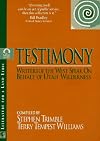
This thin volume excels as an example of how art can be used to to persuade and perhaps achieve political action. These nearly two dozen brief pieces--essays, declarations, personal stories and poems--extol the virtues of wilderness in general and Southern Utah wilderness specifically were published as a limited edition chapbook and delivered to the desks of members of Congress. At the time, Congress was debating two bills that would have opened 92% of Utah's federally held lands to show more development. Although the bills were defeated for procedural reasons, the book has been cited as a significant reason for the creation of the Grand Staircase-Escalante National Monument in 1996. Remarkably, preservation of these lands are still are still in question today as they continue to be enlarged and reduced depending on the administration in the Whitehouse.
That aside, this is a terrific sampling from some of America's best nature writers. Although the subject matter becomes a bit repetitive, it's great to see how various writers approach convincing politicians that undeveloped land is worth more to America and the American character than the limited value of the resources it might contain. Once a wild place is gone, it can never be recreated in the same way. show less
That aside, this is a terrific sampling from some of America's best nature writers. Although the subject matter becomes a bit repetitive, it's great to see how various writers approach convincing politicians that undeveloped land is worth more to America and the American character than the limited value of the resources it might contain. Once a wild place is gone, it can never be recreated in the same way. show less

In Mormon culture, women are expected to do two things: keep a journal and bear children. Both gestures are a participatory bow to the past and the future.
So what did it mean when Williams -- a writer, “in love with words” -- took custody of her mother’s 35 journals upon her death ... and found them all completely empty? Williams reels from the discovery (“her blank journals became a second death”), and 24 years later, processes it via vignettes here.
I should have loved this book. show more I’m the age of the author and of her mother when she died. My own mother recently died. I love explorations of voice and stillness, I love narratives structured as vignettes (e.g. Touch, Einstein's Dreams, The Incident Report). So I began slowly, savoring the passages and giving them time to arrange themselves. When little seemed to accumulate, I read them without breaks.
In the end, I'm left adrift. There’s evocative language; family, feminism and nature; being heard and being silenced. But while I was interested enough to finish, I never much grew to understand or care about Williams. I suspect readers already familiar with her (e.g. via Refuge) will have a much different, better reading experience. Perhaps I'll read that, and come back to this in a year.
(Review based on an advance reading copy provided by the publisher.) show less
So what did it mean when Williams -- a writer, “in love with words” -- took custody of her mother’s 35 journals upon her death ... and found them all completely empty? Williams reels from the discovery (“her blank journals became a second death”), and 24 years later, processes it via vignettes here.
I should have loved this book. show more I’m the age of the author and of her mother when she died. My own mother recently died. I love explorations of voice and stillness, I love narratives structured as vignettes (e.g. Touch, Einstein's Dreams, The Incident Report). So I began slowly, savoring the passages and giving them time to arrange themselves. When little seemed to accumulate, I read them without breaks.
In the end, I'm left adrift. There’s evocative language; family, feminism and nature; being heard and being silenced. But while I was interested enough to finish, I never much grew to understand or care about Williams. I suspect readers already familiar with her (e.g. via Refuge) will have a much different, better reading experience. Perhaps I'll read that, and come back to this in a year.
(Review based on an advance reading copy provided by the publisher.) show less
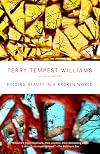
This is Terry Tempest Williams' most challenging book I've read so far. She takes a very personal narrative on global issues, relating the art of mosaics, the behavior of prairie dogs, and a visit to Rwanda to work with victims of genocide, and somehow makes it work.
The last part of the book, chronicling her visit to a Rwandan village, was difficult to read. There is profound suffering and an overall sense of defeat and unending sorrow. Yet Williams renders her very personal journey within a show more universal context of finding the ability to survive and the will to mend this broken world.
Williams' writing is profoundly compassionate, erudite, and visceral. Finding Beauty in a Broken World is a deeply humane book. Hers is a voice that should, and needs, to be heard, recognized, and celebrated. show less
The last part of the book, chronicling her visit to a Rwandan village, was difficult to read. There is profound suffering and an overall sense of defeat and unending sorrow. Yet Williams renders her very personal journey within a show more universal context of finding the ability to survive and the will to mend this broken world.
Williams' writing is profoundly compassionate, erudite, and visceral. Finding Beauty in a Broken World is a deeply humane book. Hers is a voice that should, and needs, to be heard, recognized, and celebrated. show less
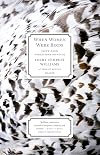
When Williams' mother died, she gave Williams all of her journals and told her to read them. Williams was honored to be trusted with her mother's record of her life. She went to the shelf full of journals, and found that every single one of them was empty. Her mother had a journal for every year of her life, but had not written a word in them.
This is the beginning of Williams' poetic reflection on women's voices, on what it means for women to have something to say and to say it. Along the show more way, she also reflects a lot on nature and relationships - romantic relationships and relationships between daughters and mothers and generations of women. She reflects on all of the pressures that silence women, particularly their imperative to sacrifice themselves to care for their children and spouses.
This is one of those books I could read over and over, and find something new in it every time. I first read it at a time in my life when I am newly free of obligations to care for other people and I have the freedom to exist solely for myself, and I am trying to find my voice. The next time I read it, I am sure different parts of it will speak to me in entirely different ways. show less
This is the beginning of Williams' poetic reflection on women's voices, on what it means for women to have something to say and to say it. Along the show more way, she also reflects a lot on nature and relationships - romantic relationships and relationships between daughters and mothers and generations of women. She reflects on all of the pressures that silence women, particularly their imperative to sacrifice themselves to care for their children and spouses.
This is one of those books I could read over and over, and find something new in it every time. I first read it at a time in my life when I am newly free of obligations to care for other people and I have the freedom to exist solely for myself, and I am trying to find my voice. The next time I read it, I am sure different parts of it will speak to me in entirely different ways. show less
Lists
Awards


You May Also Like


Associated Authors
Statistics
- Works
- 35
- Also by
- 29
- Members
- 4,575
- Popularity
- #5,496
- Rating
- 3.9
- Reviews
- 90
- ISBNs
- 77
- Languages
- 2
- Favorited
- 22