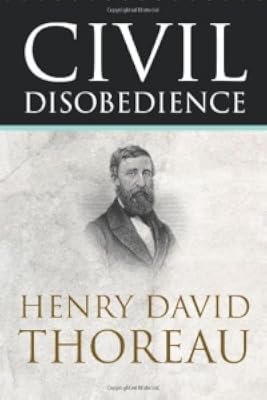
Civil Disobedience
by Henry David Thoreau
On This Page
Description
Thoreau wrote Civil Disobedience in 1849. It argues the superiority of the individual conscience over acquiescence to government. Thoreau was inspired to write in response to slavery and the Mexican-American war. He believed that people could not be made agents of injustice if they were governed by their own consciences.Tags
Recommendations


















Member Recommendations

Member Reviews
A brilliant essay by Henry David Thoreau, and proof that the struggle to define the American destiny has been going on since its inception.
This American government--what is it but a tradition, though a recent one, endeavoring to transmit itself unimpaired to posterity, but each instant losing some of its integrity?
Thoreau was deeply aggrieved of the American government and its politicians, who were dancing about the issue of slavery. He states, and rightfully so, that a moral issue such as this cannot take a backseat to any political allegiance to a government, and that the individual must not bend to an immoral demand simply because it is exigent.
I cannot for an instant recognize that political organization as my government which is show more the slave’s government also.
This people must cease to hold slaves, and to make war on Mexico, though it cost them their existence as a people.
I can think of a number of issues on which I feel the moral position and the government position could not be further apart. Thoreau refused to pay his taxes in protest of being made to be party to the State’s position by doing so. I am not that brave, but I would often like to scream to the skies how can anyone believe in this position of government and still count themselves as a moral human being.
I was taken by how much the political hypocrisy resembles some of what we encounter in our own political arena. And, the old adage that you must “follow the money” holds true then and now.
Practically speaking, the opponents to a reform in Massachusetts are not a hundred thousand politicians at the South, but a hundred thousand merchants and farmers here, who are more interested in commerce and agriculture than they are in humanity, and are not prepared to do justice to the slave and to Mexico, cost what it may.
One last comment that impressed itself upon me was the following.
to be strictly just, it must have the sanction and consent of the governed. It can have no pure right over my person and property but what I concede to it. The progress from an absolute to a limited monarchy, from a limited monarchy to a democracy, is a progress toward a true respect for the individual.
I’m afraid a “true respect for the individual” might be something our government has completely lost, but I hope it is not something we, the people, are willing to concede.
Always amazing to read something written 171 years ago and find so much there that will apply to life in 2020. show less
This American government--what is it but a tradition, though a recent one, endeavoring to transmit itself unimpaired to posterity, but each instant losing some of its integrity?
Thoreau was deeply aggrieved of the American government and its politicians, who were dancing about the issue of slavery. He states, and rightfully so, that a moral issue such as this cannot take a backseat to any political allegiance to a government, and that the individual must not bend to an immoral demand simply because it is exigent.
I cannot for an instant recognize that political organization as my government which is show more the slave’s government also.
This people must cease to hold slaves, and to make war on Mexico, though it cost them their existence as a people.
I can think of a number of issues on which I feel the moral position and the government position could not be further apart. Thoreau refused to pay his taxes in protest of being made to be party to the State’s position by doing so. I am not that brave, but I would often like to scream to the skies how can anyone believe in this position of government and still count themselves as a moral human being.
I was taken by how much the political hypocrisy resembles some of what we encounter in our own political arena. And, the old adage that you must “follow the money” holds true then and now.
Practically speaking, the opponents to a reform in Massachusetts are not a hundred thousand politicians at the South, but a hundred thousand merchants and farmers here, who are more interested in commerce and agriculture than they are in humanity, and are not prepared to do justice to the slave and to Mexico, cost what it may.
One last comment that impressed itself upon me was the following.
to be strictly just, it must have the sanction and consent of the governed. It can have no pure right over my person and property but what I concede to it. The progress from an absolute to a limited monarchy, from a limited monarchy to a democracy, is a progress toward a true respect for the individual.
I’m afraid a “true respect for the individual” might be something our government has completely lost, but I hope it is not something we, the people, are willing to concede.
Always amazing to read something written 171 years ago and find so much there that will apply to life in 2020. show less
“There are thousands who are in opinion opposed to slavery and to the war, who yet in effect do nothing to put an end to them; who, esteeming themselves children of Washington and Franklin, sit down with their hands in their pockets, and say that they know not what to do, and do nothing.”
Reading this is worth it, purely for some of the quotations alone. Startlingly relevant and a call to arms, Thoreau asks us to question what is legal (or written as law) vs. what is right, and if they are the same. If they're not, what can we do to change the legislation so that we are can align the law, and the government with our consciences.
Of course, Thoreau was privileged, and his position, power and education allow him to ponder these issues show more -- in some cases, they are not his lived experience. And yet it was refreshing to see someone in this time and context protest war and protest slavery. "They were a product of their time" is an excuse I hear a lot, and it's a tired one.
I found this really easy to read and while I didn't understand a lot of the finer points (this would be interesting to discuss in a classroom setting) I enjoyed it nonetheless. show less
Reading this is worth it, purely for some of the quotations alone. Startlingly relevant and a call to arms, Thoreau asks us to question what is legal (or written as law) vs. what is right, and if they are the same. If they're not, what can we do to change the legislation so that we are can align the law, and the government with our consciences.
Of course, Thoreau was privileged, and his position, power and education allow him to ponder these issues show more -- in some cases, they are not his lived experience. And yet it was refreshing to see someone in this time and context protest war and protest slavery. "They were a product of their time" is an excuse I hear a lot, and it's a tired one.
I found this really easy to read and while I didn't understand a lot of the finer points (this would be interesting to discuss in a classroom setting) I enjoyed it nonetheless. show less
Civil Disobedience. Just the title of Thoreau’s essay makes me grin and almost rub my hands together in mischievous delight. I’ve always believed that everyone practices some form of civil disobedience in their lives. For some, it’s the daily wink-wink type of disobedience like disregarding the speed limit, having a couple cocktails before driving home, or running a stop sign. All of these and many others are condoned in some fashion by non-enforcement of existing laws or by economic interests at odds with common sense. And, for the most part, we seem to be ok with these forms of disobedience until someone gets hurt. Indeed, this form of disobedience is not really done as an agitation for change but more for personal convenience. show more For others, civil disobedience is a weapon for change, a refusal to conform, a protest against war, or an action relating to some other moral issue deeply felt by an individual or individuals.
In my mind, civil disobedience is generally non-violent action, and Thoreau does not advocate violence. He does point out the shortcomings of government as it exists today and its ability to do violence to its own citizens and citizens of other countries. He is very eloquent in his descriptions of the shortcomings of governments to date. But he is equally articulate about the responsibilities of people to think about the kind of government they desire and acting towards that desire.
Thoreau is characteristically blunt in his assessment of the government, its susceptibility to being manipulated by the few, and its ability to do harm:
“The government itself, which is only the mode which the people have chosen to execute their will, is equally liable to be abused and perverted before the people can act through it. Witness the present Mexican war, the work of comparatively a few individuals using the standing government as their tool; for in the outset, the people would not have consented to this measure.”
“How does it become a man to behave toward the American Government to-day? I answer, that he cannot without disgrace be associated with it. I cannot for an instant recognize that political organization as my government which is the slave’s government also.”
“Unjust laws exist: shall we be content to obey them, or shall we endeavor to amend them, and obey them until we have succeeded, or shall we transgress them at once? Men, generally, under such a government as this, think that they ought to wait until they have persuaded the majority to alter them. They think that, if they should resist, the remedy would be worse than the evil. It makes it worse. Why is it not more apt to anticipate and provide for reform? Why does it not cherish its wise minority? Why does it cry and resist before it is hurt? Why does it not encourage its citizens to point out its faults, and do better than it would have them? Why does it always crucify Christ and excommunicate Copernicus and Luther, and pronounce Washington and Franklin rebels?”
He is equally expressive on what he feels his and all other citizens’ roles should be in making government better and holding it accountable:
“Must the citizen ever for a moment, or in the least degree, resign his conscience to the legislator? Why has every man a conscience then? I think that we should be men first, and subject afterward. It is not desirable to cultivate a respect for the law, so much as for the right. The only obligation which I have a right to assume is to do at any time what I think right. It is truly enough said that a corporation has on conscience; but a corporation of conscientious men is a corporation with a conscience.”
Thoreau believes in hitting government where it hurts, in the pocketbook, so as not to fund bad behavior like the war for nefarious reasons:
“If a thousand men were not to pay their tax bills this year that would not be a violent and bloody measure, as it would be to pay them, and enable the State to commit violence and shed innocent blood. This is, in fact, the definition of a peaceable revolution, if any such is possible.”
But he uses that particular weapon for general purposes as well, as he states here:
“It is for no particular item in the tax bill that I refuse to pay it. I simply wish to refuse allegiance to the State, to withdraw and stand aloof from it effectually.”
Nor is he too worried about the consequences, as his well-publicized night in jail attests too. Granted, he only spent one night in a pretty benign village jail. My one night in a county juvenile facility was not nearly as pleasant as his stay seemed to be. Nevertheless, he feels that one should take the consequences head-on:
“Under a government that imprisons unjustly, the true place for a just man is also in prison.”
But for me the best words of wisdom are about personal responsibility and the hope that we all take time to think about and imagine what government we really want:
“I came into this world, not chiefly to make this a good place to live in, but to live in it, be it good or bad. A man has not everything to do, but something; and because he cannot do everything, it is not necessary that he should be doing something wrong.”
“The best thing a man can do for his culture when he is rich is to endeavor to carry out those schemes which he entertained when he was poor.”
“For it matters not how small the beginning may seem to be: what is once well done is done forever.”
“They who know of no purer sources of truth, who have traced up its stream no higher, stand, and wisely stand, by the Bible and the Constitution, and drink at it there with reverence and humanity; but they who behold where it comes trickling into this lake or that pool, gird up their loins once more, and continue their pilgrimage toward the fountain-head.”
“But, to speak practically and as a citizen, unlike those who call themselves no-government men, I ask for, not at once no government, but at once a better government. Let every man make known what kind of government would command his respect, and that will be one step toward obtaining it.”
“I please myself with imagining a State at last which can afford to be just to all men, and to treat the individual with respect as a neighbor; which even would not think it inconsistent with its own repose if a few were to live aloof from it, not meddling with it, nor embraced by it, who fulfilled all the duties of neighbors and fellow men. A State which bore this kind of fruit, and suffered it to drop off as fast as it ripened, would prepare the way for a still more perfect and glorious State, which I have also imagined, but not yet anywhere seen.”
[TRIGGER WARNING: POLITICS! Skip this paragraph if you might be offended by other people’s political views] There are just so many little tidbits in there that remind me how much I love Thoreau’s writings and philosophy. It’s amazing how well this essay still rings true today as well, albeit with a couple of words switched out, such as “slave” for “_______”. You can put your governmental grievance in the space. I know I have contemplated not paying my taxes in the past, usually as the only way I can see to not fund America’s wars (as Thoreau did not want to fund the Mexican-American war) or see my tax money go to the military-industrial complex Eisenhower warned us about and Thoreau would have abhorred. In keeping with Thoreau’s request that everyone make know the kind of government they could respect, I’ll just say that my government would not involve itself in never-ending wars for profit, torture, abnegate habeus corpus, or spy on its own citizens, among other things.
I have read this essay many times in the past and will do so as many times as possible in the future. So it is with great joy that I learned about the Sharp Teeth Press edition of Civil Disobedience. I would have eaten ramen and drank bad tea or done whatever it took to get a copy as soon as possible. Luckily, $125 for the regular edition, I didn’t have to worry too much. I can now look forward to many readings of this beautifully executed little book.
Being a single essay, this is a small book of 32 pages but presented in a way that adds even more power to the essay. The thick Rives BFK paper allows the type to bite deeply into page. The hand-made paper sides contrast nicely with the brown cow leather spine; especially with the unevenness of the border that makes each book slightly different. Nate Van Dyke’s portrait of Thoreau for the frontispiece is striking and his expression perfectly suited to the seriousness of the essay. The use of the pilcrow, or paragraph mark, instead of indents takes some getting used to but adds to the uniqueness of the edition. I did reference my Easton Press edition of Civil Disobedience and Other Essays because it has some illuminating footnotes but there was nothing that so important that I missed it being included here.
This essay should be required reading for all and it is wonderful to see it get the fine press treatment. I would love to see more like it from Sharp Teeth Press.
AVAILABILITY: This book is in an edition of 150. As of this writing is still available directly from the press here.
For the complete book review, including images of the physical book, visit my blog The Whole Book Experience at http://www.thewholebookexperience.com/ show less
In my mind, civil disobedience is generally non-violent action, and Thoreau does not advocate violence. He does point out the shortcomings of government as it exists today and its ability to do violence to its own citizens and citizens of other countries. He is very eloquent in his descriptions of the shortcomings of governments to date. But he is equally articulate about the responsibilities of people to think about the kind of government they desire and acting towards that desire.
Thoreau is characteristically blunt in his assessment of the government, its susceptibility to being manipulated by the few, and its ability to do harm:
“The government itself, which is only the mode which the people have chosen to execute their will, is equally liable to be abused and perverted before the people can act through it. Witness the present Mexican war, the work of comparatively a few individuals using the standing government as their tool; for in the outset, the people would not have consented to this measure.”
“How does it become a man to behave toward the American Government to-day? I answer, that he cannot without disgrace be associated with it. I cannot for an instant recognize that political organization as my government which is the slave’s government also.”
“Unjust laws exist: shall we be content to obey them, or shall we endeavor to amend them, and obey them until we have succeeded, or shall we transgress them at once? Men, generally, under such a government as this, think that they ought to wait until they have persuaded the majority to alter them. They think that, if they should resist, the remedy would be worse than the evil. It makes it worse. Why is it not more apt to anticipate and provide for reform? Why does it not cherish its wise minority? Why does it cry and resist before it is hurt? Why does it not encourage its citizens to point out its faults, and do better than it would have them? Why does it always crucify Christ and excommunicate Copernicus and Luther, and pronounce Washington and Franklin rebels?”
He is equally expressive on what he feels his and all other citizens’ roles should be in making government better and holding it accountable:
“Must the citizen ever for a moment, or in the least degree, resign his conscience to the legislator? Why has every man a conscience then? I think that we should be men first, and subject afterward. It is not desirable to cultivate a respect for the law, so much as for the right. The only obligation which I have a right to assume is to do at any time what I think right. It is truly enough said that a corporation has on conscience; but a corporation of conscientious men is a corporation with a conscience.”
Thoreau believes in hitting government where it hurts, in the pocketbook, so as not to fund bad behavior like the war for nefarious reasons:
“If a thousand men were not to pay their tax bills this year that would not be a violent and bloody measure, as it would be to pay them, and enable the State to commit violence and shed innocent blood. This is, in fact, the definition of a peaceable revolution, if any such is possible.”
But he uses that particular weapon for general purposes as well, as he states here:
“It is for no particular item in the tax bill that I refuse to pay it. I simply wish to refuse allegiance to the State, to withdraw and stand aloof from it effectually.”
Nor is he too worried about the consequences, as his well-publicized night in jail attests too. Granted, he only spent one night in a pretty benign village jail. My one night in a county juvenile facility was not nearly as pleasant as his stay seemed to be. Nevertheless, he feels that one should take the consequences head-on:
“Under a government that imprisons unjustly, the true place for a just man is also in prison.”
But for me the best words of wisdom are about personal responsibility and the hope that we all take time to think about and imagine what government we really want:
“I came into this world, not chiefly to make this a good place to live in, but to live in it, be it good or bad. A man has not everything to do, but something; and because he cannot do everything, it is not necessary that he should be doing something wrong.”
“The best thing a man can do for his culture when he is rich is to endeavor to carry out those schemes which he entertained when he was poor.”
“For it matters not how small the beginning may seem to be: what is once well done is done forever.”
“They who know of no purer sources of truth, who have traced up its stream no higher, stand, and wisely stand, by the Bible and the Constitution, and drink at it there with reverence and humanity; but they who behold where it comes trickling into this lake or that pool, gird up their loins once more, and continue their pilgrimage toward the fountain-head.”
“But, to speak practically and as a citizen, unlike those who call themselves no-government men, I ask for, not at once no government, but at once a better government. Let every man make known what kind of government would command his respect, and that will be one step toward obtaining it.”
“I please myself with imagining a State at last which can afford to be just to all men, and to treat the individual with respect as a neighbor; which even would not think it inconsistent with its own repose if a few were to live aloof from it, not meddling with it, nor embraced by it, who fulfilled all the duties of neighbors and fellow men. A State which bore this kind of fruit, and suffered it to drop off as fast as it ripened, would prepare the way for a still more perfect and glorious State, which I have also imagined, but not yet anywhere seen.”
[TRIGGER WARNING: POLITICS! Skip this paragraph if you might be offended by other people’s political views] There are just so many little tidbits in there that remind me how much I love Thoreau’s writings and philosophy. It’s amazing how well this essay still rings true today as well, albeit with a couple of words switched out, such as “slave” for “_______”. You can put your governmental grievance in the space. I know I have contemplated not paying my taxes in the past, usually as the only way I can see to not fund America’s wars (as Thoreau did not want to fund the Mexican-American war) or see my tax money go to the military-industrial complex Eisenhower warned us about and Thoreau would have abhorred. In keeping with Thoreau’s request that everyone make know the kind of government they could respect, I’ll just say that my government would not involve itself in never-ending wars for profit, torture, abnegate habeus corpus, or spy on its own citizens, among other things.
I have read this essay many times in the past and will do so as many times as possible in the future. So it is with great joy that I learned about the Sharp Teeth Press edition of Civil Disobedience. I would have eaten ramen and drank bad tea or done whatever it took to get a copy as soon as possible. Luckily, $125 for the regular edition, I didn’t have to worry too much. I can now look forward to many readings of this beautifully executed little book.
Being a single essay, this is a small book of 32 pages but presented in a way that adds even more power to the essay. The thick Rives BFK paper allows the type to bite deeply into page. The hand-made paper sides contrast nicely with the brown cow leather spine; especially with the unevenness of the border that makes each book slightly different. Nate Van Dyke’s portrait of Thoreau for the frontispiece is striking and his expression perfectly suited to the seriousness of the essay. The use of the pilcrow, or paragraph mark, instead of indents takes some getting used to but adds to the uniqueness of the edition. I did reference my Easton Press edition of Civil Disobedience and Other Essays because it has some illuminating footnotes but there was nothing that so important that I missed it being included here.
This essay should be required reading for all and it is wonderful to see it get the fine press treatment. I would love to see more like it from Sharp Teeth Press.
AVAILABILITY: This book is in an edition of 150. As of this writing is still available directly from the press here.
For the complete book review, including images of the physical book, visit my blog The Whole Book Experience at http://www.thewholebookexperience.com/ show less
"All men recognize the right of revolution; that is, the right to refuse allegiance to, and to resist, the government, when its tyranny or its inefficiency are great and unendurable."
Thoreau advocates that people not simply submit to laws but that laws are subject to conscience. A moral person should not give allegiance to a state with unjust laws. This piece was written specifically against slavery and the Mexican war, and later influenced the nonviolent protests of Ghandi and the civil rights movement.
This is all and good and awesome. However, Thoreau's proposition is simple withdrawal from the state, not paying taxes, not even voting(!). In order to not pay taxes, one should stay poor because money corrupts the morals... and go to show more prison as a badge of honor.
While a great inspration to nonviolent protests, Thoreau's idea is rather impractical - you got to be a hermit, go to prison, and not even vote - this seems to me as a guarantee that nothing will change in the goverment. show less
Thoreau advocates that people not simply submit to laws but that laws are subject to conscience. A moral person should not give allegiance to a state with unjust laws. This piece was written specifically against slavery and the Mexican war, and later influenced the nonviolent protests of Ghandi and the civil rights movement.
This is all and good and awesome. However, Thoreau's proposition is simple withdrawal from the state, not paying taxes, not even voting(!). In order to not pay taxes, one should stay poor because money corrupts the morals... and go to show more prison as a badge of honor.
While a great inspration to nonviolent protests, Thoreau's idea is rather impractical - you got to be a hermit, go to prison, and not even vote - this seems to me as a guarantee that nothing will change in the goverment. show less
This is a very interesting read. Though the language can seem a bit old and hard to get through and understand the message is important and rings out loud and clear. Many people are content to sit around and wait for the right thing to happen but in order for the right the to happen there must be action. If laws are unjust it is your duty to break those laws. So many people forget the actions of the founders of the US were treasonous. Sometime the only way to stand up for what is right is to work outside the law. It can be hard but it is always important to fight for what you think is right.
Tax-evader.
I'm not sure what Thoreau's city-state world of insignificant government would look like, and I don't understand why this twisted reasoning is held up by American English teachers as enlightened. For good mid-19th century anti-slavery and reformative writing, don't start here. Try Emily Dickinson, Mark Twain, Harriet Beecher Stowe, etc.
As to influencing MLK Jr and Gandhi, etc, those men may have adopted one of his principles but they only applied it to specific social issues. Thoreau makes a sweeping dismissal of government and all it does, unless it's serving his personal agenda and belief system. Clearly he does not recognize that one of the major obligations of republican (not Republican Party) government is to provide us show more with a framework in which to construct a society where one individual's belief system does NOT supersede everyone else.
The text does exemplify American individualism, and I am not claiming that he is wrong - only that his extremism is as misleading as the blind patriots he mocks.
"It is not so desirable to cultivate a respect for the law, so much as for the right."-Henry David Thoreau
Government done correctly legislates what is right. HDT could have done more good but being part of the solution and becoming the best damn legislator he claims America needed. Instead, he wrote this whiny, self-justifying treatise. show less
I'm not sure what Thoreau's city-state world of insignificant government would look like, and I don't understand why this twisted reasoning is held up by American English teachers as enlightened. For good mid-19th century anti-slavery and reformative writing, don't start here. Try Emily Dickinson, Mark Twain, Harriet Beecher Stowe, etc.
As to influencing MLK Jr and Gandhi, etc, those men may have adopted one of his principles but they only applied it to specific social issues. Thoreau makes a sweeping dismissal of government and all it does, unless it's serving his personal agenda and belief system. Clearly he does not recognize that one of the major obligations of republican (not Republican Party) government is to provide us show more with a framework in which to construct a society where one individual's belief system does NOT supersede everyone else.
The text does exemplify American individualism, and I am not claiming that he is wrong - only that his extremism is as misleading as the blind patriots he mocks.
"It is not so desirable to cultivate a respect for the law, so much as for the right."-Henry David Thoreau
Government done correctly legislates what is right. HDT could have done more good but being part of the solution and becoming the best damn legislator he claims America needed. Instead, he wrote this whiny, self-justifying treatise. show less
This is an important historic essay with applications for today (and all of time). Thoreau is speaking against slavery and a War, but the greater argument is FOR independent minds and the right to free speech without legal or interpersonal silencing (or “being cancelled”). As I write this, there is talk of “a mandate” that all should support the Presidential admin because of an overwhelming win in an election; and it is used to justify ALL actions of the current agenda. Probably the real “mandate” was to avoid the loser’s plan and agenda.
However, strong support for one party’s Economic plan is not support for any war anywhere; moderate preference of one party over another or one candidate over another should not be show more viewed as a blank-check for any and every plan of the party in power.
We should be able legally and in the public arena to say “Though I voted for____, I do not agree with ____” while still remaining welcome among those with whom we disagree sometimes. show less
However, strong support for one party’s Economic plan is not support for any war anywhere; moderate preference of one party over another or one candidate over another should not be show more viewed as a blank-check for any and every plan of the party in power.
We should be able legally and in the public arena to say “Though I voted for____, I do not agree with ____” while still remaining welcome among those with whom we disagree sometimes. show less
Members
- Recently Added By
Lists

Política - Clásicos
164 works; 2 members

CCE 100 Great Books List
145 works; 8 members

Books Read in 2017
4,249 works; 130 members

How to Read a Book's Recommended Reading List
309 works; 10 members

Greatest Books, allegedly
484 works; 9 members

Robert B. Downs's Books that Changed the World
16 works; 1 member

Books Read in 2023
5,547 works; 145 members
New Lifetime Reading Plan by Fadiman and Major
225 works; 5 members

Robert B. Downs's Books that Changed America
15 works; 1 member

Recommended Reading : 600 Classics Reviewed, Editors of Salem Press, 2015
634 works; 6 members

In Our Time books
4,934 works; 2 members
Author Information

615+ Works 49,279 Members
In September 1842, Nathaniel Hawthorne noted this social encounter in his journal: "Mr. Thorow dined with us yesterday. He is a singular character---a young man with much of wild original nature still remaining in him; and so far as he is sophisticated, it is in a way and method of his own. He is as ugly as sin, long-nosed, queer-mouthed, and with show more uncouth and somewhat rustic, although courteous manners, corresponding very well with such an exterior. But his ugliness is of an honest and agreeable fashion, and becomes him much better than beauty. On the whole, I find him a healthy and wholesome man to know." Most responses to Thoreau are as ambiguously respectful as was Hawthorne's. Thoreau was neither an easy person to like nor an easy writer to read. Thoreau described himself as a mystic, a Transcendentalist, and a natural philosopher. He is a writer of essays about nature---not of facts about it but of his ideals and emotions in its presence. His wish to understand nature led him to Walden Pond, where he lived from 1845 to 1847 in a cabin that he built. Though he was an educated man with a Harvard degree, fluent in ancient and modern German, he preferred to study nature by living "a life of simplicity, independence, magnanimity, and trust." Knowing this, we should beware of misreading the book that best reflected this great experience in Thoreau's life: Walden; or, Life in the Woods (1854). It is not a handbook of the simple life. Though there are elements in the book of a "whole-earth catalogue" mentality, to focus on the radical "economic" aspects of Thoreau's work is to miss much in the book. Nor is it an autobiography. The right way to read Walden is as a "transcendental" narrative prose poem, whose hero is a man named Henry, a modern Odysseus in search of a "true America." Thoreau left Walden Pond on September 6, 1846, exactly two years, two months, and two days after he had settled there. As he explained in the pages of Walden: "I left the woods for as good a reason as I went to live there. Perhaps it seemed to me that I had several more lives to live, and could not spare any more time for that one." Growth, change, and development were essential to his character. One should not overlook the significance of his selecting July 4 as the day for taking possession of his residence at Walden Pond, a day that celebrates the establishment of a new government whose highest ideal is individual freedom. In terms of Thoreau's redefinition of the nation-idea, "the only true America" is that place where one may grow wild according to one's nature, where one may "enjoy the land, but own it not." Thoreau believed that each person should live according to individual conscience, willing to oppose the majority if necessary. An early proponent of nonviolent resistance, he was jailed briefly for refusing to pay his poll tax to support the Mexican War and the slave system that had promoted that war. His essay "On Civil Disobedience" (1849), which came from this period of passive resistance, was acknowledged by Mahatma Gandhi (who read it in a South African jail) as the basis for his campaign to free India. Martin Luther King, Jr. later attributed to Thoreau and Gandhi the inspiration for his leadership in the civil rights movement in the United States. Thoreau contracted tuberculosis in 1835 and suffered from it sporadically afterwards. His health declined over three years with brief periods of remission, until he eventually became bedridden. Recognizing the terminal nature of his disease, Thoreau spent his last years revising and editing his unpublished works, particularly The Maine Woods and Excursions, and petitioning publishers to print revised editions of A Week and Walden. He died on May 6, 1862 at age 44. (Bowker Author Biography) show less
Some Editions
Awards and Honors
Awards
Series
Belongs to Publisher Series
Work Relationships
Is contained in
Is abridged in
Has as a student's study guide
Common Knowledge
- Canonical title*
- A Desobediência Civil
- Original title
- Resistance to Civil Government
- Alternate titles
- On the Duty of Civil Disobedience
- Original publication date
- 1849
- Quotations
- But government in which the majority rule in all cases can not be based on justice, even as far as men understand it.
- Original language
- English
- Canonical DDC/MDS
- 123
- Canonical LCC
- PS3051.C5
- Disambiguation notice
- Only "Civil Disobedience"- please don't combine with anything that contains other texts as well.
*Some information comes from Common Knowledge in other languages. Click "Edit" for more information.
Classifications
- Genres
- Nonfiction, Philosophy, General Nonfiction, Politics and Government
- DDC/MDS
- 123 — Philosophy & psychology Epistemology (how do you know what you know?) Determinism and indeterminism
- LCC
- PS3051 .C5 — Language and Literature American literature American literature Individual authors 19th century
- BISAC
Statistics
- Members
- 1,893
- Popularity
- 11,311
- Reviews
- 33
- Rating
- (3.84)
- Languages
- 16 — Catalan, Danish, Dutch, English, Esperanto, Finnish, French, German, Greek, Italian, Japanese, Lithuanian, Norwegian (Bokmål), Spanish, Swedish, Portuguese (Brazil)
- Media
- Paper, Audiobook, Ebook
- ISBNs
- 190
- ASINs
- 63