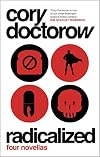
Radicalized
by Cory Doctorow
On This Page
Description
From New York Times bestselling author Cory Doctorow, Radicalized is four urgent SF novellas of America's present and future within one audiobook. Told through one of the most on-pulse genre voices of our generation, Radicalized is a timely audiobook comprised of four SF novellas connected by social, technological, and economic visions of today and what America could be in the near, near future. Unauthorized Bread is a tale of immigration, the toxicity of economic and technological show more stratification, and the young and downtrodden fighting against all odds to survive and prosper. In Model Minority, a Superman-like figure attempts to rectify the corruption of the police forces he long erroneously thought protected the to find his efforts adversely affecting their victims. Radicalized is a story of a darkweb-enforced violent uprising against insurance companies told from the perspective of a man desperate to secure funding for an experimental drug that could cure his wife's terminal cancer. The fourth story, Masque of the Red Death, harkens back to Doctorow's Walkaway, taking on issues of survivalism versus community. show lessTags
Recommendations





Member Reviews
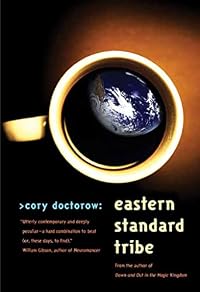
This is my fourth book from Doctorow and definitely my favorite. I liked "The Rapture of the Nerds" a lot and thought "Someone Comes to Town, Someone Leaves Town" and "Eastern Standard Tribe" were pretty good.
This is different because it's a collection. 4 Novellas each dealing with a different social issue set in the United States - the rich taking advantage of the poor, racism, the failing healthcare system, and finally the collapse of the government.
If you think everything's fine, you'll probably read this as science fiction. If you're actually paying attention, it's more like a documentary. Sure one of the stories has superheroes in it, but still if you believe in empathy, this book will make you want to pick up a protest sign and show more write your senators/representatives. I enjoyed it immensely but it also made me sad and angry and worried. Just like the news does every day. show less
This is different because it's a collection. 4 Novellas each dealing with a different social issue set in the United States - the rich taking advantage of the poor, racism, the failing healthcare system, and finally the collapse of the government.
If you think everything's fine, you'll probably read this as science fiction. If you're actually paying attention, it's more like a documentary. Sure one of the stories has superheroes in it, but still if you believe in empathy, this book will make you want to pick up a protest sign and show more write your senators/representatives. I enjoyed it immensely but it also made me sad and angry and worried. Just like the news does every day. show less
This is a collection of 4 novellas, all set in the near-future, all with uncomfortable and powerful prophecies about the inequalities and systematic unfairnesses of the world. Deliberately emotionally manipulative, dark and angry, the occassional grains of hope are there, but this is basically a disturbing read, not a comforting one, and I think that is exactly what the author intended.
Unauthorised bread is a story about the way systems treat the powerless and the way technology means we are increasingly disenfranchised. Poor immigrants in social housing are reliant on proprietary kitchen goods, like toasters and dishwashers, which mean they are locked into specific expensive bread and plates. Doctorow weaves a story of breaking the show more system which tells a convincing tale that individual freedom to live how you want and bake your own bread is more important than corporate profits and intellectual property.
Model Minority is a depressing flight of fancy on the idea that one day Superman sees the police beating up a black man, and decides to make the world a better place. It turns out the system is large and corrupt and covers its own back, flight and x-ray vision aren't enough to solve all America's problems, and sticking your head over the parapet can leave you with many more problems of your own.
Radicalized fascinated me. The concept is that angry people who have lost loved ones are radicalized on the dark web, until they turn into terrorists and suicide bombers. The twist is that these are all boring american white men, who have lost people due to cancer, and the target of their terrorism is heath insurers who could have paid for more treatments but chose not to. It is a very nicely drawn piece of work to paint empathetic characters and draw the story on until the person locked up as 'an accessory to terrorism' is a nice guy who has hurt no-one and is very sympathetic. The fact that the author deeply muddies the water between 'insurance is patchy in America and people die due to lack of health care that would be standard and free anywhere in the world' and 'grieving people want to spend millions on probably pointless cancer treatments' makes it even more conflicted and complex. As does the disturbing conclusion 'terrorism works' (although if you know any human history, you probably know that already.)
The Masque of the Red Death is a modern retelling of Poe's story, and oh, it's powerfully written but deeply grim. The skin crawlingly unlikable narrator has grown rich managing portfolios in the city, and has decided he can escape the unpleasant demise of society by escaping with a chosen few to his Fort Doom. Yet despite him being deeply unpleasant and painfully unselfaware, I still found it miserable and horrible to watch his doomed enterprise fall to pieces and him hide from his only chance of help because of his mad worldview. Powerful and prophetic, but really Not Very Nice. show less
Unauthorised bread is a story about the way systems treat the powerless and the way technology means we are increasingly disenfranchised. Poor immigrants in social housing are reliant on proprietary kitchen goods, like toasters and dishwashers, which mean they are locked into specific expensive bread and plates. Doctorow weaves a story of breaking the show more system which tells a convincing tale that individual freedom to live how you want and bake your own bread is more important than corporate profits and intellectual property.
Model Minority is a depressing flight of fancy on the idea that one day Superman sees the police beating up a black man, and decides to make the world a better place. It turns out the system is large and corrupt and covers its own back, flight and x-ray vision aren't enough to solve all America's problems, and sticking your head over the parapet can leave you with many more problems of your own.
Radicalized fascinated me. The concept is that angry people who have lost loved ones are radicalized on the dark web, until they turn into terrorists and suicide bombers. The twist is that these are all boring american white men, who have lost people due to cancer, and the target of their terrorism is heath insurers who could have paid for more treatments but chose not to. It is a very nicely drawn piece of work to paint empathetic characters and draw the story on until the person locked up as 'an accessory to terrorism' is a nice guy who has hurt no-one and is very sympathetic. The fact that the author deeply muddies the water between 'insurance is patchy in America and people die due to lack of health care that would be standard and free anywhere in the world' and 'grieving people want to spend millions on probably pointless cancer treatments' makes it even more conflicted and complex. As does the disturbing conclusion 'terrorism works' (although if you know any human history, you probably know that already.)
The Masque of the Red Death is a modern retelling of Poe's story, and oh, it's powerfully written but deeply grim. The skin crawlingly unlikable narrator has grown rich managing portfolios in the city, and has decided he can escape the unpleasant demise of society by escaping with a chosen few to his Fort Doom. Yet despite him being deeply unpleasant and painfully unselfaware, I still found it miserable and horrible to watch his doomed enterprise fall to pieces and him hide from his only chance of help because of his mad worldview. Powerful and prophetic, but really Not Very Nice. show less
These four smart and disarming speculative shorts were not easy to get through, but that's why I consider them to be necessary to get through. Doctorow unflinchingly describes the scale of injustice and discomfort that millions of "others" experience on a daily basis and is able to demonstrate through discrete, punchy and concise cautionary tales (à la Falling Down and Black Mirror) what happens when those unthinkable institutional biases finally affect the privileged – as they eventually do and will continue to do at an increasingly rapid pace. Reading these stories in the middle of summer 2020 disturbingly underscores how close we actually are to the dystopian fabric of Doctorow's prose; the collection's subtitle Four Tales of Our show more Present Moment could not have been more prescient as we navigate breaking crests of tidal capitalism, racism, classism, and the other jury-rigged sawhorses struggling to bolster the world's rotting nation-states. On more than one night I found it difficult to sleep for the weight of words and the clarity of structure with which he describes our calamity of inequity. That's what these stories were designed to do. It doesn't matter if you don't "like" them; sometimes the allegorical truth is – mildly or wildly, depending upon one's level of agency – uncomfortable. Knowledge here is power, and, as Doctorow signs off in his acknowledgments, "This isn't the kind of fight you win, it's the kind of fight you fight." show less
If you've read Cory Doctorow's allegorical stories before you have some idea what to expect, but with a little bit darker twist. If you haven't know that he is a proponent of open software, open societies and success through mutual support and understanding, not command-and-control and capitalism. He makes his points with reasonably entertaining if slightly preachy stories. If that sounds good to you, this collection is as good a place to start as any.
The first story, "Unauthorized Bread", will be very familiar to anyone who has read Walkaway or Makers. It imagines a world where society has become segregated between the haves and the have-nots. Where the internet of things is everywhere and used as another form of oppression and show more control. You toaster will only make toast if you buy company approved bread. The dish washer will only wash approved dishes with approved soap. And so on for lights, thermostat, building elevators, etc. But they will also only work as long as that company is in business and their servers are working. So what happens when the company goes out of business and people start figuring out how to jail-break their appliances (and their society)?
"Model Minority" presents a very current portrait of how minorities are treated by majorities in the US with the slight added twist that a couple of super heroes are also real, and feeling some guilt. It asks where was (Superman) when Bull Connor turned attack dogs on protesters in Alabama? Does (Wayne Enterprises) supply weapons and surveillance equipment to the police? What happens when well-meaning members of the majority try to fix the symptoms by fiat without understanding the causes or the needs of the minority?
The title story, "Radicalized", comes third and focuses on issues of health care for-profit. Family, all or nearly all men, of people dead or dying of cancer meet up in online support groups. All of their loved ones could potentially be helped by treatments the health insurance companies refuse to cover. For some of them, the group feeds and grows their anger until they start taking it out on insurance executives, politicians who oppose universal health care, and so on. Given how much of Doctorow's other work focuses on non-violent, open, collective solutions as the way, I don't think this story is a call to arms as much as it is a dark warning tale in the spirit of Carson's Silent Spring.
And finally, if you follow Doctorow on twitter, you might have noticed that his handle has recently changed to "The Masque of the Red Death", which is also the title of the final story in the collection. Suffice to say that this is more-or-less the flip side of Walkaway told from the perspective of the doomsday prepper and his cadre of selected lackeys/companions. If you've read the Edgar Allen Poe story of the same title then you know pretty much how it plays out.
The stories read fairly quickly and supply the better-together message in Doctorow's usual entertaining fashion. show less
The first story, "Unauthorized Bread", will be very familiar to anyone who has read Walkaway or Makers. It imagines a world where society has become segregated between the haves and the have-nots. Where the internet of things is everywhere and used as another form of oppression and show more control. You toaster will only make toast if you buy company approved bread. The dish washer will only wash approved dishes with approved soap. And so on for lights, thermostat, building elevators, etc. But they will also only work as long as that company is in business and their servers are working. So what happens when the company goes out of business and people start figuring out how to jail-break their appliances (and their society)?
"Model Minority" presents a very current portrait of how minorities are treated by majorities in the US with the slight added twist that a couple of super heroes are also real, and feeling some guilt. It asks where was (Superman) when Bull Connor turned attack dogs on protesters in Alabama? Does (Wayne Enterprises) supply weapons and surveillance equipment to the police? What happens when well-meaning members of the majority try to fix the symptoms by fiat without understanding the causes or the needs of the minority?
The title story, "Radicalized", comes third and focuses on issues of health care for-profit. Family, all or nearly all men, of people dead or dying of cancer meet up in online support groups. All of their loved ones could potentially be helped by treatments the health insurance companies refuse to cover. For some of them, the group feeds and grows their anger until they start taking it out on insurance executives, politicians who oppose universal health care, and so on. Given how much of Doctorow's other work focuses on non-violent, open, collective solutions as the way, I don't think this story is a call to arms as much as it is a dark warning tale in the spirit of Carson's Silent Spring.
And finally, if you follow Doctorow on twitter, you might have noticed that his handle has recently changed to "The Masque of the Red Death", which is also the title of the final story in the collection. Suffice to say that this is more-or-less the flip side of Walkaway told from the perspective of the doomsday prepper and his cadre of selected lackeys/companions. If you've read the Edgar Allen Poe story of the same title then you know pretty much how it plays out.
The stories read fairly quickly and supply the better-together message in Doctorow's usual entertaining fashion. show less
A collection of 4 novellas, all superb. This might actually be my favorite Doctorow book to date, and I quite like him generally. The stories variously investigate the proliferation of DRM, systematic racism in America through the lens of Superman, and the limits of doomsday prepping—but it's the title story that shook me the most, about the development of a terrorist organization targeting medical-pharmaceutical-political complex. It's a scary look at how online radicalization works, and what's really scary is less how plausible it is and more how it leaves you feeling, "gee, this actually might be a good idea."
5 stars
Unauthorized Bread
Capitalism has risen to new outrageousness when the apartment you had waited 18 months to move into, and had subsidized rent, had appliances--toaster oven, dishwasher, washer/dryer, refrigerator, microwave--that would only work if you bought the more expensive bread, soap, food, etc., that were made to go in it. Then one day the company went bankrupt, so all the appliances stopped working. The deep net showed a way to hack them so they'd work, but they'd all have to be put back to factory settings when the company got bought up by bigger fish and went back online.
Have you ever heard of a virtual machine? Specializing in the humanities, I only know about it because when my University was closing down, we show more peasants needed to work on files that were confidential, and the big boys in Baltimore couldn't know about it. Well this is how Doctorow helped his characters solve their dilemma.
3 stars
Model Minority
I never thought about Superman being around today and being a civil rights activist. But Doctorow did, and this is how he imagined Superman acting when he sees three cops beating up a POC after they planted a bag of dope on the middle console of his vehicle. Doesn't go the way you'd expect.
4 stars
Radicalized
Joe's wife Lacey is diagnosed with Stage IV metastasized breast cancer and has 3 months to live. Her doctor says she is a good candidate for an alternative, radical treatment that costs a million $. Insurance company, of course, immediately negs it. Joe's family is devastated, and Joe is outer-space angry. Instead of getting help for his all-consuming anger, Joe finds a forum for men whose wives are dying of breast cancer because the insurance company won't cover a radical treatment. Members of the forum share their grief, but they also talk about getting even. The reader lives a little vicariously in this one.
5 stars
The Masque of the Red Death
"Little by little the world's cities filled up with powerful, self - governing people whose discipline, hard work, and brilliance meant that they got richer and richer.
Give the socialists credit, they had this figured out. They knew that the world was heading to a state where the number of betas and gammas the alphas needed to keep the systems running would far exceed the demand, and that those unnecessary people would be squeezed out, little by little, and then, all at once. They wouldn't go without a fight, of course. Of course! Who would? p.250
"...the smartest and best had figured out how to improve even the most marginal assets, well beyond the capacity of the 99%, and now the 99% had found themselves relieved of all their worldly goods and lacking the sums to rent anywhere to perch while they waited to die.
This was an "adjustment period," two words that sounded bloodless and bureaucratic, but which described the chaos that would reign while the unnecessariat were Eased out of existence and humanity realigned itself around the strongest and brightest that evolution could select.
Economists called it an "adjustment period" but people like Martin called it The Event." p.251
Are you prepared for Armageddon? All the 1%ers are, you can bet on that. In this little gem, Martin is one of the 0.1%ers, and he plans his Fort Doom out to the last decimal. His place out in the Nevada desert can support him and the 29 others of his carefully-selected kind for a month, until things settle down. His first mistake is calling Armageddon just a few days before the real thing set in. That meant that not everyone showed up, when they realized that he'd jumped the gun. It also meant that a couple of the ones that did show up, thought about turning around and leaving again. That was just the first of the many things that Martin could never have foreseen.
This story had me on the edge of my seat. show less
Unauthorized Bread
Capitalism has risen to new outrageousness when the apartment you had waited 18 months to move into, and had subsidized rent, had appliances--toaster oven, dishwasher, washer/dryer, refrigerator, microwave--that would only work if you bought the more expensive bread, soap, food, etc., that were made to go in it. Then one day the company went bankrupt, so all the appliances stopped working. The deep net showed a way to hack them so they'd work, but they'd all have to be put back to factory settings when the company got bought up by bigger fish and went back online.
Have you ever heard of a virtual machine? Specializing in the humanities, I only know about it because when my University was closing down, we show more peasants needed to work on files that were confidential, and the big boys in Baltimore couldn't know about it. Well this is how Doctorow helped his characters solve their dilemma.
3 stars
Model Minority
I never thought about Superman being around today and being a civil rights activist. But Doctorow did, and this is how he imagined Superman acting when he sees three cops beating up a POC after they planted a bag of dope on the middle console of his vehicle. Doesn't go the way you'd expect.
4 stars
Radicalized
Joe's wife Lacey is diagnosed with Stage IV metastasized breast cancer and has 3 months to live. Her doctor says she is a good candidate for an alternative, radical treatment that costs a million $. Insurance company, of course, immediately negs it. Joe's family is devastated, and Joe is outer-space angry. Instead of getting help for his all-consuming anger, Joe finds a forum for men whose wives are dying of breast cancer because the insurance company won't cover a radical treatment. Members of the forum share their grief, but they also talk about getting even. The reader lives a little vicariously in this one.
5 stars
The Masque of the Red Death
"Little by little the world's cities filled up with powerful, self - governing people whose discipline, hard work, and brilliance meant that they got richer and richer.
Give the socialists credit, they had this figured out. They knew that the world was heading to a state where the number of betas and gammas the alphas needed to keep the systems running would far exceed the demand, and that those unnecessary people would be squeezed out, little by little, and then, all at once. They wouldn't go without a fight, of course. Of course! Who would? p.250
"...the smartest and best had figured out how to improve even the most marginal assets, well beyond the capacity of the 99%, and now the 99% had found themselves relieved of all their worldly goods and lacking the sums to rent anywhere to perch while they waited to die.
This was an "adjustment period," two words that sounded bloodless and bureaucratic, but which described the chaos that would reign while the unnecessariat were Eased out of existence and humanity realigned itself around the strongest and brightest that evolution could select.
Economists called it an "adjustment period" but people like Martin called it The Event." p.251
Are you prepared for Armageddon? All the 1%ers are, you can bet on that. In this little gem, Martin is one of the 0.1%ers, and he plans his Fort Doom out to the last decimal. His place out in the Nevada desert can support him and the 29 others of his carefully-selected kind for a month, until things settle down. His first mistake is calling Armageddon just a few days before the real thing set in. That meant that not everyone showed up, when they realized that he'd jumped the gun. It also meant that a couple of the ones that did show up, thought about turning around and leaving again. That was just the first of the many things that Martin could never have foreseen.
This story had me on the edge of my seat. show less
Some very pointed political statements in these stories which can be a bit heavy handed at times but I enjoyed (and was engaged by) each and every story.
Unauthorized Bread: 5 stars. Funny, moving, tense. Great story that sucked me in from the first page.
Model Minority: 4.5 stars. A quirky twist to a heavy problem. Depressing but in a good, impactful way. A bit heavy handed/lecture-y at times (which can be kind of a thing with Doctorow).
Radicalized: Hard to rate this one. Very morally gray and it was pretty fascinating to watch the spiral but also feels less personal and more tell than show.
Masque of the Red Death: 5 stars. It’s like Patrick Bateman trying to ride out the apocalypse. At first I didn’t think I’d be in to it, but show more it’s pretty fun watching the end times screw over a horrible person. Ironically, the one about society’s collapse was one of the least dark stories - and I needed it after the two previous depressing stories. (Not that the first story was light but I found some of it quite funny and it felt more hopeful than the others.) show less
Unauthorized Bread: 5 stars. Funny, moving, tense. Great story that sucked me in from the first page.
Model Minority: 4.5 stars. A quirky twist to a heavy problem. Depressing but in a good, impactful way. A bit heavy handed/lecture-y at times (which can be kind of a thing with Doctorow).
Radicalized: Hard to rate this one. Very morally gray and it was pretty fascinating to watch the spiral but also feels less personal and more tell than show.
Masque of the Red Death: 5 stars. It’s like Patrick Bateman trying to ride out the apocalypse. At first I didn’t think I’d be in to it, but show more it’s pretty fun watching the end times screw over a horrible person. Ironically, the one about society’s collapse was one of the least dark stories - and I needed it after the two previous depressing stories. (Not that the first story was light but I found some of it quite funny and it felt more hopeful than the others.) show less
Members
- Recently Added By
Lists

Best Dystopias
280 works; 277 members

Top Five Books of 2020
982 works; 350 members

Canada Reads Winners and Nominees
129 works; 9 members

Books Read in 2020
4,379 works; 124 members

TBR of Books I Don't Own
132 works; 1 member

Books Read in 2025
4,090 works; 97 members

Favorite Science Fiction
452 works; 215 members
Author Information

119+ Works 25,795 Members
Writer and activist Cory Doctorow was born in Toronto, Canada on July 17, 1971. In 1999 he co-founded a free software company called Opencola and served as Canadian Regional Director of the Science Fiction and Fantasy Writers of America. For four years he worked as European Affairs Coordinator for the Electronic Frontier Foundation and in 2007 won show more its Pioneer Award. His first novel, Down and Out in the Magic Kingdom, won a Locus Award for Best First Novel. His short story collection A Place So Foreign and Eight More won a Sunburst Award, and his bestselling novel Little Brother received the 2009 Prometheus Award, a Sunburst Award, and the John W. Campbell Memorial Award. Doctorow also writes nonfiction books and articles, and he co-edits the blog Boing Boing. (Bowker Author Biography) show less
Some Editions
Awards and Honors
Awards
Distinctions
Work Relationships
Is contained in
Common Knowledge
- Original publication date
- 2019-03
- Dedication
- For my parents: Roz and Gord Doctorow, who taught me why we fight, and not to give up. This isn't the kind of fight we win, it's the kind of fight we fight.
- First words
- The way Salima found out that Boulangism had gone bankrupt: her toaster wouldn't accept her bread.
- Last words
- (Click to show. Warning: May contain spoilers.)He'd regain his strength after a nap.
- Publisher's editor
- Nielsen Hayden, Patrick
- Blurbers
- Robinson, Kim Stanley
- Original language
- English
- Disambiguation notice
- This is a collection containing four stories. Do not combine with the novella of the same name.
Classifications
Statistics
- Members
- 602
- Popularity
- 48,294
- Reviews
- 27
- Rating
- (3.96)
- Languages
- English, Italian, Spanish
- Media
- Paper, Ebook
- ISBNs
- 14
- ASINs
- 3