The Quarter
by Naguib Mahfouz
On This Page
Description
Meet the people of Cairo's Gamaliya quarter. There is Nabqa, son of Adam the waterseller who can only speak truths; the beautiful and talented Tawhida who does not age with time; Ali Zaidan, the gambler, late to love; and Boss Saqr who stashes his money above the bath. A neighbourhood of demons, dancing and sweet halva, the quarter keeps quiet vigil over the secrets of all who live there. This collection by pre-eminent Egyptian writer Naguib Mahfouz was recently discovered among his old show more papers. Found with a slip of paper titled 'for publishing 1994', they are published here for the first time. Resplendent with Mahfouz's delicate and poignant observations of everyday happenings, these lively stories take the reader deep into the beating heart of Cairo. show lessTags
Recommendations













Member Reviews
I am very late with this review because I felt so bad about what I was going to say. Who was I to say negative things about this work by a recipient of the Nobel Prize in Literature?! Oh dear!
I really didn’t like this book. I couldn’t understand this because I’ve read and enjoyed Mahfouz’s books in the past. The answer is in the introduction (pp. XXIV-XXVI), which I initially skipped. Here Mahfouz adopted a new writing style that basically eliminated all of the atmosphere that made his earlier works so alluring. Instead, the reader is unceremoniously dumped right into the story. This is not the least bit gratifying for the reader. Truth be told, I couldn’t even finish this book (and that is a very rare phenomenon).
I really didn’t like this book. I couldn’t understand this because I’ve read and enjoyed Mahfouz’s books in the past. The answer is in the introduction (pp. XXIV-XXVI), which I initially skipped. Here Mahfouz adopted a new writing style that basically eliminated all of the atmosphere that made his earlier works so alluring. Instead, the reader is unceremoniously dumped right into the story. This is not the least bit gratifying for the reader. Truth be told, I couldn’t even finish this book (and that is a very rare phenomenon).
 This review was written for LibraryThing Early Reviewers.
These short stories, set in the Gamaliya Quarter of Cairo, have the feel of fables and parables. Family, religion and community play a large part in the lives of the quarter residents, and a large part in their troubles.
An unwed mother makes it so the father will never be able to avoid seeing his unacknowledged baby. The “Son of the Quarter” calls out the transgressions of prominent people upon instructions from an unseen voice. Tragedy ensues when a Sheikh divorces his young wife for reasons not her fault. A madman predicts a death.
The stories are short and deceptively simple at times, belying the depth of their message. Naguib Mahfouz focuses on the lives of the lives of the residents, adds some supernatural beliefs and elements show more at times, and creates beautiful little slices of life. They portray the frailty, faith and kindness of human nature. His 1988 Nobel Prize for Literature acceptance speech is worth reading by itself. “Today, the greatness of a civilised leader ought to be measured by the universality of his vision and his sense of responsibility towards all humankind.” Truer now than ever.
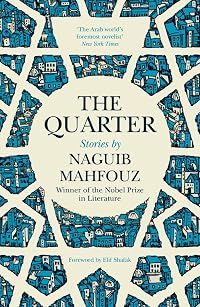
The cover is a beautiful depiction of the quarter and the original handwritten Arabic text of a few stories are included in the book. show less
An unwed mother makes it so the father will never be able to avoid seeing his unacknowledged baby. The “Son of the Quarter” calls out the transgressions of prominent people upon instructions from an unseen voice. Tragedy ensues when a Sheikh divorces his young wife for reasons not her fault. A madman predicts a death.
The stories are short and deceptively simple at times, belying the depth of their message. Naguib Mahfouz focuses on the lives of the lives of the residents, adds some supernatural beliefs and elements show more at times, and creates beautiful little slices of life. They portray the frailty, faith and kindness of human nature. His 1988 Nobel Prize for Literature acceptance speech is worth reading by itself. “Today, the greatness of a civilised leader ought to be measured by the universality of his vision and his sense of responsibility towards all humankind.” Truer now than ever.
The cover is a beautiful depiction of the quarter and the original handwritten Arabic text of a few stories are included in the book. show less
This review was written for LibraryThing Early Reviewers.Collection of 18 fascinating vignettes of the inhabitants of a quarter [hara] in modern Cairo. Each is a parable or folktale-like short story with a central theme and often a pithy gnomic aphorism; some stories only 2 or 3 pages. The civil authority [Head of the Quarter] and spiritual leader, the Imam appear in each story and might sum up the conclusion.
In "The Oven" we read of a pair of lovers from different classes--a baker and a merchant's daughter--who elope and though her father has written her off, saves him from bankruptcy. "She has returned; she needs no forgiveness", the Head tells the Imam. This was my favorite story.
In "Pursuit", a wronged woman badgers the man who has given her a child out of wedlock; this one reminded me show more somewhat of the Biblical Unjust Judge and the Widow parable in its emphasis on persistence.
Naqba, in another story, cannot lie.
In "The Arrow", a man is killed and the story shows how people still cling to superstitions, in spite of the all-too-human logic of the action in front of them.
In "The End of Boss Saqr" a man's first wife finds out what her dying husband had meant by whispering to her: "Over the bath."
In "Tawhida", the title character always remains young in the narrator's mind although many years have passed.
The book also included Mahfouz's Nobel Prize Acceptance speech and four of these stories in the original Arabic in the author's handwriting.
Highly recommended, although the author's [Cairo Trilogy] might be a better introduction to his oeuvre. show less
In "The Oven" we read of a pair of lovers from different classes--a baker and a merchant's daughter--who elope and though her father has written her off, saves him from bankruptcy. "She has returned; she needs no forgiveness", the Head tells the Imam. This was my favorite story.
In "Pursuit", a wronged woman badgers the man who has given her a child out of wedlock; this one reminded me show more somewhat of the Biblical Unjust Judge and the Widow parable in its emphasis on persistence.
Naqba, in another story, cannot lie.
In "The Arrow", a man is killed and the story shows how people still cling to superstitions, in spite of the all-too-human logic of the action in front of them.
In "The End of Boss Saqr" a man's first wife finds out what her dying husband had meant by whispering to her: "Over the bath."
In "Tawhida", the title character always remains young in the narrator's mind although many years have passed.
The book also included Mahfouz's Nobel Prize Acceptance speech and four of these stories in the original Arabic in the author's handwriting.
Highly recommended, although the author's [Cairo Trilogy] might be a better introduction to his oeuvre. show less
This review was written for LibraryThing Early Reviewers.Naguib Mahfouz was the first Arabic writer to win the Nobel Prize for Literature and no other Arabic writer has been awarded the Nobel Prize since Mahfouz received it in 1988. (Orhan Pamuk, winner in 2006, wrote in Turkish which is not the same as Arabic.) Given how many Arabic speakers there are in the world (420 million) you would think that there would have been somebody else deserving of the award. French writing laureates number 14 as do German writing winners and those languages are spoken by only one-quarter of the number that speak Arabic. It's not news that the selection for Nobel Literature laureates is manifestly skewed towards white, male Europeans but it does make an interesting backdrop to this book.
Mahfouz died in 2006 show more but this collection of stories was only found recently. They were labellled with a piece of paper saying "For publishin 1994". It's not surprising that they were not published then as Mahfouz was attacked and wounded severely in 1994 as a result of a fatwa issued by a Muslim cleric because Mahfouz supported Salman Rushdie's right to publish after a fatwa was issued against him for writing The Satanic Verses. After reading these stories I wonder if Mahfouz was quite finished his editing of them as some seem clunky and uneven. Or perhaps I just wasn't in the right mood to read these.
I did like the story entitled "Tawhida" which is about a young girl who married into the narrator's family and charmed everyone. The narrator seems to have been smitten by her but lost track of her for years. Then one day when he is old a car pulls up in front of him with an old woman as a passenger and she waves to him. He doesn't recognize her. "She had a face that might be an icon to old age: gaunt, pale, thin, and wrinkled. She was wearing dark glasses." But as soon as he heard her voice "the past came rushing back like a perfume bottle smashing to the ground." Such lovely imagery!
I have read Mahfouz's more famous book, Midaq Alley, which I enjoyed ver much. So I hope this little book will please some reader. show less
Mahfouz died in 2006 show more but this collection of stories was only found recently. They were labellled with a piece of paper saying "For publishin 1994". It's not surprising that they were not published then as Mahfouz was attacked and wounded severely in 1994 as a result of a fatwa issued by a Muslim cleric because Mahfouz supported Salman Rushdie's right to publish after a fatwa was issued against him for writing The Satanic Verses. After reading these stories I wonder if Mahfouz was quite finished his editing of them as some seem clunky and uneven. Or perhaps I just wasn't in the right mood to read these.
I did like the story entitled "Tawhida" which is about a young girl who married into the narrator's family and charmed everyone. The narrator seems to have been smitten by her but lost track of her for years. Then one day when he is old a car pulls up in front of him with an old woman as a passenger and she waves to him. He doesn't recognize her. "She had a face that might be an icon to old age: gaunt, pale, thin, and wrinkled. She was wearing dark glasses." But as soon as he heard her voice "the past came rushing back like a perfume bottle smashing to the ground." Such lovely imagery!
I have read Mahfouz's more famous book, Midaq Alley, which I enjoyed ver much. So I hope this little book will please some reader. show less
This review was written for LibraryThing Early Reviewers.The Quarter is a collection of stories by Mahfouz recently discovered labelled “for publishing 1994”. The stories are well written, as would be expected, and the sparse prose means each of the parable-like vignettes is very short, most only about three pages long. There really isn’t much there overall though. The book is less than 100 pages and that’s including an introduction, translator’s notes, some pictures of the original handwritten versions of some of the stories and Mahfouz’s Nobel Prize acceptance speech. The introduction talks about there being no way of knowing if these were intended as a complete work or if there was more to be added, but I feel given the length and the fact that he didn’t actually publish them show more in the end indicates that it wasn’t intended in this form and there was probably supposed to be more to it. It’s not that what’s there is bad, it’s Naguib Mahfouz after all, but it doesn’t add up to much across the book. show less
This review was written for LibraryThing Early Reviewers.Few of these microfictions, unpublished in Mahfouz's lifetime and recently rediscovered by a researcher, amount to wholly-realised stories. Most are simply sketches, with the most frequent trope being the beggar / madman figure whose prophecy unsurprisingly comes true. Other stock characters are the "Boss" of the titular Quarter, the vendor of sweets / pickles / bread etc., and the imam. None of these pieces will stick in the memory, but the economical prose is perfectly fine and the stories as a whole succeed in evoking their Gamaliya setting.
The scant 60 or so small pages of prose are padded out with a foreword, a translator's introduction, Mahfouz's Nobel speech (not one of the best) and copies of his Arabic holograph for four of the show more pieces. Despite this extra material and the high production values, this is for Mahfouz completists or Cairo-lovers only. show less
The scant 60 or so small pages of prose are padded out with a foreword, a translator's introduction, Mahfouz's Nobel speech (not one of the best) and copies of his Arabic holograph for four of the show more pieces. Despite this extra material and the high production values, this is for Mahfouz completists or Cairo-lovers only. show less
This review was written for LibraryThing Early Reviewers.I think it is more likely that readers who have read Mahfouz's novels will appreciate these short stories more than readers who have not. Mahfouz is known for his ability to immerse the reader in the life and lives in Cairo with his incredible characters and evocative prose. These stories seem like character sketches. Apparently they were found among the author's belongings after his death. I think they were not intended to be published, yet nonetheless they convey the mindset of life in "the quarter", the secrecy, the superstition, and the intrigue. A fantastic bonus is that Mahfouz' s acceptance speech for the Nobel Prize for Literature is included with the stories. Such a gifted man and eloquent representative of his culture!
This review was written for LibraryThing Early Reviewers.Members
- Recently Added By
Lists

Arab and Arab Diaspora Literature We Recommend
112 works; 53 members
Author Information

331+ Works 19,166 Members
Naguib Mahfouz was born in Cairo, Egypt on December 11, 1911. He received a degree in philosophy from the University of Cairo. He took on several civil service and government department jobs to supplement his income while writing, but retired from that career in 1971. During his lifetime, he wrote more than 30 novels including The Games of Fate, show more The Cairo Trilogy, Children of Gebelawi, The Thief and the Dogs, Autumn Quail, Small Talk on the Nile, and Miramar. He received numerous awards including the Egyptian State Prize, the Presidential Medal from the American University in Cairo, and the Nobel Prize for Literature in 1988. He died as a result of a head injury on August 30, 2006 at the age of 94. (Bowker Author Biography) show less
Some Editions
Awards and Honors
Common Knowledge
- Canonical title
- The Quarter
- Original publication date
- 2018
- First words
- The disaster had happened.
- Last words
- (Click to show. Warning: May contain spoilers.)'If you didn't recognise me,' she said with a laugh, 'it's not my fault!'
- Original language
- Arabic
Classifications
- Genres
- Fiction and Literature, General Fiction
- DDC/MDS
- 892.736 — Literature & rhetoric Literatures of other languages Afro-Asiatic literatures Arabic (Egypt, Lebanon, Palestine, Saudi Arabia, Sudan) Arabic fiction 1945–2000
- LCC
- PJ7846 .A46 .A2 — Language and Literature Oriental languages and literatures Oriental philology and literature Arabic Arabic literature Individual authors or works
- BISAC
Statistics
- Members
- 62
- Popularity
- 500,187
- Reviews
- 12
- Rating
- (3.34)
- Languages
- English
- Media
- Paper, Ebook
- ISBNs
- 3
- ASINs
- 1