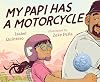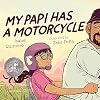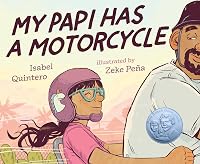
My Papi Has a Motorcycle
by Isabel Quintero, Zeke Peña (Illustrator)
On This Page
Description
"When Daisy Ramona zooms around her neighborhood with her papi on his motorcycle, she sees the people and places she's always known. She also sees a community that is rapidly changing around her. But as the sun sets purple-blue-gold behind Daisy Ramona and her papi, she knows that the love she feels will always be there. With vivid illustrations and text bursting with heart, My Papi Has a Motorcycle is a young girl's love letter to her hardworking dad and to memories of home that we hold show more close in the midst of change."-- show lessTags
Recommendations



Member Reviews
Ascreaming, bright-blue comet zooms through the streets of Corona, California, in a race against the orange setting sun.
A unicorn-decorated purple helmet can’t hide the grin of the young girl tightly gripping the waist of her carpenter father, who’s hunched over his blazing motorcycle as a comet tail of sawdust streams behind them. Basking in her father’s wordless expression of love, she watches the flash of colors zip by as familiar landmarks blend into one another. Changes loom all around them, from the abandoned raspado (snow cone) shop to the housing construction displacing old citrus groves. Yet love fills in the spaces between nostalgia and the daily excitement of a rich life shared with neighbors and family. Quintero’s show more homage to her papi and her hometown creates a vivid landscape that weaves in and out of her little-girl memory, jarring somewhat as it intersects with adult recollections. At the end, her family buys raspados from a handcart—are the vendor and defunct shop’s owner one and the same? Peña’s comic-book–style illustrations capture cultural-insider Mexican-American references, such as a book from Cathy Camper and Raúl the Third’s Lowrider series and the Indigenous jaguar mask on the protagonist’s brother’s T-shirt. Dialogue in speech bubbles incorporates both Spanish and English, and the gist of the conversation is easily followed; a fully Spanish edition releases simultaneously.
Every girl should be so lucky as to have such a papi. (Picture book. 7-11)
-Kirkus Review show less
A unicorn-decorated purple helmet can’t hide the grin of the young girl tightly gripping the waist of her carpenter father, who’s hunched over his blazing motorcycle as a comet tail of sawdust streams behind them. Basking in her father’s wordless expression of love, she watches the flash of colors zip by as familiar landmarks blend into one another. Changes loom all around them, from the abandoned raspado (snow cone) shop to the housing construction displacing old citrus groves. Yet love fills in the spaces between nostalgia and the daily excitement of a rich life shared with neighbors and family. Quintero’s show more homage to her papi and her hometown creates a vivid landscape that weaves in and out of her little-girl memory, jarring somewhat as it intersects with adult recollections. At the end, her family buys raspados from a handcart—are the vendor and defunct shop’s owner one and the same? Peña’s comic-book–style illustrations capture cultural-insider Mexican-American references, such as a book from Cathy Camper and Raúl the Third’s Lowrider series and the Indigenous jaguar mask on the protagonist’s brother’s T-shirt. Dialogue in speech bubbles incorporates both Spanish and English, and the gist of the conversation is easily followed; a fully Spanish edition releases simultaneously.
Every girl should be so lucky as to have such a papi. (Picture book. 7-11)
-Kirkus Review show less
Ascreaming, bright-blue comet zooms through the streets of Corona, California, in a race against the orange setting sun.
A unicorn-decorated purple helmet can’t hide the grin of the young girl tightly gripping the waist of her carpenter father, who’s hunched over his blazing motorcycle as a comet tail of sawdust streams behind them. Basking in her father’s wordless expression of love, she watches the flash of colors zip by as familiar landmarks blend into one another. Changes loom all around them, from the abandoned raspado (snow cone) shop to the housing construction displacing old citrus groves. Yet love fills in the spaces between nostalgia and the daily excitement of a rich life shared with neighbors and family. Quintero’s show more homage to her papi and her hometown creates a vivid landscape that weaves in and out of her little-girl memory, jarring somewhat as it intersects with adult recollections. At the end, her family buys raspados from a handcart—are the vendor and defunct shop’s owner one and the same? Peña’s comic-book–style illustrations capture cultural-insider Mexican-American references, such as a book from Cathy Camper and Raúl the Third’s Lowrider series and the Indigenous jaguar mask on the protagonist’s brother’s T-shirt. Dialogue in speech bubbles incorporates both Spanish and English, and the gist of the conversation is easily followed; a fully Spanish edition releases simultaneously.
Every girl should be so lucky as to have such a papi. (Picture book. 7-11)
-Kirkus Review show less
A unicorn-decorated purple helmet can’t hide the grin of the young girl tightly gripping the waist of her carpenter father, who’s hunched over his blazing motorcycle as a comet tail of sawdust streams behind them. Basking in her father’s wordless expression of love, she watches the flash of colors zip by as familiar landmarks blend into one another. Changes loom all around them, from the abandoned raspado (snow cone) shop to the housing construction displacing old citrus groves. Yet love fills in the spaces between nostalgia and the daily excitement of a rich life shared with neighbors and family. Quintero’s show more homage to her papi and her hometown creates a vivid landscape that weaves in and out of her little-girl memory, jarring somewhat as it intersects with adult recollections. At the end, her family buys raspados from a handcart—are the vendor and defunct shop’s owner one and the same? Peña’s comic-book–style illustrations capture cultural-insider Mexican-American references, such as a book from Cathy Camper and Raúl the Third’s Lowrider series and the Indigenous jaguar mask on the protagonist’s brother’s T-shirt. Dialogue in speech bubbles incorporates both Spanish and English, and the gist of the conversation is easily followed; a fully Spanish edition releases simultaneously.
Every girl should be so lucky as to have such a papi. (Picture book. 7-11)
-Kirkus Review show less
This has been getting a lot of buzz and rightly so - it's a joyous celebration of family, culture, and optimism for the future, even when families face changes. And, of course, motorcycles! The only drawback for me is that I'd love to see more books with Hispanic characters set in the Midwest, rather than the Southwest, but I'll take what I can get.
The main character, Daisy Ramona, has learned to love motorcycles through her Papi's own love. When he comes home, she grabs their helmets and they take a spin on his motorcycle through the neighborhood. They ride exuberantly past the small businesses, waving to neighbors and recognizing their favorite places. But as they go, they notice more and more businesses are closed, more and more show more changes are coming to their home. They ride past the construction sites where Daisy's Papi works, building new homes for other people, and finally return home; where they see that their neighbors have found new ways to adapt to their changing world.
An author's note talks about their own experiences with the changing landscape and the history of immigrants who have built the country and the workers who still labor to build houses and cities but are often forgotten. This is a poignant and timely reminder, not only showing a wonderful father-daughter relationship but in my own area of the Midwest, of the Hispanic communities that suffer prejudice and poverty with many people conveniently forgetting how much labor they have put into our history, and still continue to contribute.
Earth colors and soft but vibrant pinks, greens, and oranges cover the pages and Daisy zooms across the streets with her Papi in her purple unicorn helmet. The pages are sprinkled with Spanish words, tastes, and sounds and the reader is taken right into a wonderful community with a colorful past and a bright future, no matter what obstacles they may face.
Verdict: I don't often say this, but I do think this is one book that every library should have. Read it with children of recent immigrants to encourage them to feel pride in their parents' accomplishments and hope for their own future. Read it with children of not-so-recent immigrants to help them gain empathy for the struggles of others. For Hispanic children to feel pride in their communities and their heritage, for other children to honor that culture and trace their own families. And just for fun motorcycles and unicorn helmets! It is a longer story, best-suited to an elementary audience.
ISBN: 9780525553410; Published May 2019 by Kokila (new imprint from Penguin); Review copy provided by the publisher; Donated to the library show less
The main character, Daisy Ramona, has learned to love motorcycles through her Papi's own love. When he comes home, she grabs their helmets and they take a spin on his motorcycle through the neighborhood. They ride exuberantly past the small businesses, waving to neighbors and recognizing their favorite places. But as they go, they notice more and more businesses are closed, more and more show more changes are coming to their home. They ride past the construction sites where Daisy's Papi works, building new homes for other people, and finally return home; where they see that their neighbors have found new ways to adapt to their changing world.
An author's note talks about their own experiences with the changing landscape and the history of immigrants who have built the country and the workers who still labor to build houses and cities but are often forgotten. This is a poignant and timely reminder, not only showing a wonderful father-daughter relationship but in my own area of the Midwest, of the Hispanic communities that suffer prejudice and poverty with many people conveniently forgetting how much labor they have put into our history, and still continue to contribute.
Earth colors and soft but vibrant pinks, greens, and oranges cover the pages and Daisy zooms across the streets with her Papi in her purple unicorn helmet. The pages are sprinkled with Spanish words, tastes, and sounds and the reader is taken right into a wonderful community with a colorful past and a bright future, no matter what obstacles they may face.
Verdict: I don't often say this, but I do think this is one book that every library should have. Read it with children of recent immigrants to encourage them to feel pride in their parents' accomplishments and hope for their own future. Read it with children of not-so-recent immigrants to help them gain empathy for the struggles of others. For Hispanic children to feel pride in their communities and their heritage, for other children to honor that culture and trace their own families. And just for fun motorcycles and unicorn helmets! It is a longer story, best-suited to an elementary audience.
ISBN: 9780525553410; Published May 2019 by Kokila (new imprint from Penguin); Review copy provided by the publisher; Donated to the library show less
This was an absolutely wonderful story celebrating Quintero's hometown all the people who helped to build it, both in the past and today. Daisy's papi owns a motorcycle, and everyday when he comes home from work, he takes Daisy out on a ride around town. As they travel through town, they pass familiar landmarks, like her abuelita's church, the tortilleria, the panaderia, the market, and her school. They also pass by all the residents of the city, like the librarian, her grandparents, her friends, the men her father works with when he builds houses, the neighbor's dogs, and stray cats. Each person and landmark is a vital piece of home for Daisy and she revels in visiting each one, celebrating the beauty of her city.
I loved the way show more history was interwoven into this story. From the murals of citrus groves and the immigrants who worked them, to the way she imagines she's taking part in the road race on Grand Boulevard, to her grandfather's lemon trees grown from the groves he used to pick, history is a vibrant presence in this book. But there is also great hope for the future. Daisy sees and accepts change in her neighborhood, acknowledging that it's inevitable and not always bad. But whatever changes, she'll always love her home and her family.
The illustrations in this book were beautifully vibrant. Every page has a background of soft sunset colors, that really make the people pop on the page. Spanish words are used throughout the text, primarily in speech bubbles, although occasionally in the text as well. The Spanish used in the main text tends to be people, places, and foods - the kinds of words that are easily understood from context. Which is just as well, since none of the Spanish is translated. I really liked that about this book. The entire tone of the book is very conversational and I think that would have been undermined if Daisy had tried to translate anything. show less
I loved the way show more history was interwoven into this story. From the murals of citrus groves and the immigrants who worked them, to the way she imagines she's taking part in the road race on Grand Boulevard, to her grandfather's lemon trees grown from the groves he used to pick, history is a vibrant presence in this book. But there is also great hope for the future. Daisy sees and accepts change in her neighborhood, acknowledging that it's inevitable and not always bad. But whatever changes, she'll always love her home and her family.
The illustrations in this book were beautifully vibrant. Every page has a background of soft sunset colors, that really make the people pop on the page. Spanish words are used throughout the text, primarily in speech bubbles, although occasionally in the text as well. The Spanish used in the main text tends to be people, places, and foods - the kinds of words that are easily understood from context. Which is just as well, since none of the Spanish is translated. I really liked that about this book. The entire tone of the book is very conversational and I think that would have been undermined if Daisy had tried to translate anything. show less
For 10 minutes I was a child again, immersed in the sounds, sights, smells, and thrills of an evening outside with my dad and/or mom. Just living in the now, an integral, recognized part of a community, rooted in a place. Everyone needs to exist in that feeling. Sure of who and where you are, with no other place to go but home and to bed.
This.
This book was magic.
This.
This book was magic.
My Papi Has a Motorcycle by Isabel Quintero is a sweet story about a loving father-daughter relationship with a daughter who clearly adores her father. We are introduced to this from the very beginning, being swept into the first-person narration creating an instant connection with the protagonist. She makes it very clear that she learns many important things from her father, and her excitement for their time together is evident in her zeal and preparedness. Our protagonist notices the tiny details of every aspect of her father, from his rough hands to his smelling like a hard day’s work, which she is clearly proud of him for as they are immigrants who have built a life for themselves. It is apparent that his hard work wears him out, show more but the daughter takes notice and understanding, still recognizing that her papi goes out of his way to show her love and affection in the little things he does for her and how he treats her. The story takes us on a magical ride, as if superheroes from the descriptions of the sun and the lightning bolt illustrations flaming from the motorcycle. Throughout the motorcycle ride, readers are entreated to the beautiful story of their lives as immigrants, of the town they have proudly built, and the stray cats who call it home. We are invited to peak into the concept of change/gentrification that seems to be occurring in the town by hints at a missing Don Rudy and the thoughts that the daughter has about change. Eventually, her father brings her to see the latest house he is working on building, right before ending their ride with a quick race on Grand Boulevard and her reflections over her life that she loves so much. show less
A good book to show students how much pride people can have for their community because of the hard work and love that went into building it. It also depicts a great example of experiencing change and being ok with it. A good book to help students look through a window into a Hispanic community.
Members
- Recently Added By
Lists

Things that GO
39 works; 1 member

Rainbow Gardens Wish List: Seedlings & Saplings
104 works; 3 members

NPR Books You Love: 100 Favorite Books For Young Readers
100 works; 1 member
Author Information

9+ Works 2,148 Members
Awards and Honors
Common Knowledge
- Original publication date
- 2019
- People/Characters
- Daisy Ramona
- Important places
- Corona, California, USA
- Dedication
- Para mi apá. Para Corona. -I. Q.
In memory of my Pops, Richard Peña, the man who taught me to work with my hands. - Z. P. - First words
- My papi has a motorcycle.
- Last words
- (Click to show. Warning: May contain spoilers.)Mañana we fly again.
- Original language
- English
Classifications
Statistics
- Members
- 879
- Popularity
- 30,827
- Reviews
- 107
- Rating
- (4.41)
- Languages
- English, Spanish
- Media
- Paper, Audiobook, Ebook
- ISBNs
- 21
- ASINs
- 3