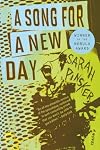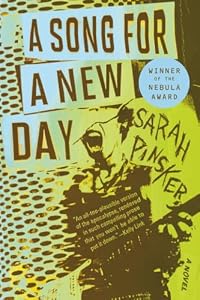
A Song for a New Day
by Sarah Pinsker
On This Page
Description
In the Before, when the government didn't prohibit large public gatherings, Luce Cannon was on top of the world. One of her songs had just taken off and she was on her way to becoming a star. Now, in the After, terror attacks and deadly viruses have led the government to ban concerts, and Luce's connection to the world--her music, her purpose--is closed off forever. She does what she has to do: she performs in illegal concerts to a small but passionate community, always evading the law. show more Rosemary Laws barely remembers the Before times. She spends her days in Hoodspace, helping customers order all of their goods online for drone delivery--no physical contact with humans needed. By lucky chance, she finds a new job and a new calling: discover amazing musicians and bring their concerts to everyone via virtual reality. The only catch is that she'll have to do something she's never done before and go out in public. Find the illegal concerts and bring musicians into the limelight they deserve. But when she sees how the world could actually be, that won't be enough. show lessTags
Recommendations






Member Reviews
“She hadn’t realized music could reach inside you.”
What an unputdownable book! It wasn’t because of the plot – it was because of the characters’ feelings, experiences, choices, growth. There was music everywhere, too, even when no one was playing.
I liked how Sarah Pinsker created her near future world. It does not feel dystopian, since we are looking at it from the inside. It does feel prescient, though. For so many of the characters, this is the status quo, this is how things are (evil monopolizing tech corporations included) – until they accept it no longer.
Both Luce and Rosemary are fascinating POV characters to follow – somehow, the mundane stuff becomes as exciting as when they experience something awesome for the show more first time. I loved both their journeys. When the POV’s finally converged, my heart melted, it felt so right. Isn’t it wonderful when such book moments happen to you?
I am trying to remember when I last read a book that described playing music, listening to music, having music inside you in such a fitting, true way… and I cannot remember. I wanted a playlist for this book so badly! Guess what, I found one :) Or rather: of course there was a playlist. It’s on Spotify, made by the author. Apparently, the chapter titles are song titles. This is so cool :))), even though it’s not quite the same thing as listening to Luce’s music. But I will listen for sure…
“Playing music was the fire that kept the monsters at bay. Nothing could touch me in the middle of a song.”
People made powerful by creating relationships and connections, being stubborn and finding a way, and the power of music – all this brought me joy. show less
What an unputdownable book! It wasn’t because of the plot – it was because of the characters’ feelings, experiences, choices, growth. There was music everywhere, too, even when no one was playing.
I liked how Sarah Pinsker created her near future world. It does not feel dystopian, since we are looking at it from the inside. It does feel prescient, though. For so many of the characters, this is the status quo, this is how things are (evil monopolizing tech corporations included) – until they accept it no longer.
Both Luce and Rosemary are fascinating POV characters to follow – somehow, the mundane stuff becomes as exciting as when they experience something awesome for the show more first time. I loved both their journeys. When the POV’s finally converged, my heart melted, it felt so right. Isn’t it wonderful when such book moments happen to you?
I am trying to remember when I last read a book that described playing music, listening to music, having music inside you in such a fitting, true way… and I cannot remember. I wanted a playlist for this book so badly! Guess what, I found one :) Or rather: of course there was a playlist. It’s on Spotify, made by the author. Apparently, the chapter titles are song titles. This is so cool :))), even though it’s not quite the same thing as listening to Luce’s music. But I will listen for sure…
“Playing music was the fire that kept the monsters at bay. Nothing could touch me in the middle of a song.”
People made powerful by creating relationships and connections, being stubborn and finding a way, and the power of music – all this brought me joy. show less
Pinsker, Sarah. A Song for a New Day. Berkley, 2019.
Near-future science fiction seldom seems as prescient as Sarah Pinsker’s Nebula-winning A Song for a New Day. Published less than six months before the outbreak of COVID-19, it describes a world in which social isolation has become the law after an outbreak of a pandemic that was coincident with a rash of bombings. Most of the bombers are now in jail and the “pox” has subsided, yet the social isolation rules, called congregation laws, remain in place, and agoraphobia has become common. Live music has been forced into small underground clubs that are frequently raided by the police. Most commercial music is now produced holographically by bands that work in isolation chambers, show more their performances stitched together by computers. The story brings together two women, Rosemary, an agoraphobic farm girl who has somehow become a talent scout for StageHolo Live, the largest of the online music producers, and Luce, a musician whose career was cut short by the plague. Pinsker, a singer-songwriter as well as a novelist, writes beautifully about the experience of performing before a live audience. She also delivers some very pointed barbs at the impersonality and inhumanity of the music industry. The characters here are irresistible, and I look forward to reading more by Pinsker. show less
Near-future science fiction seldom seems as prescient as Sarah Pinsker’s Nebula-winning A Song for a New Day. Published less than six months before the outbreak of COVID-19, it describes a world in which social isolation has become the law after an outbreak of a pandemic that was coincident with a rash of bombings. Most of the bombers are now in jail and the “pox” has subsided, yet the social isolation rules, called congregation laws, remain in place, and agoraphobia has become common. Live music has been forced into small underground clubs that are frequently raided by the police. Most commercial music is now produced holographically by bands that work in isolation chambers, show more their performances stitched together by computers. The story brings together two women, Rosemary, an agoraphobic farm girl who has somehow become a talent scout for StageHolo Live, the largest of the online music producers, and Luce, a musician whose career was cut short by the plague. Pinsker, a singer-songwriter as well as a novelist, writes beautifully about the experience of performing before a live audience. She also delivers some very pointed barbs at the impersonality and inhumanity of the music industry. The characters here are irresistible, and I look forward to reading more by Pinsker. show less
I enjoyed this, though it felt a bit more YA than I had expected. The storyline was a good one—corporatized music as a symptom of post-pandemic ills, and those of an alienated, segmented society in general. But what captivated me most was how Pinsker, who wrote this well in advance of the onslaught of covid-19 (it was expanded from a story in her 2019 collection, Sooner or Later Everything Falls Into the Sea, and was published in September 2019), got so many of the social isolation details scarily right. She spins that premise out into an exploration of what happens when public gatherings are banned, music is channeled into mega-retail AI channels, and live music is forced underground. It's a great premise, superimposing the rise of show more giant corporate entities with American fear, and how a desire to stay safe can become stifling legislation—it's very punk rock. But what may have felt more like an allegory when Pinsker wrote it is a sharp what-if right now. Things are going to be different post-covid, and this outcome is a bit more plausible than it was six months ago. So that was an interesting overlay to an entertaining dystopian novel... creepy, for sure, but also uplifting in the end, which is certainly welcome. show less
I received an advance copy of this book via NetGalley.
I'm a big fan of Sarah Pinsker's work. I adored her collection Sooner or Later Everything Falls Into the Sea and have been genuinely excited that her first novel would be inspired by her fantastic novelette "Our Lady of the Open Road." The book absolutely lived up to my high expectations.
Pinsker's science fiction is eerily plausible: a near-future world where a series of terrorist attacks and illness with high mortality have led to laws against congregations of people. Society fully embraces the digital and insular, relying on drone delivery for most all goods and on virtual experiences for dating, sports events, and--most notably for this book--concerts, with StageHoloLive being the show more major purveyor of much entertainment.
Enter the two protagonists: Luce, a gifted musician on the cusp of going big when the world fell apart, and Rosemary, a young woman rendered agoraphobic by her parents and culture, but who perkily heads out to find undercover musical acts as part of her new job for StageHoloLive. All of the characters in the book are nuanced and realistic, and Pinsker's own background in bands completely grounds the world. This develops into a book with some shades of Charles de Lint's works, yet with an original, fresh approach to a timeless theme: a celebration of music, of EXPERIENCING music, of how much more is involved than merely listening.
This book is beautiful, and its depths with linger with me for a long while. show less
I'm a big fan of Sarah Pinsker's work. I adored her collection Sooner or Later Everything Falls Into the Sea and have been genuinely excited that her first novel would be inspired by her fantastic novelette "Our Lady of the Open Road." The book absolutely lived up to my high expectations.
Pinsker's science fiction is eerily plausible: a near-future world where a series of terrorist attacks and illness with high mortality have led to laws against congregations of people. Society fully embraces the digital and insular, relying on drone delivery for most all goods and on virtual experiences for dating, sports events, and--most notably for this book--concerts, with StageHoloLive being the show more major purveyor of much entertainment.
Enter the two protagonists: Luce, a gifted musician on the cusp of going big when the world fell apart, and Rosemary, a young woman rendered agoraphobic by her parents and culture, but who perkily heads out to find undercover musical acts as part of her new job for StageHoloLive. All of the characters in the book are nuanced and realistic, and Pinsker's own background in bands completely grounds the world. This develops into a book with some shades of Charles de Lint's works, yet with an original, fresh approach to a timeless theme: a celebration of music, of EXPERIENCING music, of how much more is involved than merely listening.
This book is beautiful, and its depths with linger with me for a long while. show less
In A Song for a New Day, there is the Before, that is, before the virus hit, and before the terror attacks on large public gatherings. And then there is the After, when large gatherings like concerts and performances are banned.
Tied in with both Before and After is Luce Cannon, who had been on her way to stardom with her hit song Blood and Diamonds. And despite the ban on concerts, she’s persisting in playing live, via a series of illegal performances. Then there’s Rosemary Laws, who doesn’t quite know of life in the Before. She lives in a virtual world, in what is known as the Hoodspace, where she works her online job, helping customers with their drone deliveries. She isn’t good with crowds – or real live people in general show more – as she works in isolation on her parents’ farm. But a job opportunity comes up with a company called StageHoloLive or SHL to discover new musicians for their virtual reality performances. That means going out into the real world and finding them.
Reading this book in today’s COVID-19 panicked world, I can so easily see this happening, and in a sense, it has, in parts of the world. Cities in Hubei province in China have been locked down. A live fashion show in Italy was altered in that models walked the runway to an empty theatre and the show was live-streamed. Travelers in a hotel in Tenerife have been quarantined.
And I wonder, how far will this go?
Could life end up like in A Song for A New Day?
I really enjoyed the music aspect of the book and wish there could have been a soundtrack to go along with it! Pinsker effortlessly captures that magic of being in a concert, amidst a sea of fans all singing the lines together. She’s a musician herself and her love for music is evident throughout.
Rosemary is a fascinating character, having lived all her life on the farm, she’s not used to, well, people. And when she begins her new job, she has to attend concerts, be among a crowd, take public transport. Life in the After means isolation booths in restaurants, and interstate buses. It means drones delivering you everything you need. Imagine growing up in that and never being out and among other people besides your family. This new job requires such growth from her and Pinsker gradually coaxes it out, nothing too shocking or dramatic, and in the end, satisfying.
A Song for a New Day is an entertaining and immersive read that will stay with me for a long time. show less
Tied in with both Before and After is Luce Cannon, who had been on her way to stardom with her hit song Blood and Diamonds. And despite the ban on concerts, she’s persisting in playing live, via a series of illegal performances. Then there’s Rosemary Laws, who doesn’t quite know of life in the Before. She lives in a virtual world, in what is known as the Hoodspace, where she works her online job, helping customers with their drone deliveries. She isn’t good with crowds – or real live people in general show more – as she works in isolation on her parents’ farm. But a job opportunity comes up with a company called StageHoloLive or SHL to discover new musicians for their virtual reality performances. That means going out into the real world and finding them.
Reading this book in today’s COVID-19 panicked world, I can so easily see this happening, and in a sense, it has, in parts of the world. Cities in Hubei province in China have been locked down. A live fashion show in Italy was altered in that models walked the runway to an empty theatre and the show was live-streamed. Travelers in a hotel in Tenerife have been quarantined.
And I wonder, how far will this go?
Could life end up like in A Song for A New Day?
I really enjoyed the music aspect of the book and wish there could have been a soundtrack to go along with it! Pinsker effortlessly captures that magic of being in a concert, amidst a sea of fans all singing the lines together. She’s a musician herself and her love for music is evident throughout.
Rosemary is a fascinating character, having lived all her life on the farm, she’s not used to, well, people. And when she begins her new job, she has to attend concerts, be among a crowd, take public transport. Life in the After means isolation booths in restaurants, and interstate buses. It means drones delivering you everything you need. Imagine growing up in that and never being out and among other people besides your family. This new job requires such growth from her and Pinsker gradually coaxes it out, nothing too shocking or dramatic, and in the end, satisfying.
A Song for a New Day is an entertaining and immersive read that will stay with me for a long time. show less
CW: multiple mass casualty events including a virus caused pandemic; on page panic attack representation.
I remember discovering the author’s name during the Baltimore book festival but I never got to attend the panel that she was in. However, I did find out about this debut novel of hers and seeing such high praise for it immediately put it on my radar. I probably would have waited for a bit longer to read it because I’m an expert at procrastination, but when this was nominated for the Nebula awards, I decided to read it before the winners are announced. And while this was such a unique reading experience for me, I’m still wondering if this was the right time. And that’s why this review might go into spoiler territory, so show more please bear with me.
The setting of this novel feels like a typical dystopia - a Before and an After with a series of mass casualty events in the middle, and the advent of more governmental control and restrictions on the people in the aftermath. But the timing of this book couldn’t have been more uncanny. In addition to major terrorist attacks on large gatherings, one of the other big mass casualty event in the book is a virus based pox like pandemic that kills a lot of people, leading to massive social isolation among the people due to fear/paranoia and a total ban on gatherings by the government - and what a time to be reading something like this when I’ve been extremely fearful myself for the past few weeks due to the coronavirus outbreak and hardly stepping out of the house. The way the author describes the fear that grips people’s minds (as well as the government’s) and how it affects their relationships with others, the advancements in technology allowing people to remain in their homes and never have to interact with anyone outside of online spaces, how much corporations and governments play on this fear to keep their control and maintain the status quo - it all feels extremely realistic and something you would think might even happen to us and that scared me a lot.
That’s not to say this was a difficult book to read because it’s actually not. The writing style is very easy and accessible, but I don’t think it’s the binge reading kind. This is a book that needs to be read slowly and savored. It’s a slow paced, slice of life kind of storytelling where we follow the characters on their daily lives and journeys of finding those connections which make them feel. And the connecting thread here is music. I didn’t know that the author is a singer/songwriter but that is very evident in the way music is such an integral part of the story - this book is essentially a love letter to the art of singing and performing, the connection that forms between an artist and their audience especially during a live performance and how that magic can never be recreated otherwise, it’s about how much humans crave that connection maybe even subconsciously and how such experiences just make them richer, and how even a simple act of solidarity between artist and listener can be a form of resistance.
I don’t want to give away too much (I’ve already done that a lot above) by talking about the characters in detail but we follow Luce and Rosemary and it was a joy to read about such amazing women. I related most to Rosemary who’s been mostly isolated her whole life but when she gets the opportunity to go out into the world, she has to brave her fears and panic and take a chance at forming those connections. And I love that she found it in music and the way she tried to change the world in her own little ways was amazing. On the other hand, Luce is who I would aspire to be - bold and badass, resilient and strong - she knows that her power is in her music and despite it being illegal, she uses every possible avenue available to her to put herself out there and perform and give opportunity to other artists to do the same. There are many other smaller characters whom Rosemary and Luce meet on their journeys and how they all support each other and collaborate forms the crux of this novel.
To conclude, this is a very unique take on a dystopian novel and if you don’t mind slice of life style storytelling, you should totally check it out. If you are a huge music/ rock bands fan, then I think you’ll appreciate this book even more than I did. Ultimately, this is a beautiful story about human connection and how powerful it is when we all stand in solidarity with each other; and I can definitely see why it’s a Nebula contender. Just pick it up and savor the experience like when you listen to a mesmerizing musical performance. show less
I remember discovering the author’s name during the Baltimore book festival but I never got to attend the panel that she was in. However, I did find out about this debut novel of hers and seeing such high praise for it immediately put it on my radar. I probably would have waited for a bit longer to read it because I’m an expert at procrastination, but when this was nominated for the Nebula awards, I decided to read it before the winners are announced. And while this was such a unique reading experience for me, I’m still wondering if this was the right time. And that’s why this review might go into spoiler territory, so show more please bear with me.
The setting of this novel feels like a typical dystopia - a Before and an After with a series of mass casualty events in the middle, and the advent of more governmental control and restrictions on the people in the aftermath. But the timing of this book couldn’t have been more uncanny. In addition to major terrorist attacks on large gatherings, one of the other big mass casualty event in the book is a virus based pox like pandemic that kills a lot of people, leading to massive social isolation among the people due to fear/paranoia and a total ban on gatherings by the government - and what a time to be reading something like this when I’ve been extremely fearful myself for the past few weeks due to the coronavirus outbreak and hardly stepping out of the house. The way the author describes the fear that grips people’s minds (as well as the government’s) and how it affects their relationships with others, the advancements in technology allowing people to remain in their homes and never have to interact with anyone outside of online spaces, how much corporations and governments play on this fear to keep their control and maintain the status quo - it all feels extremely realistic and something you would think might even happen to us and that scared me a lot.
That’s not to say this was a difficult book to read because it’s actually not. The writing style is very easy and accessible, but I don’t think it’s the binge reading kind. This is a book that needs to be read slowly and savored. It’s a slow paced, slice of life kind of storytelling where we follow the characters on their daily lives and journeys of finding those connections which make them feel. And the connecting thread here is music. I didn’t know that the author is a singer/songwriter but that is very evident in the way music is such an integral part of the story - this book is essentially a love letter to the art of singing and performing, the connection that forms between an artist and their audience especially during a live performance and how that magic can never be recreated otherwise, it’s about how much humans crave that connection maybe even subconsciously and how such experiences just make them richer, and how even a simple act of solidarity between artist and listener can be a form of resistance.
I don’t want to give away too much (I’ve already done that a lot above) by talking about the characters in detail but we follow Luce and Rosemary and it was a joy to read about such amazing women. I related most to Rosemary who’s been mostly isolated her whole life but when she gets the opportunity to go out into the world, she has to brave her fears and panic and take a chance at forming those connections. And I love that she found it in music and the way she tried to change the world in her own little ways was amazing. On the other hand, Luce is who I would aspire to be - bold and badass, resilient and strong - she knows that her power is in her music and despite it being illegal, she uses every possible avenue available to her to put herself out there and perform and give opportunity to other artists to do the same. There are many other smaller characters whom Rosemary and Luce meet on their journeys and how they all support each other and collaborate forms the crux of this novel.
To conclude, this is a very unique take on a dystopian novel and if you don’t mind slice of life style storytelling, you should totally check it out. If you are a huge music/ rock bands fan, then I think you’ll appreciate this book even more than I did. Ultimately, this is a beautiful story about human connection and how powerful it is when we all stand in solidarity with each other; and I can definitely see why it’s a Nebula contender. Just pick it up and savor the experience like when you listen to a mesmerizing musical performance. show less
I don't usually choose science fiction as a genre. However, this novel came to my attention because its author and critics called it "eerily prescient" when the 2020 pandemic government mandates began. Published in 2019, Pinsker focused on changes in the music industry and underground musicians. She chose to call an underground musicians' enclave in Baltimore "The 2020."
Rosemary, one of the protagonists, is a young adult who began attending school online when she was 13 and had little memory of the world of cities, crowds, and human interaction. When the author introduces her to the reader, we realize that Rosemary has worked at the helpdesk remotely for about six years for a company called Superwally, which seems like Amazon. She show more interacts with Avs (avatars) rather than images of real people. She only knows a virtual world, brought to her through hoodies, which provide a virtual reality existence. Living in a small community where her parents keep her isolated and safe, she has little knowledge of life "Before." the world changed. The crash happened after a pandemic and multiple terrorist attacks occurred in the country. When one of her clients tries to reward her with exposure to a music concert that enhances her virtual world, she seeks new employment that requires real-life human experiences. The story progresses as She begins to confront realities that existed before the pox spread through the country. It becomes apparent that bomb threats and other violent episodes provided enough of an antecedent for music concerts and other large gatherings to become illegal.
Another protagonist, Luce Cannon, is a singer whose band gave the last concert before the shutdown of live music. Luce and Rosemary meet as Luce attempts to maintain live shows, and Rosemary navigates the "Before" world in the "After." Rosemary is at first appalled that the musicians she meets violate congregation laws and seem to ignore all of the safety warnings about germs. However, the musicians she meets gradually help her realize that her upbringing was replete with fear and isolation. Music is the bridge that allows her to experience the human touch and navigate the world of human association without the barrier of hoodies and internet connections. Although crowds lead to panic attacks and new sensations, she realizes that there may be some value to what she had grown to avoid, even though face-to-face relationships lead to vulnerabilities.
Sarah Pinsker received the Nebula Award for the best novel of 2019. Her proposed society made me wonder about the new normal evolving on the tail of the 2020 pandemic and the simultaneous angst in an unsettled and sometimes violent America. Pinsker provided several thought-provoking situations and scenarios. Some thoughts I had while reading include:
What are the advantage and disadvantages of being disconnected from social media and the virtual world? People offline in the novel were considered almost cultish and called "noncomms."
What are levels of protection and monitoring acceptable for private companies and government agencies? Pinsker's story included "hoodspace" where everything was controlled, and humans were supposedly safe.
To what extent are we willing to accept conservation and automation? Veneers were common practice in Pinsker's novel so that resources were used more efficiently.
Other themes included:
What is home?
What laws may go overboard in protecting citizens?
What are the ramifications of police surveillance of citizens and body camera surveillance of police?
What are the consequences of big business conglomerates tracking our online footprint?
Is there value to an invisible or virtual bubble?
See my reviews at https://quipsandquotes.net/ show less
Rosemary, one of the protagonists, is a young adult who began attending school online when she was 13 and had little memory of the world of cities, crowds, and human interaction. When the author introduces her to the reader, we realize that Rosemary has worked at the helpdesk remotely for about six years for a company called Superwally, which seems like Amazon. She show more interacts with Avs (avatars) rather than images of real people. She only knows a virtual world, brought to her through hoodies, which provide a virtual reality existence. Living in a small community where her parents keep her isolated and safe, she has little knowledge of life "Before." the world changed. The crash happened after a pandemic and multiple terrorist attacks occurred in the country. When one of her clients tries to reward her with exposure to a music concert that enhances her virtual world, she seeks new employment that requires real-life human experiences. The story progresses as She begins to confront realities that existed before the pox spread through the country. It becomes apparent that bomb threats and other violent episodes provided enough of an antecedent for music concerts and other large gatherings to become illegal.
Another protagonist, Luce Cannon, is a singer whose band gave the last concert before the shutdown of live music. Luce and Rosemary meet as Luce attempts to maintain live shows, and Rosemary navigates the "Before" world in the "After." Rosemary is at first appalled that the musicians she meets violate congregation laws and seem to ignore all of the safety warnings about germs. However, the musicians she meets gradually help her realize that her upbringing was replete with fear and isolation. Music is the bridge that allows her to experience the human touch and navigate the world of human association without the barrier of hoodies and internet connections. Although crowds lead to panic attacks and new sensations, she realizes that there may be some value to what she had grown to avoid, even though face-to-face relationships lead to vulnerabilities.
Sarah Pinsker received the Nebula Award for the best novel of 2019. Her proposed society made me wonder about the new normal evolving on the tail of the 2020 pandemic and the simultaneous angst in an unsettled and sometimes violent America. Pinsker provided several thought-provoking situations and scenarios. Some thoughts I had while reading include:
What are the advantage and disadvantages of being disconnected from social media and the virtual world? People offline in the novel were considered almost cultish and called "noncomms."
What are levels of protection and monitoring acceptable for private companies and government agencies? Pinsker's story included "hoodspace" where everything was controlled, and humans were supposedly safe.
To what extent are we willing to accept conservation and automation? Veneers were common practice in Pinsker's novel so that resources were used more efficiently.
Other themes included:
What is home?
What laws may go overboard in protecting citizens?
What are the ramifications of police surveillance of citizens and body camera surveillance of police?
What are the consequences of big business conglomerates tracking our online footprint?
Is there value to an invisible or virtual bubble?
See my reviews at https://quipsandquotes.net/ show less
Members
- Recently Added By
Lists

Favorite Science Fiction by Women Authors
737 works; 202 members

2020 Hugo Eligible Novels
71 works; 12 members

Diversity in Fantasy and Science Fiction
219 works; 31 members

Science Fiction by female authors
43 works; 4 members
Recommended Speculative Fiction by Women and People of Color
298 works; 45 members
LGBTQ+ Speculative Fiction
819 works; 51 members

Kirkus Starred Fiction Reviews of Books Published in 2019
411 works; 12 members
Viral Outbreaks and Pandemics
82 works; 8 members

Best Lesbian Fiction (And Narrative Non-Fiction)
155 works; 36 members

2023 Update: The Best Twenty Books You've Read in the Past Five Years
40 works; 3 members

Favorite Science Fiction
452 works; 216 members
Author Information

34+ Works 1,590 Members
Sarah Pinsker is based in Baltimore, Maryland. She is the author of the novelette In Joy, Knowing the Abyss Behind. It won a 2014 Sturgeon Award. Her novelette Our Lady of the Open Road won the 2016 Nebula Award for Best Novelette. She is a singer/songwriter with three albums on various independent label. The third album was made with her rock show more band, the Stalking Horses. (Bowker Author Biography) show less
Some Editions
Awards and Honors
Awards
Distinctions
Common Knowledge
- Original title
- A Song for a New Day
- Original publication date
- 2019
- People/Characters
- Luce Cannon; Rosemary Laws; April; Joni; Chava Leah Kanner
- Important places
- Graceland, Memphis, Tennessee, USA
- Important events
- The Before (fictional); The After (fictional)
- Dedication
- For everyone who plays music and everyone who listens
And for Zu, who inspires all my songs - First words
- There were, to my knowledge, one hundred and seventy-two ways to wreck a hotel room.
- Last words
- (Click to show. Warning: May contain spoilers.)That's it's possible to be a note nestled into a chord, off but right, in the moment before the song moves on around you.
- Publisher's editor
- Brewer, Rebecca
- Blurbers
- Link, Kelly; Anders, Charlie Jane; Griffith, Nicola; Leckie, Ann; Lafferty, Mur; Johnson, Kij (show all 12); Older, Malka; Nagata, Linda; Liu, Ken; Hand, Elizabeth; Miller, Sam J.; Duncan, Andy
- Canonical DDC/MDS
- 813.6
- Canonical LCC
- PS3616.I579
Classifications
Statistics
- Members
- 506
- Popularity
- 59,082
- Reviews
- 22
- Rating
- (3.89)
- Languages
- English, Spanish
- Media
- Paper, Audiobook, Ebook
- ISBNs
- 14
- ASINs
- 5