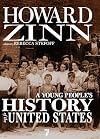
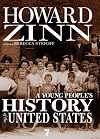
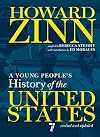
A Young People's History of the United States (For Young People Series)
by Howard Zinn
On This Page
Description
History. Juvenile Nonfiction. Sociology. HTML:A Young People's History of the United States brings to US history the viewpoints of workers, slaves, immigrants, women, Native Americans, and others whose stories, and their impact, are rarely included in books for young people. A Young People's History of the United States is also a companion volume to The People Speak, the film adapted from A People's History of the United States and Voices of a People’s History of the United States.show more Beginning with a look at Christopher Columbus’s arrival through the eyes of the Arawak Indians, then leading the reader through the struggles for workers’ rights, women’s rights, and civil rights during the nineteenth and twentieth centuries, and ending with the current protests against continued American imperialism, Zinn in the volumes of A Young People’s History of the United States presents a radical new way of understanding America’s history. In so doing, he reminds readers that America’s true... show less
Tags
Recommendations








Member Reviews
A history book written from the perspective of the oppressed, "A Young People's History of the United States" provides a shocking account of how war, racism, and economic injustice created America and exponentially increased its power from the days of Columbus to the Spanish American War. This book does not sugarcoat any part of American history to downplay the immense bloodshed and oppression. It is an important to include nontraditional viewpoints in a young adult's learning of American history; such books should be widely read. What I enjoyed most about this book was how it highlighted true heroes such as Batolome de Las Casas and Mark Twain, who denounced the so-called heroes of their day, Columbus and Theodore Roosevelt, show more respectively, who encouraged massacres of innocent people. Personally, I cannot wait to read the original version of this book, which is targeted towards adults. show less
Best selling historian Howard Zinn has taken his seminal "A People's History of the United States" and adapted it for a slightly younger audience. As soon as I saw this book at Barnes and Noble, I knew I wanted to read it for my nonfiction class. I was first introduced to "A People' History" as an undergrad, when my professor gave us the first chapter to read for class. After reading the first chapter, I was hooked, and bought the most recent edition the next time I was at the bookstore. The original version is a masterpiece in American history, told from the point of view of those largely left out of traditional history texts- Columbus' arrival is told from the point of view of the natives of Hispaniola, while later chapters are told show more from the point of view of slaves, union workers, and women. I was greatly influenced by my original reading of "A People's History," so I was excited by the idea that younger students would be able to access Zinn's work for themselves. "A Young People's History" is an excellent book for middle school children, although I think that teachers would likely have to pick certain sections to use as a supplement to the assigned text. Even though "A Young People's History" is much condensed from the original, at 426 pages, it's still rather hefty. For my purposes as a future high school teacher, I would stick with the original version, rather than the "Young People's History," but even then, I'd still have to select certain chapters to use.
I did have one slight issue with "A Young People's History," and that was the lack of source notes or bibliography. Most of the books we read in class this semester offered the reader some sort of guide as to where the author got his or her information. There are slight selections in the text where Zinn gives citations for a a page or two of supplemental information, but the book as a whole has no source notes or end notes, no bibliography, and no suggestions for further reading. I was somewhat bothered by this, as it was one of our main criteria for assessing a book in class, but the more I thought about it, the less worried I became. Typically, sources are cited when they have provided the author new information, or at least I was taught that there was no reason to cite something you already knew, or something that was considered common knowledge. Howard Zinn has a Ph.D. in history, and I think that the information he presents would be considered common knowledge for his level of education. Thus if it is information he already knew, would he need to cite it? I'm not quite sure, but the lack of source notes would not keep me from using this book, if I were to teach middle school. As I said, I would use the original adult version in high school classes, and that version has a twenty page bibliography, so I wouldn't have the same concerns.
The only other problem I could foresee in using "A Young People's History" would potentially be with what some may see as a political slant. There are those who find Zinn's work to be left-leaning, even socialist at times. I think this is an unnecessary concern, as he is just presenting facts (and in the adult version, gives the sources of those facts), but I know that some people may read more into it. Also, I think that any possible political leaning in the original "People's History" is less obvious in the "Young People's History," so I really would not anticipate any real complaints.
Overall, I find this "Young People's History" to be a great introduction to American history for younger students; the book does provide a glossary for unfamiliar terms, as well as a user-friendly index to make connections, so while did take away some points for the lack of source notes (even though I wasn't personally bothered by it), I gave back some points for these features.
I was also pleased to find out about the "Zinn Education Project," which is an online set of resources aimed at helping teachers use the original "People's History" in middle school and high school classrooms. They have lists of other "people's pedagogy" resources, as well as lesson plans to go along with Zinn's work. show less
I did have one slight issue with "A Young People's History," and that was the lack of source notes or bibliography. Most of the books we read in class this semester offered the reader some sort of guide as to where the author got his or her information. There are slight selections in the text where Zinn gives citations for a a page or two of supplemental information, but the book as a whole has no source notes or end notes, no bibliography, and no suggestions for further reading. I was somewhat bothered by this, as it was one of our main criteria for assessing a book in class, but the more I thought about it, the less worried I became. Typically, sources are cited when they have provided the author new information, or at least I was taught that there was no reason to cite something you already knew, or something that was considered common knowledge. Howard Zinn has a Ph.D. in history, and I think that the information he presents would be considered common knowledge for his level of education. Thus if it is information he already knew, would he need to cite it? I'm not quite sure, but the lack of source notes would not keep me from using this book, if I were to teach middle school. As I said, I would use the original adult version in high school classes, and that version has a twenty page bibliography, so I wouldn't have the same concerns.
The only other problem I could foresee in using "A Young People's History" would potentially be with what some may see as a political slant. There are those who find Zinn's work to be left-leaning, even socialist at times. I think this is an unnecessary concern, as he is just presenting facts (and in the adult version, gives the sources of those facts), but I know that some people may read more into it. Also, I think that any possible political leaning in the original "People's History" is less obvious in the "Young People's History," so I really would not anticipate any real complaints.
Overall, I find this "Young People's History" to be a great introduction to American history for younger students; the book does provide a glossary for unfamiliar terms, as well as a user-friendly index to make connections, so while did take away some points for the lack of source notes (even though I wasn't personally bothered by it), I gave back some points for these features.
I was also pleased to find out about the "Zinn Education Project," which is an online set of resources aimed at helping teachers use the original "People's History" in middle school and high school classrooms. They have lists of other "people's pedagogy" resources, as well as lesson plans to go along with Zinn's work. show less
I loved the original A People's History and longed for a way to use it in a high-school setting, and now I've found an adapted version more suitable to a younger audience. It is not just a watered down edited version of the original, but it has also had passages added to it which include the contributions of young people to America's history. It has also had a few scetches and drawings to illustrate the text. I am looking forward to bringing this resource into my classroom and hearing how the students respond to it in relation to their regular textbook.
Important work. Wish he had used the last chapter as the introduction, to give younger readers a better sense of the importance of narrative in the presentation and study of history. Definitely a great springboard for much family discussion and deeper reading.
This text offers a critical look at American history. While it is important to offer students material from every perspective, Howard Zinn's perspective is extremely American-centric. He states that there is no country "in the history of the world" where racism has had such an impact. He belittles the rest of the world with opinions like this. To be fair the text is edited down from the much larger People's History that Zinn has been revising since 1980. The Young People's edit leave out a lot of context and evidence. It covers a wide swath of American history in a short text, so it is far from a complete historical text. Zinn offers the "other" perspective, but from the point-of-view of the dominant class. I don't intend that statement show more as a criticism. show less
I was disappointed in this book. The author(s) (I highly doubt Zinn, himself, produced this) really dumbed the original book down a lot. The result is much more propaganda-feeling, and far less academic.
Ratings
Members
- Recently Added By
Author Information

83+ Works 26,058 Members
A committed radical historian and activist, Howard Zinn approaches the study of the past from the point of view of those whom he feels have been exploited by the powerful. Zinn was born in Brooklyn, New York in 1922. After working in local shipyards during his teens, he joined the U.S. Army Air Force, where he saw combat as a bombardier in World show more War II. He received a Ph.D. in history from Columbia University in 1958 and was a postdoctoral fellow in East Asian studies at Harvard University. While teaching at Spelman College in Atlanta, Georgia, Zinn joined the civil rights movement and wrote The Southern Mystique (1964) and SNCC: The New Abolitionists (1964). He also became an outspoken critic of the Vietnam War, writing Vietnam: The Logic of Withdrawal (1967) and visiting Hanoi to receive the first American prisoners released by the North Vietnamese. Zinn's best-known and most-praised work, as well as his most controversial, is A People's History of the United States (1980). It explores American history under the thesis that most historians have favored those in power, leaving another story untold. Zinn discusses such topics as Native American views of Columbus and the socialist and anarchist opposition to World War I in examining his theory that historical change is most often due to "mass movements of ordinary people." Zinn's other books include You Can't Be Neutral on a Moving Train: A Personal History of Our Times (1995) and Artists in Times of War (2004). He has also written the plays Emma (1976), Daughter of Venus (1985), and Marx in Soho (1999). (Bowker Author Biography) Howard Zinn grew up in the immigrant slums of Brooklyn, where he worked in shipyards in his late teens. He saw combat duty as an air force bombardier in World War II, and afterward received his doctorate in history from Columbia University. His first book, "La Guardia in Congress", was an Albert Beveridge Prize winner. In 1956, he moved with his wife and children to Atlanta to become chairman of the history department of Spelman College. He has since written and edited many more books, including A People's History of the United States, SNCC: The New Abolitionist; Disobedience and Democracy; The Politics of History; The Pentagon Papers: Critical Essays; You Can't Be Neutral on a Moving Train: A Personal History of Our Times; and The Zinn Reader (Seven Stories Press, 1997). Zinn is also the author of three plays, Emma, Daughter of Venus, and Marx in Soho. Among the many honors Zinn has received is the 1998 Lannan Literary Award for nonfiction. A professor emeritus of political science at Boston University, he lives with his wife, Roslyn, in the Boston area, near their children and grandchildren. (Publisher Provided) show less
All Editions
Some Editions
Common Knowledge
- Original publication date
- 2007; 2014
- Important places
- USA
- Dedication
- To all the parents and teachers over the years who have asked for a people's history for young people, and to the younger generation, who we hope will use their talents to make a better world.
- First words
- Arawak men and women came out of their villages onto the beaches.
Introduction: Ever since my book "A People's History of the United States" was published twenty-five years ago, parents and teachers have been asking me about an edition that would be attractive to youngsters. - Last words
- (Click to show. Warning: May contain spoilers.)Women garment workers in New York City, at the start of the twentieth century, gained inspiration for their own movement of resistance from the words of the poet Shelley:
Rise like lions after slumber
In unvanquishable number!
Shake your chains to earth, like dew
Which in sleep had fallen on you--
Ye are many, they are few! - Blurbers
- Menkart, Deborah; Walker, Alice
- Original language
- English
- Disambiguation notice
- Omnibus edition. Do not combine with individual volumes.
ISBN: 9781522694854 1522694854
Classifications
Statistics
- Members
- 539
- Popularity
- 54,992
- Reviews
- 6
- Rating
- (4.10)
- Languages
- English, Turkish
- Media
- Paper, Audiobook, Ebook
- ISBNs
- 6
- ASINs
- 4