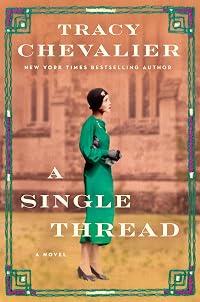
A Single Thread
by Tracy Chevalier
On This Page
Description
1932. After the Great War took both her beloved brother and her fiancé, Violet Speedwell has become a "surplus woman," one of a generation doomed to a life of spinsterhood after the war killed so many young men. Yet Violet cannot reconcile herself to a life spent caring for her grieving, embittered mother. After countless meals of boiled eggs and dry toast, she saves enough to move out of her mother's place and into the town of Winchester, home to one of England's grandest cathedrals. show more There, Violet is drawn into a society of broderers--women who embroider kneelers for the Cathedral, carrying on a centuries-long tradition of bringing comfort to worshippers. Violet finds support and community in the group, fulfillment in the work they create, and even a growing friendship with the vivacious Gilda. But when forces threaten her new independence and another war appears on the horizon, Violet must fight to put down roots in a place where women aren't expected to grow. show lessTags
Recommendations












Member Reviews
Enjoyed this more than I expected. The pursuant, Jack Wells, is so contrived and his encounters with the main character Violet Speedwell so unlikely that it showed its flaws starkly, but sometimes I quite like that - as with Ian McEwen's plots. Chevalier's own plot in this book is a bit wayward, but it was a great romp to relax with and read when I was laid up in bed for a day. It's the second book Ipicked up for its embroidery, and I enjoyed learning about Louisa Pesel and the Winchester broderers - the more so because they're real, and I've since discovered that there's an interesting early piece of stumpwork by a fella in the Winchester College archives.
I wasn't expecting the solo walking holiday, but that part resonated with me. I show more walk a lot in the Highlands alone, and I always felt fine there, threatened only by white-outs and crags and dependent on my own navigation skills. But walking in more populated areas like Sussex, I've had some frightening encounters with predatory blokes because footpaths through fields and woods are far too accessible to ne'er-do-wells. Violet's rising terror, and analysis of her situation ("he wasn't a smiler"), part fear, part introspective private humour, sounded very like the voice in my own head. All her thoughts were a pleasure to read: her pathetic need for the broderers' company, her need to produce something bautiful and leave a mark, her romantic interest in kindly older Arthur, her uncertainty about her stance with the gay couple, and her grass-is-greener responses to being anywhere (!) were fun, together with her actual strengths standing up to her employer or knowing when to cut Arthur loose, wrapped in her general feeling of humility.
Not a great story, like Girl with a Parl Earring, but a worthwhile novel that made for a fun distraction and a nice bit of textile history. show less
I wasn't expecting the solo walking holiday, but that part resonated with me. I show more walk a lot in the Highlands alone, and I always felt fine there, threatened only by white-outs and crags and dependent on my own navigation skills. But walking in more populated areas like Sussex, I've had some frightening encounters with predatory blokes because footpaths through fields and woods are far too accessible to ne'er-do-wells. Violet's rising terror, and analysis of her situation ("he wasn't a smiler"), part fear, part introspective private humour, sounded very like the voice in my own head. All her thoughts were a pleasure to read: her pathetic need for the broderers' company, her need to produce something bautiful and leave a mark, her romantic interest in kindly older Arthur, her uncertainty about her stance with the gay couple, and her grass-is-greener responses to being anywhere (!) were fun, together with her actual strengths standing up to her employer or knowing when to cut Arthur loose, wrapped in her general feeling of humility.
Not a great story, like Girl with a Parl Earring, but a worthwhile novel that made for a fun distraction and a nice bit of textile history. show less
Tracy Chevalier is one of my favourite authors, therefore I was very much looking forward to reading A Single Thread. Who knew that a story about broderers and bell ringers would be so captivating! It’s 1932 and Violet Speedwell moves to Winchester from Southampton, escaping an overbearing mother, to work in an insurance office. She becomes involved and enrols in a group, all with their own secrets, who embroider kneelers and cushions for the cathedral. She also meets married Arthur Knight, a bell ringer, and develops feelings for him.
I thought this was a delightful and thoughtfully written tale of friendship, family and unrequited love. Tracy Chevalier has woven a brilliant story touching on social history during the inter-war show more years. It’s well researched and beautifully combines historical fact with fiction, giving a great sense of time and place. The writing style is wonderful, the author has her own reflective and engaging approach - it easily transported me to the era.
This is a fabulous read, a story to savour, it’s gentle and moving but also contains a hint of something darker and menacing. If you enjoy character based stories, then you can do no better than read this one. I loved it and was sad to turn the last page. show less
I thought this was a delightful and thoughtfully written tale of friendship, family and unrequited love. Tracy Chevalier has woven a brilliant story touching on social history during the inter-war show more years. It’s well researched and beautifully combines historical fact with fiction, giving a great sense of time and place. The writing style is wonderful, the author has her own reflective and engaging approach - it easily transported me to the era.
This is a fabulous read, a story to savour, it’s gentle and moving but also contains a hint of something darker and menacing. If you enjoy character based stories, then you can do no better than read this one. I loved it and was sad to turn the last page. show less
Many moons ago, I completely fell in love with Tracy Chevalier's Girl With a Pearl Earring, therefore it's faintly criminal that I'm only getting back to her as an author again now.
This was a very different book to Girl With a Pearl Earring, but it was fabulous. I'd describe it as a cross between Iris Murdoch's The Bell mixed with Penelope Lively, Barbara Pym and Margaret Drabble. It's a modern book (published in 2019), but is exquisitely written to feel like a book written in the mid 20th century.
Set in 1932, Violet Speedwell has moved to Winchester to escape living with her mother who has become a particularly difficult woman post the death of her husband and especially since the death of her son, Violet's brother, in WWI. Violet show more herself lost her fiancé in the war, and as such is starting from scratch again as a spinster in a new town where she knows few people. Visiting the cathedral one day during a service to commemorate new kneelers embroidered by a local team of broderers, Violet finds herself drawn to join the local broderer group, which opens up new friendships and an impossible romantic interest for the lonely Violet.
I just loved this book from start to finish. Tracy Chevalier is such a talented writer - her writing is tight throughout, and at no point did the book lose my attention. The characters and setting are depicted superbly, and although it's a quiet book in many respects, I was hooked from beginning to end. It was over 11 hours as an audiobook listen, and I could have easily kept going with it for another 11.
4.5 stars - highly recommended. Perfectly executed. show less
This was a very different book to Girl With a Pearl Earring, but it was fabulous. I'd describe it as a cross between Iris Murdoch's The Bell mixed with Penelope Lively, Barbara Pym and Margaret Drabble. It's a modern book (published in 2019), but is exquisitely written to feel like a book written in the mid 20th century.
Set in 1932, Violet Speedwell has moved to Winchester to escape living with her mother who has become a particularly difficult woman post the death of her husband and especially since the death of her son, Violet's brother, in WWI. Violet show more herself lost her fiancé in the war, and as such is starting from scratch again as a spinster in a new town where she knows few people. Visiting the cathedral one day during a service to commemorate new kneelers embroidered by a local team of broderers, Violet finds herself drawn to join the local broderer group, which opens up new friendships and an impossible romantic interest for the lonely Violet.
I just loved this book from start to finish. Tracy Chevalier is such a talented writer - her writing is tight throughout, and at no point did the book lose my attention. The characters and setting are depicted superbly, and although it's a quiet book in many respects, I was hooked from beginning to end. It was over 11 hours as an audiobook listen, and I could have easily kept going with it for another 11.
4.5 stars - highly recommended. Perfectly executed. show less
I am amazed. I’ve read several of Tracy Chevalier's books. I expected yet another historically based story that would be a quick and interesting read. This book is so much more. It’s clearly based in a time and place but it interleaves a well known event, British women having to deal with a world where many of the men they would have married died in World War I and the numbers were clearly against them having a normal life. But along with that she brings to life two lesser known stories of how women were reimaging the beauty of the Winchester Cathedral by creating cushions and kneelers, using needlepoint, to match the grace of their surroundings, and the men who rang the bells in those cathedrals.
But this book hit me personally. show more Bear with me while I take a trip down memory lane. In 1957 I was in Junior High and in Brooklyn kids like me were put into SP, Special Progress, meaning we only spent two years in Junior High rather than the normal three. But that also meant we had only two shop classes and the boys in my class were assigned to Art Weaving rather than metal or wood working. That was for girls so we refused to go along. So the principal came in one day and politely told us, “Deal with it.” So we did. I wound up creating a beautiful sampler of a tree which I framed and have to this day. I understood perfectly Chevalier’s description of the calming effect of working on one of these. Violet, the main character uses these to escape the real world issues she had little control over
Back to the book. Violet has many issues to deal with even beyond being a “surplus woman” as they were called, and the men who took advantage of them. She’s personally lost an older brother and a fiancée to the war and a father to old age and is left with a mother angry at the world and taking it out on Violet. She escapes by getting a typing job in another town and finds a group of women doing embroidery on canvas to supply Winchester Cathedral with kneelers, bench covers, and donation bags. They teach her how to stitch and she finds comfort in their midst. Slowly but surely her world expands to the women and eventually the men who ring the bells. Eventually she finds herself attracted to one of the bellringers, a much older man, living in another town married to a very sick wife. I don’t want to give away the whole story but you can see how this has been set up. She’s got things to deal with and no obvious way out. Stay tuned.
What is extremely impressive is the amount of detail. Violet is emblematic of a whole generation who had to do things like go into a workforce where they could at best achieve acceptance as long as they would put up with low wages. We learn intricate details about what is then considered embroidery on canvas and the types of stitches available. Then there are the details about the magnificent Cathedral and its place in history. There's also a very British approach to holidays spent hiking. There’s more- the ringing of the bells. Who knew how complex and regimented it was. At the end of the book Chevalier acknowledges her debt to many. She immediately lets us know that what is referred to throughout the book as embroidery on canvas is what today call needlepoint. She’s clearly done quite a bit of research and lets us in on the secret. There really was a group of women who had a leader determined to provide beautiful pieces to complement the magnificence of the Cathedral.
This worked on all levels. I highly recommend it. show less
But this book hit me personally. show more Bear with me while I take a trip down memory lane. In 1957 I was in Junior High and in Brooklyn kids like me were put into SP, Special Progress, meaning we only spent two years in Junior High rather than the normal three. But that also meant we had only two shop classes and the boys in my class were assigned to Art Weaving rather than metal or wood working. That was for girls so we refused to go along. So the principal came in one day and politely told us, “Deal with it.” So we did. I wound up creating a beautiful sampler of a tree which I framed and have to this day. I understood perfectly Chevalier’s description of the calming effect of working on one of these. Violet, the main character uses these to escape the real world issues she had little control over
Back to the book. Violet has many issues to deal with even beyond being a “surplus woman” as they were called, and the men who took advantage of them. She’s personally lost an older brother and a fiancée to the war and a father to old age and is left with a mother angry at the world and taking it out on Violet. She escapes by getting a typing job in another town and finds a group of women doing embroidery on canvas to supply Winchester Cathedral with kneelers, bench covers, and donation bags. They teach her how to stitch and she finds comfort in their midst. Slowly but surely her world expands to the women and eventually the men who ring the bells. Eventually she finds herself attracted to one of the bellringers, a much older man, living in another town married to a very sick wife. I don’t want to give away the whole story but you can see how this has been set up. She’s got things to deal with and no obvious way out. Stay tuned.
What is extremely impressive is the amount of detail. Violet is emblematic of a whole generation who had to do things like go into a workforce where they could at best achieve acceptance as long as they would put up with low wages. We learn intricate details about what is then considered embroidery on canvas and the types of stitches available. Then there are the details about the magnificent Cathedral and its place in history. There's also a very British approach to holidays spent hiking. There’s more- the ringing of the bells. Who knew how complex and regimented it was. At the end of the book Chevalier acknowledges her debt to many. She immediately lets us know that what is referred to throughout the book as embroidery on canvas is what today call needlepoint. She’s clearly done quite a bit of research and lets us in on the secret. There really was a group of women who had a leader determined to provide beautiful pieces to complement the magnificence of the Cathedral.
This worked on all levels. I highly recommend it. show less
Not just any author could craft a compelling narrative from embroidery and bellringing, but Tracy Chevalier isn't just any author. The book follows Violet Speedwell, a "surplus woman" after so many men, including her fiancé, were killed in WWI. Violet's been living with her widowed mother, and has had just about enough of her constant complaints and criticisms, so she moves a scant 12 miles away to Winchester, home of the famous Winchester Cathedral (where Jane Austen and many others are buried). As happy as she is to be on her own, she struggles with the challenges of supporting herself (she does have a job, but it barely pays enough for food and a rented room) and finding some kind of social life, all in a world that still doesn't show more look very fondly on women on their own.
On a visit to Winchester Cathedral, Violet stumbles up a Blessing of the Embroidery service, and decides to join the cathedral broderers, who are engaged in a years-long project to embroider new kneelers and cushions for the cathedral. And thus begins Violet's journey of self-discovery. Most of Violet's journey involves learning how to be a friend (this is what leads her to meet the bellringers), how not to be guilted into moving back in to take care of her mother, and, generally speaking, how to be an independent person.
Like all of Chevalier's books, the reader is immersed in the world that she creates with her words. Even the details of embroidery stitches and the difference between ringing a set of 5 bells versus 9 bells is interesting as we learn alongside Violet and see the world opening up in front of her. show less
On a visit to Winchester Cathedral, Violet stumbles up a Blessing of the Embroidery service, and decides to join the cathedral broderers, who are engaged in a years-long project to embroider new kneelers and cushions for the cathedral. And thus begins Violet's journey of self-discovery. Most of Violet's journey involves learning how to be a friend (this is what leads her to meet the bellringers), how not to be guilted into moving back in to take care of her mother, and, generally speaking, how to be an independent person.
Like all of Chevalier's books, the reader is immersed in the world that she creates with her words. Even the details of embroidery stitches and the difference between ringing a set of 5 bells versus 9 bells is interesting as we learn alongside Violet and see the world opening up in front of her. show less
Nothing much happens in A Single Thread by Tracy Chevalier, so why did I fall in love with it? It's not the first time this has happened either. Stoner by John Williams is the slow moving story of an ordinary man and it was such an exquisite portrait of his life that it instantly became an all-time favourite of mine.
Violet Speedwell is the protagonist in A Single Thread and in 1932 she is reeling following the painful loss of her brother and fiance in WWI. Violet decides to leave home and try to make it on her own in Winchester. Life is tough for surplus women and Violet does her best to get by and carve out a life of joy for herself.
While admiring the architecture of the local cathedral, she comes across the work of a group of show more broderers and decides she'd like to make a kneeler. It will be a permanent reminder of her life when she too is gone.
I've often shared Violet's thoughts that when I die, there will be no lasting evidence I was ever here. One of the reasons I love looking at architecture, paintings and needlework is that I can wonder about the hands that painstakingly created these precious objects from the past and imagine the lives their creators lived. I'm sure the desire to create something that might just outlive me was a small part of the reason I started stitching in the first place. Creating a tangible gift for a loved one with your own hands is something special and Violet wants to do this too.
This combination of historical fiction and stitching - along with the unexpected inclusion of bell ringing - was a sure sign I was going to enjoy this novel.
Adding to my reading experience was the fact I suggested this book for a monthly book club on GoodReads called A Stitcher's Book Club. A couple of us read A Single Thread at the same time and I'm sure this added to my overall reading enjoyment.
Containing themes of family, duty, responsibility, post-war culture, grief and expectations of women in society, A Single Thread by Tracy Chevalier was a real feel good read and I heartily enjoyed it. show less
Violet Speedwell is the protagonist in A Single Thread and in 1932 she is reeling following the painful loss of her brother and fiance in WWI. Violet decides to leave home and try to make it on her own in Winchester. Life is tough for surplus women and Violet does her best to get by and carve out a life of joy for herself.
While admiring the architecture of the local cathedral, she comes across the work of a group of show more broderers and decides she'd like to make a kneeler. It will be a permanent reminder of her life when she too is gone.
I've often shared Violet's thoughts that when I die, there will be no lasting evidence I was ever here. One of the reasons I love looking at architecture, paintings and needlework is that I can wonder about the hands that painstakingly created these precious objects from the past and imagine the lives their creators lived. I'm sure the desire to create something that might just outlive me was a small part of the reason I started stitching in the first place. Creating a tangible gift for a loved one with your own hands is something special and Violet wants to do this too.
This combination of historical fiction and stitching - along with the unexpected inclusion of bell ringing - was a sure sign I was going to enjoy this novel.
Adding to my reading experience was the fact I suggested this book for a monthly book club on GoodReads called A Stitcher's Book Club. A couple of us read A Single Thread at the same time and I'm sure this added to my overall reading enjoyment.
Containing themes of family, duty, responsibility, post-war culture, grief and expectations of women in society, A Single Thread by Tracy Chevalier was a real feel good read and I heartily enjoyed it. show less
Do I want to read a new Tracy Chevalier book? It's a no-brainer, I would always say a big resounding yes! She's an incredibly versatile author when you think of her back catalogue and here she is again concentrating on another period in history, this time the more recent history of those difficult interwar years.
Our heroine is Violet Speedwell. Aged 38 when the book opens in 1932, she's one of the surplus women, those who remain spinsters because of the loss of so many men in World War 1. Violet, however, wants to be anything but surplus. She wants to be useful, she wants to be independent, she doesn't want to be confined to looking after her mother for the rest of her life.
Talking of her mother, Mrs Speedwell is a fabulous character, show more full of complaints and poor Violet can do nothing right. I had to smile! I loved Violet though. That hint of steel running through her core made her so courageous in the face of so much adversity. She moves alone to Winchester from Southampton, surviving on fish paste and cress sandwiches, some days forfeiting a hot meal to have the treat of a trip to the pictures, and yet she's doing it, she's branching out alone. It is at Winchester Cathedral that she embarks on a new hobby: she becomes a broderer, part of a group of women embroidering kneelers. It's also in Winchester that she meets someone who is destined to change her future but enough of that - read this book for yourself to find out!
Chevalier has hit just the right tone with this book. The horror of the first war is still hanging over so many people, the losses still just as strong as they were then, and yet Hitler's power in Germany is growing and a second war is looming on the horizon. It's such an interesting time to read about, especially from a woman's point of view, and one of Violet's age.
A Single Thread is a book I wanted to devour but I also wanted to savour every word. The descriptions are so rich and the author has a particular talent for making her characters not only three-dimensional but also completely fascinating. They come to life on the page and are a people-watcher's dream come true.
This is a wonderful read, a gentle one and yet so full of life. It's the perfect read for those of us who enjoy social history, those little details about how people lived their ordinary lives. I found it to be compelling reading and I loved how it ended, uplifting and hopeful for the future. show less
Our heroine is Violet Speedwell. Aged 38 when the book opens in 1932, she's one of the surplus women, those who remain spinsters because of the loss of so many men in World War 1. Violet, however, wants to be anything but surplus. She wants to be useful, she wants to be independent, she doesn't want to be confined to looking after her mother for the rest of her life.
Talking of her mother, Mrs Speedwell is a fabulous character, show more full of complaints and poor Violet can do nothing right. I had to smile! I loved Violet though. That hint of steel running through her core made her so courageous in the face of so much adversity. She moves alone to Winchester from Southampton, surviving on fish paste and cress sandwiches, some days forfeiting a hot meal to have the treat of a trip to the pictures, and yet she's doing it, she's branching out alone. It is at Winchester Cathedral that she embarks on a new hobby: she becomes a broderer, part of a group of women embroidering kneelers. It's also in Winchester that she meets someone who is destined to change her future but enough of that - read this book for yourself to find out!
Chevalier has hit just the right tone with this book. The horror of the first war is still hanging over so many people, the losses still just as strong as they were then, and yet Hitler's power in Germany is growing and a second war is looming on the horizon. It's such an interesting time to read about, especially from a woman's point of view, and one of Violet's age.
A Single Thread is a book I wanted to devour but I also wanted to savour every word. The descriptions are so rich and the author has a particular talent for making her characters not only three-dimensional but also completely fascinating. They come to life on the page and are a people-watcher's dream come true.
This is a wonderful read, a gentle one and yet so full of life. It's the perfect read for those of us who enjoy social history, those little details about how people lived their ordinary lives. I found it to be compelling reading and I loved how it ended, uplifting and hopeful for the future. show less
Members
- Recently Added By
Lists

Top Five Books of 2019
387 works; 111 members

Books Read in 2019
4,052 works; 110 members
Author Information

28+ Works 43,151 Members
Tracy Chevalier was born on October 19, 1962 in Washington, D.C. After receiving a B.A. in English from Oberlin College, she moved to England in 1984 where she worked several years as a reference book editor. Leaving her job in 1993, she began a year-long M.A in creative writing at the University of East Anglia. She is the author of several novels show more including The Virgin Blue, Burning Bright, Remarkable Creatures, and The Last Runaway. Her novel Girl with a Pearl Earring was made into a film starring Colin Firth and Scarlett Johansson. (Bowker Author Biography) show less
Some Editions
Awards and Honors
Series
Belongs to Publisher Series
Gallimard, Folio (7000)
Common Knowledge
- Canonical title
- A Single Thread
- Original title
- A Single Thread
- Original publication date
- 2019-09-17
- People/Characters*
- Violet Speedwell; Gilda Hill; Louisa Pesel; Arthur Knight
- Important places
- Winchester Cathedral, Winchester, Hampshire, England, UK
- Important events
- Post World War I; The rise of Hitler and the Nazis
- Dedication*
- A Morag
- First words
- "Ssh!" Violet Speedwell inarcò le sopracciglia: che bisogno c'era di zittirla, se non aveva neanche aperto bocca?
“SHHH!”
Violet Speedwell frowned. She did not need shushing; she had not said anything. - Quotations
- It was quiet here in the cathedral's attic, without the hubbub of the visitors and worshippers. Violet felt as if she were inside an enormous whale, its ribs the wooden beams.
- Last words
- (Click to show. Warning: May contain spoilers.)Forse tutte e due le cose, pensò Violet.
(Click to show. Warning: May contain spoilers.)Was she looking at her mother’s face, or listening to her father’s bell? When Iris smiled, a wide, toothless grin, Violet thought it might be both. - Original language*
- Inglese
*Some information comes from Common Knowledge in other languages. Click "Edit" for more information.
Classifications
Statistics
- Members
- 1,166
- Popularity
- 21,608
- Reviews
- 76
- Rating
- (3.74)
- Languages
- 6 — Dutch, English, French, German, Italian, Spanish
- Media
- Paper, Audiobook, Ebook
- ISBNs
- 34
- ASINs
- 11