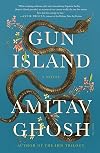
Gun Island
by Amitav Ghosh
On This Page
Description
A dealer of rare books, Dr. Deen Datta is used to a quiet life spent indoors, but as his once-solid beliefs begin to shift, he is forced to set out on an extraordinary journey; one that takes him from India to Los Angeles and Venice via a tangled route through the memories and experiences of those he meets along the way. There is Piya, a fellow Bengali-American who sets his journey in motion; Tipu, an entrepreneurial young man who opens Deen's eyes to the realities of growing up in today's show more world; Rafi, with his desperate attempt to help someone in need; and Cinta, an old friend who provides the missing link in the story they are all a part of. It is a journey that will upend everything he thought he knew about himself, about the Bengali legends of his childhood, and about the world around him. show lessTags
Recommendations
































Member Reviews
I am a sucker for scenes with snakes, and it is the scene in the temple early on that pulled me into this novel. Despite that, though, this novel felt really uneven. There were some beautifully written scenes featuring strange occurrences involving the natural world during the narrator's travels to the Sundarbans, Los Angeles, and Venice, and I actually really liked how the myth slowly became entangled with the present day, but some of the themes felt very heavy-handed, almost didactic, and while there was a lot of explaining, the story never seemed to really gel. Mixed feelings, leaning toward positive.
It’s unusual for me to read a novel while knowing with pretty high confidence what the author is trying to achieve. It certainly looks like Ghosh is following his own advice from [b:The Great Derangement: Climate Change and the Unthinkable|29362082|The Great Derangement Climate Change and the Unthinkable|Amitav Ghosh|https://i.gr-assets.com/images/S/compressed.photo.goodreads.com/books/1462497923l/29362082._SY75_.jpg|49607520], which explores why so little recent literature has examined the current impacts of climate change. There is plenty of futuristic post-apocalyptic so-called cli-fi, but that tends to consist of survivalist thrillers. Ghosh concludes that climate change seems too outlandish and supernatural for contemporary show more fiction, which is preoccupied by individual emotions. In ‘Gun Island’ he seeks to reconcile the two, by depicting climate change as weird and uncanny then delving into his characters’ emotional responses to it. To be perfectly honest, I don’t think the combination always gels, but it’s a really fascinating attempt. Writing fiction about a changing climate that daily life encourages us to studiously ignore is a huge challenge. Ghosh seeks to reconcile unfolding disaster and the daily mundane using a search for a myth that evolves into a quest to help the vulnerable.
The main character, Deen, is a depressive rare book dealer with the extraordinary freedom to drop his whole life in New York and jaunt to Venice or Bangladesh to satisfy his curiosity. His privileged ability to cross borders is contrasted with the refugee characters, Rafi and Tipu, who suffer danger and exploitation in their tortuously slow journey from Bangladesh to Europe. Yet Deen’s skin colour still makes any tiny eccentricity of behaviour suspicious on American aeroplanes. There wasn’t any recognition that Deen’s many transatlantic flights generated massive carbon emissions, though. As someone who isn’t fond of travelling, I find it extraordinary that people can just ignore the destructive waste involved in taking a flight. (I gave up flying in 2008.) I can understand wanting to visit distant family, but Deen’s spur-of-the-moment acceptance of invitations to cross the Atlantic seemed excessive. Anyway, Deen is an interesting and sympathetic protagonist, largely reactive in his behaviour but thoughtful in his contemplation of events. He receives quite a lot of infodumps from various characters, on environmental, humanitarian, and historic topics. These aren’t as gracefully integrated into the narrative as, say, [a:Kim Stanley Robinson|1858|Kim Stanley Robinson|https://images.gr-assets.com/authors/1376955089p2/1858.jpg] manages. Perhaps because literary fiction is not usually required to convey technical information, whereas this is continually necessary in sci-fi. For literary fiction to adequately process climate change, it may need to adopt a more sci-fi-like approach, as by definition the surrounding world is not just a backdrop but a critical part of the narrative. The setting can even become the main character. That said, historical fiction has to do quite a bit of the same work establishing the setting and Ghosh has excellent form as a historical novelist. I enjoyed [b:Sea of Poppies|1330324|Sea of Poppies (Ibis Trilogy, #1)|Amitav Ghosh|https://i.gr-assets.com/images/S/compressed.photo.goodreads.com/books/1327376395l/1330324._SY75_.jpg|1319808] and [b:River of Smoke|9783627|River of Smoke|Amitav Ghosh|https://i.gr-assets.com/images/S/compressed.photo.goodreads.com/books/1310286525l/9783627._SY75_.jpg|14673463] very much. Still, his focus on climate change as uncanny gives ‘Gun Island’ a very different tone to either of them.
What makes ‘Gun Island’ original, I think, is the way that it's actively struggling to understand the contradictions of contemporary life. The refugee crisis, extreme weather events, species extinctions, and neo-fascism all feature prominently, yet so do individual interpersonal dramas and exploration of the titular myth. Reconciling all this tidily would be extraordinarily difficult and I don’t think Ghosh manages it. Not that I’d necessarily expect him tie it all up neatly. There are some very striking scenes in Venice in particular, however I wasn’t very keen on the ending.It is stated in the text to involve a miracle, a deus ex machina. Cinta dies for no apparent reason, which I found odd and unnecessary. Ghosh also employs a trope that I’ve noticed proliferating a lot in media recently (notably the TV show Supergirl!): that a sympathetic interview with an individual can humanise a feared group (refugees in this case) and change collective perceptions. Personally, I do not think that a single video clip going viral can create lasting change. Social media absolutely deluges us in such viral content all day every day, so a surge in positive responses to one item will quickly give way to distraction by the next thing. I assume that Ghosh wanted to give Tipu and Rafi a happy ending, an impulse I can well understand, but that element still felt a little trite. In my view, this trope reflects how submerged we are in social media: we look for solutions to problems that involve publicising some attention-grabbing bit of content. I really think it’s a lot more complicated than that! Maybe Ghosh is also implicitly making this point? Or extending the miracle beyond the natural to the digital realm?
Ending aside, there are moments of beautifully expressed insight scattered throughout ‘Gun Island’. This one really captures something about the anxieties of surveillance capitalism:
Deen’s near-farcical worry that he might live a long life is contrasted very neatly with the risk of sudden death from climate change related freak weather or simple bad luck. Ghosh is particularly adept at exploring the theme of risk and probability, one that could hardly be more relevant to climate change:
I hope more literary authors take up the baton and write novels that examine climate change as sincerely as Ghosh does here. A comparison that occurred to me is Ali Smith’s [b:Spring|40545817|Spring|Ali Smith|https://i.gr-assets.com/images/S/compressed.photo.goodreads.com/books/1529267582l/40545817._SY75_.jpg|62958956], which also explores the refugee crisis and social media with great sensitivity and acuity. I adored [b:Spring|40545817|Spring|Ali Smith|https://i.gr-assets.com/images/S/compressed.photo.goodreads.com/books/1529267582l/40545817._SY75_.jpg|62958956] and wonder if it hung together better than ‘Gun Island’ thanks to its mosaic of narrative points of view. Kim Stanley Robinson’s [b:New York 2140|29570143|New York 2140|Kim Stanley Robinson|https://i.gr-assets.com/images/S/compressed.photo.goodreads.com/books/1471618737l/29570143._SY75_.jpg|49898123], my favourite climate change novel, has much the same structure, whereas ‘Gun Island’ stays in Deen’s first person perspective throughout despite its extensive cast. I wonder how effective a climate change novel can be when narrated by a single individual, even if that individual hears from a variety of other people throughout. Climate change is very emphatically a collective problem that requires us to look far beyond the individual. Not that our individual Western lifestyles won’t have to change to reduce carbon emissions, of course. Still, I think first person is a slightly odd choice for a novel such as this. I wonder if a mixed third person perspective would have lifted ‘Gun Island’ from intriguing to brilliant. show less
The main character, Deen, is a depressive rare book dealer with the extraordinary freedom to drop his whole life in New York and jaunt to Venice or Bangladesh to satisfy his curiosity. His privileged ability to cross borders is contrasted with the refugee characters, Rafi and Tipu, who suffer danger and exploitation in their tortuously slow journey from Bangladesh to Europe. Yet Deen’s skin colour still makes any tiny eccentricity of behaviour suspicious on American aeroplanes. There wasn’t any recognition that Deen’s many transatlantic flights generated massive carbon emissions, though. As someone who isn’t fond of travelling, I find it extraordinary that people can just ignore the destructive waste involved in taking a flight. (I gave up flying in 2008.) I can understand wanting to visit distant family, but Deen’s spur-of-the-moment acceptance of invitations to cross the Atlantic seemed excessive. Anyway, Deen is an interesting and sympathetic protagonist, largely reactive in his behaviour but thoughtful in his contemplation of events. He receives quite a lot of infodumps from various characters, on environmental, humanitarian, and historic topics. These aren’t as gracefully integrated into the narrative as, say, [a:Kim Stanley Robinson|1858|Kim Stanley Robinson|https://images.gr-assets.com/authors/1376955089p2/1858.jpg] manages. Perhaps because literary fiction is not usually required to convey technical information, whereas this is continually necessary in sci-fi. For literary fiction to adequately process climate change, it may need to adopt a more sci-fi-like approach, as by definition the surrounding world is not just a backdrop but a critical part of the narrative. The setting can even become the main character. That said, historical fiction has to do quite a bit of the same work establishing the setting and Ghosh has excellent form as a historical novelist. I enjoyed [b:Sea of Poppies|1330324|Sea of Poppies (Ibis Trilogy, #1)|Amitav Ghosh|https://i.gr-assets.com/images/S/compressed.photo.goodreads.com/books/1327376395l/1330324._SY75_.jpg|1319808] and [b:River of Smoke|9783627|River of Smoke|Amitav Ghosh|https://i.gr-assets.com/images/S/compressed.photo.goodreads.com/books/1310286525l/9783627._SY75_.jpg|14673463] very much. Still, his focus on climate change as uncanny gives ‘Gun Island’ a very different tone to either of them.
What makes ‘Gun Island’ original, I think, is the way that it's actively struggling to understand the contradictions of contemporary life. The refugee crisis, extreme weather events, species extinctions, and neo-fascism all feature prominently, yet so do individual interpersonal dramas and exploration of the titular myth. Reconciling all this tidily would be extraordinarily difficult and I don’t think Ghosh manages it. Not that I’d necessarily expect him tie it all up neatly. There are some very striking scenes in Venice in particular, however I wasn’t very keen on the ending.
Ending aside, there are moments of beautifully expressed insight scattered throughout ‘Gun Island’. This one really captures something about the anxieties of surveillance capitalism:
Now, staring at my dwindling savings, I began to wonder whether this was the fate that awaited me.
Searching for answers, I immersed myself in the statistics and probabilities that were constantly thrust upon me by anonymous robo-messages: how long would I live? How many years would my savings last if I had to be committed to a nursing home?
What if I lived to ninety-five; did I have enough insurance?
I keyed in the question and stared in alarm at the numbers that appeared before me: the odds were good enough that I felt compelled to reach for my credit card. But no sooner had I paid for the extra insurance than another window popped up, displaying the odds of my living to a hundred and three - and I saw, to my dismay, that they were no smaller than those of a passer-by being hit by an icicle falling off my windowsill. And since that was a possibility against which I was already insured, I could think of no good reason not to reach for my credit card again.
But even that brought me no peace of mind: it was as if I were tumbling down a rabbit hole of mathematical uncertainty. I fell into a kind of paralysis, a state of drawn-out, perpetual panic.
Deen’s near-farcical worry that he might live a long life is contrasted very neatly with the risk of sudden death from climate change related freak weather or simple bad luck. Ghosh is particularly adept at exploring the theme of risk and probability, one that could hardly be more relevant to climate change:
But even as this was going through my mind a tremor of doubt crept through me. How could one know? Was there some kind of abacus somewhere that allowed one to determine whether an experience fell into the realm of chance? No, of course not, because any number of inexplicable things could happen without disproving the possibility of their being connected by chance. In this, chance was like God - nothing that happened, no event or eventuality, could either prove or disprove its immanence. And, at the same time, like God, chance provided reassurance, safety, cleanliness, purity. Wasn’t that why chance was so often said to be ‘pure’? - because it flowed over the world like a fresh mountain stream cleansing everything it touched. To cease to believe in it was to cross over into the territory of fate and destiny, devils and demons, spells and miracles - or, more prosaically, into the conspiratorial universe of the paranoiac, where hidden forces decide everything.
I hope more literary authors take up the baton and write novels that examine climate change as sincerely as Ghosh does here. A comparison that occurred to me is Ali Smith’s [b:Spring|40545817|Spring|Ali Smith|https://i.gr-assets.com/images/S/compressed.photo.goodreads.com/books/1529267582l/40545817._SY75_.jpg|62958956], which also explores the refugee crisis and social media with great sensitivity and acuity. I adored [b:Spring|40545817|Spring|Ali Smith|https://i.gr-assets.com/images/S/compressed.photo.goodreads.com/books/1529267582l/40545817._SY75_.jpg|62958956] and wonder if it hung together better than ‘Gun Island’ thanks to its mosaic of narrative points of view. Kim Stanley Robinson’s [b:New York 2140|29570143|New York 2140|Kim Stanley Robinson|https://i.gr-assets.com/images/S/compressed.photo.goodreads.com/books/1471618737l/29570143._SY75_.jpg|49898123], my favourite climate change novel, has much the same structure, whereas ‘Gun Island’ stays in Deen’s first person perspective throughout despite its extensive cast. I wonder how effective a climate change novel can be when narrated by a single individual, even if that individual hears from a variety of other people throughout. Climate change is very emphatically a collective problem that requires us to look far beyond the individual. Not that our individual Western lifestyles won’t have to change to reduce carbon emissions, of course. Still, I think first person is a slightly odd choice for a novel such as this. I wonder if a mixed third person perspective would have lifted ‘Gun Island’ from intriguing to brilliant. show less
”We go about our daily business through habit, as though we were in the grip of forces that have overwhelmed our will; we see shocking and monstrous things happening all around us and we avert our eyes; we surrender ourselves willingly to whatever it is that has us in its power.”
I had previously read Ghosh’s The Hungry Tide, which led me to this book. It is not advertised as a sequel but is set in the same area of the world, the Sundarbans, and features several of the same characters, many years later. Themes include current issues such as migrations and climate change.
Narrator Dinanath "Deen" Datta, a New York-based Bengali American, is an antiquarian book dealer. He believes he is a rational person; however, he encounters what show more appear to be a string of mystical events and struggles to make sense of them. He travels frequently. While in the Sundarbans, he visits a shrine to the mythical snake goddess, Manasa Devi, dedicated by the titular Gun Merchant in the 17th century. The story contains encounters with many venomous creatures, such as snakes and spiders, and cataclysmic weather events, such as tornadoes, violent storms, and floods. The storyline is, intentionally, filled with coincidences.
The writing is strong, but the structure is odd. In a series of fragmented episodes, Deen travels across the world to places such as Venice, Kolkata, Los Angeles, and New York, tracing the legend of the Gun Merchant, which is reenacted in present times. The reader will need to connect the dots. I wish the migration story of displaced persons had been more fleshed out. It takes place in bits and pieces, with lots of “sound bites.” I did not enjoy it as much as The Hungry Tide, which is one of my favorite books, but I will be reading more of Ghosh’s works. show less
I had previously read Ghosh’s The Hungry Tide, which led me to this book. It is not advertised as a sequel but is set in the same area of the world, the Sundarbans, and features several of the same characters, many years later. Themes include current issues such as migrations and climate change.
Narrator Dinanath "Deen" Datta, a New York-based Bengali American, is an antiquarian book dealer. He believes he is a rational person; however, he encounters what show more appear to be a string of mystical events and struggles to make sense of them. He travels frequently. While in the Sundarbans, he visits a shrine to the mythical snake goddess, Manasa Devi, dedicated by the titular Gun Merchant in the 17th century. The story contains encounters with many venomous creatures, such as snakes and spiders, and cataclysmic weather events, such as tornadoes, violent storms, and floods. The storyline is, intentionally, filled with coincidences.
The writing is strong, but the structure is odd. In a series of fragmented episodes, Deen travels across the world to places such as Venice, Kolkata, Los Angeles, and New York, tracing the legend of the Gun Merchant, which is reenacted in present times. The reader will need to connect the dots. I wish the migration story of displaced persons had been more fleshed out. It takes place in bits and pieces, with lots of “sound bites.” I did not enjoy it as much as The Hungry Tide, which is one of my favorite books, but I will be reading more of Ghosh’s works. show less
Amitav Ghosh is one of my favourite authors: I read and liked The Glass Palace (2000) a long time ago, and I was transfixed by his historical fiction trilogy, Ibis. There is so much resentful agenda-driven fiction these days—but Ghosh writes big picture novels that illuminate and clarify rather than blame.
The big picture issue that he tackles in Gun Island is the state of the planet, and climate change in particular. The point that he makes that's new for me, is that we might have reached a tipping point where the unstoppable tide of global commerce makes it impossible to rein in emissions and prevent catastrophe. Whereas in 1987 there was an international agreement to phase out CFCs and there is evidence now that the hole in the show more ozone layer is repairing itself, no such international cooperation is happening now to deal with climate change. The argument Ghosh so elegantly advances in this novel, is that Nature is losing the battle.
But as with his other novels, it's the human story that drives the narrative. His central character Dinnanath Dutta a.k.a. Deen, is a sixty-something dealer in rare books. A Bengali trading in the US, he has failed to establish any firm relationships, and although we learn little about that, it is easy to guess that his mildly pompous, diffident personality has something to do with it. He's not a man to step out of his comfort zone; he is always at the edges of social gatherings and conferences, more of an aloof observer than a participant. The first person narration enables the reader to discern Deen's own attitudes from his lofty description of Kanai:
More annoying to Deen, with a PhD that he's proud of even though he abandoned academia to become a book dealer, is that Kanai knows more about Bengali folklore than he does. Moreover, Deen prides himself on logic and reason, which is why he is irritated to find himself intrigued by Kanai's taunts about the ancient Bengali myth of the Bandooki Sadagar a.k.a. the Gun Merchant who is pursued around the globe by Manasa Devi, the Goddess of Snakes. Each time odd things happen in the novel and are attributed by others to some mystical origin, Deen doesn't argue about it since that's not in his nature, but he interrogates himself and comes firmly to the conclusion that there is always a rational explanation even if it isn't clear at the time. What he learns from the journey that unfolds, is that logic and reason isn't necessarily incompatible with legends, because legends attend to constants in human interactions.
To read the rest of my review please visit https://anzlitlovers.com/2019/08/12/gun-island-by-amitav-ghosh/ show less
The big picture issue that he tackles in Gun Island is the state of the planet, and climate change in particular. The point that he makes that's new for me, is that we might have reached a tipping point where the unstoppable tide of global commerce makes it impossible to rein in emissions and prevent catastrophe. Whereas in 1987 there was an international agreement to phase out CFCs and there is evidence now that the hole in the show more ozone layer is repairing itself, no such international cooperation is happening now to deal with climate change. The argument Ghosh so elegantly advances in this novel, is that Nature is losing the battle.
But as with his other novels, it's the human story that drives the narrative. His central character Dinnanath Dutta a.k.a. Deen, is a sixty-something dealer in rare books. A Bengali trading in the US, he has failed to establish any firm relationships, and although we learn little about that, it is easy to guess that his mildly pompous, diffident personality has something to do with it. He's not a man to step out of his comfort zone; he is always at the edges of social gatherings and conferences, more of an aloof observer than a participant. The first person narration enables the reader to discern Deen's own attitudes from his lofty description of Kanai:
I had just entered the venue — a stuffy colonial-era club — when I was accosted by a distant relative, Kanai Dutt.
I had not seen Kanai in many years, which was not entirely a matter of regret for me: he had always been a glib, vain, precocious know-it-all who relied on his quick tongue and good looks to charm women and get ahead in the world. He lived mainly in New Delhi and had thrived in the hothouse atmosphere of that city, establishing himself as a darling of the media: it was by no means uncommon to turn on the television and find him yelling his head off on a talkshow. He knew everyone, as they say, and was often written about in magazines, newspapers and even books.
The thing that most irritated me about Kanai was that he always found a way of tripping me up. This occasion was no exception; he began by throwing me a curveball in the shape of my childhood nickname, Dinu (which I had long since abandoned in favour of the more American-sounding 'Deen'). (p.5)
More annoying to Deen, with a PhD that he's proud of even though he abandoned academia to become a book dealer, is that Kanai knows more about Bengali folklore than he does. Moreover, Deen prides himself on logic and reason, which is why he is irritated to find himself intrigued by Kanai's taunts about the ancient Bengali myth of the Bandooki Sadagar a.k.a. the Gun Merchant who is pursued around the globe by Manasa Devi, the Goddess of Snakes. Each time odd things happen in the novel and are attributed by others to some mystical origin, Deen doesn't argue about it since that's not in his nature, but he interrogates himself and comes firmly to the conclusion that there is always a rational explanation even if it isn't clear at the time. What he learns from the journey that unfolds, is that logic and reason isn't necessarily incompatible with legends, because legends attend to constants in human interactions.
To read the rest of my review please visit https://anzlitlovers.com/2019/08/12/gun-island-by-amitav-ghosh/ show less
‘”The legend is filled with secrets and if you don’t know their meaning it’s impossible to understand.” And then he added: “But some day, when the time is right, someone will understand it and who knows? For them it may open up a world we cannot see.”’
Approaching his late fifties, rare books dealer Dinanath Datta – known as Deen – is, quite frankly, a bit of a downer, moping about over his failed love life and generally being gloomy. From friends, he learns of the legend of the Gun Merchant and the existence of a mysterious shrine in his native Bengal. The shrine is on an island called Bonduk-dwip, translated as Gun Island. Deen is encouraged to visit the island and from then on everything goes a bit off-piste. His show more adventures involve his friend Piya, with whom a romance may perhaps be possible; the two young men Tipu and Rafi, who embody the migrant spirit; and Cinta, a renowned scholar and long-time acquaintance who helps Deen explore the riddle of the Gun Merchant legend. Travelling across the globe, from New York to Bengal, from Venice to Los Angeles, this is an intelligent, beautifully written book that confronts many of today’s current crises: migrants, global warming and man-made pollution, and mankind’s connection – or lack of – with Nature.
Fittingly, for a book about a legend, it is itself a very meta kind of novel: there are stories within stories, as characters reveal their past (usually prefaced by: ‘it’s a long story’). At one point Deen, a lover of books, of course, reflects back on his childhood fondness for novels: ‘how can any reality match the worlds that exist only in books?’ This aspect of the novel is an interesting one, as Ghosh muses constantly on legends, stories and myths, and the importance they have in individual and cultural identity. But, what it means for this particular novel is that it all felt a little unsure of its own identity; what begins as a fascinating look at the Gun Merchant legend, and how it possibly came about – it transpires that the name of the island shrine could actually mean something else entirely – suddenly becomes a Dan Brownesque chase across the globe, complete with symbols and codes to decipher. There are pretty unbelievable coincidences throughout the book, as Deen just happens to be passing a particular place and bumps into someone he knows, or when he shouts out for help when he and Cinta are in danger, the voice that responds just happens to speak Bangla and, lo and behold, is someone else he has previously met. Tipu, having been bitten by a snake, suddenly starts getting visions and exchanges cryptic messages with Deen…I’m afraid by this point I was getting a little frustrated.
As the book drives towards its climax – a boat chase involving a migrant ship in which all the main characters converge – there are extraordinary, almost supernatural omens and events that suddenly shift the novel into a whole other dimension. And when the book itself directs attention to these events – as characters exclaim ‘I’ve never seen anything like this’ – it all gets a little heavy-handed. Suddenly we are delivered a sermon on global politics, migration and society that felt, well, exactly that: preachy. And then…the end. Just like that. A bit of a damp squib, leaving this particular reader a little vexed at the abruptness.
I am a huge fan of Amitav Ghosh, and the concept of the novel and its examination of myths and stories in modern culture and society was a strong one, but as it developed I felt the book lost its way, tried to become both a code-busting, globe-trotting thriller and a critique of Western attitudes to migrants and climate change, and in doing so lost its impetus. The writing is excellent, but the central character of Deen is a bit of a wet blanket, to be honest, more passive than active. Frustrating is the word I would use for my reaction to finishing this – it could have been so much more, so just an average 3 stars, I’m afraid. show less
Approaching his late fifties, rare books dealer Dinanath Datta – known as Deen – is, quite frankly, a bit of a downer, moping about over his failed love life and generally being gloomy. From friends, he learns of the legend of the Gun Merchant and the existence of a mysterious shrine in his native Bengal. The shrine is on an island called Bonduk-dwip, translated as Gun Island. Deen is encouraged to visit the island and from then on everything goes a bit off-piste. His show more adventures involve his friend Piya, with whom a romance may perhaps be possible; the two young men Tipu and Rafi, who embody the migrant spirit; and Cinta, a renowned scholar and long-time acquaintance who helps Deen explore the riddle of the Gun Merchant legend. Travelling across the globe, from New York to Bengal, from Venice to Los Angeles, this is an intelligent, beautifully written book that confronts many of today’s current crises: migrants, global warming and man-made pollution, and mankind’s connection – or lack of – with Nature.
Fittingly, for a book about a legend, it is itself a very meta kind of novel: there are stories within stories, as characters reveal their past (usually prefaced by: ‘it’s a long story’). At one point Deen, a lover of books, of course, reflects back on his childhood fondness for novels: ‘how can any reality match the worlds that exist only in books?’ This aspect of the novel is an interesting one, as Ghosh muses constantly on legends, stories and myths, and the importance they have in individual and cultural identity. But, what it means for this particular novel is that it all felt a little unsure of its own identity; what begins as a fascinating look at the Gun Merchant legend, and how it possibly came about – it transpires that the name of the island shrine could actually mean something else entirely – suddenly becomes a Dan Brownesque chase across the globe, complete with symbols and codes to decipher. There are pretty unbelievable coincidences throughout the book, as Deen just happens to be passing a particular place and bumps into someone he knows, or when he shouts out for help when he and Cinta are in danger, the voice that responds just happens to speak Bangla and, lo and behold, is someone else he has previously met. Tipu, having been bitten by a snake, suddenly starts getting visions and exchanges cryptic messages with Deen…I’m afraid by this point I was getting a little frustrated.
As the book drives towards its climax – a boat chase involving a migrant ship in which all the main characters converge – there are extraordinary, almost supernatural omens and events that suddenly shift the novel into a whole other dimension. And when the book itself directs attention to these events – as characters exclaim ‘I’ve never seen anything like this’ – it all gets a little heavy-handed. Suddenly we are delivered a sermon on global politics, migration and society that felt, well, exactly that: preachy. And then…the end. Just like that. A bit of a damp squib, leaving this particular reader a little vexed at the abruptness.
I am a huge fan of Amitav Ghosh, and the concept of the novel and its examination of myths and stories in modern culture and society was a strong one, but as it developed I felt the book lost its way, tried to become both a code-busting, globe-trotting thriller and a critique of Western attitudes to migrants and climate change, and in doing so lost its impetus. The writing is excellent, but the central character of Deen is a bit of a wet blanket, to be honest, more passive than active. Frustrating is the word I would use for my reaction to finishing this – it could have been so much more, so just an average 3 stars, I’m afraid. show less
Deen Datta is a rare book dealer in New York who leads a rather uneventful life until one day he runs into a distant family member who tells him an old aunt wants to speak to him about a story she once heard on an island in the Sundarbans. This story seems to be a strange and unheard of version of a myth that is commonly known in eastern India and in Bangladesh. It deals with a rich guy who is on the run for the snake goddess, but wherever he goes, she always finds him. In this version, the rich guy is called the gun merchant.
Deen once wrote his dissertation on this myth, but isn't really interested in this new version. Still, out of politeness, and because he feels attracted to a lady who works for this old aunt, he joins an excursion show more to the temple in the Sundarbans that is associated with the gun merchant. That is the start of a series of adventures where Deen and 2 young guys he meets more or less retrace the route of the gun merchant as far as Venice in Italy.
On the one hand this book has some Dan Brown like qualities mixed with the supernatural atmosphere of one of Ghosh's earlier novels: the Calcutta chromosome. You could see a movie being made of it. On the other hand, the book is about the grand themes of our times: climate change and mass migration. That is a lot to bring together in one story and I fear that it was a bit too much at times.
For this reason I couldn't really go with the flow of the story. I felt that some of the characters were solely added to have a person to explain this or that about the history of Venice, or about climate change. In these parts the book became more of a pamphlet than a novel. And though I am really interested in these themes, I am not really sure if it worked as a novel.
Then again, I am a great fan of Ghosh's writing and enjoyed reading this one too. Especially as I ran into some of the characters from The Hungry Tide again. That felt like meeting old friends! show less
Deen once wrote his dissertation on this myth, but isn't really interested in this new version. Still, out of politeness, and because he feels attracted to a lady who works for this old aunt, he joins an excursion show more to the temple in the Sundarbans that is associated with the gun merchant. That is the start of a series of adventures where Deen and 2 young guys he meets more or less retrace the route of the gun merchant as far as Venice in Italy.
On the one hand this book has some Dan Brown like qualities mixed with the supernatural atmosphere of one of Ghosh's earlier novels: the Calcutta chromosome. You could see a movie being made of it. On the other hand, the book is about the grand themes of our times: climate change and mass migration. That is a lot to bring together in one story and I fear that it was a bit too much at times.
For this reason I couldn't really go with the flow of the story. I felt that some of the characters were solely added to have a person to explain this or that about the history of Venice, or about climate change. In these parts the book became more of a pamphlet than a novel. And though I am really interested in these themes, I am not really sure if it worked as a novel.
Then again, I am a great fan of Ghosh's writing and enjoyed reading this one too. Especially as I ran into some of the characters from The Hungry Tide again. That felt like meeting old friends! show less
I had a love-hate relationship with this book. Too many big themes -- global migration, refugees, environmental pollution, climate change, even historical linguistics on language change -- dealt with cursorily to do any of them justice. Global migration and refugees were better developed (although still wanting) and took precedence for me; the rest was distracting. I enjoyed most of the storytelling -- the mix of folklore, religion, history, and literature that runs throughout, but some of the didactic commentary on environment and climate change and the miraculous spiritual revelation (largely Christian) of the final three pages deflated the novel's strengths.
Members
- Recently Added By
Lists

Books Set in Italy
167 works; 19 members

All Things India
95 works; 21 members

Books Set on Islands
190 works; 24 members

Venice
9 works; 2 members

Beginner's Guide to Climate Fiction
24 works; 7 members

Traveling the world in books
24 works; 1 member

Fiction Published in 2019
35 works; 1 member

World Books
51 works; 4 members

Books Read in 2025
4,128 works; 98 members
Author Information

44+ Works 15,893 Members
Born in Calcutta, and spent his childhood in Bangladesh, Sri Lanka, and Northern India. He studied in Delhi, Oxford, and Egypt and taught at various Indian and American universities. Author of a travel book and three acclaimed novels. Ghosh has also written for GRANTA, THE NEW YORKER, THE NEW YORK TIMES, and THE OBSERVER. He lives in New York City show more with his wife and two children. (Publisher Provided) Amitav Ghosh was born in Calcutta, India on July 11, 1956. He studied in Delhi, Oxford and Alexandria. His first book, The Circle of Reason, won France's Prix Médicis. He has won several other awards including the Sahitya Akademi Award and the Ananda Puraskar for The Shadow Lines, the Arthur C. Clarke award for The Calcutta Chromosome, and the Crossword Book Prize for The Hungry Tide and Sea of Poppies. His other works include In an Antique Land, Dancing in Cambodia, The Glass Palace, and River of Smoke. In 2007, he was awarded the Padma Shri, one of India's highest honors, by the President of India. He made the New Zealand Best Seller List in 2015 with his title Flood of Fire. (Bowker Author Biography) show less
Some Editions
Awards and Honors
Awards
Distinctions
The Guardian Book of the Day (2019-06-05)
Common Knowledge
- Canonical title
- Gun Island
- Original title
- Gun Island
- Original publication date
- 2019-06
- People/Characters
- Deen Datta; Nilima Bose; Piyali Roy; Giacinta Schiavon; Moyna Mandol; Tutul Mandol (show all 8); Horen Naskar; Rafi
- Important places
- Sundarban Islands; Kolkata, India; Venice, Veneto, Italy
- Dedication
- For
Anna Nadotti
and
Irene Bignardi - First words
- Part I
The Gun Merchant
Calcutta
The strangest thing about this strange journey was that it was launched by a word—and not an unusually resonant one either but a banal, commonplace coinage that is in wid... (show all)e circulation, from Cairo to Calcutta. - Last words
- (Click to show. Warning: May contain spoilers.)'We came too late,' she said. 'Cinta's gone.'
- Blurbers
- Proulx, Annie; Mukherjee, Neel; Adams, Matthew; Thomas-Corr, Johanna
- Original language
- English
Classifications
Statistics
- Members
- 409
- Popularity
- 76,072
- Reviews
- 12
- Rating
- (3.67)
- Languages
- 8 — English, French, German, Hindi, Hungarian, Italian, Marathi, Swedish
- Media
- Paper, Audiobook, Ebook
- ISBNs
- 24
- ASINs
- 4