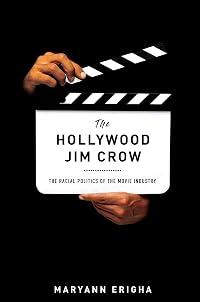
The Hollywood Jim Crow: The Racial Politics of the Movie Industry
by Maryann Erigha
On This Page
Description
The story of racial hierarchy in the American film industry The #OscarsSoWhite campaign, and the content of the leaked Sony emails which revealed, among many other things, that a powerful Hollywood insider didn’t believe that Denzel Washington could “open” a western genre film, provide glaring evidence that the opportunities for people of color in Hollywood are limited. In The Hollywood Jim Crow, Maryann Erigha tells the story of inequality, looking at the practices and biases that show more limit the production and circulation of movies directed by racial minorities. She examines over 1,300 contemporary films, specifically focusing on directors, to show the key elements at work in maintaining “the Hollywood Jim Crow.” Unlike the Jim Crow era where ideas about innate racial inferiority and superiority were the grounds for segregation, Hollywood’s version tries to use economic and cultural explanations to justify the underrepresentation and stigmatization of Black filmmakers. Erigha exposes the key elements at work in maintaining Hollywood’s racial hierarchy, namely the relationship between genre and race, the ghettoization of Black directors to black films, and how Blackness is perceived by the Hollywood producers and studios who decide what gets made and who gets to make it. Erigha questions the notion that increased representation of African Americans behind the camera is the sole answer to the racial inequality gap. Instead, she suggests focusing on the obstacles to integration for African American film directors. Hollywood movies have an expansive reach and exert tremendous power in the national and global production, distribution, and exhibition of popular culture. The Hollywood Jim Crow fully dissects the racial inequality embedded in this industry, looking at alternative ways for African Americans to find success in Hollywood and suggesting how they can band together to forge their own career paths. show lessTags
Recommendations




Member Reviews
Erigha, Maryann. The Hollywood Jim Crow: The Racial Politics of the Movie Industry. New York University Press, 2019.
Historically, African American life has often been unrepresented or misrepresented in Hollywood films. Maryann Erigha’s Hollywood Jim Crow updates the problem through the first two decades of the twenty-first century. While giving Hollywood some credit for some improvement in its hiring practices, she notes that racial exclusion and inequality is still more prevalent in Hollywood than in the television and music industries. She points out that the growing importance of the global audience has been used as an excuse not to feature black actors and directors, unfairly labeling them as unbankable in non-domestic markets. show more One unprofitable film, she argues, is much more likely to stall the career of a black star or director than of whites in comparable positions. It is especially difficult, she says, for a black director to move up from low-budget, independent films to large-budget Hollywood productions, especially the tentpole science fiction blockbusters that studios depend on. Black Panther (2018) stands out, she says, as a notable exception.
She concludes that like the “Jim Crow order of the past, the logic of the Hollywood Jim Crow assumes racial difference, acts on that difference to stratify groups, and produces a result of unequal outcomes.” She advocates the creation of a “Black cinema collective” to form a “structured system of production, distributions, and exhibition that is owned, organized, and operated by African Americans.” Such a collective is a worthwhile endeavor, but I wish Erigha said more about where such an organization would obtain its startup funding. 4 stars. show less
Historically, African American life has often been unrepresented or misrepresented in Hollywood films. Maryann Erigha’s Hollywood Jim Crow updates the problem through the first two decades of the twenty-first century. While giving Hollywood some credit for some improvement in its hiring practices, she notes that racial exclusion and inequality is still more prevalent in Hollywood than in the television and music industries. She points out that the growing importance of the global audience has been used as an excuse not to feature black actors and directors, unfairly labeling them as unbankable in non-domestic markets. show more One unprofitable film, she argues, is much more likely to stall the career of a black star or director than of whites in comparable positions. It is especially difficult, she says, for a black director to move up from low-budget, independent films to large-budget Hollywood productions, especially the tentpole science fiction blockbusters that studios depend on. Black Panther (2018) stands out, she says, as a notable exception.
She concludes that like the “Jim Crow order of the past, the logic of the Hollywood Jim Crow assumes racial difference, acts on that difference to stratify groups, and produces a result of unequal outcomes.” She advocates the creation of a “Black cinema collective” to form a “structured system of production, distributions, and exhibition that is owned, organized, and operated by African Americans.” Such a collective is a worthwhile endeavor, but I wish Erigha said more about where such an organization would obtain its startup funding. 4 stars. show less
Members
- Recently Added By
Lists

BLM
210 works; 1 member
Author Information
1 Work 28 Members
Maryann Erigha is Assistant Professor of Sociology and African American Studies at the University of Georgia.
Classifications
- Genres
- Nonfiction, General Nonfiction, History
- DDC/MDS
- 791.43 — Arts & recreation Recreation, sports, and performing arts Public performances Motion pictures, radio, television, podcasting Motion pictures
- LCC
- PN1995.9 .N4 .E75 — Language and Literature Literature (General) Literature (General) Drama Motion pictures
- BISAC
Statistics
- Members
- 28
- Popularity
- 983,283
- Reviews
- 1
- Rating
- (4.00)
- Languages
- English
- Media
- Paper, Ebook
- ISBNs
- 4
- ASINs
- 1