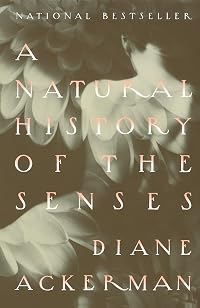
A Natural History of the Senses
by Diane Ackerman
On This Page
Description
Diane Ackerman's lusciously written grand tour of the realm of the senses includes conversations with an iceberg in Antarctica and a professional nose in New York, along with dissertations on kisses and tattoos, sadistic cuisine and the music played by the planet Earth. Delightful - gives the reader the richest possible feeling of the worlds the senses take in.Tags
Recommendations
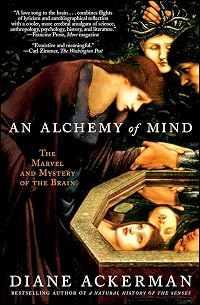
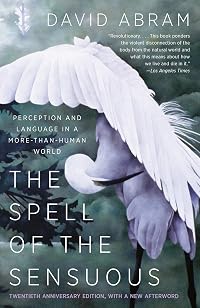
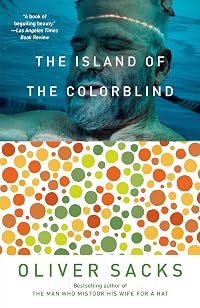




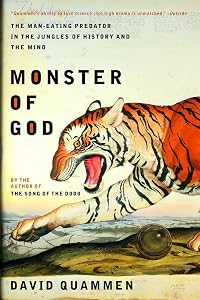
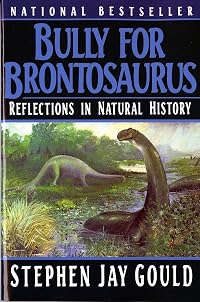
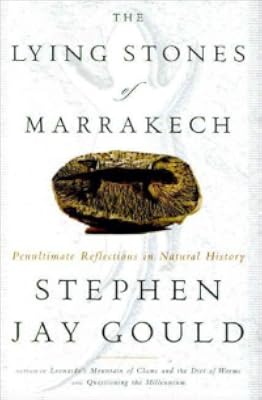
Member Recommendations
Member Reviews
This book is my bible. I've read it a number of times and plan to read it again, and again, and again.
Ackerman sums up her intention for this book wonderfully in her introduction--
"To begin to understand the gorgeous fever that is consciousness, we must try to understand the senses--how they evolved, how they can be extended, what their limits are, to which one we have attached taboos, and what they can teach us about the ravishing world we have the privilege to inhabit."
We are connected to the world around us through our senses. The more aware we are of this connection, the better our appreciation of our world. Awareness improves our focus on our senses and teaches us how to better utilize them. Ackerman improves our awareness by show more exploring each sense from both biological and historical aspects. Ackerman's use of language infuses poetry into these analyses, likened to the experience of exploring an environment.
Your food will taste better and the air will smell sweeter after reading this book. We seem to take our senses for granted when in fact they are one of the keys to happiness and love for life. If anything, this book should be in the self-help section.
Take a deep breath and taste each molecule you take in. The world is a beautiful place. show less
Ackerman sums up her intention for this book wonderfully in her introduction--
"To begin to understand the gorgeous fever that is consciousness, we must try to understand the senses--how they evolved, how they can be extended, what their limits are, to which one we have attached taboos, and what they can teach us about the ravishing world we have the privilege to inhabit."
We are connected to the world around us through our senses. The more aware we are of this connection, the better our appreciation of our world. Awareness improves our focus on our senses and teaches us how to better utilize them. Ackerman improves our awareness by show more exploring each sense from both biological and historical aspects. Ackerman's use of language infuses poetry into these analyses, likened to the experience of exploring an environment.
Your food will taste better and the air will smell sweeter after reading this book. We seem to take our senses for granted when in fact they are one of the keys to happiness and love for life. If anything, this book should be in the self-help section.
Take a deep breath and taste each molecule you take in. The world is a beautiful place. show less
I never like to give a bad review. It seems mean to the author and to those who like the book. However, in this case, someone should, just for balance.
This book was just a painful slog for me. If a friend hadn't recommended it so highly, I would have blessedly abandoned it. I finished it, finally, but found no there there. Reading it was like being stuck for weeks -- perhaps on a cruise to the Antarctic or at a summer job on a New Mexican ranch -- with a self-indulgent, self-centered 18-year-old girl who likes to recite why she was voted most likely to succeed and editor of the literary magazine at her competitive suburban high school.
Ackerman slathers purple prose alternately over strings of quotations dug up from better writers on the show more five senses, and -- and this is much worse -- pretentious personal anecdotes like her cruise to the Antarctic or her job on a "working cattle ranch" in New Mexico.
Her mode of nature writing, or science writing, or whatever this book purports to be, is to make an assertion that she attributes to "us," and then to puncture this alleged trope with recitations from a high school science textbook. Yes, the sky is not really blue, it just looks blue. This is not actually a revelation for most educated people.
Her language is overwrought. Her demonstrations of alleged poetic sensibility are transparent pleas for admiration. Her attempts on nearly every page to show herself as an epicurean of everything -- kissing! cold water! -- would embarrass anyone with a modicum of modesty or perspective, much less the actual Epicurius.
I wanted to give it one star, but I am reserving that for, I don't know, a fascist text, should I ever be forced to read one. So, two stars, in honor of the ten or so pages I found actually interesting. They were about other people, of course, that being artists with vision problems.
TLDR? Not quick. Not enjoyable. Not illuminating. Not worth it. show less
This book was just a painful slog for me. If a friend hadn't recommended it so highly, I would have blessedly abandoned it. I finished it, finally, but found no there there. Reading it was like being stuck for weeks -- perhaps on a cruise to the Antarctic or at a summer job on a New Mexican ranch -- with a self-indulgent, self-centered 18-year-old girl who likes to recite why she was voted most likely to succeed and editor of the literary magazine at her competitive suburban high school.
Ackerman slathers purple prose alternately over strings of quotations dug up from better writers on the show more five senses, and -- and this is much worse -- pretentious personal anecdotes like her cruise to the Antarctic or her job on a "working cattle ranch" in New Mexico.
Her mode of nature writing, or science writing, or whatever this book purports to be, is to make an assertion that she attributes to "us," and then to puncture this alleged trope with recitations from a high school science textbook. Yes, the sky is not really blue, it just looks blue. This is not actually a revelation for most educated people.
Her language is overwrought. Her demonstrations of alleged poetic sensibility are transparent pleas for admiration. Her attempts on nearly every page to show herself as an epicurean of everything -- kissing! cold water! -- would embarrass anyone with a modicum of modesty or perspective, much less the actual Epicurius.
I wanted to give it one star, but I am reserving that for, I don't know, a fascist text, should I ever be forced to read one. So, two stars, in honor of the ten or so pages I found actually interesting. They were about other people, of course, that being artists with vision problems.
TLDR? Not quick. Not enjoyable. Not illuminating. Not worth it. show less
In A Natural History of the Senses Diane Ackerman has produced a densely populated compendium of scientific, artistic, and emotional details related to smell, touch, taste, sound, sight, and synesthesia. She doesn’t occupy herself with any one aspect of each sense for long, always moving on, wanting not to deprive you of anything she knows. If the devil is in the details then there’s much deviltry in her book.
There’s also, to my surprise, much that pleases. The first time I tried the book I had put it aside, unwilling to sit with it any longer, resorting finally to reading random pages until the desire to do even that died. Its feasts of “sensuist” experiences seemed so much excess, the act of reading it work providing little show more that inspired. I’d think: I’d be exhausted if my senses, any of them, were keyed up as much as all of Diane Ackerman’s are seemingly all of the time. She speaks of the SHOCKING green of chlorophyll. Shocking?
And yet now, coming to the book again a quarter century later, it’s all so much more impressive. I even found her provoking me to make small resolutions. Examples of notes to self:
—She is moved to tears by Eucalyptus smells . . . We have plenty of these trees around here. Find a few, stick my nose near or against them, and see what happens.
—She hears the sound of waves breaking on the beach in a way others do not . . . I live near the ocean. Head on over there and do as she instructs: press ear against sand and listen.
Yep. I’ve come to my senses. A Natural History of the Senses inspires. show less
There’s also, to my surprise, much that pleases. The first time I tried the book I had put it aside, unwilling to sit with it any longer, resorting finally to reading random pages until the desire to do even that died. Its feasts of “sensuist” experiences seemed so much excess, the act of reading it work providing little show more that inspired. I’d think: I’d be exhausted if my senses, any of them, were keyed up as much as all of Diane Ackerman’s are seemingly all of the time. She speaks of the SHOCKING green of chlorophyll. Shocking?
And yet now, coming to the book again a quarter century later, it’s all so much more impressive. I even found her provoking me to make small resolutions. Examples of notes to self:
—She is moved to tears by Eucalyptus smells . . . We have plenty of these trees around here. Find a few, stick my nose near or against them, and see what happens.
—She hears the sound of waves breaking on the beach in a way others do not . . . I live near the ocean. Head on over there and do as she instructs: press ear against sand and listen.
Yep. I’ve come to my senses. A Natural History of the Senses inspires. show less
This book is a delightful romp through the senses. While Diane Ackerman weaves in and out of the biological aspects of the human senses, she takes us through a ride. The ride takes us through our senses' role in literature, life, human relations, art, and many aspects of human endeavor.
Diane's book is a joyous romp, but don't read it in one sitting. If you wish to discover little worlds you have forgotten, read one chapter daily. Savour the material and let it sink in.
Remember, this book is not a thriller. Enjoy it and read it again after a few years.
Diane's book is a joyous romp, but don't read it in one sitting. If you wish to discover little worlds you have forgotten, read one chapter daily. Savour the material and let it sink in.
Remember, this book is not a thriller. Enjoy it and read it again after a few years.
This went back and forth from being fascinating to being something of a slog. Ackerman meanders through facts, histories, and her personal experiences as they relate to the five senses, covering a wide range of topics.
The author is a poet—and I’m not a big fan of modern poetry—and that really came through in certain sections. Sometimes I really liked the way she turned a phrase, like this one, toward the end of the book.
But often enough, I just felt like I was punching my way through lots and lots of words.
I’m glad I read it—I never would have known about miraculous show more fruit or the greater honeyguide and lots of cool other things if I hadn’t. On the other hand, if I’d never read it, I never would have heard of the sadistic cook Mizald, who I imagine has been burning in hell these many years.
Anyway.
This was written about 30 years ago, and I don’t know if the way she referenced her sources was typical or not. She’s got a Further Reading section at the end, listing the books she used for research (presumably), but there are no footnotes or endnotes with more specific citations. I looked things up that I cared enough about to verify.
I heard about this book from a brief reference in The Other End of the Leash, and thought it sounded intriguing. Lots of it was, but if I were a skimmer, I probably would have had a better reading experience. show less
The author is a poet—and I’m not a big fan of modern poetry—and that really came through in certain sections. Sometimes I really liked the way she turned a phrase, like this one, toward the end of the book.
What a strange lot writers are, we questers after the perfect word, the glorious phrase that will somehow make the exquisite avalanche of consciousness sayable.
But often enough, I just felt like I was punching my way through lots and lots of words.
I’m glad I read it—I never would have known about miraculous show more fruit or the greater honeyguide and lots of cool other things if I hadn’t. On the other hand, if I’d never read it, I never would have heard of the sadistic cook Mizald, who I imagine has been burning in hell these many years.
Anyway.
This was written about 30 years ago, and I don’t know if the way she referenced her sources was typical or not. She’s got a Further Reading section at the end, listing the books she used for research (presumably), but there are no footnotes or endnotes with more specific citations. I looked things up that I cared enough about to verify.
I heard about this book from a brief reference in The Other End of the Leash, and thought it sounded intriguing. Lots of it was, but if I were a skimmer, I probably would have had a better reading experience. show less
If I had to keep only one non-fiction book out of my whole collection, this would be the one. Ms. Ackerman writes beautifully, leaving you hungry for more. She has a fantastic way of interweaving fact, poetry, anecdote, and humor. I read it way too fast, and had to go back for more.
Diane Ackerman's historical, scientific, and cultural journey through our senses is one of the most engaging books I've enjoyed. Her research, combined with her impeccable use of language brings the subject to light in a wonderful way. I was spellbound...and then would laugh out loud.
Members
- Recently Added By
Lists

Non-fiction that you shouldn't waste your time on
45 works; 15 members

500 Great Books by Women
507 works; 60 members

Authors from the United States
245 works; 3 members

Books Read in 2010
631 works; 10 members

Literary Works Read in College
316 works; 15 members

Books You Read For University
184 works; 3 members
Author Information

Diane Ackerman was born on October 7, 1948 in Waukegan, Illinois. She received a B.A. in English from Pennsylvania State University and her M.A., M.F.A., and Ph.D. in English from Cornell University. Poet, author, educator, adventurer, and naturalist, she tries to bridge science and art in her writing, exploring questions of who we are, where we show more come from, and how we fit into the fabric of the world. She has written many books of poetry including The Planets: A Cosmic Pastoral; Wife of Light; Jaguar of Sweet Laughter: New and Selected Poems; Origami Bridges: Poems of Psychoanalysis and Fire; and I Praise My Destroyer. Her nonfiction works include A Natural History of the Senses; A Natural History of Love; The Moon by Whale Light: And Other Adventures Among Bats, Crocodilians, Penguins, and Whales; An Alchemy of Mind; and On Extended Wings. She also writes nature books for children including Animal Sense; Monk Seal Hideaway; and Bats: Shadows in the Night. She is coeditor of a Norton anthology, The Book of Love. Her essays about nature and human nature have appeared in Parade, National Geographic, The New York Times, and The New Yorker magazines. She hosted a five-hour PBS television series inspired by A Natural History of the Senses. She received the Orion Book Award for The Zookeepers Wife. Her other awards include the Abbie Copps Poetry Prize, Black Warrior Poetry Prize, Pushcart Prize, Peter I. B. Lavan award, and the Wordsmith award. She has taught at a variety of universities, including Columbia and Cornell. (Bowker Author Biography) show less
Some Editions
Awards and Honors
Common Knowledge
- Original title
- A Natural History of the Senses
- Original publication date
- 1990
- People/Characters
- Clarissa Vaughan; Virginia Woolf; Laura Brown
- Important places
- New York, New York, USA; London, England, UK; Los Angeles, California, USA
- Important events
- Virginia Woolf's suicide
- Epigraph
- The initial mystery that attends any journey is: how did the traveller reach his starting point in the first place? How did I reach the window, the walls, the fireplace, the room itself; how do I happen to be beneath this cei... (show all)ling and above this floor? Oh, that is a matter for conjecture, for argument pro and con, for research, supposition, dialectic! I can hardly remember how. Unlike Livingstone, on the verge of darkest Africa, I have no maps to hand, no globe of the terrestrial or the celestial spheres, no chart of mountains, lakes, no sextant, no artificial horizon. If ever I possessed a compass, it has long since disappeared. There must be, however, some reasonable explanation for my presence here. Some step started me toward this point, as opposed to all other points on the habitable globe. I must consider; I must discover it.
—Louise Bogan, Journey Around My Room
A mind that is stretched to a new idea never returns to its original dimension.
—Oliver Wendell Holmes - First words
- How sense-luscious the world is.
- Last words
- (Click to show. Warning: May contain spoilers.)It began in mystery, and it will end in mystery, but what a savage and beautiful country lies in between.
- Original language
- English
Classifications
Statistics
- Members
- 3,169
- Popularity
- 5,521
- Reviews
- 35
- Rating
- (4.14)
- Languages
- 13 — Chinese, Danish, Dutch, English, Estonian, Finnish, French, German, Italian, Portuguese, Slovenian, Spanish, Swedish
- Media
- Paper, Audiobook, Ebook
- ISBNs
- 32
- ASINs
- 9