169 Members (3.55)
On This Page
Description
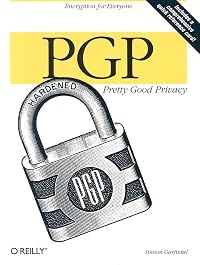
Use of the Internet is expanding beyond anyone's expectations. As corporations, government offices, and ordinary citizens begin to rely on the information highway to conduct business, they are realizing how important it is to protect their communications -- both to keep them a secret from prying eyes and to ensure that they are not altered during transmission. Encryption, which until recently was an esoteric field of interest only to spies, the military, and a few academics, provides a show more mechanism for doing this.PGP, which stands for Pretty Good Privacy, is a free and widely available encryption program that lets you protect files and electronic mail. Written by Phil Zimmermann and released in 1991, PGP works on virtually every platform and has become very popular both in the U.S. and abroad. Because it uses state-of-the-art public key cryptography, PGP can be used to authenticate messages, as well as keep them secret. With PGP, you can digitally "sign" a message when you send it. By checking the digital signature at the other end, the recipient can be sure that the message was not changed during transmission and that the message actually came from you.PGP offers a popular alternative to U.S. government initiatives like the Clipper Chip because, unlike Clipper, it does not allow the government or any other outside agency access to your secret keys.PGP: Pretty Good Privacy by Simson Garfinkel is both a readable technical user's guide and a fascinating behind-the-scenes look at cryptography and privacy. Part I, "PGP Overview," introduces PGP and the cryptography that underlies it. Part II, "Cryptography History and Policy," describes the history of PGP -- its personalities, legal battles, and other intrigues; it also provides background on the battles over public key cryptography patents and the U.S. government export restrictions, and other aspects of the ongoing public debates about privacy and free speech. Part III, "Using PGP," describes how to use PGP: protecting files and email, creating and using keys, signing messages, certifying and distributing keys, and using key servers. Part IV, "Appendices," describes how to obtain PGP from Internet sites, how to install it on PCs, UNIX systems, and the Macintosh, and other background information. The book also contains a glossary, a bibliography, and a handy reference card that summarizes all of the PGP commands, environment variables, and configuration variables. show lessTags
Recommendations
















Member Recommendations


Member Reviews
Members
- Recently Added By
Author Information

Simson L. Garfinkel is a freelance writer, computer entrepreneur, and columnist for the Boston Globe. His articles have appeared in more than fifty publications, including ComputerWorld, Forbes, the New York Times, and Technology Review. Hal Abelson is Class of 1922 Professor in the Department of Electrical Engineering and Computer Science at the show more Massachusetts Institute of Technology. show less
Series

Common Knowledge
- People/Characters
- Phil Zimmermann; James Bidzos
- Dedication
- On the afternoon of October 16, 1994, in the courtyard of the Harvard University Hillel Foundation, I was wed to Elisabeth C. Rosenberg. Although the preparation of this book did interfere with the planning of our nuptials, ... (show all)I have promised Beth that it will not interfere with our honeymoon in Israel. After we return from the Promised Land, I hope that my new wife will look at this dedication to her--and smile.
S.L.G. to E.C.R., October 16, 1994 - First words
- 1994 was not a good year for privacy in the United States.
- Last words
- (Click to show. Warning: May contain spoilers.)Once again, the first number that passed one round of Fermat's test passed all four.
Classifications
- Genres
- Technology, Nonfiction, General Nonfiction
- DDC/MDS
- 005.82 — Computer science, information & general works Computer science, knowledge & systems Artificial Intelligence/Virtual Reality Computer Security Cryptography and Steganography
- LCC
- QA76.9 .A25 .G36 — Science Mathematics Mathematics Instruments and machines Calculating machines Electronic computers. Computer science
- BISAC
Statistics
- Members
- 169
- Popularity
- 193,901
- Rating
- (3.55)
- Languages
- Czech, English, French, German
- Media
- Paper, Ebook
- ISBNs
- 5
- UPCs
- 1