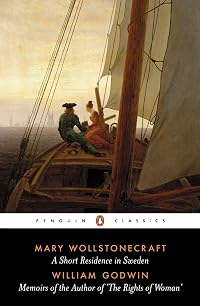
A Short Residence in Sweden, Norway, and Denmark and Memoirs of the Author of 'The Rights of Woman'
by Mary Wollstonecraft, William Godwin
On This Page
Description
In these two closely linked works - a travel book and a biography of its author - we witness a moving encounter between two of the most daring and original minds of the late eighteenth century: A Short Residence in Sweden is the record of Wollstonecraft's last journey in search of happiness, into the remote and beautiful backwoods of Scandinavia. The quest for a lost treasure ship, the pain of a wrecked love affair, memories of the French Revolution, and the longing for some Golden Age, all show more shape this vivid narrative, which Richard Holmes argues is one of the neglected masterpieces of early English Romanticism. Memoirs is Godwin's own account of Wollstonecraft's life, written with passionate intensity a few weeks after her tragic death. Casting aside literary convention, Godwin creates an intimate portrait of his wife, startling in its candour and psychological truth. Received with outrage by friends and critics alike, and virtually suppressed for a century, it can now be recognized as one of the landmarks in the development of modern biography. show lessTags
Recommendations








Member Reviews
I've been wanting to read these two texts for ages, and I have no idea what took me so long to finally sit down with them. Wollstonecraft's Short Residence is fascinating, and the excellent introduction by Richard Holmes provides important contextualization to the work. Godwin's Memoirs are a poignant testament to a life unconventionally lived. Much deserving of a wider audience.
This edition of Penguin Classics bring together two short works, namely Letters written during a short residence in Sweden, Norway, and Denmark by Mary Wollstonecraft and Memoirs of the author of A vindication of the rights of woman by William Godwin, her husband.
The Letters written during a short residence in Sweden, Norway, and Denmark is a collection of letters written by Mary Wollstonecraft during a voyage to Skandinavia. There are beautiful descriptions of landscapes, nature and the places she visits. According to the introduction by Richard Holmes this voyage to Skandinavia was no trip for mere pleasure. Holmes convincingly makes the case that Mary Wollstonecraft undertook the trip to search for a cargo of plate silver, valued at show more a fortune, on behalf of her lover, Gilbert Imlay. The silver originated from confiscated goods during the French Revolution. Dealing with and shipping such cargo was illegal, and the captain made away with the cargo and disappeared. The introduction suggests that she searched for the cargo and successfully negotiated a deal for its return.
In the letters themselves there is never any mention of business dealings. Holmes underlines the point to emphasize how remarkable a woman Mary Wollstonecraft was in her time. Undertaking such a journey with such a mission was certainly not free from danger.
After the death of Mary Wollstonecraft her husband, the writer William Godwin wrote a short memoir describing her life. Mary Wollstonecraft was a feminist, in favor of free love. She had a passionate love affair and a child with the American Gilbert Imlay during the French Revolution in Paris. She is most well known for her A vindication of the rights of woman.
She later married Wlliam Godwin and had a second daughter with him, the later Mary Shelley.
Godwin's honest and truthful memoir caused a scandal upon publication.
Richard Holmes is an expert on writers and history of the late 18th and early 19th century. It is obvious that his 55 page introduction to the Penguin Classics edition far exceeds the normal needs of an introduction. The introductory essay should be considered a third work in this edition. It is a speculative essay on the biography and the purpose of Wollstonecraft's trip to Skandinavia.
Although the letters are not so spectacular, the edition with Holmes essay and Godwin's memoir makes this a very interesting book. Highly recommended. show less
The Letters written during a short residence in Sweden, Norway, and Denmark is a collection of letters written by Mary Wollstonecraft during a voyage to Skandinavia. There are beautiful descriptions of landscapes, nature and the places she visits. According to the introduction by Richard Holmes this voyage to Skandinavia was no trip for mere pleasure. Holmes convincingly makes the case that Mary Wollstonecraft undertook the trip to search for a cargo of plate silver, valued at show more a fortune, on behalf of her lover, Gilbert Imlay. The silver originated from confiscated goods during the French Revolution. Dealing with and shipping such cargo was illegal, and the captain made away with the cargo and disappeared. The introduction suggests that she searched for the cargo and successfully negotiated a deal for its return.
In the letters themselves there is never any mention of business dealings. Holmes underlines the point to emphasize how remarkable a woman Mary Wollstonecraft was in her time. Undertaking such a journey with such a mission was certainly not free from danger.
After the death of Mary Wollstonecraft her husband, the writer William Godwin wrote a short memoir describing her life. Mary Wollstonecraft was a feminist, in favor of free love. She had a passionate love affair and a child with the American Gilbert Imlay during the French Revolution in Paris. She is most well known for her A vindication of the rights of woman.
She later married Wlliam Godwin and had a second daughter with him, the later Mary Shelley.
Godwin's honest and truthful memoir caused a scandal upon publication.
Richard Holmes is an expert on writers and history of the late 18th and early 19th century. It is obvious that his 55 page introduction to the Penguin Classics edition far exceeds the normal needs of an introduction. The introductory essay should be considered a third work in this edition. It is a speculative essay on the biography and the purpose of Wollstonecraft's trip to Skandinavia.
Although the letters are not so spectacular, the edition with Holmes essay and Godwin's memoir makes this a very interesting book. Highly recommended. show less
In these two closely linked works - a travel book and a biography of its author - we witness a moving encounter between two of the most daring and original minds of the late eighteenth century: A Short Residence in Sweden is the record of Wollstonecraft's last journey in search of happiness, into the remote and beautiful backwoods of Scandinavia. The quest for a lost treasure ship, the pain of a wrecked love affair, memories of the French Revolution, and the longing for some Golden Age, all shape this vivid narrative, which Richard Holmes argues is one of the neglected masterpieces of early English Romanticism. Memoirs is Godwin's own account of Wollstonecraft's life, written with passionate intensity a few weeks after her tragic death. show more Casting aside literary convention, Godwin creates an intimate portrait of his wife, startling in its candour and psychological truth. Received with outrage by friends and critics alike, and virtually suppressed for a century, it can now be recognized as one of the landmarks in the development of modern biography. show less
The Penguin edition contains a long introduction by Richard Holmes, a kind of detective story in which he traces and teases out the reasons for Wollstonecraft's journey. Fascinating. Can it really be true that she was searching for a treasure-ship?
Ratings
Members
- Recently Added By
Lists

Best of Travel Narratives
142 works; 28 members
Author Information

51+ Works 7,921 Members
Mary Wollstonecraft was born in London on April 27, 1759. She opened a school in Newington Green with her sister Eliza and a friend Fanny Blood in 1784. Her experiences lead her to attack traditional teaching methods and suggested new topics of study in Thoughts on the Education of Girls. In 1792, she published A Vindication of the Rights of show more Woman, in which she attacked the educational restrictions that kept women ignorant and dependant on men as well as describing marriage as legal prostitution. In Maria or the Wrongs of Woman, published unfinished in 1798, she asserted that women had strong sexual desires and that it was degrading and immoral to pretend otherwise. In 1793, Wollstonecraft became involved with American writer Gilbert Imlay and had a daughter named Fanny. After this relationship ended, she married William Godwin in March 1797 and had a daughter named Mary in August. Wollstonecraft died from complications following childbirth on September 10, 1797. Her daughter Mary later married Percy Bysshe Shelley and wrote Frankenstein. (Bowker Author Biography) show less

67+ Works 2,354 Members
Writer William Godwin was born in Wisbech, Cambridgeshire on March 3, 1756. He attended Hoxton Presbyterian College and became a minister. He left the ministry in 1787 in order to become a full-time writer. His best-known works are Enquiry Concerning Political Justice (1793) and The Adventures of Caleb Williams (1794). In 1797, he married feminist show more writer Mary Wollstonecraft and they had a child who later became known as Mary Wollstonecraft Shelley the author of Frankenstein. He primarily wrote novels during his later years, including Mandeville (1817), Cloudesley (1830) and Deloraine (1833). He died on April 7, 1836. (Bowker Author Biography) show less
Some Editions
Series
Belongs to Publisher Series
Work Relationships
Common Knowledge
- Canonical title
- A Short Residence in Sweden, Norway, and Denmark and Memoirs of the Author of 'The Rights of Woman'
- Original title
- A Short Residence in Sweden, Norway, and Demark (1796) (1796); Memoirs of the Author of ‘The Rights of Woman’ (1798) (1798)
- Original publication date
- 1796
- People/Characters
- Mary Wollstonecraft; William Godwin; Mary Wollstonecraft Shelley; Fanny Imlay
- Important places
- Sweden; Norway; Denmark
- First words
- This book brings together two forgotten classics of English eighteenth-century non-fiction.
- Last words
- (Click to show. Warning: May contain spoilers.)While I have described the improvement I was in the act of receiving, I believe I have put down the leading traits of her intellectual character.
Classifications
- Genres
- Travel, Biography & Memoir, Literature Studies and Criticism
- DDC/MDS
- 828.603 — Literature & rhetoric English & Old English literatures English miscellaneous writings English miscellaneous writings 1745-1799
- LCC
- PR5841 .W8 .Z475 — Language and Literature English English Literature 19th century , 1770/1800-1890/1900
- BISAC
Statistics
- Members
- 174
- Popularity
- 188,625
- Reviews
- 4
- Rating
- (3.88)
- Languages
- English, Swedish
- Media
- Paper, Ebook
- ISBNs
- 2
- ASINs
- 1