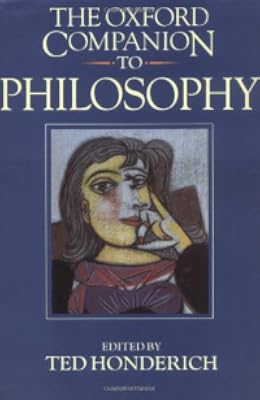
The Oxford Companion to Philosophy
by Ted Honderich (Editor)
On This Page
Description
Philosophy can be intriguing--and at times baffling. It deals with the central problems of the human condition--with important questions of free will, morality, life after death, the limits of logic and reason--though often in rather esoteric terms. Now, in The Oxford Companion to Philosophy, readers have the most authoritative and engaging one-volume reference work on philosophy available, offering clear and reliable guidance to the ideas of all notable philosophers from antiquity to the show more present day, and to the major philosophical systems around the globe, from Confucianism to phenomenology. Here is indeed a world of thought, with entries on idealism and empiricism, ethics and aesthetics, epicureanism and stoicism, deism and pantheism, liberalism and conservativism, logical positivism and existentialism--over two thousand entries in all. The contributors represent a veritable who's who of modern philosophy, including such eminent figures as Isaiah Berlin, Sissela Bok, Ronald Dworkin, John Searle, Michael Walzer, and W.V. Quine. We read Paul Feyerabend on the history of the philosophy of science, Peter Singer on Hegel, Anthony Kenny on Frege, and Anthony Quinton on philosophy itself. We meet the great thinkers--from Aristotle and Plato, to Augustine and Aquinas, to Descartes and Kant, to Nietzsche and Schopenhauer, right up to contemporary thinkers such as Richard Rorty, Jacques Derrida, Luce Iragaray, and Noam Chomsky (over 150 living philosophers are profiled). There are short entries on key concepts such as personal identity and the mind-body problem, major doctrines from utilitarianism to Marxism, schools of thought such as the Heidelberg School or the Vienna Circle, and contentious public issues such as abortion, capital punishment, and welfare. In addition, the book offers short explanations of philosophical terms (qualia, supervenience, iff), puzzles (the Achilles paradox, the prisoner's dilemma), and curiosities (the philosopher's stone, slime). Almost every entry is accompanied by suggestions for further reading, and the book includes both a chronological chart of the history of philosophy and a gallery of portraits of eighty eminent philosophers, from Pythagoras and Confucius to Rudolf Carnap and G.E. Moore. And finally, as in all Oxford Companions, the contributors also explore lighter or more curious aspects of the subject, such as "Deaths of Philosophers" (quite a few were executed, including Socrates, Boethius, Giordano Bruno, and Thomas More) or "Nothing so Absurd" (referring to Cicero's remark that "There is nothing so absurd but some philosopher has said it"). Thus the Companion is both informative and a pleasure to browse in, providing quick answers to any question, and much intriguing reading for a Sunday afternoon. An indispensable guide and a constant source of stimulation and enlightenment, The Oxford Companion to Philosophy with appeal to everyone interested in abstract thought, the eternal questions, and the foundations of human understanding. show lessTags
Recommendations








Member Reviews
This massive compendium isn't really worth reading cover to cover, though one could argue that the point of the book is to be a reference guide. It would be like reading a dictionary from cover to cover or an encyclopedia. It is an interesting time-waster sometimes but not really worth it. Rather than doing that, I merely looked up things that interested me and left it at that. It might be better to check out an online encyclopedia, but those have some flaws as well. The main pro of this book is that it is well-researched and written by a number of experts. It is controlled information. They didn't let some homeless hobo with a library card in there to talk about his opinions on Aristotle. The main weakness of the book is that it is show more printed material. If they find something else about Hegel for example, they will never be able to take this book and edit it unless they print an entirely new copy. The good thing is that philosophy is one of those subjects that doesn't move as fast. If it was a book on computers from the same era it would be completely obsolete by now except to a specialized collector perhaps. show less
An invaluable reference book that offers intriguing synopses of philosophical subjects. The entire global history of philosophy is covered in the book. All of the alphabetical entries are cross-referenced.
Ratings
Members
- Recently Added By
Lists

Books referenced in Jim Holt's Why Does the World Exist?
119 works; 1 member
Author Information

Ted Honderich is Grote Professor Emeritus at University College London and a visiting professor at the University of Bath
Series
Belongs to Publisher Series
Common Knowledge
- Canonical title
- The Oxford Companion to Philosophy
- Original publication date
- 1995
- Dedication
- To Bee, Ingrid, John, Kiaran, and Rina, with love
- First words
- Abandonment: A rhetorical term used by existentialist philosophers such as Heidegger and Sartre to describe the absence of any sources of ethical authority external to oneself.
- Last words
- (Click to show. Warning: May contain spoilers.)Zoroastrianism: Consequently Zoroastrianism, unlike Christianity, Judaism, and Islam, escapes the paradox of an all-powerful God who is responsible for what any people take to be unnecessary evil.
- Disambiguation notice
- The Oxford Guide to Philosophy was originally published as The Oxford Companion to Philosophy, second edition.
Classifications
Statistics
- Members
- 1,889
- Popularity
- 11,423
- Reviews
- 2
- Rating
- (4.19)
- Languages
- English, German, Spanish
- Media
- Paper, Ebook
- ISBNs
- 11
- ASINs
- 10