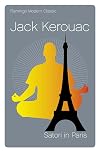
Satori in Paris
by Jack Kerouac 
On This Page
Description
From the renowned Beat writer, Kerouac's colorful and meandering search for his family history, now reissued following his centenary celebrationSatori in Paris is the semi-autobiographical tale of Jack Kerouac's trip to France in search of his heritage. Beginning in Paris and moving west to Brittany, Kerouac traces the paths of his ancestors and explores his own understanding of the Buddhism that came to define his beliefs. From his familiar milieu of strangers and all-night conversations in show more seedy bars, to a pivotal cab ride in which he experiences Buddhism's satori-a feeling of sudden understanding-Kerouac's affecting and revolutionary writing transports the reader. Published at the height of his fame and showcasing his mature talent, Satori in Paris is a lyrical, rollicking tale of philosophy, identity, and the power and strangeness of travel. show lessTags
Recommendations







































Member Reviews
Two late, short works by Kerouac.
Satori in Paris — presented in this edition as a novel, but also sometimes listed as a travel book — is narrated by an American writer of French-Canadian descent, “Jean Louis Lebris de Kérouac”, who is on a trip to France in search of records of his presumed ancestor, a Breton officer in Montcalm’s army. After various chaotic adventures in Paris, involving alcohol, women, and a Mozart concert at St-Germain-des-Prés, he draws a blank at the Bibliothéque nationale, and decides to head for Brest, where he discovers even less. But at some point during the trip — he’s not quite sure when, but it may have been whilst drinking a beer with his cabbie on the way to Orly — he has a moment of show more transformative awakening, or satori. The narrator's adventures are bizarre and often hilarious, and the whole pointless journey is clearly set up as an elaborate self-parody. This is the sort of thing that inevitably happens — we’re supposed to think — if a chaotic Beat-generation writer embarks on a serious project. Kerouac also has fun with the way the Parisians react to his Québecois dialect — Americans are supposed to speak bad French or none, not some weirdly archaic version of Breton French. In Brest, no-one bats an eyelid…
Pic is a novella, completed in 1969 from several much earlier fragments, and published posthumously. It’s perhaps best seen as an experiment that might never have seen the light of day if Kerouac hadn’t been such an influential figure. It’s written in dialect and told in the first person by a small Black child from rural North Carolina, Pictorial Review Jackson. After his grandfather is taken into hospital, Pic goes to live in the very Southern-Gothic home of an aunt, where he’s in constant danger from his other, blind, grandfather, who believes that Pic is cursed. He’s rescued by his older brother — a jazz musician — and travels with him to New York and eventually San Francisco. It’s not hard to see how a book created on that premise might be problematic (cultural appropriation, anybody?), and it doesn’t get any easier when there are inserted scenes from other books that don’t really fit the premise (to the extent that the narrator keeps forgetting that he’s supposed to be a small, uneducated child from the South), or when the book ends abruptly in a couple of sentences without any of the problems in the text having been resolved. Interesting, and there are some isolated passages of fine writing, but not really a success as a novella. show less
Satori in Paris — presented in this edition as a novel, but also sometimes listed as a travel book — is narrated by an American writer of French-Canadian descent, “Jean Louis Lebris de Kérouac”, who is on a trip to France in search of records of his presumed ancestor, a Breton officer in Montcalm’s army. After various chaotic adventures in Paris, involving alcohol, women, and a Mozart concert at St-Germain-des-Prés, he draws a blank at the Bibliothéque nationale, and decides to head for Brest, where he discovers even less. But at some point during the trip — he’s not quite sure when, but it may have been whilst drinking a beer with his cabbie on the way to Orly — he has a moment of show more transformative awakening, or satori. The narrator's adventures are bizarre and often hilarious, and the whole pointless journey is clearly set up as an elaborate self-parody. This is the sort of thing that inevitably happens — we’re supposed to think — if a chaotic Beat-generation writer embarks on a serious project. Kerouac also has fun with the way the Parisians react to his Québecois dialect — Americans are supposed to speak bad French or none, not some weirdly archaic version of Breton French. In Brest, no-one bats an eyelid…
Pic is a novella, completed in 1969 from several much earlier fragments, and published posthumously. It’s perhaps best seen as an experiment that might never have seen the light of day if Kerouac hadn’t been such an influential figure. It’s written in dialect and told in the first person by a small Black child from rural North Carolina, Pictorial Review Jackson. After his grandfather is taken into hospital, Pic goes to live in the very Southern-Gothic home of an aunt, where he’s in constant danger from his other, blind, grandfather, who believes that Pic is cursed. He’s rescued by his older brother — a jazz musician — and travels with him to New York and eventually San Francisco. It’s not hard to see how a book created on that premise might be problematic (cultural appropriation, anybody?), and it doesn’t get any easier when there are inserted scenes from other books that don’t really fit the premise (to the extent that the narrator keeps forgetting that he’s supposed to be a small, uneducated child from the South), or when the book ends abruptly in a couple of sentences without any of the problems in the text having been resolved. Interesting, and there are some isolated passages of fine writing, but not really a success as a novella. show less
Several writers of the Beat Generation were interested in Chinese and Japanese culture and (Zen) Buddhism, as was Jack Kerouac. "Satori" -- the Japanese word that appears in the title of this novella, Satori in Paris, signifies the Buddhist concept of a moment of awakening, a moment of reaching some deep insight.
Satori in Paris is a short novella in which Kerouac describes a trip to Paris. Belonging to his later work it is characterized by his late style of stream of conscious writing, while the writer appears to be inebriated or otherwise high. In this particular work, the overall effect of that is a feeling of happiness. To Kerouac, his trip to Paris was a quest to look for his French identity. Early on he explores the possible origin show more and meaning of his name. What exactly his moment of awakening would be, is not mentioned very clearly in the novella. As Kerouach points twice toward the taxi driver, both at the beginning and at the end, at least part of his experience lies in interaction with this man.It seems to be a profound feeling of connection at the human level. Apparently, the trip to France was a kind of homecoming to Kerouac, which, however, went much deeper that his identification as belonging to a French background, more so a deeply and spiritually experienced sense of humanity.
I that sense, Satori in Paris should not be seen as a minor work easily dismissed, but as a text central to Kerouac's work. show less
Satori in Paris is a short novella in which Kerouac describes a trip to Paris. Belonging to his later work it is characterized by his late style of stream of conscious writing, while the writer appears to be inebriated or otherwise high. In this particular work, the overall effect of that is a feeling of happiness. To Kerouac, his trip to Paris was a quest to look for his French identity. Early on he explores the possible origin show more and meaning of his name. What exactly his moment of awakening would be, is not mentioned very clearly in the novella. As Kerouach points twice toward the taxi driver, both at the beginning and at the end, at least part of his experience lies in interaction with this man.It seems to be a profound feeling of connection at the human level. Apparently, the trip to France was a kind of homecoming to Kerouac, which, however, went much deeper that his identification as belonging to a French background, more so a deeply and spiritually experienced sense of humanity.
I that sense, Satori in Paris should not be seen as a minor work easily dismissed, but as a text central to Kerouac's work. show less
Aos 44 anos de idade, Jack Kerouac viaja a Paris e à Bretanha em busca de suas raízes de família. Lança mão de seu francês da infância em busca de documentos, registros oficiais e no contato com o submundo da França.
Kerouac sendo Kerouac, em um breve, movimentado e divertido diário de viagens: física, turística e de autodescoberta.
Kerouac sendo Kerouac, em um breve, movimentado e divertido diário de viagens: física, turística e de autodescoberta.
While I usually review books in some detail, Satori in Paris, by Jack Kerouac is a slim travelogue written later in the illustrious author’s career. So because of its brevity I will present a review in verse:
Poor old Jack,
Looking for the myth of Family Kerouac.
To compliment his own myth,
The vagabond of On The Road
In finds little of the adventures
That made the legend,
Instead he is a vagabond poet
In a city of vagabond poets.
Drunk and Catholic
The charmer of jazz clubs,
And Beatnik Buddhism
is nowhere
in this relation of
confused enlightenment
Old alchholics tend to find,
And Jack yearns for Neil,
The reader yearns for Jack,
But we do learn the myth,
Of the family Kerouac
show more target="_top">http://pissandvinegar.vox.com/library/post/satori-in-paris-by-jack-kerouac.html show less
Poor old Jack,
Looking for the myth of Family Kerouac.
To compliment his own myth,
The vagabond of On The Road
In finds little of the adventures
That made the legend,
Instead he is a vagabond poet
In a city of vagabond poets.
Drunk and Catholic
The charmer of jazz clubs,
And Beatnik Buddhism
is nowhere
in this relation of
confused enlightenment
Old alchholics tend to find,
And Jack yearns for Neil,
The reader yearns for Jack,
But we do learn the myth,
Of the family Kerouac
show more target="_top">http://pissandvinegar.vox.com/library/post/satori-in-paris-by-jack-kerouac.html show less
I quite enjoyed "On the Road," with the emphasis falling on 'quite.' I managed about a page (and thus one sentence) of "Big Sur" before giving it up as a lost cause. "Satori in Paris" just about falls between the two - stodgy, typically-Kerouac prose that is hard to digest, but at least little enough to make the book finishable.
Here, Kerouac travels through northern France in search of his origins, and therefore a satori, or spiritual awakening.
Here, Kerouac travels through northern France in search of his origins, and therefore a satori, or spiritual awakening.
This book is Good. If you have ever ridden a bus or a train, slept in a hostel or even couch surfed, this reading will speak to you. The title speaks for itself. In my opinion, the smartest title to come from any of the writers of the beat generation. I enjoyed the random idiosyncratic overtures Kerouac had to offer in this less proclaimed book of his; Continuity based of course: with a non linear sense of reality, within the depths of the mindscape; and elaborated quite nice I must admit.
If you are looking for something less personally exploitive than 'On the Road', this book is definitely the Jack Kerouac you are looking for.
If you are looking for something less personally exploitive than 'On the Road', this book is definitely the Jack Kerouac you are looking for.
This confirms it for me: I'm not and never will be a fan of Jack Kerouac. Oh my, how this man does ramble. About nothing. On and on and on. And carouses. And drinks. And drinks. And carouses. And drinks.
On the Road. In Paris.
Not much satori at all.
On the Road. In Paris.
Not much satori at all.
Members
- Recently Added By
Lists

Reading LIst
648 works; 1 member
Author Information

217+ Works 68,545 Members
Jack Kerouac was born in Lowell, Massachusetts, in 1922. His first novel, The Town and the City, was published in 1950. He considered all of his "true story novels," including On the Road, to be chapters of "one vast book," his autobiographical Legend of Duluoz. He died in St. Petersburg, Florida, in 1969 at the age of forty-seven. (Publisher show more Provided) show less
Jack Kerouac has a Legacy Library. Legacy libraries are the personal libraries of famous readers, entered by LibraryThing members from the Legacy Libraries group.
Series
Belongs to Publisher Series
Gallimard, Folio (2458)
Work Relationships
Is contained in
Is abridged in
Common Knowledge
- Canonical title
- Satori in Paris
- Original title
- Satori in Paris
- Original publication date
- 1966
- People/Characters
- Jack Kerouac
- Important places
- Paris, France
- First words
- Somewhere during my ten days in Paris (and Brittany) I received an illumination of some kind that seems to've changed me again, towards what I suppose'll be my pattern for another seven years or more: in effect, a satori: the... (show all) Japanese word for "sudden illumination," "sudden awakening" or simply "kick in the eye."
- Last words
- (Click to show. Warning: May contain spoilers.)When God says "I Am Lived," we'll have forgotten what all the parting was about.
Classifications
- Genres
- General Fiction, Fiction and Literature
- DDC/MDS
- 914.4360483 — History & geography Geography & travel Geography of and travel in Europe France and Monaco Grand Est and Ile-de-France Île-de-France; Paris metropolitan area, River Seine
- LCC
- DC29 .K43 — History of Europe, Asia, Africa and Oceania France – Andorra – Monaco History of France Description and travel
- BISAC
Statistics
- Members
- 414
- Popularity
- 75,191
- Reviews
- 9
- Rating
- (3.22)
- Languages
- 8 — Czech, Dutch, English, Finnish, French, Italian, Portuguese, Spanish
- Media
- Paper, Audiobook, Ebook
- ISBNs
- 23
- ASINs
- 14