Nansen: The Explorer as Hero
by Roland Huntford
On This Page
Description
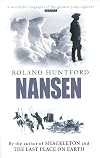
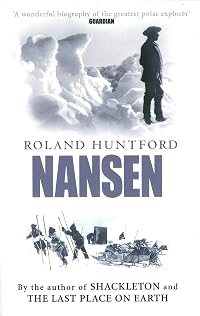
Behind the great polar explorers of the early twentieth century - Amundsen, Shackleton, Scott in the South and Peary in the North - looms the spirit of Fridtjof Nansen (1861-1930), the mentor of them all. He was the father of modern polar exploration, the last act of territorial discovery before the leap into space began. Nansen was a prime illustration of Carlyle's dictum that 'the history of the world is but the biography of great men'. He was not merely a pioneer in the wildly diverse show more fields of oceanography and skiing, but one of the founders of neurology. A restless, unquiet Faustian spirit, Nansen was a Renaissance Man born out of his time into the new Norway of Ibsen and Grieg. He was an artist and historian, a diplomat who had dealings with Lenin, Trotsky and Stalin, and played a part in the Versailles Peace Conference, where he helped the Americans in their efforts to contain the Bolsheviks. He also undertook famine relief in Russia. Finally, working for the League of Nations as both High Commissioner for Refugees and High Commissioner for the Repatriation of Prisoners of War, he became the first of the modern media-conscious international civil servants. show lessTags
Recommendations















Member Reviews
I picked this biography up in the Fram Museum in Oslo, Norway. I knew quite a bit already about Roald Amundsen, who was first to the South Pole, and had read and loved [[Roland Huntford]]'s account of Amundsen's race to the South Pole. Nansen is a fascinating person, who did much more than explore the North polar region, and I really enjoyed this biography.
Nansen had a varied life. His career was actually as a scientist, and he began his research on sea creatures, discovering some of the first insights into the neuron system in the 1880s. While doing this research in Bergen, he honed his interest in skiing, which was just taking off in Norway. He was one of the first to ski across Norway and really helped to popularize skiing (both show more cross country and downhill) in Norway. His love of adventure and exploration led him to take a break from his scientific endeavors to set up a voyage to Greenland. He ended up being the first to ski across the interior of Greenland, and he proved that travel on skis and with sled dogs was the key to polar travel.
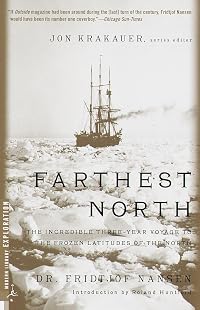
His next endeavor was an attempt to get to the North Pole. He sailed on the Fram, a boat specially developed to withstand the crushing polar ice. Though Nansen did not reach the North Pole, he got the farthest north of any recorded attempt, and everyone got back safely, including the Fram. The Fram had dropped off Nansen and one other man, Johansen, to travel to the North Pole while the Fram used a suspected current to drift them through the ice back to open water and to Norway.
After these adventures, it took Nansen a while to find a new path. He was already married, but the marriage was never easy. Nansen continued to travel, giving lectures about his explorations. He also returned to his scientific studies, focusing on ocean currents. His popularity led him to become a statesman. Norway was under Swedish rule and Nansen was pivotal in the peaceful separation of the countries. He also was pivotal in convincing Prince Edward of Denmark to accept the Norwegian throne (he changed his name to King Haakon). After WWI, Nansen continued his forays into international relations. He was heavily involved in the League of Nations. He also worked hard to help emigres from Russia, where the Communists were taking over. The refugees' status of being country-less led Nansen to suggest a passport not tied to a specific country. This is still called the Nansen passport. He won a Nobel Peace Prize for all of his work in these areas.
This is a long and detailed biography of an incredibly interesting person. I really enjoyed it. It was interesting because Nansen's life was very tied up in Norwegian history as well. Happy to have spent the time on this book. show less
Nansen had a varied life. His career was actually as a scientist, and he began his research on sea creatures, discovering some of the first insights into the neuron system in the 1880s. While doing this research in Bergen, he honed his interest in skiing, which was just taking off in Norway. He was one of the first to ski across Norway and really helped to popularize skiing (both show more cross country and downhill) in Norway. His love of adventure and exploration led him to take a break from his scientific endeavors to set up a voyage to Greenland. He ended up being the first to ski across the interior of Greenland, and he proved that travel on skis and with sled dogs was the key to polar travel.
His next endeavor was an attempt to get to the North Pole. He sailed on the Fram, a boat specially developed to withstand the crushing polar ice. Though Nansen did not reach the North Pole, he got the farthest north of any recorded attempt, and everyone got back safely, including the Fram. The Fram had dropped off Nansen and one other man, Johansen, to travel to the North Pole while the Fram used a suspected current to drift them through the ice back to open water and to Norway.
After these adventures, it took Nansen a while to find a new path. He was already married, but the marriage was never easy. Nansen continued to travel, giving lectures about his explorations. He also returned to his scientific studies, focusing on ocean currents. His popularity led him to become a statesman. Norway was under Swedish rule and Nansen was pivotal in the peaceful separation of the countries. He also was pivotal in convincing Prince Edward of Denmark to accept the Norwegian throne (he changed his name to King Haakon). After WWI, Nansen continued his forays into international relations. He was heavily involved in the League of Nations. He also worked hard to help emigres from Russia, where the Communists were taking over. The refugees' status of being country-less led Nansen to suggest a passport not tied to a specific country. This is still called the Nansen passport. He won a Nobel Peace Prize for all of his work in these areas.
This is a long and detailed biography of an incredibly interesting person. I really enjoyed it. It was interesting because Nansen's life was very tied up in Norwegian history as well. Happy to have spent the time on this book. show less
Roland Huntford writes so well, and is so thorough, that these brick-like books are a joy to read.
Nansen was consulted by all the young upstarts keen to freeze off digits in polar regions.
Nansen was consulted by all the young upstarts keen to freeze off digits in polar regions.
Christ, this book does go on: way too long to be enjoyable, but chock-full of Nansen, to be sure.
Excellent book. A well rounded exploration of Nansen as an explorer and a man.
The original Norwegian polar hero. Inspiration and mentor to Amundsen, ignored by Scott, outlived both of them. Great early career, questionable later career. Fram!
Ratings
Members
- Recently Added By
Author Information

13+ Works 1,557 Members
Roland Huntford is the world's foremost authority on the polar expeditions and their protagonists. The biographer of Shackleton and Nansen, his other books include Scott and Amundsen: The Last Place on Earth. He was the Scandinavian correspondent on The Observer for many years.
Common Knowledge
- Canonical title
- Nansen: The Explorer as Hero
- People/Characters
- Fridtjof Nansen
- Important places
- Arctic; Antarctica
Classifications
- Genres
- Biography & Memoir, Literature Studies and Criticism
- DDC/MDS
- 809 — Literature & rhetoric Literature, rhetoric & criticism History, description, critical appraisal of more than two literatures
- LCC
- G635 .N3 .H86 — Geography, Anthropology and Recreation Geography (General) Arctic and Antarctic regions
- BISAC
Statistics
- Members
- 188
- Popularity
- 174,060
- Reviews
- 5
- Rating
- (3.81)
- Languages
- English, Norwegian (Bokmål), Norwegian
- Media
- Paper, Ebook
- ISBNs
- 10
- ASINs
- 2