
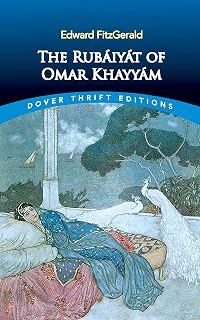
The Rubáiyat of Omar Khayyám (FitzGerald)
by Omar Khayyám, Edward FitzGerald (Translator), Omar Khayyám (Author)
On This Page
Description
Edward FitzGerald gave the title The Rubaiyat of Omar Khayyam to his translation of poetry attributed to the Persian poet, astronomer and mathematician Omar Khayyam (1048-1123). The word "Rubaiyat" means quatrains - verses of four lines. These works by Fitzgerald are the best known English translations. This edition contains both the first and fifth editions of the Rubaiyat. This influential translation is seen by many as a zenith of English literature in the nineteenth century. Fitzgerald show more states that his translation "will interest you from its form, and also in many respects in its detail: very unliteral as it is. Many quatrains are mashed together: and something lost, I doubt, of Omar's simplicity, which is so much a virtue in him." And, "I suppose very few People have ever taken such Pains in Translation as I have: though certainly not to be literal. But at all Cost, a Thing must live: with a transfusion of one's own worse Life if one can't retain the Original's better. Better a live Sparrow than a stuffed Eagle.". show less
Tags
Recommendations

























Member Reviews
When people say a book is difficult to read they normally mean there is something intrinsically challenging about the text. Ulysses is difficult because, well, it's by James Joyce; The Tale of Genji is difficult because there are five hundred characters spanning half a century, and no one has a name. But this edition of Rubáiyát of Omar Khayyám is the first book I've read that was difficult to read from a purely mechanical point of view.
After the book's thorough and interesting introduction we come to the reproduction of the original book. FitzGerald didn't want to ruin the text of the poem with footnotes, so uses endnotes, marked out by numeric superscripts. So far so good. Daniel Karlin, this edition's editor, wants to respect show more FitzGerald's wishes so also omits footnotes and moreover omits any superscripts to inform the reader of the presence of one of his endnotes. So now not only does the reader need to mark three pages simultaneously, the poem, FitzGerald's endnotes, and Karlin's end-endnotes, but also he must keep flicking to the latter of the three in case Karlin has just pointed out something useful. (In fact for the full experience one should mark a fourth set of pages where variants are included for each stanza from the five different editions of FitzGerald's work.)
Having virtually dislocated my fingers after three stanzas in order to keep up with this merry charade I felt obliged to utter a playground epithet pointing out that this style of reading was a poor substitute for a game of soliders. And so I gave up on Karlin's end-endnotes and made do with Fitzgerald's, referring to Karlin's only if something I really didn't understand came up. And then I re-read the poem using Karlin's notes rather than Fitzgerald's. And then I read the variant stanzas, and the intriguing appendices. Suffice it to that once I figured out how to read the book I really did enjoy it. show less
After the book's thorough and interesting introduction we come to the reproduction of the original book. FitzGerald didn't want to ruin the text of the poem with footnotes, so uses endnotes, marked out by numeric superscripts. So far so good. Daniel Karlin, this edition's editor, wants to respect show more FitzGerald's wishes so also omits footnotes and moreover omits any superscripts to inform the reader of the presence of one of his endnotes. So now not only does the reader need to mark three pages simultaneously, the poem, FitzGerald's endnotes, and Karlin's end-endnotes, but also he must keep flicking to the latter of the three in case Karlin has just pointed out something useful. (In fact for the full experience one should mark a fourth set of pages where variants are included for each stanza from the five different editions of FitzGerald's work.)
Having virtually dislocated my fingers after three stanzas in order to keep up with this merry charade I felt obliged to utter a playground epithet pointing out that this style of reading was a poor substitute for a game of soliders. And so I gave up on Karlin's end-endnotes and made do with Fitzgerald's, referring to Karlin's only if something I really didn't understand came up. And then I re-read the poem using Karlin's notes rather than Fitzgerald's. And then I read the variant stanzas, and the intriguing appendices. Suffice it to that once I figured out how to read the book I really did enjoy it. show less
When people say a book is difficult to read they normally mean there is something intrinsically challenging about the text. Ulysses is difficult because, well, it's by James Joyce; The Tale of Genji is difficult because there are five hundred characters spanning half a century, and no one has a name. But this edition of Rubáiyát of Omar Khayyám is the first book I've read that was difficult to read from a purely mechanical point of view.
After the book's thorough and interesting introduction we come to the reproduction of the original book. FitzGerald didn't want to ruin the text of the poem with footnotes, so uses endnotes, marked out by numeric superscripts. So far so good. Daniel Karlin, this edition's editor, wants to respect show more FitzGerald's wishes so also omits footnotes and moreover omits any superscripts to inform the reader of the presence of one of his endnotes. So now not only does the reader need to mark three pages simultaneously, the poem, FitzGerald's endnotes, and Karlin's end-endnotes, but also he must keep flicking to the latter of the three in case Karlin has just pointed out something useful. (In fact for the full experience one should mark a fourth set of pages where variants are included for each stanza from the five different editions of FitzGerald's work.)
Having virtually dislocated my fingers after three stanzas in order to keep up with this merry charade I felt obliged to utter a playground epithet pointing out that this style of reading was a poor substitute for a game of soliders. And so I gave up on Karlin's end-endnotes and made do with Fitzgerald's, referring to Karlin's only if something I really didn't understand came up. And then I re-read the poem using Karlin's notes rather than Fitzgerald's. And then I read the variant stanzas, and the intriguing appendices. Suffice it to that once I figured out how to read the book I really did enjoy it. show less
After the book's thorough and interesting introduction we come to the reproduction of the original book. FitzGerald didn't want to ruin the text of the poem with footnotes, so uses endnotes, marked out by numeric superscripts. So far so good. Daniel Karlin, this edition's editor, wants to respect show more FitzGerald's wishes so also omits footnotes and moreover omits any superscripts to inform the reader of the presence of one of his endnotes. So now not only does the reader need to mark three pages simultaneously, the poem, FitzGerald's endnotes, and Karlin's end-endnotes, but also he must keep flicking to the latter of the three in case Karlin has just pointed out something useful. (In fact for the full experience one should mark a fourth set of pages where variants are included for each stanza from the five different editions of FitzGerald's work.)
Having virtually dislocated my fingers after three stanzas in order to keep up with this merry charade I felt obliged to utter a playground epithet pointing out that this style of reading was a poor substitute for a game of soliders. And so I gave up on Karlin's end-endnotes and made do with Fitzgerald's, referring to Karlin's only if something I really didn't understand came up. And then I re-read the poem using Karlin's notes rather than Fitzgerald's. And then I read the variant stanzas, and the intriguing appendices. Suffice it to that once I figured out how to read the book I really did enjoy it. show less
Having read several other editions of the Rubáiyát, this is the first time I've read one with FitzGerald's foreword and his notes, which added much to the experience this time around.
I was not previously aware of the debate regarding the possibility of reading Khayyám's frequent references to wine as literal (how I'd previously read it) or as a metaphor for divinity. Interestingly, having introduced me to the debate, FitzGerald comes down firmly on the literalist side. Nevertheless, I've enjoyed reading this one with the metaphor in mind and it will inform future readings. I understand FitzGerald's position, though, as not all of the stanzas lend themselves to a mystical rendition, however that could be due either to his translation show more or my own lack of spiritual knowledge.
However that may be, this remains my favourite book of poetry (admittedly out of a relatively limited exposure to verse). show less
I was not previously aware of the debate regarding the possibility of reading Khayyám's frequent references to wine as literal (how I'd previously read it) or as a metaphor for divinity. Interestingly, having introduced me to the debate, FitzGerald comes down firmly on the literalist side. Nevertheless, I've enjoyed reading this one with the metaphor in mind and it will inform future readings. I understand FitzGerald's position, though, as not all of the stanzas lend themselves to a mystical rendition, however that could be due either to his translation show more or my own lack of spiritual knowledge.
However that may be, this remains my favourite book of poetry (admittedly out of a relatively limited exposure to verse). show less
If life is meaningless, why not enjoy its simple pleasures? If Epicurus had read what this Persian philosopher, astronomer, mathematician, and poet had written, he probably would have approved of it.
Omar Khayyam, through the brilliant English poetic voice that Edward FitzGerald lent him, speaks to us in a way that few are capable of. Realizing how incapable to provide any substantial answers any philosophical attempt is, what else can you conclude than a sort of Epicureanism that takes being alive as everything you will ever get, and that your enjoyments, sparse as they are, should be praised? If you have no metaphysical expectations beyond this life and experiences, Omar will speak directly to you. If you have a different set of show more beliefs, he might offend you, as he has many others throughout history. In any case, you won't feel indifferent to his thoughts. And thanks to Edward FitzGerald's translation, you will find in the words and their musicality the joys of the wine that Omar repeatedly praises. show less
Omar Khayyam, through the brilliant English poetic voice that Edward FitzGerald lent him, speaks to us in a way that few are capable of. Realizing how incapable to provide any substantial answers any philosophical attempt is, what else can you conclude than a sort of Epicureanism that takes being alive as everything you will ever get, and that your enjoyments, sparse as they are, should be praised? If you have no metaphysical expectations beyond this life and experiences, Omar will speak directly to you. If you have a different set of show more beliefs, he might offend you, as he has many others throughout history. In any case, you won't feel indifferent to his thoughts. And thanks to Edward FitzGerald's translation, you will find in the words and their musicality the joys of the wine that Omar repeatedly praises. show less
What magical AABA masculine quatrains! I'm just starting to move into great works of the non-Western canon, and I've been aware of The Rubáiyát for a long time. Now that I've read through it twice, I see why it is an oft-cited great work of literature. The Bodleian Library has produced a gorgeous hardcover, ribbon-bookmarked volume using the English translation of Edward Fitzgerald and the delicate illustrations of René Bull. Amusingly, Omar seems to struggle with a penchant for wine ("the Juice") in light of his religious strictures (cf. quatrain LXI), while at the same time, in a more generalized and universal mode, delivering quatrain after quatrain of sublime profundity (cf. LXXIII) that leaves the Juice a trivial matter in this show more short life. A majority of the verse has an ironic flare bordering on sardonic absurdity (cf. LXV), but upon subsequent readings of such verses one discovers the depth of their meaning and resonance. Perhaps the greatest achievement of the poem cycle is the allegory of the clay pots. show less
"Irâm indeed is gone with all its Rose,
And Jamshyd's Sev'n-ring'd Cup where no one knows:
But still the Vine her ancient Ruby yields,
And still a Garden by the Water blows.
- Verse V
The introduction and notes in this edition [9780713604184] are illuminating, and got me doing something I realise I haven't done before: searching the internet for Rubaiyát references. The most interesting thing I learned was that Khayyám's mention of "Irâm" being "gone with all its Rose" is a reference to a lost city, called by T.E. Lawrence the Atlantis of the Sands, and which the Koran mentions as, perhaps, being destroyed for its sins. There have been expeditions to locate Irâm, "The City of the Pillars", and, like Atlantis in the West, many disputed show more claims for its discovery.
Depleting my store of cultural ignorance is a never-ending, but enriching, task. show less
And Jamshyd's Sev'n-ring'd Cup where no one knows:
But still the Vine her ancient Ruby yields,
And still a Garden by the Water blows.
- Verse V
The introduction and notes in this edition [9780713604184] are illuminating, and got me doing something I realise I haven't done before: searching the internet for Rubaiyát references. The most interesting thing I learned was that Khayyám's mention of "Irâm" being "gone with all its Rose" is a reference to a lost city, called by T.E. Lawrence the Atlantis of the Sands, and which the Koran mentions as, perhaps, being destroyed for its sins. There have been expeditions to locate Irâm, "The City of the Pillars", and, like Atlantis in the West, many disputed show more claims for its discovery.
Depleting my store of cultural ignorance is a never-ending, but enriching, task. show less
Omar Khayyám was a twelfth-century scientist and poet in Persia. This slim volume contains seventy-five quatrains (rubáiyát) each accompanied by an illustration by Sullivan. The text was translated by Fitzgerald in the late nineteenth century. The central theme of the poetry presented her seems to be drink and be merry, but especially drink. Khayyám is very fond of the daughter of the vine, as he calls it. Some of the poems also reveal a personal philosophy that no one knows why we are here on this earth and we never will learn, so live for today because yesterday has passed and tomorrow never really comes. I enjoyed the poetry, though it was sometimes difficult to understand. (That probably owes to the date of the translation and show more to my own unfamiliarity with poetry in general.) Each drawing coincides with a quatrain of the poem. The artwork is truly wonderful, line and ink drawings with expressive faces and lithe bodies. I quite liked this book and would like to read another edition, with a more modern translation. show less
Members
- Recently Added By
Lists

Harold Bloom - The Western Canon: C. The Democratic Age
336 works; 15 members

Favorite Recent Poetry: 1980-2022
178 works; 71 members

Books Read in 2026
1,881 works; 66 members

Poetry volumes by single author
121 works; 8 members

Books Read in 2025
4,091 works; 97 members

Recommended Reading : 600 Classics Reviewed, Editors of Salem Press, 2015
634 works; 6 members

Books We Love to Reread
688 works; 296 members

Books Read in 2024
4,623 works; 126 members

Greatest Books, allegedly
484 works; 9 members

Books Read in 2022
5,166 works; 114 members

Trinity College Booklist (1951): Class Nine, Foreign Literatures
161 works; 3 members

Books Read in 2021
5,361 works; 114 members

Books Read in 2015
3,299 works; 126 members

Books Read in 2014
2,343 works; 89 members

Folio Society
831 works; 53 members

Books Read in 2017
4,249 works; 130 members

Best of World Literature
432 works; 51 members
Books Read in 2016
4,666 works; 199 members

In Our Time books
4,934 works; 2 members
Author Information

135+ Works 10,251 Members
Known in Iran as a leading mathematician, Omar gained literary importance through certain quatrains that were translated by Edward FitzGerald. The Ruba'iyat is justly famous in English translation. Others besides FitzGerald have tried their hand at translating it, not all with admired results. Bowens's is a good example of competent and pleasing show more work. (Bowker Author Biography) show less

All Editions
Some Editions
Awards and Honors
Awards
Series
Belongs to Publisher Series
Work Relationships
Is contained in
The Rubáiyát of Omar Khayyám and Other Persian Poems: An Anthology of Verse Translations by A. J. Arberry
Is abridged in
Has as a commentary on the text
Has as a student's study guide
Common Knowledge
- Canonical title
- The Rubáiyát of Omar Khayyám {Edward Fitzgerald}; The Rubáiyat of Omar Khayyám (FitzGerald) (FitzGerald)
- Original title
- Rubaíyát Omar Khayyám : trosiad i'r Gymraeg o gyfieithiad {neu aralleiriad os mynner} adnabyddus Edward Fitzgerald {argraffiad cyntaf}
- Alternate titles
- Rubaiyat of Omar Khayyam
- Original publication date
- 1859 (transl. to Eng.) (transl. to Eng.)
- People/Characters
- Jamshid; Kaikobâd; Omar Khayyám; Kaikhoshrû; Rustum; Hâtim Tai (show all 8); Sultan Mahmûd; Bahrâm Gôr
- Important places
- Persia; Iram, Arabia
- Dedication*
- Cyflwynedig i J. E. J.
- First words
- Awake! for Morning in the Bowl of Night
Has flung the Stone that puts the Stars to Flight;
And Lo! the Hunter of the East has caught
The Sultán's Turret in a Noose of Light.
Introduction: In 1861 a bundle of pamphlets was placed on a second-hand bookstall in London for clearance at a penny apiece.
- Version "Published for the Classics Club" - Quotations
- The Moving Finger writes; and, having writ, Moves on;
- Last words
- (Click to show. Warning: May contain spoilers.)Tamám Shud
(Click to show. Warning: May contain spoilers.)Where I made One-turn down an empty glass! - Original language
- Persian
- Canonical DDC/MDS
- 891.5511
- Canonical LCC
- PK6511.A1 A4
- Disambiguation notice
- This work consists of all editions that can reasonably be attributed to Edward FitzGerald, by means of title, ISBN or author credit.
The FitzGerald translations of The Rubáiyát of Omar Kayyam into Engli... (show all)sh are generally considered to have been paraphrased to the point that "inspired by" may be more accurate than "translated from." Most popular English language editions of the Rubáiyát use the FitzGerald verses both because of their intrinsic value and because it is no longer in copyright. Books that contain bits of Fitzgerald as well as other, more literal translations are combined with the Persian original and other translations of the Rubáiyát here.
Please do not combine this FitzGerald work with other translations.
*Some information comes from Common Knowledge in other languages. Click "Edit" for more information.
Classifications
- Genres
- Poetry, Fiction and Literature
- DDC/MDS
- 891.5511 — Literature & rhetoric Literatures of other languages East Indo-European and Celtic literatures Iranian literatures Modern Persian / Farsi literature (8th century CE to present) Persian poetry ca. 1000–1389
- LCC
- PK6511 .A1 .A4 — Language and Literature Indo-Iranian languages and literatures Indo-Iranian philology and literature Iranian philology and literature New Persian Literature Individual authors or works Omar Khayyam
- BISAC
Statistics
- Members
- 6,064
- Popularity
- 2,082
- Reviews
- 87
- Rating
- (3.96)
- Languages
- 17 — Arabic, Dutch, English, Esperanto, French, German, Galician, Italian, Japanese, Korean, Multiple languages, Norwegian, Farsi/Persian, Russian, Spanish, Swedish, Welsh
- Media
- Paper, Audiobook, Ebook
- ISBNs
- 224
- UPCs
- 4
- ASINs
- 509