On This Page
Description
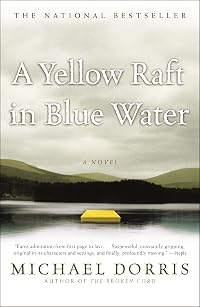
Michael Dorris' contemporary classic novel is a fierce saga of three generations of Indian women, beset by hardships and torn by angry secrets, yet inextricably joined by the bonds of kinship. Starting at the present day and moving back in time, the novel is told in the voices of three women: fifteen-year-old part-black Rayona, searching for a way to find herself; her American Indian mother, Christine, consumed by tenderness and resentment toward those she loves; and the fierce and show more mysterious Ida, mother and grandmother, whose haunting secrets, betrayals, and dreams echo through the years, braiding together the strands of the shared past-and their future. show lessTags
Recommendations



















Member Reviews
A Yellow Raft in Blue Water brings us the lives of three Indian women, a daughter, a mother and a grandmother, in their respective first person narrative voices. We meet Rayona first; she is fifteen years old, and her life is not easy. She and her mother live in Seattle, but Mom is often "sick" and in the hospital. We are not told (as Rayona is not told) what is wrong with her. Rayona's father is a black man who moves in and out of her life, contributing very little to it other than the effects of his DNA on her appearance. When Rayona's mother Christine decides they must return to the reservation to live with HER mother, no reason is given for that either. In Christine's section of the novel, we hear her tell her story, going back to show more her own teen years. We learn of her bond with her younger brother Lee and his best friend, Dayton; and of the dynamic attraction that drew her to Elgin Taylor and brought her Rayona. Finally, we hear from Christine's mother, who has always insisted that her children call her "Aunt Ida", because she was not married when they were born and therefore isn't entitled to be called "Mother". As each section unfolds, we learn things that the previous narrator did not tell us, because she did not KNOW. Secrets are at the heart of each woman's life; sometimes they are revealed to the characters, but more often only we, the readers are let in on all the truths, all the motivations, all the heartbreaks. This is an incredible novel, and I highly recommend it. show less
This is a story told through three generations of women from the same family, only instead of beginning with the grandmother, it begins with the granddaughter and works backwards. This may sound like an unusual and unfriendly way to tell the history of a family but it actually helps you to feel the emotions of the characters and understand their actions so much more. What starts out as unbelievable behavior ends up being explained in the end and you realize just how much love the family has for each other, even if it doesn't seem to be that they show it at all. It's often said that we are made up of our own experiences, but this is a book that proves that part of us is made up of the things others before us have experienced.
I found it show more interesting that for each section of the book the writing was slightly different. This makes sense, as the story is told from each character's point of view, but the attention to detail in wording and language really hit home throughout, especially at the end of the book, when Ida tells her story. She doesn't speak English, but her native "Indian", which is a more eloquent and descriptive language than English and the writing demonstrates this beautifully.
There wasn't much of a conclusion to the book, or even a real conclusion to each person's story, but I'm not certain that there really needed to be. Readers are taken to a point where their part of the character's story has been wrapped up and packaged in a set of chapters and bringing each section to an actual conclusion, either by the death of the character or some other event would only prolong the story, rather than bring it to a stopping point. I hadn't realized this at the time that I was reading and found the lack of a definite finish line somewhat unsettling, but as the story eased into me completely, I found myself quite satisfied.
Yellow Raft in Blue Water is a heartwarming journey, written very well, and almost certainly guaranteed to pull the reader in as it reminds them how important family can truly be, even when the traditional idea of family is far from what you have to work with. show less
I found it show more interesting that for each section of the book the writing was slightly different. This makes sense, as the story is told from each character's point of view, but the attention to detail in wording and language really hit home throughout, especially at the end of the book, when Ida tells her story. She doesn't speak English, but her native "Indian", which is a more eloquent and descriptive language than English and the writing demonstrates this beautifully.
There wasn't much of a conclusion to the book, or even a real conclusion to each person's story, but I'm not certain that there really needed to be. Readers are taken to a point where their part of the character's story has been wrapped up and packaged in a set of chapters and bringing each section to an actual conclusion, either by the death of the character or some other event would only prolong the story, rather than bring it to a stopping point. I hadn't realized this at the time that I was reading and found the lack of a definite finish line somewhat unsettling, but as the story eased into me completely, I found myself quite satisfied.
Yellow Raft in Blue Water is a heartwarming journey, written very well, and almost certainly guaranteed to pull the reader in as it reminds them how important family can truly be, even when the traditional idea of family is far from what you have to work with. show less
Three generations of Indian women tell the stories of their lives and their prickly relationships with one another. As each story unfolds, things that didn’t make sense earlier start to fit together.
It kept me reading but now that I’ve finished, I realize the three voices telling the story were too similar. The young girl sounded more sophisticated and world wise than the character seemed; her mother was way too self aware than she acted. The grandmother who stayed on the reservation not only didn’t sound like someone who grew up Indian, she was also an unbelievable character with too much cold-blooded scheming. Finally, there were too many coincidences and unbelievable events.
All that said, I still enjoyed the family drama and show more the pleasure of seeing their secrets unfold. show less
It kept me reading but now that I’ve finished, I realize the three voices telling the story were too similar. The young girl sounded more sophisticated and world wise than the character seemed; her mother was way too self aware than she acted. The grandmother who stayed on the reservation not only didn’t sound like someone who grew up Indian, she was also an unbelievable character with too much cold-blooded scheming. Finally, there were too many coincidences and unbelievable events.
All that said, I still enjoyed the family drama and show more the pleasure of seeing their secrets unfold. show less
Michael Dorris weaves a moving story of three generations of Native American women, whose lives are complicated and twisted, and whose love for one another is buried beneath misunderstanding and lack of communication. At the outset, we are told the story of Rayona’s life, through Rayona’s eyes. She is the half-Indian, half-black daughter of Christine. Her mother seems dissociative and somewhat cruel, and my reaction was to have no sympathy and very little understanding of a mother who would behave this way. But, even in Rayona’s account there is the hint of trouble between Christine and her mother, Ida, and when we reach book two and see the events through Christine’s eyes we come to understand behavior that seemed so puzzling show more before. And, finally, we are allowed to hear the background story that is Ida’s life and see the roots of all this dysfunction that haunts the lives of each of these women.
I was drawn into this book immediately and felt there was momentum that pulled me forward right through to the end. All the characters were very realistic and there was enough of mystery surrounding their lives to make you want to unravel the threads of the story for a peek at the past. I particularly liked the secondary characters of Dayton and Lee. They fleshed out the story and gave it a depth it would have lacked without them.
There is a clear picture of life on the reservation, the poverty and problems with alcohol and the unique problems that come from living where the ties are so close and intermingled. Although I have no first hand knowledge of life on a reservation, the novel feels well researched and accurately portrayed. Reading it in the wake of [b:Killers of the Flower Moon: The Osage Murders and the Birth of the FBI|29496076|Killers of the Flower Moon The Osage Murders and the Birth of the FBI|David Grann|https://images.gr-assets.com/books/1470699853s/29496076.jpg|49782213], a non-fiction account of the Osage Indians, gave me a gauge against which to measure it, and it held up well. show less
I was drawn into this book immediately and felt there was momentum that pulled me forward right through to the end. All the characters were very realistic and there was enough of mystery surrounding their lives to make you want to unravel the threads of the story for a peek at the past. I particularly liked the secondary characters of Dayton and Lee. They fleshed out the story and gave it a depth it would have lacked without them.
There is a clear picture of life on the reservation, the poverty and problems with alcohol and the unique problems that come from living where the ties are so close and intermingled. Although I have no first hand knowledge of life on a reservation, the novel feels well researched and accurately portrayed. Reading it in the wake of [b:Killers of the Flower Moon: The Osage Murders and the Birth of the FBI|29496076|Killers of the Flower Moon The Osage Murders and the Birth of the FBI|David Grann|https://images.gr-assets.com/books/1470699853s/29496076.jpg|49782213], a non-fiction account of the Osage Indians, gave me a gauge against which to measure it, and it held up well. show less
Dorris braids a single story told in reverse chronological order, from three unique perspectives. Rayona, a 15-year-old “half-breed,” begins the story, relaying her efforts to raise her own irresponsible mother. We then move to Ray’s mother, Christine, who recounts her struggles growing up and rebelling against her unaffectionate mother, Aunt Ida. Finally we hear from Aunt Ida, the matriarch of the family, whose secrets have shaped her daughter and granddaughter in ways she never intended.
It’s a great premise for a literary work. However, I don’t think Dorris succeeds in his execution. I really grew to care about Rayona, but then her story ends abruptly and Dorris transfers the tale to Christine. Because they are both show more portrayed as so unfeeling and irresponsible, I had a hard time caring about Christine or Aunt Ida, though I did begin to empathize with Ida when she finally tells her story in part three. HERE is a story I really want to know more about. But Dorris ends the book abruptly … almost mid-sentence.
I’m left feeling very dissatisfied, and almost as if I wasted my time reading this. A reviewer on amazon.com wrote this: It’s pretty much like a wonderful chocolate mousse with cockroaches stirred in here and there. The mousse is wonderful, but you’ll never forget the images and crunches of those bits of cockroaches.
It gets 2 stars from me – I can’t think of anyone to whom I’d recommend this book. show less
It’s a great premise for a literary work. However, I don’t think Dorris succeeds in his execution. I really grew to care about Rayona, but then her story ends abruptly and Dorris transfers the tale to Christine. Because they are both show more portrayed as so unfeeling and irresponsible, I had a hard time caring about Christine or Aunt Ida, though I did begin to empathize with Ida when she finally tells her story in part three. HERE is a story I really want to know more about. But Dorris ends the book abruptly … almost mid-sentence.
I’m left feeling very dissatisfied, and almost as if I wasted my time reading this. A reviewer on amazon.com wrote this: It’s pretty much like a wonderful chocolate mousse with cockroaches stirred in here and there. The mousse is wonderful, but you’ll never forget the images and crunches of those bits of cockroaches.
It gets 2 stars from me – I can’t think of anyone to whom I’d recommend this book. show less
A Yellow Raft in Blue Water tells the story of three generations of women whose roots stem from a Montana reservation. I enjoyed the structure Michael Dorris employed for this: each woman tells her story in the first person, in her own section, and we move from the youngest to the eldest. I suppose Dorris could have rotated narrators—it would still have fit with the braiding metaphor he uses in the first and final paragraphs of the book—but sticking with each character and giving each woman her own defined arc was the proper choice. Although the (sometimes hidden) contexts of our lives certainly reflect “twisting and tying and blending,” it seems appropriate to reflect the corresponding internal lives with coherent narratives of show more experience.
The first section of the book, Rayona’s, reads like a fairly typical coming-of-age story. Rayona deals with something of a breakdown by her mother and is essentially abandoned at a distant relative’s house (“distant” also in that her relative doesn’t communicate much/well) on the reservation her mother grew up on. Rayona encounters both the odious and the angelic as she learns her own value. This section is satisfying if familiar, and could stand on its own as an unimpressive novella; I put the book aside for a month or so between finishing it and moving on to the next section.
It turns out that Rayona’s mother Christine is a wonderful revelation. She is severely flawed, and perhaps in some ways unlikeable, but at the same time contains a sort of nobility or magnificence that demands a reader’s compassion. I loved reading this section, and I loved this character. I read Rayona and Ida with interest, but I read Christine with connection. Her flaws are rooted in her upbringing, in her emotional force, in her suffocated love of life; she is a splendid woman for all of her stilted steeliness and self-destruction. She isn’t precisely punishing herself toward redemption, but her life contains an omnipresent mixture of humility and rage. Christine works with what she has—vitality sans pluckiness. If I take one thing from this book, it will be the love I felt for this character.
Ida’s section is decent, but like Rayona’s section it didn’t carry the emotion of Christine’s. I encountered a few quibbles with the plot, but overall I was fine with the revelations the section contained, and satisfied with Ida and the book as a whole.
Although the book presents three female protagonists who speak from the first person, the men in the book occupy a strange space. They are almost ghosts of a sort. Lee (Christine’s brother), as one of the most important characters in the book, serves fundamentally as a ghost figure. When Lee is alive, he represents life itself—he is vital, beautiful, worshiped, humble, caring, naive. In his death, he is the loss of these things. For Rayona he is a lost heritage, for Christine he is life ruptured, for Ida he is a now-absent validation of her motherhood to Christine. Overall, the men in the book exist in either weakness (Father Tom, Elgin, Lecan) or strength (Sky, Dayton, Father Hurlburt), and it is up to the women to secure for themselves the proper support. I found it humorous that the final dialogue in the book is Father Hurlburt asking Ida, “What are you doing?” while not resisting her, as if the best thing a man can do is to allow a woman space and support; understanding left implicit, and always available. show less
The first section of the book, Rayona’s, reads like a fairly typical coming-of-age story. Rayona deals with something of a breakdown by her mother and is essentially abandoned at a distant relative’s house (“distant” also in that her relative doesn’t communicate much/well) on the reservation her mother grew up on. Rayona encounters both the odious and the angelic as she learns her own value. This section is satisfying if familiar, and could stand on its own as an unimpressive novella; I put the book aside for a month or so between finishing it and moving on to the next section.
It turns out that Rayona’s mother Christine is a wonderful revelation. She is severely flawed, and perhaps in some ways unlikeable, but at the same time contains a sort of nobility or magnificence that demands a reader’s compassion. I loved reading this section, and I loved this character. I read Rayona and Ida with interest, but I read Christine with connection. Her flaws are rooted in her upbringing, in her emotional force, in her suffocated love of life; she is a splendid woman for all of her stilted steeliness and self-destruction. She isn’t precisely punishing herself toward redemption, but her life contains an omnipresent mixture of humility and rage. Christine works with what she has—vitality sans pluckiness. If I take one thing from this book, it will be the love I felt for this character.
Ida’s section is decent, but like Rayona’s section it didn’t carry the emotion of Christine’s. I encountered a few quibbles with the plot, but overall I was fine with the revelations the section contained, and satisfied with Ida and the book as a whole.
Although the book presents three female protagonists who speak from the first person, the men in the book occupy a strange space. They are almost ghosts of a sort. Lee (Christine’s brother), as one of the most important characters in the book, serves fundamentally as a ghost figure. When Lee is alive, he represents life itself—he is vital, beautiful, worshiped, humble, caring, naive. In his death, he is the loss of these things. For Rayona he is a lost heritage, for Christine he is life ruptured, for Ida he is a now-absent validation of her motherhood to Christine. Overall, the men in the book exist in either weakness (Father Tom, Elgin, Lecan) or strength (Sky, Dayton, Father Hurlburt), and it is up to the women to secure for themselves the proper support. I found it humorous that the final dialogue in the book is Father Hurlburt asking Ida, “What are you doing?” while not resisting her, as if the best thing a man can do is to allow a woman space and support; understanding left implicit, and always available. show less
This was the book I read in its entirety on a greyhound bus from Los Angeles to Santa Cruz as a senior in high school. The book has stayed with me for over a decade as a beautiful weaving of stories and the long-term effects of parents decisions on their children’s trajectories and lives. I should re-read at some point as an adult and see if it is as powerful.
Members
- Recently Added By
Lists

Native American / Indigenous Literature
172 works; 100 members

AP Lit
363 works; 6 members
Talk Discussions
Past Discussions
A Yellow Raft in Blue Water, Michael Dorris in World Reading Circle (March 2013)
Author Information

17+ Works 7,557 Members
Michael Dorris, Author Michael Dorris received an undergraduate degree in English, with honors, from Georgetown University and a graduate degree in anthropology from Yale. He taught for fifteen years at Dartmouth College and founded the Native American Studies Program there. His novels include "A Yellow Raft in Blue Water" and "The Crown of show more Columbus," co-authored with Louise Erdrich. "The Broken Cord," which was named Best Non-Fiction of the Year by the National Book Critics Circle, brought attention to the disorder Fetal Alcohol Syndrome. He has also written novels for young adults, which include "Guests," "Sees Behind Trees," and "Morning Girl," which won the Scott O'Dell Award for Historical Fiction. (Bowker Author Biography) show less
Awards and Honors
Distinctions
Series

Work Relationships
Common Knowledge
- Canonical title
- A Yellow Raft in Blue Water
- Original title
- A Yellow Raft in Blue Water
- Original publication date
- 1987
- People/Characters
- Rayona Diane Taylor; Christine George Taylor; Aunt Ida George
- Important places
- Montana, USA
- Dedication
- For Louise Companion through every page, Through every day Compeer
- First words
- I sit on the bed at a crooked angle, one foot on the floor, my hip against the tent of Mom's legs, my elbows on the hospital table.
- Last words
- (Click to show. Warning: May contain spoilers.)As a man with cut hair, he did not identify the rhythm of three strands, the whispers of coming and going, of twisting and tying and blending, of catching and of letting go, of braiding.
- Original language
- English
Classifications
Statistics
- Members
- 2,189
- Popularity
- 9,328
- Reviews
- 38
- Rating
- (3.84)
- Languages
- Danish, Dutch, English
- Media
- Paper, Audiobook
- ISBNs
- 26
- ASINs
- 11