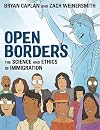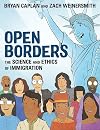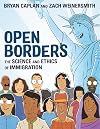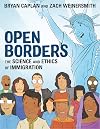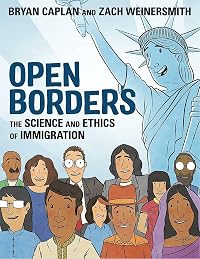
Open Borders: The Science and Ethics of Immigration
by Bryan Caplan (Author), Zach Weinersmith (Illustrator)
On This Page
Description
"American policy-makers have long been locked in a heated battle over whether, how many, and what kind of immigrants to allow to live and work in the country. Those in favor of welcoming more immigrants often cite humanitarian reasons, while those in favor of more restrictive laws argue the need to protect native citizens. But economist Bryan Caplan adds a new, compelling perspective to the immigration debate: He argues that opening all borders could eliminate absolute poverty worldwide and show more usher in a booming worldwide economy--greatly benefiting humanity. With a clear and conversational tone, exhaustive research, and vibrant illustrations by Zach Weinersmith, Open Borders makes the case for unrestricted immigration easy to follow and hard to deny"--Provided by publisher. show lessTags
Recommendations






















Member Reviews
In graphic non-fiction form, libertarian economist and immigration policy expert Caplan discusses how completely unrestricted immigration into and out of the United States is the best option morally, culturally, legally, and ethically. He breaks down every possible argument against open borders, pointing out for almost all of them that they are based on fears of things that already can and do happen with very restricted borders, and calls immigration restrictions “a solution in search of a problem”.
This book came out in 2019, when I was reading much less, and it’s just a coincidence that I am finally reading it now, in a moment when the artificial divide between “legal” and “illegal” immigration is in the news again. This show more book is not really for me - I don’t care about the GDP or whatever “American culture” is. I don’t really agree with Caplan on most of his non-open-borders-related positions, but in a way that’s what makes this book so powerful and important. He shows me how to talk to people like him, and to break through any arguments they might have. I do think that he misses that most people who screech about immigration are doing it out of pure racism and xenophobia, but at least breaking through their other arguments will expose that.
Weinersmith’s illustrations are, as always, a fucking delight. show less
This book came out in 2019, when I was reading much less, and it’s just a coincidence that I am finally reading it now, in a moment when the artificial divide between “legal” and “illegal” immigration is in the news again. This show more book is not really for me - I don’t care about the GDP or whatever “American culture” is. I don’t really agree with Caplan on most of his non-open-borders-related positions, but in a way that’s what makes this book so powerful and important. He shows me how to talk to people like him, and to break through any arguments they might have. I do think that he misses that most people who screech about immigration are doing it out of pure racism and xenophobia, but at least breaking through their other arguments will expose that.
Weinersmith’s illustrations are, as always, a fucking delight. show less
Economist Bryan Caplan and cartoonist Zachary Weinersmith. What a bizarro-world combo, yet oddly super compelling. This is a personal favorite for me because it combines two passions of mine: advocacy for robust immigration reform (specifically pro-open borders) and the wit and art of the Saturday Morning Breakfast Cereal webcomic. I couldn't wait to get my hands on this book when it was first announced, and was thrilled to attend their book launch event at the Cato Institute. What they accomplished in this book is exactly what I think has been needed in the immigration debate: an argument for the extreme that doesn't come across as condescending or irrational.
Caplan lays out the economic and philosophical/moral principals that back a show more case for open borders in a way that gets to the crux of it all, while being easy to digest. Caplan's referencing real world examples and hypotheticals to explain each point and break down the minutiae really made it easy to follow each concept. Caplan systematically dismantles each argument against open borders, whether it be economic arguments, national security/law and order, or just purely moral arguments. I thought one of the book's strongest sections is where Caplan takes on the main different ethical frameworks and shows how each one makes the case for open borders. It really demonstrated how arguing against immigration really relies on fear rather than logic, undermining many of the arguments against it.
This is the kind of book needed in a time when immigration has become such a prominent issue in global, national, and local politics. While personally I am pro-open borders myself, I understand that the political realities make this a near impossibility, at least in my lifetime. But as Caplan explains, while he too is pro-open borders, his goal is to shift the Overton Window to make immigration liberalization a more viable political position. By making open borders a mainstream position, but still the extreme position, it makes other immigration liberalization measures more reasonable to the general public. By removing the stigma of "only radicals believe in open borders," we can make the case for immigration liberalization more readily accepted.
I truly believe that everyone needs to read this book. Not just people who might be on the fence about open borders, but people fully opposed to it, and people fully in favor of it too. There's much to be gained by reading Bryan and Zach's work, whether its a changing of your opposition to immigration, or a better understanding of the arguments to be made in favor of it to make you a better advocate for it. show less
Caplan lays out the economic and philosophical/moral principals that back a show more case for open borders in a way that gets to the crux of it all, while being easy to digest. Caplan's referencing real world examples and hypotheticals to explain each point and break down the minutiae really made it easy to follow each concept. Caplan systematically dismantles each argument against open borders, whether it be economic arguments, national security/law and order, or just purely moral arguments. I thought one of the book's strongest sections is where Caplan takes on the main different ethical frameworks and shows how each one makes the case for open borders. It really demonstrated how arguing against immigration really relies on fear rather than logic, undermining many of the arguments against it.
This is the kind of book needed in a time when immigration has become such a prominent issue in global, national, and local politics. While personally I am pro-open borders myself, I understand that the political realities make this a near impossibility, at least in my lifetime. But as Caplan explains, while he too is pro-open borders, his goal is to shift the Overton Window to make immigration liberalization a more viable political position. By making open borders a mainstream position, but still the extreme position, it makes other immigration liberalization measures more reasonable to the general public. By removing the stigma of "only radicals believe in open borders," we can make the case for immigration liberalization more readily accepted.
I truly believe that everyone needs to read this book. Not just people who might be on the fence about open borders, but people fully opposed to it, and people fully in favor of it too. There's much to be gained by reading Bryan and Zach's work, whether its a changing of your opposition to immigration, or a better understanding of the arguments to be made in favor of it to make you a better advocate for it. show less
The format of this book (graphic novel) is probably second only to catchy short videos with personal stories as a way to push an arbitrary agenda to people.
Unfortunately, while it makes some arguments, it also commits one big statistical/logical fallacy repeatedly: if 1 x A is good, then 100 x A will be 100x better than 1 x A. A lot of things are non-linear. Making an argument that the entire population of earth migrating to the US will produce effects which are just linearly estimated from current trends is insane. Aside from the changing marginal quality of immigrants as you go from the best to the average to the last (even within a given "educational level"), there are non-linear effects on society due to different proportions of show more immigrants.
Another area which is largely glossed over is the political consequence of immigration. "Low-education voluntary immigrants are only slightly left, and they don't vote very much anyway" isn't a convincing argument.
The assumption that the government will do X and Y together is also usually wrong -- often they just do X and then forget about the corresponding Y, so it's reasonable to oppose X even if you think X Y is better than no-X no-Y.
Due to statistics recording children of immigrants as citizens (due to birthright citizenship in the US), it's harder to identify total costs of immigrant offspring.
I respect the book for putting forth an argument (and in a particularly persuasive format), but it's not complete or convincing. show less
Unfortunately, while it makes some arguments, it also commits one big statistical/logical fallacy repeatedly: if 1 x A is good, then 100 x A will be 100x better than 1 x A. A lot of things are non-linear. Making an argument that the entire population of earth migrating to the US will produce effects which are just linearly estimated from current trends is insane. Aside from the changing marginal quality of immigrants as you go from the best to the average to the last (even within a given "educational level"), there are non-linear effects on society due to different proportions of show more immigrants.
Another area which is largely glossed over is the political consequence of immigration. "Low-education voluntary immigrants are only slightly left, and they don't vote very much anyway" isn't a convincing argument.
The assumption that the government will do X and Y together is also usually wrong -- often they just do X and then forget about the corresponding Y, so it's reasonable to oppose X even if you think X Y is better than no-X no-Y.
Due to statistics recording children of immigrants as citizens (due to birthright citizenship in the US), it's harder to identify total costs of immigrant offspring.
I respect the book for putting forth an argument (and in a particularly persuasive format), but it's not complete or convincing. show less
Bryan Caplan is an economist (at George Mason University no less) who lays out an argument for lifting restrictions on immigration. And he does so in graphic novel form, illustrated by Zach Weinersmith of Saturday Morning Breakfast Cereal fame. I'm naturally receptive to the idea of open borders as someone whose politics are informed by compassion for others and welcoming diversity. But Caplan uses the economic consensus to make the case for how immigration benefits all people, even the natives of prosperous nations, in ways designed to appeal to the logic of conservative and libertarian mindsets. Will it work? Who knows, but I'm glad that someone is making the case and in such a fun, colorful medium!
A powerful argument in favor of open borders - or, at the very least, "keyhole solutions" that improve on our current situation.
Quotes
Moving the average third-worlder to the U.S. raises wages about 400%. While U.S. workers are plainly more skilled than third-world workers, 60-70% of the global pay gap stems from where you are, not who you are. (33)
The children of immigrants who grow up [in the U.S.] deeply acculturate to their new home. Culture takes centuries to spread by persuasion, but only one generation to spread by immersion. (122)
The secret of mass consumption is mass production. (187)
The status quo is already a disaster for billions of people. It's wrong to lock this disaster in place because "we can't be absolutely sure open show more borders will work." (190)
Events like Brexit show that Europeans are "waking up" to glaring downsides of immigration. As usual, it's the places least affected by immigration that most oppose it. Nationalist ideology, not life experience, drives opposition. (203)
In the short run, even ironclad arguments for radical change never prevail, but that doesn't make them pointless. Why not? Because compelling arguments shift the Overton Window, slowly redefining what's "thinkable." (208) show less
Quotes
Moving the average third-worlder to the U.S. raises wages about 400%. While U.S. workers are plainly more skilled than third-world workers, 60-70% of the global pay gap stems from where you are, not who you are. (33)
The children of immigrants who grow up [in the U.S.] deeply acculturate to their new home. Culture takes centuries to spread by persuasion, but only one generation to spread by immersion. (122)
The secret of mass consumption is mass production. (187)
The status quo is already a disaster for billions of people. It's wrong to lock this disaster in place because "we can't be absolutely sure open show more borders will work." (190)
Events like Brexit show that Europeans are "waking up" to glaring downsides of immigration. As usual, it's the places least affected by immigration that most oppose it. Nationalist ideology, not life experience, drives opposition. (203)
In the short run, even ironclad arguments for radical change never prevail, but that doesn't make them pointless. Why not? Because compelling arguments shift the Overton Window, slowly redefining what's "thinkable." (208) show less
I cannot take a book seriously that does not take a good, hard look at global capitalism and neocolonialism. While I'm sympathetic to the idea of open borders, nothing is going to fundamentally change about our planet if humans just move around without changing how wealth is distributed or how most countries systems are set up to reward the rich at the expense of the poor.
Overall I liked it- an economist makes the case for open borders, illustrated by SMBC's [a:Zach Weinersmith|4094380|Zach Weinersmith|https://images.gr-assets.com/authors/1494889920p2/4094380.jpg][a:Zach Weinersmith|4094380|Zach Weinersmith|https://images.gr-assets.com/authors/1494889920p2/4094380.jpg], and though addressed to a general audience, as an economist he makes the argument that allowing free movement of people is primarily a lucrative financial boon globally, that the host country gains needed labor while the workers who come here benefit from quality of life as well as sending money back home which raises quality of life there.
The suggestion of using keyhole solutions to address specific conservative grievances is literal show more gatekeeping, though, and already contributes to the astronomical amount of time waiting "in line" for an opening, whether it be for skilled workers or people who marry and must prove via documents/social media posts/friend testimony/etc. that their relationship is legitimate.
And of course, so much of discussion over immigration policy is based on old evergreen xenophobic arguments- the same "they won't assimilate because they're too Other/they bring disease and drugs/etc." arguments were applied to the Chinese 150 years ago and repeated for various other groups, so unfortunately addressing the actual "economic concerns" by citizenists may fall on deaf ears. Could be a persuasive argument for that elusive moderate, though. show less
The suggestion of using keyhole solutions to address specific conservative grievances is literal show more gatekeeping, though, and already contributes to the astronomical amount of time waiting "in line" for an opening, whether it be for skilled workers or people who marry and must prove via documents/social media posts/friend testimony/etc. that their relationship is legitimate.
And of course, so much of discussion over immigration policy is based on old evergreen xenophobic arguments- the same "they won't assimilate because they're too Other/they bring disease and drugs/etc." arguments were applied to the Chinese 150 years ago and repeated for various other groups, so unfortunately addressing the actual "economic concerns" by citizenists may fall on deaf ears. Could be a persuasive argument for that elusive moderate, though. show less
Members
- Recently Added By
Lists

Macmillan Publishers
129 works; 3 members

Best Graphic Novel Nonfiction
281 works; 102 members

Top Five Books of 2025
954 works; 304 members
Author Information

Bryan Caplan is professor of economics at George Mason University. His books include Selfish Reasons to Have More Kids: Why Being a Great Parent Is Less Work and More Fun Than You Think. Twitter @bryan_caplan
All Editions
Awards and Honors
Distinctions
Notable Lists
Common Knowledge
- Canonical title
- Open Borders: The Science and Ethics of Immigration
- Original publication date
- 2019-10-29
- People/Characters
- Bryan Caplan; Martin Luther King, Jr.; Michael Clemens; Isabel Gonzalez; Willie Sutton; Corina Caplan (show all 26); Socrates; Voltaire "François-Marie Arouet", 1694-1778; Harriet Tubman; Carl Friedrich Gauss; Arnold Schoenberg; Ayatollah Khomeini; Leon Trotsky; Robert Mugabe; Confucius; Abraham; John Stuart Mill; John Rawls; Robert Nozick; Lee Kuan Yew; Kant, Immanuel, 1724-1804; Vladimir Lenin; Oliver Cromwell; Jose Antonio Vargas; Fabio Rojas; Mark Krikorian
- Important places
- Antarctica; Puerto Rico; Mexico; Miami Beach, Florida, USA; New York, New York, USA; China (show all 7); India
- Important events
- Chinese Exclusion Act of 1882
- Dedication
- To Corina Caplan, the immigrant who shares my life . . . and to her parents, who brought her here to me. - Bryan Caplan
- First words
- Earth. Home to vast wealth . . . and crushing poverty.
- Last words
- (Click to show. Warning: May contain spoilers.)Realizing this fantastic opportunity will be a long journey. But when you get there, you won't believe your eyes.
- Blurbers
- Childress, Joshua; Stossel, John; North, Ryan; DenBleyker, Rob
- Original language
- English
Classifications
- Genres
- Nonfiction, General Nonfiction, Graphic Novels & Comics
- DDC/MDS
- 304.8 — Society, government, & culture Social sciences, sociology & anthropology Factors affecting social behavior Movement of people
- LCC
- JV6035 .C36 — Political Science Colonies and colonization. Emigration and immigration. International migration Colonies and colonization. Emigration and Emigration and immigration. International
- BISAC
Statistics
- Members
- 355
- Popularity
- 89,283
- Reviews
- 18
- Rating
- (3.97)
- Languages
- English, Italian
- Media
- Paper, Ebook
- ISBNs
- 6
- ASINs
- 2