
On This Page
Description
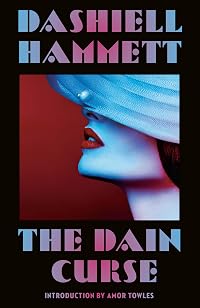
The Continental Op is a short, squat, and utterly unsentimental tank of a private detective. Miss Gabrielle Dain Leggett is young, wealthy, and a devotee of morphine and religious cults. She has an unfortunate effect on the people around her: they have a habit of dying violently. Is Gabrielle the victim of a family curse? Or is the truth about her weirder and infinitely more dangerous? The Dain Curse is one of the Continental Op's most bizarre cases and a tautly crafted masterpiece of suspense.Tags
Recommendations










Member Reviews
(Original Review, 1981-03-08)
"We don't do it that way...You're a storywriter. I can't trust you not to build up on what I tell you. I'll save mine till after you've spoken your piece, so yours won't be twisted to fit mine."
In “The Dain Curse” by Dashiell Hammett
"'Are you -- who make your living snooping -- sneering at my curiosity about people and my attempts to satisfy it?'
'We're different...I do mine with the object of putting people in jail, and I get paid for it, though not as much as I should.'
'That's not different...I do mine with the object of putting people in books, and I get paid for it, though not as much as I should.'"
In “The Dain Curse” by Dashiell Hammett
Hammett's main stated intention with the work was to attempt show more to make something approaching literature out of the detective genre. He clearly based his characters on people he knew but that doesn't preclude him also having other motives and working with other frames of reference. And in the end, this discussion exists outside of what Hammett really intended.
The work he created is dense enough to support multiple readings and resonate with other works of literature, and it is simply interesting to speculate on these.
I don't think any of us with our readings are claiming that Hammett meant it that way- we are just articulating ideas and references which have come to mind while reading “The Dain Curse”. There are plenty of books in the hard-boiled category about which it would be impossible to have these kinds of discussions, but “The Maltese Falcon” is, for a number of us, one which throws up many leads and echoes. I regularly re-read my Hammett. Yes, all 5 novels, including the thoroughly daft “The Dain Curse”… show less
"We don't do it that way...You're a storywriter. I can't trust you not to build up on what I tell you. I'll save mine till after you've spoken your piece, so yours won't be twisted to fit mine."
In “The Dain Curse” by Dashiell Hammett
"'Are you -- who make your living snooping -- sneering at my curiosity about people and my attempts to satisfy it?'
'We're different...I do mine with the object of putting people in jail, and I get paid for it, though not as much as I should.'
'That's not different...I do mine with the object of putting people in books, and I get paid for it, though not as much as I should.'"
In “The Dain Curse” by Dashiell Hammett
Hammett's main stated intention with the work was to attempt show more to make something approaching literature out of the detective genre. He clearly based his characters on people he knew but that doesn't preclude him also having other motives and working with other frames of reference. And in the end, this discussion exists outside of what Hammett really intended.
The work he created is dense enough to support multiple readings and resonate with other works of literature, and it is simply interesting to speculate on these.
I don't think any of us with our readings are claiming that Hammett meant it that way- we are just articulating ideas and references which have come to mind while reading “The Dain Curse”. There are plenty of books in the hard-boiled category about which it would be impossible to have these kinds of discussions, but “The Maltese Falcon” is, for a number of us, one which throws up many leads and echoes. I regularly re-read my Hammett. Yes, all 5 novels, including the thoroughly daft “The Dain Curse”… show less
*Possible spoilers ahead*
Hammett wrote only five novels, two of which--The Glass Key and this one--are considered "minor" works. This shows just how far off the mark critical consensus can be, since Hammett himself believed that The Glass Key was his finest book. (He was right.) The Dain Curse is not in the same class, but it's a fun, engaging detective yarn that has a lot going for it. Firstly, this is a Continental Op case, which means that it's fast-moving and loaded with action. Secondly, even though Hammett had become a mainstream success, this novel enthusiastically embraces the wackiness of the pulp magazines in which he was first published: the Op tangles with a religious cult, hallucinatory gas and a variety of just plain show more bizarre characters. (He even sees a junky through withdrawal.) Finally, The Dain Curse is full of the surgically precise language that originated with Hammett and became a mandatory feature of hard-boiled fiction forever after. Don't let anyone tell you that this is a minor novel: Dashiell Hammett didn't write anything "minor"! show less
Hammett wrote only five novels, two of which--The Glass Key and this one--are considered "minor" works. This shows just how far off the mark critical consensus can be, since Hammett himself believed that The Glass Key was his finest book. (He was right.) The Dain Curse is not in the same class, but it's a fun, engaging detective yarn that has a lot going for it. Firstly, this is a Continental Op case, which means that it's fast-moving and loaded with action. Secondly, even though Hammett had become a mainstream success, this novel enthusiastically embraces the wackiness of the pulp magazines in which he was first published: the Op tangles with a religious cult, hallucinatory gas and a variety of just plain show more bizarre characters. (He even sees a junky through withdrawal.) Finally, The Dain Curse is full of the surgically precise language that originated with Hammett and became a mandatory feature of hard-boiled fiction forever after. Don't let anyone tell you that this is a minor novel: Dashiell Hammett didn't write anything "minor"! show less
The Curse: Head Spinning Confusion
Hammett’s The Dain Curse, for all of its many flaws, still bears his hallmarks that make reading him nearly ninety years after first publication fun. Here, what begins as a simple jewelry insurance investigation by the, as usual, unnamed Continental Op, expands in short order into a novel of multiple murders, dope addiction, child abuse, and religious cultism for money, not to mention criminal mastermind manipulation. The flaws, so you know them going in, are a wildly convoluted plot that even with careful reading you may find hard to follow. Regular exposition in the form of formulating theories about the crimes as they build up. (In defense, Hammett first serialized the novel in four parts in Black show more Mask magazine, where a recasting of the plot would have proven helpful to readers). And added to these, the typical racism and sexism of the period.
Of course, what balances out these flaws are Hammett’s crisp writing style, his Damon Runyonesque characters, his wisecracking dialogue, and his liberal use of slang, some of it now arcane. Then, too, there is his spot-on understanding of human nature, particularly the dark side; Hammett worked as a detective for the Pinkerton agency before and after his stint in the army during WWI. So, the best advice when approaching this novel is, don’t let the flaws frustrate you, appreciate it for all its good stuff (that, true, gets used to better effect in his noir classics The Maltese Falcon and The Thin Man).
Now, as to that long and winding plot, astute readers will spot the killer early on. You won’t know the why and the how, but your suspicions will be aroused and no twisting of the plot will throw you off the scent. The Op shows up at the Leggetts’ on behalf of the agency’s client to investigate some missing jewels. Leggett is a scientist and he’s taken on the assignment of purifying color flaws in diamonds; his specialty is the science of color. The Leggetts have a daughter, Gabrielle, who is very much an odd duck in appearance and behavior; additionally, she’s a morphine addict. She disappears and we learn she belongs to a local religious cult. Shortly, the Leggetts, first the husband, followed by the wife, turn up dead. A young man in love with Gabrielle tries to protect you. The diamonds reappear after a few more people get murdered. The Op is out of the case. But Gabrielle falls big time into the clutches of the cult and her estate lawyer summons the Op to figure out what’s happening to her. Meanwhile, the Op takes time to meet and dine with an acquaintance, a novelist, who has taken an interest in the ever morphing case, wherein lots of chatter happens about the psychological state of people and plot points get proposed and hashed out. With much effort and a few murders, the Op rescues Gabrielle from the cult as he destroys it.
All seems resolved, except that Gabrielle and her boyfriend run off and marry. The estate lawyer again enlists the Op’s aid. Off he goes to visit the couple at their honeymoon retreat on the California coast. He arrives to find the nice young husband dead, murdered. He becomes involved with a small army of local officials, brings in more Ops, and all set about trying to deduce what the heck is going on. You guessed it: more bodies are added to the pile. In the end, characters and readers alike find themselves in a total state of exhaustion, patience tried to the limit, while the Op helps Gabrielle kick her habit and solves the series of crime. To put a fine point on the conclusion, we have a chapter devoted to where everybody—and the cast of characters is numerous—ends of. Readers wipe their brows and take an extra dose of their blood pressure meds. show less
Hammett’s The Dain Curse, for all of its many flaws, still bears his hallmarks that make reading him nearly ninety years after first publication fun. Here, what begins as a simple jewelry insurance investigation by the, as usual, unnamed Continental Op, expands in short order into a novel of multiple murders, dope addiction, child abuse, and religious cultism for money, not to mention criminal mastermind manipulation. The flaws, so you know them going in, are a wildly convoluted plot that even with careful reading you may find hard to follow. Regular exposition in the form of formulating theories about the crimes as they build up. (In defense, Hammett first serialized the novel in four parts in Black show more Mask magazine, where a recasting of the plot would have proven helpful to readers). And added to these, the typical racism and sexism of the period.
Of course, what balances out these flaws are Hammett’s crisp writing style, his Damon Runyonesque characters, his wisecracking dialogue, and his liberal use of slang, some of it now arcane. Then, too, there is his spot-on understanding of human nature, particularly the dark side; Hammett worked as a detective for the Pinkerton agency before and after his stint in the army during WWI. So, the best advice when approaching this novel is, don’t let the flaws frustrate you, appreciate it for all its good stuff (that, true, gets used to better effect in his noir classics The Maltese Falcon and The Thin Man).
Now, as to that long and winding plot, astute readers will spot the killer early on. You won’t know the why and the how, but your suspicions will be aroused and no twisting of the plot will throw you off the scent. The Op shows up at the Leggetts’ on behalf of the agency’s client to investigate some missing jewels. Leggett is a scientist and he’s taken on the assignment of purifying color flaws in diamonds; his specialty is the science of color. The Leggetts have a daughter, Gabrielle, who is very much an odd duck in appearance and behavior; additionally, she’s a morphine addict. She disappears and we learn she belongs to a local religious cult. Shortly, the Leggetts, first the husband, followed by the wife, turn up dead. A young man in love with Gabrielle tries to protect you. The diamonds reappear after a few more people get murdered. The Op is out of the case. But Gabrielle falls big time into the clutches of the cult and her estate lawyer summons the Op to figure out what’s happening to her. Meanwhile, the Op takes time to meet and dine with an acquaintance, a novelist, who has taken an interest in the ever morphing case, wherein lots of chatter happens about the psychological state of people and plot points get proposed and hashed out. With much effort and a few murders, the Op rescues Gabrielle from the cult as he destroys it.
All seems resolved, except that Gabrielle and her boyfriend run off and marry. The estate lawyer again enlists the Op’s aid. Off he goes to visit the couple at their honeymoon retreat on the California coast. He arrives to find the nice young husband dead, murdered. He becomes involved with a small army of local officials, brings in more Ops, and all set about trying to deduce what the heck is going on. You guessed it: more bodies are added to the pile. In the end, characters and readers alike find themselves in a total state of exhaustion, patience tried to the limit, while the Op helps Gabrielle kick her habit and solves the series of crime. To put a fine point on the conclusion, we have a chapter devoted to where everybody—and the cast of characters is numerous—ends of. Readers wipe their brows and take an extra dose of their blood pressure meds. show less
The Curse: Head Spinning Confusion
Hammett’s The Dain Curse, for all of its many flaws, still bears his hallmarks that make reading him nearly ninety years after first publication fun. Here, what begins as a simple jewelry insurance investigation by the, as usual, unnamed Continental Op, expands in short order into a novel of multiple murders, dope addiction, child abuse, and religious cultism for money, not to mention criminal mastermind manipulation. The flaws, so you know them going in, are a wildly convoluted plot that even with careful reading you may find hard to follow. Regular exposition in the form of formulating theories about the crimes as they build up. (In defense, Hammett first serialized the novel in four parts in Black show more Mask magazine, where a recasting of the plot would have proven helpful to readers). And added to these, the typical racism and sexism of the period.
Of course, what balances out these flaws are Hammett’s crisp writing style, his Damon Runyonesque characters, his wisecracking dialogue, and his liberal use of slang, some of it now arcane. Then, too, there is his spot-on understanding of human nature, particularly the dark side; Hammett worked as a detective for the Pinkerton agency before and after his stint in the army during WWI. So, the best advice when approaching this novel is, don’t let the flaws frustrate you, appreciate it for all its good stuff (that, true, gets used to better effect in his noir classics The Maltese Falcon and The Thin Man).
Now, as to that long and winding plot, astute readers will spot the killer early on. You won’t know the why and the how, but your suspicions will be aroused and no twisting of the plot will throw you off the scent. The Op shows up at the Leggetts’ on behalf of the agency’s client to investigate some missing jewels. Leggett is a scientist and he’s taken on the assignment of purifying color flaws in diamonds; his specialty is the science of color. The Leggetts have a daughter, Gabrielle, who is very much an odd duck in appearance and behavior; additionally, she’s a morphine addict. She disappears and we learn she belongs to a local religious cult. Shortly, the Leggetts, first the husband, followed by the wife, turn up dead. A young man in love with Gabrielle tries to protect you. The diamonds reappear after a few more people get murdered. The Op is out of the case. But Gabrielle falls big time into the clutches of the cult and her estate lawyer summons the Op to figure out what’s happening to her. Meanwhile, the Op takes time to meet and dine with an acquaintance, a novelist, who has taken an interest in the ever morphing case, wherein lots of chatter happens about the psychological state of people and plot points get proposed and hashed out. With much effort and a few murders, the Op rescues Gabrielle from the cult as he destroys it.
All seems resolved, except that Gabrielle and her boyfriend run off and marry. The estate lawyer again enlists the Op’s aid. Off he goes to visit the couple at their honeymoon retreat on the California coast. He arrives to find the nice young husband dead, murdered. He becomes involved with a small army of local officials, brings in more Ops, and all set about trying to deduce what the heck is going on. You guessed it: more bodies are added to the pile. In the end, characters and readers alike find themselves in a total state of exhaustion, patience tried to the limit, while the Op helps Gabrielle kick her habit and solves the series of crime. To put a fine point on the conclusion, we have a chapter devoted to where everybody—and the cast of characters is numerous—ends of. Readers wipe their brows and take an extra dose of their blood pressure meds. show less
Hammett’s The Dain Curse, for all of its many flaws, still bears his hallmarks that make reading him nearly ninety years after first publication fun. Here, what begins as a simple jewelry insurance investigation by the, as usual, unnamed Continental Op, expands in short order into a novel of multiple murders, dope addiction, child abuse, and religious cultism for money, not to mention criminal mastermind manipulation. The flaws, so you know them going in, are a wildly convoluted plot that even with careful reading you may find hard to follow. Regular exposition in the form of formulating theories about the crimes as they build up. (In defense, Hammett first serialized the novel in four parts in Black show more Mask magazine, where a recasting of the plot would have proven helpful to readers). And added to these, the typical racism and sexism of the period.
Of course, what balances out these flaws are Hammett’s crisp writing style, his Damon Runyonesque characters, his wisecracking dialogue, and his liberal use of slang, some of it now arcane. Then, too, there is his spot-on understanding of human nature, particularly the dark side; Hammett worked as a detective for the Pinkerton agency before and after his stint in the army during WWI. So, the best advice when approaching this novel is, don’t let the flaws frustrate you, appreciate it for all its good stuff (that, true, gets used to better effect in his noir classics The Maltese Falcon and The Thin Man).
Now, as to that long and winding plot, astute readers will spot the killer early on. You won’t know the why and the how, but your suspicions will be aroused and no twisting of the plot will throw you off the scent. The Op shows up at the Leggetts’ on behalf of the agency’s client to investigate some missing jewels. Leggett is a scientist and he’s taken on the assignment of purifying color flaws in diamonds; his specialty is the science of color. The Leggetts have a daughter, Gabrielle, who is very much an odd duck in appearance and behavior; additionally, she’s a morphine addict. She disappears and we learn she belongs to a local religious cult. Shortly, the Leggetts, first the husband, followed by the wife, turn up dead. A young man in love with Gabrielle tries to protect you. The diamonds reappear after a few more people get murdered. The Op is out of the case. But Gabrielle falls big time into the clutches of the cult and her estate lawyer summons the Op to figure out what’s happening to her. Meanwhile, the Op takes time to meet and dine with an acquaintance, a novelist, who has taken an interest in the ever morphing case, wherein lots of chatter happens about the psychological state of people and plot points get proposed and hashed out. With much effort and a few murders, the Op rescues Gabrielle from the cult as he destroys it.
All seems resolved, except that Gabrielle and her boyfriend run off and marry. The estate lawyer again enlists the Op’s aid. Off he goes to visit the couple at their honeymoon retreat on the California coast. He arrives to find the nice young husband dead, murdered. He becomes involved with a small army of local officials, brings in more Ops, and all set about trying to deduce what the heck is going on. You guessed it: more bodies are added to the pile. In the end, characters and readers alike find themselves in a total state of exhaustion, patience tried to the limit, while the Op helps Gabrielle kick her habit and solves the series of crime. To put a fine point on the conclusion, we have a chapter devoted to where everybody—and the cast of characters is numerous—ends of. Readers wipe their brows and take an extra dose of their blood pressure meds. show less
When Raymond Chandler said of Dashiell Hammett that he "gave murder back to the people who commit it for reasons, not just to provide a corpse", he cannot have been thinking of The Dain Curse.
The friends and associates of the morphine-fuddled Gabrielle Leggett are dying violently because, she thinks, she is cursed. The Continental Op believes that there is a more prosaic reason for the deaths. His investigations lead him from stolen diamonds via spiritualism and ritual sacrifice to a smugglers' cave.
The plot meanders around California, with new characters popping up at every stop. There's a lot going on and it's a gripping read.
By the second-last chapter it seems that Hammett just wants the story to end. He ties up all the loose ends, show more and there are plenty, into a blatantly artificial resolution.
4* Even a mediocre Hammett is pretty good. show less
The friends and associates of the morphine-fuddled Gabrielle Leggett are dying violently because, she thinks, she is cursed. The Continental Op believes that there is a more prosaic reason for the deaths. His investigations lead him from stolen diamonds via spiritualism and ritual sacrifice to a smugglers' cave.
The plot meanders around California, with new characters popping up at every stop. There's a lot going on and it's a gripping read.
By the second-last chapter it seems that Hammett just wants the story to end. He ties up all the loose ends, show more and there are plenty, into a blatantly artificial resolution.
4* Even a mediocre Hammett is pretty good. show less
The Dain Curse by Dashiell Hammett, father of the modern crime novel, is not only an action-packed tale of misdeeds and murder, but a study of 1920s American culture and society. Within the novel’s pages, here is a sampling of what a reader will encounter:
First-Person Hard Boiled Narrator
The unnamed Continental Op detective tells the tale in crisp, exacting language as he describes the people and places and situations he encounters. For example, here is an account of his first-time meeting a scientist by the name of Edgar Leggett, “His voice was unexpectedly harsh, rasping, though he manner was friendly enough. He was a dark-skinned erect man in his middle forties, muscularly slender and of medium height. He would have been handsome show more if his brown face hadn’t been so deeply marked with sharp, hard lines across the forehead and from the nostrils down across mouth-corners. Dark hair, worth rather long, curled above and around the broad, grooved forehead. Red-brown eyes were abnormally bright behind horn-rimmed spectacles. His nose was long, thin, and high-bridged. His lips were thin, sharp, nimble, over a small, bony chin. His black and white cloths were well made and cared for.” I quote the detective’s entire study to underscore how careful and laser-sharp observation is required at each step and phase in his solving this complex, convoluted case.
Presto Tempo
Like picking up clues as you read and solving the mystery before reaching the end? Good luck with this one – events are packed so tight and happen so fast, it is like trying to identify each note while listening to a Paganini Caprice. Fortunately, for the mystery-challenged, people like myself, the backstory is given as the end of each of the three parts, along with the Continental Op’s take on the case.
Femme Fatale
What is compelling noir without a femme fatale? This novel features a doozy – Gabrielle. There is something about this slender, large-eyed twenty-year-old that fascinates men and pull them to her like a powerful, deadly magnet. Is it her drug-induced craziness, or her intense personality, made more intense by a family curse, or, then again, her attractive face and exceptionally white, smooth skin? Or, perhaps more likely, a combination of all of these plus that undefinable feminine something.
Novelist Owen Fitzstephan
Hammett probably had lots of fun including a fiction writer in this book, a writer described by the detective as, “A man who pretended to be lazier than he was, would rather talk that do anything else, and had a lot of what seemed to be accurate information and original ideas on any subject that happened to come up, as long as it was a little out of the ordinary.” What kind of ideas does Owen Fitzstephan have on subjects out of the ordinary? I wouldn’t want to give too much away, so I’ll just say we come to see which one of these two – the Continental Op or the talented novelist – has more compassion and a greater grasp of human nature.
America the Violent
Guns are as common as candy – an entire society of people thinking their problems are best solved by shooting others or shooting themselves. Doesn’t matter, law or outlaw, man or woman, young or old, so many people quick to point a gun and pull the trigger. There aren’t as many corpses for the morgue as Hammett's Red Harvest but there are enough to count on more than one hand.
California Fruits and Nuts
By 1928 when Hammett wrote this novel, America was generations removed from a land of traditional believers in traditional religions. Matter of fact, many people relocated to California to escape the ways and beliefs of their parents - so many alternatives; so many sects and cults, so many ways to express yourself in faith and belief and alternate lifestyles. The Continental Op detective has to deal with a California cult calling itself "Temple of the Holy Grail." Here is what he says about the cult and the cult’s leaders: “They brought their cult to California because everybody does, and picked San Francisco because it held less competition than Los Angeles. They didn’t want a mob of converts: they wanted them few but wealthy.” Again, novel as study in the sociology and psychology of gun-crazed America.
American author Dashiell Hammett, 1894 - 1961 show less
Head to the west coast, where the Continental Op is called in to figure out a burglary and diamond theft for his insurance company employer. A suspect turns up dead, but without the diamonds. Then the guy who was burgled commits suicide, or maybe it wasn't. And he's got a wife who's behaving oddly and a daughter who is gorgeous, troubled, addicted to morphine and pretty sure that she's the victim of a family curse.
Things just keep happening here. Once you think everything's resolved, something pops up, generally a dead body. It's Hammett at his hard-boiled best.
Things just keep happening here. Once you think everything's resolved, something pops up, generally a dead body. It's Hammett at his hard-boiled best.
Members
- Recently Added By
Lists

Noirvember: The Best Noir
113 works; 56 members

Best Noir Fiction
160 works; 14 members

Books mentioned in Julian Symons’ Bloody Murder
438 works; 6 members

Books Read in 2014
2,343 works; 89 members

Jones & Newman: Best Horror Books Further Recommended Reading
577 works; 4 members

Best Crime Fiction
262 works; 39 members
Author Information

361+ Works 32,276 Members
Samuel Dashiell Hammett was born on May 27, 1894 in St Mary's County, Maryland. Raised in Baltimore and Philadelphia, he attended Baltimore Polytechnic until he was 13 years old, but was forced to drop out and work a series of jobs to help support his family. At the age of 21 Hammett was hired by the Pinkerton National Detective Agency as an show more operative. After a stint in the United States Army during World War II, he married a nurse named Josephine Annas Dolan, whom he met when he fell ill with tuberculosis. In 1922, Hammett began writing for Black Mask magazine. Using his background in detective work, he created the tough guy detective characters Sam Spade and the Continental Op, as well as debonair sleuths Nick and Nora Charles. By 1927, Hammett had written the Poisonville series, which later became the novel Red Harvest. He wrote more than 85 short stories and five novels during his lifetime. The novels include The Dain Curse, The Glass Key, The Thin Man, and The Maltese Falcon, which was later adapted into a classic movie starring Humphrey Bogart. He also wrote an autobiography entitled Beams Falling: The Art of Dashiell Hammett. After his marriage faltered in the late 1920s, Hammett met Lillian Hellman, then a married 24-year-old aspiring playwright. In 1930, Hellman left her husband for Hammett. Eventually they both divorced their spouses and, although the two never married, they remained together until Hammett's death on January 10, 1961. (Bowker Author Biography) show less
Some Editions
Series

Belongs to Publisher Series
Work Relationships
Is contained in
The Dain Curse / The Thin Man / The Glass Key / Red Harvest / The Maltese Falcon by Dashiell Hammett
Dashiell Hammett: The Library of America Edition: (Two-volume boxed set) by Dashiell Hammett (indirect)
Common Knowledge
- Canonical title
- The Dain Curse
- Original title
- The Dain Curse
- Alternate titles
- Estranha Maldição (PT) (PT)
- Original publication date
- 1929-07-19; 1932
- People/Characters
- Continental Op; Gabrielle Leggett; Edgar Leggett; Owen Fitzstephan
- Important places
- San Francisco, California, USA; Queseda, California, USA; California, USA
- Related movies
- The Dain Curse (1978 | IMDb)
- Dedication
- To Albert S. Samuels
- First words
- It was a diamond all right, shining in the grass half a dozen feet from the blue brick walk.
- Last words
- (Click to show. Warning: May contain spoilers.)Laurence Collinson laughed with us, but not from further down than his chin. I had an idea he thought I hadn't a refining influence.
(Click to show. Warning: May contain spoilers.)I had an idea he thought I hadn't a refining influence. - Original language
- English
Classifications
Statistics
- Members
- 1,520
- Popularity
- 15,114
- Reviews
- 38
- Rating
- (3.62)
- Languages
- 13 — Danish, Dutch, English, Estonian, Finnish, French, German, Greek, Italian, Norwegian (Bokmål), Spanish, Swedish, Portuguese (Portugal)
- Media
- Paper, Audiobook, Ebook
- ISBNs
- 59
- ASINs
- 36