On This Page
Description
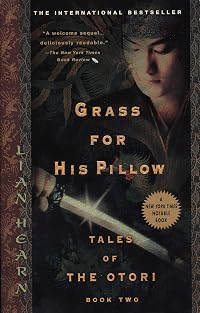
In Book I of the Otori trilogy, Across the nightingale floor, Lian Hearn created a wholly original, fully-realized fantasy world where great powers clashed and young love dawned against a dazzling and mystical landscape. Nightingale was named a New York times Notable Book of the Year, one of Book magazine's best novels of the year, and one of School library journal's Best Adult Books for High School Readers. In this second tale, we return to the story of Takeo--the young orphan taken up by show more the Otori Lord and now a closely held member of the Tribe--and his beloved Shirakawa Kaede, heir to the Maruyama, who must find a way to unify the domain she has inherited. In a complex social hierarchy, amid dissembling clans and fractured alliances, there is no place for passionate love. show lessTags
Recommendations























Member Reviews
At the end of Across the Nightingale Floor, Takeo was kidnapped by members of the Tribe, a clan of murderers who are intent on making him one of theirs. Having inherited an uncommon number of exceptional gifts from his father, he is of great value to them. Here we find Takeo at first fighting them off and attempting to flee, without success. They eventually wear him down and he gives his word that he will stay with the Tribe, even as his heart yearns for Kaede. But Takeo is soon wrapped up in the harsh and difficult training that is required of him and even takes on a lover. Meanwhile, Kaede makes her way back to her family's estate to find that it has fallen in a state of disrepair and poverty. Her father, who has fallen prey to mental show more illness since Kaede's mother's death, is unable to fulfill his duties and after many attempts and cajoling, she eventually convinces him to teach her skills which are only known to men so that she can take over the running of the estate and secure an army to realize great plans ahead.
Takeo and Kaede's individual struggles were interesting to observe, as is the evolution of both characters from inexperienced youths to committed and driven adults. But I can't say I quite as taken with this book as I was with the first one. That being said, the groundwork is set up for what promises to be a thrilling ride in the third book. show less
Takeo and Kaede's individual struggles were interesting to observe, as is the evolution of both characters from inexperienced youths to committed and driven adults. But I can't say I quite as taken with this book as I was with the first one. That being said, the groundwork is set up for what promises to be a thrilling ride in the third book. show less
I almost never re-read books, but I read this one twice and loved it equally both times. The second installment of the Tales of the Otori Trilogy, Grass for His Pillow alternates between two linked stories: Lord Otori Takeo's quest to avenge the death of his adopted father and Lady Shirakawa Kaede's struggle to reclaim her domain in spite of traditions that deny women power. In the first book, the characters felt like puppets manipulated by the demands of the plot, but in this one, they are three-dimensional human beings. Takeo is intriguingly torn between his pacifist upbringing, his longing for vengeance and the requirements of the tribe of ruthless assassins who have adopted him. Kaede, meanwhile, believably transforms from a show more political pawn to a powerful woman without becoming a cliched "girl power" character, making her one of my all-time favorite female characters. Both of these characters, along with an interesting supporting cast, struggle through a suspense-filled plot that kept me turning pages long after midnight. At times, reading this book was like watching a good horror movie: being able to guess exactly what was coming kept me glued to my seat, unable to tear my eyes away. Perhaps some people would say the book is predictable, but for me, this only intensified the suspense. This is an excellent choice for readers seeking a good escape on a Sunday afternoon -- just beware that you'll have to dash to the bookstore to buy the third installment as soon as you've finished this one. show less
The sequel to Across the Nightingale Floor, set in an alternate medieval Japan, picks up a few months following that book. Takeo has reluctantly left the love of his life, Kaede, and gone with The Tribe, his father's people, as part of a deal he made with them to allow him to avenge Otori Shigeru who had rescued him from certain death in the first book and become his adopted father. The Tribe claimed him due to his father having been a Tribe assassin who'd run away from that life.
In this book, Takeo, whose special talents and heightened senses surpass that of most of the Tribe's people, is being trained as an assassin, but the elders don't trust him, nor does he trust them. He believes his destiny lies elsewhere, but he's obligated by show more the agreement he'd made, to stay, until his heightened hearing reveals to him that he'll be killed on an upcoming mission. He escapes, instead, and sets out on a journey to claim Shigeru's domain from Shigeru's deceitful uncles and unite the many lands of the island realm.
Meanwhile, Kaede has returned to her home to find her mother dead, her father a step short of madness, and the estate in disarray. Though it goes against the laws of society for a woman to act like a man, she sets out to unite her family domain with that of her recently deceased kinswoman's, and the book follows these parallel story threads until Kaede and Takeo meet again, setting up the action for the final book of the trilogy.
This is a fully realized realm, with well-drawn characters, young people who make mistakes yet believe in their cause. The writing is plain and crisp and the book rarely lags. I've just started reading the next one and can't wait to read the fate of Takeo and Kaede. show less
In this book, Takeo, whose special talents and heightened senses surpass that of most of the Tribe's people, is being trained as an assassin, but the elders don't trust him, nor does he trust them. He believes his destiny lies elsewhere, but he's obligated by show more the agreement he'd made, to stay, until his heightened hearing reveals to him that he'll be killed on an upcoming mission. He escapes, instead, and sets out on a journey to claim Shigeru's domain from Shigeru's deceitful uncles and unite the many lands of the island realm.
Meanwhile, Kaede has returned to her home to find her mother dead, her father a step short of madness, and the estate in disarray. Though it goes against the laws of society for a woman to act like a man, she sets out to unite her family domain with that of her recently deceased kinswoman's, and the book follows these parallel story threads until Kaede and Takeo meet again, setting up the action for the final book of the trilogy.
This is a fully realized realm, with well-drawn characters, young people who make mistakes yet believe in their cause. The writing is plain and crisp and the book rarely lags. I've just started reading the next one and can't wait to read the fate of Takeo and Kaede. show less
I am usually reluctant to read the second book in a series because it often doesn't read as well as the first. Thankfully, this is not the case with this series of books. "Grass for his pillow" is just as beautifully written as "Across the nightingale floor" as it continues to follow the lives of Takeo and his beloved Kaede. Can't wait to see how it's all going to end, I am expecting a stunning finish so I hope I'm not disappointed.
I enjoyed the two storylines of this book as they ran alongside each other. There's some great world-building going on as Hearn illustrates the rules of this society, revealing things about clans and the Tribe and all that. I found both of the protagonists stories to be equally compelling and they kept my interest, and I was so pleased with how strong Kaede was turning out to be. But then the romance came back into it and everything fell apart. It would be different if it was at least believable, but for me it was not at all. It's not just stupid kids and their impulses - it's lazy writing. Their characters, particularly Kaede's, completely dissolve for the sake of this improbable connection.
I enjoyed the middle of this book the best, show more but the beginning and the end are both soaked in the soppy, unrealistic, romance of two teenagers that should have far more important things on their mind than banging.
There's also some teasing that the author does that I find very frustrating as a reader. As we follow Takeo's story, there are constant references made to the fact that this is a story being told in the future. It's told from first person and the narrator often says "I would later learn . . ." or "I would come to understand . . ." It wasn't a problem the first reference or two, but after that it became exhausting and frustrating. This is also confusing when we jump to Kaede, as her story is told from third person and is devoid of these remarks.
I'm really waffling between two and three stars on this, but I truly was enjoying the book until the last two chapters so I will let it stand with three. show less
I enjoyed the middle of this book the best, show more but the beginning and the end are both soaked in the soppy, unrealistic, romance of two teenagers that should have far more important things on their mind than banging.
There's also some teasing that the author does that I find very frustrating as a reader. As we follow Takeo's story, there are constant references made to the fact that this is a story being told in the future. It's told from first person and the narrator often says "I would later learn . . ." or "I would come to understand . . ." It wasn't a problem the first reference or two, but after that it became exhausting and frustrating. This is also confusing when we jump to Kaede, as her story is told from third person and is devoid of these remarks.
I'm really waffling between two and three stars on this, but I truly was enjoying the book until the last two chapters so I will let it stand with three. show less
Is it often, or even always, true that the second book is more satisfying than the first, in a series? We know the characters (unless you are reading George R.R. Martin), we know the setting, and we've got some of the plot under our reading belt.
This second book definitely was satisfying. I became more attached to the main characters and their story, I learned more fascinating details about their world.
I don't know whether to describe this book as set in medieval Japan, or not as it is fiction. But the author definitely has done her homework and the books are full of interesting, and picturesque, details making me feel as if I were there hearing the noises, seeing the scenes. But even though the environment is completely different show more than the one where I live, nevertheless, I was very identified with the main characters and am completely cheering for them. show less
This second book definitely was satisfying. I became more attached to the main characters and their story, I learned more fascinating details about their world.
I don't know whether to describe this book as set in medieval Japan, or not as it is fiction. But the author definitely has done her homework and the books are full of interesting, and picturesque, details making me feel as if I were there hearing the noises, seeing the scenes. But even though the environment is completely different show more than the one where I live, nevertheless, I was very identified with the main characters and am completely cheering for them. show less
This second volume in the Otori trilogy commences at the point where book 1 left off. Faced with an ultimatum from the Tribe, his biological father's people, to either join them and finish his training with them, renouncing his inheritance from his adoptive father Otori Shigeru, or else be killed, Takeo has to go with them. (Takeo's adoption into the Otori clan is later declared illegal by the self serving uncles who arranged for Shigeru's murder in any case). He then endures privations and punishments to make him comply, but it is clear that some of those among the Tribe resent his gifts and his possible supplanting of themselves in his Tribe family's hierarchy so are working their own agendas.
Left behind, Shirakawa Kaede has major show more problems of her own, finding her mother has died and her father has more or less suffered a breakdown after being unable to stop warriors travelling through his land enroute to the fighting which now has broken out between lord Arai and the former supporters of the dead warlord Iida Sadamu. Her father still has loyalties to the opponents of Lord Arai although Arai now expects Kaede to ally herself to him. The house and grounds are in poor order, as are the lands around, thanks to a combination of natural disasters and the ongoing fighting. A local lord then develops a fascination with Kaede: he is known to prefer men, but wants to 'collect' her and add her to his collection, something which would entail her having to marry him - which she is under pressure to do - and then being more or less sequestered for the rest of her life. Despite this she manages to convince her father to start teaching her - giving her a son's education as she only knows the script used by women - so that she can understand the estate accounts and know everything she needs in order to take over management of the estate which he has neglected for a long time. She also tries to protect her sisters.
The obstacles in the way of Kaede and Takeo ever marrying seem insurmountable, and political events are escalating. Only with allies can Kaede take the inheritance of the richer lands that her dead kinswoman intended she should have and can she and Takeo gain the resources they need as a power base.
In a lot of ways this is a typical middle book in a trilogy. It takes the characters forward in their personal timelines and development but not a great deal happens plotwise. Some of the things set up at the start of the book do not pan out as expected for instance, Kaede miscarries the child she conceived when she and Takeo made love on the night of Iida's death, thinking they would not survive . There are ominious indications of future threats as well as the immediate ones. The fantasy version of medieval Japan is again beautifully evoked with the very different attitudes, compared to Western ones, to honour, suicide and religion.
For me, the ending was a bit rushed and didn't quite gell with what has been developed up to now - the two main characters act out of a more Western style viewpoint than the one their culture would dictate. So I can only give this a 4 star rating. show less
Left behind, Shirakawa Kaede has major show more problems of her own, finding her mother has died and her father has more or less suffered a breakdown after being unable to stop warriors travelling through his land enroute to the fighting which now has broken out between lord Arai and the former supporters of the dead warlord Iida Sadamu. Her father still has loyalties to the opponents of Lord Arai although Arai now expects Kaede to ally herself to him. The house and grounds are in poor order, as are the lands around, thanks to a combination of natural disasters and the ongoing fighting. A local lord then develops a fascination with Kaede: he is known to prefer men, but wants to 'collect' her and add her to his collection, something which would entail her having to marry him - which she is under pressure to do - and then being more or less sequestered for the rest of her life. Despite this she manages to convince her father to start teaching her - giving her a son's education as she only knows the script used by women - so that she can understand the estate accounts and know everything she needs in order to take over management of the estate which he has neglected for a long time. She also tries to protect her sisters.
The obstacles in the way of Kaede and Takeo ever marrying seem insurmountable, and political events are escalating. Only with allies can Kaede take the inheritance of the richer lands that her dead kinswoman intended she should have and can she and Takeo gain the resources they need as a power base.
In a lot of ways this is a typical middle book in a trilogy. It takes the characters forward in their personal timelines and development but not a great deal happens plotwise. Some of the things set up at the start of the book do not pan out as expected
For me, the ending was a bit rushed and didn't quite gell with what has been developed up to now - the two main characters act out of a more Western style viewpoint than the one their culture would dictate. So I can only give this a 4 star rating. show less
Members
- Recently Added By
Lists

Japanese Literature
230 works; 40 members

Fantasy by Women Who Broke Away from Europe
144 works; 12 members

Books Read in 2014
2,343 works; 86 members
Author Information

79+ Works 17,557 Members
Some Editions
Awards and Honors
Series

Work Relationships
Common Knowledge
- Canonical title
- Grass for His Pillow
- Original title
- Grass for his pillow
- Original publication date
- 2003
- People/Characters
- Otori Takeo; Shirakawa Kaede
- Important places
- Hagi, Japan; Inuyama, Japan; Kumamoto, Japan; Maruyama, Japan
- Epigraph
- Oh nights when, wind wimixing in, the rain falls, On nights when, rain mixing in, the snow falls --- Yamanoue no Okura: A dialogue on Poverty
- Dedication
- For D.
- First words
- Shirakawa Kaede lay deeply asleep in the state close to unconsciousness that Kikuta can deliver with their gaze.
- Last words*
- (Click to show. Warning: May contain spoilers.)Fünf Schlachten lagen vor uns, vier Mal würden wir den Sieg davontragen, ein Mal uns geschlagen geben.
- Original language*
- Anglais (Royaume-Uni) (Royaume-Uni)
*Some information comes from Common Knowledge in other languages. Click "Edit" for more information.
Classifications
Statistics
- Members
- 3,137
- Popularity
- 5,565
- Reviews
- 42
- Rating
- (3.89)
- Languages
- 18 — Danish, Dutch, English, Estonian, Finnish, French, German, Greek, Indonesian, Italian, Latvian, Lithuanian, Norwegian (Bokmål), Norwegian, Polish, Portuguese, Spanish, Swedish
- Media
- Paper, Audiobook, Ebook
- ISBNs
- 85
- UPCs
- 1
- ASINs
- 15