On This Page
Description
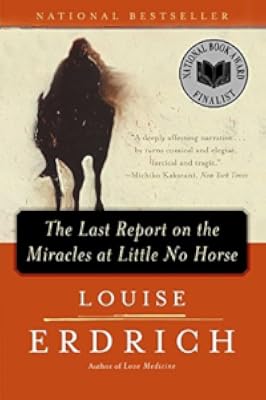
For over half a century, Father Damien Modeste has lived a secret life as a woman, while serving his beloved people, the Ojibwe, on the remote reservation of Little No Horse. Now nearing the end of his life, Father Damien dreads the discovery of his physical identity. To complicate his fears, his quiet life changes when a troubled colleague comes to the reservation to investigate the life of the perplexing, difficult, possibly false saint, Sister Leopolda. Father Damien alone knows the show more strange truth of Sister Leopolda's piety, but the facts are bound up in his own secret. He is forced to choose: Should he reveal all he knows and risk everything? Or should he manufacture a protective history? In a masterwork that both deepens and enlarges the world of her previous novels set on the same reservation, Louise Erdrich captures the essence of a time and the spirit of a woman who feels compelled by her beliefs to serve her people as a priest. The Last Report on the Miracles at Little No Horse is a work of an avid heart, a writer's writer, and a storytelling genius. show lessTags
Recommendations




Member Reviews
This complex and atmospheric narrative recounts the unlikely career of Agnes DeWitt, a passionately religious woman who cannot find her place as a nun. Through a series of tragedies and coincidences, she disguises herself as a recently deceased priest and takes up his posting at a remote reservation.
There, Father Damien, nee Agnes, finds her faith strengthened by the complexities of the human experience. Bearing witness to untold cruelty, and unimaginable resilience across the many decades of her life, she must face her final test in the person of Father Jude, a priest sent to investigate the claims of miracles and make a recommendation for sainthood.
Father Damien will need to decide whether he can bear to reveal his own deepest show more secrets in the twilight of his life or let the Vatican award recognition upon a truly evil woman.
The cast of characters here is large and the nonlinear story telling can be a bit bewildering at times. Still, the power of the storytelling cannot be denied and I enjoyed living in the richly detailed world of the novel. show less
There, Father Damien, nee Agnes, finds her faith strengthened by the complexities of the human experience. Bearing witness to untold cruelty, and unimaginable resilience across the many decades of her life, she must face her final test in the person of Father Jude, a priest sent to investigate the claims of miracles and make a recommendation for sainthood.
Father Damien will need to decide whether he can bear to reveal his own deepest show more secrets in the twilight of his life or let the Vatican award recognition upon a truly evil woman.
The cast of characters here is large and the nonlinear story telling can be a bit bewildering at times. Still, the power of the storytelling cannot be denied and I enjoyed living in the richly detailed world of the novel. show less
So what’s your view of Indians? Or is the correct phrase native Americans? Either way, it’s probably better than ‘injuns!’. In truth, I’m not sure that native American is the right term to apply to Indians? Isn’t there new evidence turning up every week that America was settled by Vikings, or other Europeans? It probably won’t be long before somebody digs up a pyramid and we have to rethink once again just who it was that ‘discovered’ America. Certainly though, ‘Indians’ is a lot easier to yell if your wagon train is about to suffer a misfortune. By the time you’ve finished yelling ‘indigenous native Americans’ the best you can hope for is that the arrow through your neck hasn’t ruined the collar of your show more good shirt.
Misfortune. There’s a lot of it in this book, a lot of it that people bring on themselves and some that they work hard to bring on others. One thing though, it will re-align your view of life on a reservation and if it doesn’t replace the mental image you currently have of ‘Indians’ (mine if three arrows sticking in a stage-coach door as it pulls into town), it will certainly place in it a series of images that are just as fresh and colourful.
There is, throughout the book, a conspicuous sense of its construction. This is a novel, no doubt, yet within it one can see the short stories that sit so neatly within the episodic, flashback style that the story is told in. Not that this is in any way a distraction because the sections between the short stories are not at all simply bridges intended to convey the reader from one amusing tale to the next but rather the thread that stitches the novel together and, like the embroidery on some fantastic, magical garment such as one of the characters might wear, the effect is dazzling.
This then is the story of life on a native American reservation over the course of the last century, and the stories of those that live on that reservation. And what complicated lives they are. As the twentieth century rolls on, or more precisely rolls by, the reservation, those that live on it are free to indulge in the trials and rivalries that have gone on unchanged for years, decades, generations. Especially generations because if there is one thing the characters like it’s a good feud and if the original cause has been forgotten then don't worry, a fresh outrage will be along soon.
Given what the characters have to contend with in terms of flood, famine, disease and the sort of winters normally associated with the climate of other planets, it's astonishing that any of them have the energy to feud, or fight, or fuck, never mind doing any of those to the extent that they do here.
This is a very, very good book. The description of life on the reservation, and of the hard winters in particular, are stunning and offset brilliantly by the warmth of the characters.
For a novel with a priest at the main character and with nuns in abundance, not to mention the appearance of the Devil himself, there's actually very little religion in the story although there is an awful lot of spirituality, and the writing is divine.
There are plot twists but these don't seem forced, more natural occurrences. Such an expanse of time allows the plot the luxury of being able to cover the minor as well as major events although, of course, in a true community there are no minor events, just ones that seem minor at the time.
Finishing this book presented me with a most curious sensation - the desire to read it again, sooner rather than later. To return to Little No Horse and spend some time with the folk there; Father Damien, young and idealistic, Father Damien, old and wise and Nanapush, ageless, immortal, both wise and foolish, locked in orbit around a wife he shames regularly but loves constantly. Even though the summer brings dust and wilting heat and the winter brings hunger and cold, this land grows stories that deserve to be read and reread. show less
Misfortune. There’s a lot of it in this book, a lot of it that people bring on themselves and some that they work hard to bring on others. One thing though, it will re-align your view of life on a reservation and if it doesn’t replace the mental image you currently have of ‘Indians’ (mine if three arrows sticking in a stage-coach door as it pulls into town), it will certainly place in it a series of images that are just as fresh and colourful.
There is, throughout the book, a conspicuous sense of its construction. This is a novel, no doubt, yet within it one can see the short stories that sit so neatly within the episodic, flashback style that the story is told in. Not that this is in any way a distraction because the sections between the short stories are not at all simply bridges intended to convey the reader from one amusing tale to the next but rather the thread that stitches the novel together and, like the embroidery on some fantastic, magical garment such as one of the characters might wear, the effect is dazzling.
This then is the story of life on a native American reservation over the course of the last century, and the stories of those that live on that reservation. And what complicated lives they are. As the twentieth century rolls on, or more precisely rolls by, the reservation, those that live on it are free to indulge in the trials and rivalries that have gone on unchanged for years, decades, generations. Especially generations because if there is one thing the characters like it’s a good feud and if the original cause has been forgotten then don't worry, a fresh outrage will be along soon.
Given what the characters have to contend with in terms of flood, famine, disease and the sort of winters normally associated with the climate of other planets, it's astonishing that any of them have the energy to feud, or fight, or fuck, never mind doing any of those to the extent that they do here.
This is a very, very good book. The description of life on the reservation, and of the hard winters in particular, are stunning and offset brilliantly by the warmth of the characters.
For a novel with a priest at the main character and with nuns in abundance, not to mention the appearance of the Devil himself, there's actually very little religion in the story although there is an awful lot of spirituality, and the writing is divine.
There are plot twists but these don't seem forced, more natural occurrences. Such an expanse of time allows the plot the luxury of being able to cover the minor as well as major events although, of course, in a true community there are no minor events, just ones that seem minor at the time.
Finishing this book presented me with a most curious sensation - the desire to read it again, sooner rather than later. To return to Little No Horse and spend some time with the folk there; Father Damien, young and idealistic, Father Damien, old and wise and Nanapush, ageless, immortal, both wise and foolish, locked in orbit around a wife he shames regularly but loves constantly. Even though the summer brings dust and wilting heat and the winter brings hunger and cold, this land grows stories that deserve to be read and reread. show less
Complicated relationships, shifting points of view, interwoven chronologies---all these things made this a challenging and highly engaging read for me. The story begins with an ancient priest, Father Damien Modeste, writing as he clearly has done many times before, to an unresponsive church hierarchy. We discover almost immediately that Father Damien has a fundamental secret, and then we are transported back to the lives he lived before arriving at the Ojibwe reservation of Little No Horse, where he has served a remarkably long tenure, and where additional secrets abound. There is something Faulknerian in the structure of this novel, although on a sentence level Erdrich's writing is clear and crisp, never convoluted or streaming. As the show more narrative moved from one time frame to another, I found myself re-reading sections 50 or 100 pages later when it became clear how That Part related to This Part. I don't consider this a criticism; I immersed myself in this story in a way that doesn't happen often to me, even with books I admire and enjoy. And I may just read it again from beginning to end.
May 2015 show less
May 2015 show less
This novel goes back to the early 1900's when the progenitors of the cast of characters I met in Love Medicine were themselves young--pre-legendary. Here we are given the story of the Catholic priest, Father Damien, sent to this remote section of the Ojibwe reservation. It is (literally) a wild ride, as always with Erdrich, beautifully written and slipping effortlessly and convincingly in and out of places not quite of this world and so tender about the mysteries that people hold within themselves. It's the sort of book that makes you remember that one should never be dismissive of anyone no matter what they appear to be on the outside, whether a hapless drunk or a feckless storyteller or an inveterate flirt. ****1/2
Intertwined stories of the unexpected history of the new priest who has arrived at an Ojibwe resevation in northern Minnesota and the families who live there, only tangentially related to the investigation of one of the sisters at the mission for possible sainthood.
Regular readers of Erdrich will see familiar themes emerging here, and recaps or foreshadowings of other incidents to be more fully developed in later works (specifically, 'Four Souls'). There's humor and heartbreak and inevitably puzzlement, misunderstanding, and disappointment when two cultures with exceedingly different worldviews rub up against one another in splendid isolation from either's homeworld.
As Father Damien's long life of service nears its end, the question of show more whether or not deep secrets ought to be revealed. The reader has been aware of some of them from the get-go, may have figured out others along the way, and will undoubtedly be surprised by some. Erdrich performs a masterful dance here, weaving between past and present, and doing it all with a lyrical understanding of the human heart. show less
Regular readers of Erdrich will see familiar themes emerging here, and recaps or foreshadowings of other incidents to be more fully developed in later works (specifically, 'Four Souls'). There's humor and heartbreak and inevitably puzzlement, misunderstanding, and disappointment when two cultures with exceedingly different worldviews rub up against one another in splendid isolation from either's homeworld.
As Father Damien's long life of service nears its end, the question of show more whether or not deep secrets ought to be revealed. The reader has been aware of some of them from the get-go, may have figured out others along the way, and will undoubtedly be surprised by some. Erdrich performs a masterful dance here, weaving between past and present, and doing it all with a lyrical understanding of the human heart. show less
Oh, my hodge-podge of immediate feeling! At first I thought it best to sleep on it, write something tomorrow, as sleep tends to ameliorate just about anything, but what the hell.
Is this 4 stars? 5 stars? First, to get my few quabbles out of the way, which may just be my own and no real flaw of the book. This being the fifth-and-a-half Erdrich book I've read, I have been steeped enough in the mythology and history of her Little No Horse/Argus/North Dakota nether regions to know a lot of the skinny already behind the mysteries in this book. Not that it matters much because I begin to realize how much I forget from previous stories, and then I get frustrated and resolve for the nth time to reread all these books again. Someday. I am show more starting to muddle all the information I've learned thus far, enough so that it sometimes held back some of my enjoyment of the moment. Has anyone else had this problem, or is it just another hell constructed by my OCD, literary fact-checking mind? Similarly, much to my annoyance because I desperately try to avoid this, I've lately guessed endings/outcomes to many books I read, and Last Report proved as no exception...that was a little bit of a letdown. I also got confused as to which parts of Father Damien's reports were known to Father Jude. Some minutiae Jude seemed to understand quite well, whereas others--primarily the fact that Damien is a WOMAN and all issues surrounding this matter--go quite undetected. This seems a little careless to me on Erdrich's part. Can someone out there tell me if I'm mistaken?
And yet, I really did enjoy this book. Though I loved Damien/Agnes, I truly love Nanapush. Even though I'm sure he's supposed to be Father Damien's foil, thereby giving Damien the limelight, he absolutely stands first in my mind. The crafty chess scene with Damien...brilliant! Trying to steal a wife from his best friend...strangely endearing. But--I agree with Meghan on this--"Le Mooz" may be the best single chapter I've read in a while. What's not to love? Moose rides, flatulence, necrophilia, and love above and beyond it all? This is what wins me over.
And how we, every single character, develop love and compassion through (or in spite of?) agitation and restlessness. Or understanding how we interpret everything to be a miracle until another explanation arises. The matters of faith, holiness, and loneliness...to be so integral to the lives of so many and yet be entirely isolated...how do we select our heroes and villains? Who has a right to say which is which? Who deserves to know who the heroes are? Even though Last Report obviously has its own answers, this book does have a lot of delicious gray area that I was glad to read after the rather underwhelming black and white of Narcissus and Goldmund I read a few books back. (I’m feeling a little guilt in suggesting that Erdrich trumps Hesse for me now.) And on a side note, LR only heightened my longing for playing the piano once again. I’m a sucker for people who write about pianos.
Like many others before it, this book leaves me with a number of questions to figure out for myself...questions I probably won’t, can’t take the time to answer just yet, but will find elsewhere on down the road.
*******
I haven't quite stopped thinking about this book in the nine months since I finished it...it deserves 5 stars. show less
Is this 4 stars? 5 stars? First, to get my few quabbles out of the way, which may just be my own and no real flaw of the book. This being the fifth-and-a-half Erdrich book I've read, I have been steeped enough in the mythology and history of her Little No Horse/Argus/North Dakota nether regions to know a lot of the skinny already behind the mysteries in this book. Not that it matters much because I begin to realize how much I forget from previous stories, and then I get frustrated and resolve for the nth time to reread all these books again. Someday. I am show more starting to muddle all the information I've learned thus far, enough so that it sometimes held back some of my enjoyment of the moment. Has anyone else had this problem, or is it just another hell constructed by my OCD, literary fact-checking mind? Similarly, much to my annoyance because I desperately try to avoid this, I've lately guessed endings/outcomes to many books I read, and Last Report proved as no exception...that was a little bit of a letdown. I also got confused as to which parts of Father Damien's reports were known to Father Jude. Some minutiae Jude seemed to understand quite well, whereas others--primarily the fact that Damien is a WOMAN and all issues surrounding this matter--go quite undetected. This seems a little careless to me on Erdrich's part. Can someone out there tell me if I'm mistaken?
And yet, I really did enjoy this book. Though I loved Damien/Agnes, I truly love Nanapush. Even though I'm sure he's supposed to be Father Damien's foil, thereby giving Damien the limelight, he absolutely stands first in my mind. The crafty chess scene with Damien...brilliant! Trying to steal a wife from his best friend...strangely endearing. But--I agree with Meghan on this--"Le Mooz" may be the best single chapter I've read in a while. What's not to love? Moose rides, flatulence, necrophilia, and love above and beyond it all? This is what wins me over.
And how we, every single character, develop love and compassion through (or in spite of?) agitation and restlessness. Or understanding how we interpret everything to be a miracle until another explanation arises. The matters of faith, holiness, and loneliness...to be so integral to the lives of so many and yet be entirely isolated...how do we select our heroes and villains? Who has a right to say which is which? Who deserves to know who the heroes are? Even though Last Report obviously has its own answers, this book does have a lot of delicious gray area that I was glad to read after the rather underwhelming black and white of Narcissus and Goldmund I read a few books back. (I’m feeling a little guilt in suggesting that Erdrich trumps Hesse for me now.) And on a side note, LR only heightened my longing for playing the piano once again. I’m a sucker for people who write about pianos.
Like many others before it, this book leaves me with a number of questions to figure out for myself...questions I probably won’t, can’t take the time to answer just yet, but will find elsewhere on down the road.
*******
I haven't quite stopped thinking about this book in the nine months since I finished it...it deserves 5 stars. show less
So good: combines elements of fable, realism (magical and otherwise), spiritual struggle, love, desire, heartbreak, abuse, family strife, gender identity...I was completely engaged. One of those "big books" that doesn't spend time drawing attention to itself but, rather, drawing you in to another world that overlaps, sometimes surprisingly, with your own.
What is the whole of our existence but the sound of an appalling love?
What is the whole of our existence but the sound of an appalling love?
Members
- Recently Added By
Lists

Recommend the 20 best books you've read in the last five years
2,168 works; 601 members

Native American / Indigenous Literature
172 works; 100 members

Best 21st Century Books (So Far)
670 works; 86 members

National Book Award Finalists - Fiction
377 works; 12 members

Vulture's 100 Best Books of the 21st Century (So Far)
98 works; 9 members

Top 100 books by Indigenous Masters
134 works; 7 members

Books Set in North Dakota
8 works; 4 members

Carole's List
445 works; 13 members

Favorite Book Titles
35 works; 1 member

Books With the Most Memorable Titles
478 works; 158 members

Books Read in 2024
4,623 works; 126 members
Author Information

70+ Works 45,331 Members
Karen Louise Erdrich was born on June 7, 1954 in Little Falls, Minnesota. Erdrich grew up in Wahpeton, North Dakota, where both of her parents were employed by the Bureau of Indian Affairs. She is a member of the Turtle Mountain Band of Chippewa. Erdrich graduated from Dartmouth College in 1976 with an AB degree, and she received a Master of Arts show more in creative writing from Johns Hopkins University in 1979. Erdrich published a number of poems and short stories from 1978 to 1982. In 1981 she married author and anthropologist Michael Dorris, and together they published The World's Greatest Fisherman, which won the Nelson Algren Award in 1982. In 1984 she won the National Book Critics Circle Award for Love Medicine, which is an expansion of a story that she had co-written with Dorris. Love Medicine was also awarded the Virginia McCormick Scully Prize (1984), the Sue Kaufman Prize (1985) and the Los Angeles Times Award for best novel (1985). In addition to her prose, Erdrich has written several volumes of poetry, a textbook, children's books, and short stories and essays for popular magazines. She has been the recipient of numerous awards for professional excellence, including the National Magazine Fiction Award in 1983 and a first-prize O. Henry Award in 1987. Erdrich has also received the Pushcart Prize in Poetry, the Western Literacy Association Award, the 1999 World Fantasy Award, and the Scott O'Dell Award for Historical Fiction in 2006. In 2007 she refused to accept an honorary doctorate from the University of North Dakota in protest of its use of the "Fighting Sioux" name and logo. Erdrich's novel The Round House made the New York Times bestseller list in 2013. Her other New York Times bestsellers include Future Home of the Living God (2017). (Bowker Author Biography) show less
Some Editions
Awards and Honors
Awards
Distinctions
Notable Lists
Series

Common Knowledge
- Canonical title
- The Last Report on the Miracles at Little No Horse
- Original publication date
- 2001-03-15
- People/Characters
- Dewitt, Agnes; Father Damien (Modeste); Sister Leopolda; Nanapush; Mary Kashpaw; Lulu Nanapush (show all 8); Jude Miller; Fleur Pillager
- Important places*
- North Dakota, Verenigde Staten
- Epigraph
- Nindinawemaganidok
There are four layers above the earth and four layers below. Sometime in our dreams and creations we pass through the layers, which are also space and time. In saying the word nindinawemaganidok, o... (show all)r my relatives, we speak of everything that has existed in time, the known and the unknown, the unseen, the obvious, all that lived before or is living now in the worlds above and below.
--Nanapush - First words
- The grass was white with frost on the shadowed sides of the reservation hills and ditches, but the morning air was almost warm, sweetened by a southern wind. Father Damien's best hours were late at night and just after rising... (show all), when all he'd had to break his fast was a cup of hot water. He was old, very old, but alert until he had to eat. Dressed in his antique cassock, he sat in his favorite chair, contemplating the graveyard that spread just past the ragged yard behind his retirement house and up a low hill. His thoughts seemed to penetrate sheer air, the maze of tree branches waving above the stones, clouds, sky, even time itself, and they surged from his brain, tense, quickly, one on the next until he'd eaten his tiny meal of toast and coffee. Just after, Father Damien's mind relaxed. His habit was then to doze again, often straight into his afternoon nap. -Prologue, The Old Priest, 1996
Eighty-some years previous, through a town that was to flourish and past a farm that would disappear, the river slid - all that happened began with that flow of water. The town on its banks was very new and its main street wa... (show all)s a long curved road that followed the will of the muddy river full of brush, silt, and oxbows that threw the whole town off the strict clean gride laid out by railroad plat. The river flooded each spring and dragged local backyards into its roil, even though the banks were strengthened with riprap and piled high with rocks torn from reconstructed walls and foundations. It was a hopelessly complicated river, one that froze deceptively, broke through, drowned one or two every year in its icy run. It was a dead river in some places, one that harbored only carp and bullheads. Wild in others, it lured moose down from Canada into the town limits. When the land along its banks was newly broken, paddleboats and barges of grain moved grandly from its source to Winnipeg, for the river flowed inscrutably north. Across what would become church land and the town park, over on the Minnesota side, a farm spread generously up and down the river and back into hot fields. -Chapter 1, Naked Woman Playing Chopin, 1910-1912 - Last words
- (Click to show. Warning: May contain spoilers.)Sometimes she dug her way down with a teaspoon toward her priest, her love, through the layers of the earth.
- Original language
- English
- Canonical DDC/MDS
- 813.54
- Canonical LCC
- PS3555.R42
*Some information comes from Common Knowledge in other languages. Click "Edit" for more information.
Classifications
Statistics
- Members
- 2,201
- Popularity
- 9,186
- Reviews
- 70
- Rating
- (4.12)
- Languages
- English, French, German, Spanish
- Media
- Paper, Audiobook, Ebook
- ISBNs
- 28
- ASINs
- 12