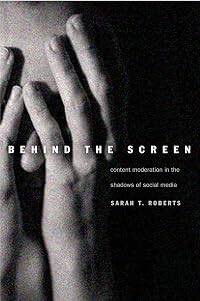
Behind the Screen: Content Moderation in the Shadows of Social Media
by Sarah T. Roberts
On This Page
Description
An eye-opening look at the invisible workers who protect us from seeing humanity's worst on today's commercial internet Social media on the internet can be a nightmarish place. A primary shield against hateful language, violent videos, and online cruelty uploaded by users is not an algorithm. It is people. Mostly invisible by design, more than 100,000 commercial content moderators evaluate posts on mainstream social media platforms: enforcing internal policies, training artificial show more intelligence systems, and actively screening and removing offensive material-sometimes thousands of items per day. Sarah T. Roberts, an award-winning social media scholar, offers the first extensive ethnographic study of the commercial content moderation industry. Based on interviews with workers from Silicon Valley to the Philippines, at boutique firms and at major social media companies, she contextualizes this hidden industry and examines the emotional toll it takes on its workers. This revealing investigation of the people "behind the screen" offers insights into not only the reality of our commercial internet but the future of globalized labor in the digital age. show lessTags
Recommendations










































Member Reviews
Behind The Screen is a very superficial attempt to portray the lives of internet content moderators, those unfortunates who look at all the porn and the hate on social media, and give them a thumbs up or down. They are the maintenance crew of the internet. Browsing social media would be a horrific experience without them.
There are three levels of moderators, according to Sarah T. Roberts. One is to work directly at a company that does it. Or, work for a contractor that moderates for others, which is called outsourcing. Lastly, there is home work, where moderators are paid to stay away. Not examined are the lives of freelancers, who surf the internet on their own, looking for gigs that last mere seconds, and pay one cent or so. They add show more tags to photos, check or write translations, caption images, categorize and classify, and determine what is porn or hate. They are the bottom of the heap.
Even at the top of the heap, those working directly at a social platform, tend to have no benefits, can’t use the facilities everyone else can, and have zero chance of this being a foot in the door, even if they take on side projects. They are second class workers with no hope of advancement. When they burn out, they are disposed of.
Despite the emphasis on the moderators, it takes Roberts 75 pages to introduce one and even begin to describe the grind. She interviewed three moderators at one Silicon Valley firm. And while she documents conversations with them about the trivial hiring process and the lack of benefits, she never bothers to ask senior management why it has policies against moderators staying more than two years or having to take three months off before applying for a second one year stint, why this path is a dead end, or how they came to implement such a system.
There follows a pointlessly bland trip to Manila to see outsourcing in action, but Roberts doesn’t compare working conditions (offices, teams, managers, hours) or highlight differences in job functions. She doesn’t speak to top management there either, and doesn’t follow through to see the effects of it all. It’s mostly about adopting American language and culture so they don’t screw up on behalf of American users. She also speaks at length with a Canadian expat in Mexico who runs an outsourcing operation. His concerns are mostly cultural too.
The one home worker she interviewed in depth was justifiably fed up with all the hate she had to read all day.
Behind The Screen leaves no impression of the life of a moderator. The most impressive thing anyone says in the book is that a completed shift is “like you spent eight hours just in this hole of filth.” Max Breen was the moderator who said it, and he also told Roberts not to bother trying the work herself. So she didn’t.
Neither does she examine the state of the freelancer, who, paid one cent per decision, can make up to $40 for a 12 hour day if they’re really good. She spoke to no doctors about the PTSD-like effects of doing this work. Instead, there is a long discussion of bogus therapy sessions for all who work at the Silicon Valley firm, though workers cannot request direct attention to their own plight, since they have no healthcare. She also doesn’t tie the moderators to the greater disease of the gig economy of precarity, no benefits and repetitive assembly-line jobs, where workers are not even considered employees, even though they’re in the same building. (This is far from unique to content moderation.) Or how totally isolated home workers pathetically try to recreate an office atmosphere with chat functions the company provides. Or how they plot to create unions for better pay and conditions. At the very end of the book she manages to mention that some moderators at Microsoft and Facebook are making claims in court over their treatment by the companies.
The book was an exercise in frustration. Long descriptions of Manila and Silicon Valley were space fillers that added nothing to understanding what goes on behind the screen. The lack of depth and follow through was surprising, and not in a good way. Roberts likes to speak of herself as an expert at the center of the issue, but she never demonstrates that expertise. There are no recommendations other than studies are needed, and her five or six interviews don’t count. Roberts has no answers and nothing new for me to tell you here.
islavery is a very hot topic. If it seems I know as much as Roberts does on this topic, it’s not true. I don’t. I have simply read far better books on it.
David Wineberg show less
There are three levels of moderators, according to Sarah T. Roberts. One is to work directly at a company that does it. Or, work for a contractor that moderates for others, which is called outsourcing. Lastly, there is home work, where moderators are paid to stay away. Not examined are the lives of freelancers, who surf the internet on their own, looking for gigs that last mere seconds, and pay one cent or so. They add show more tags to photos, check or write translations, caption images, categorize and classify, and determine what is porn or hate. They are the bottom of the heap.
Even at the top of the heap, those working directly at a social platform, tend to have no benefits, can’t use the facilities everyone else can, and have zero chance of this being a foot in the door, even if they take on side projects. They are second class workers with no hope of advancement. When they burn out, they are disposed of.
Despite the emphasis on the moderators, it takes Roberts 75 pages to introduce one and even begin to describe the grind. She interviewed three moderators at one Silicon Valley firm. And while she documents conversations with them about the trivial hiring process and the lack of benefits, she never bothers to ask senior management why it has policies against moderators staying more than two years or having to take three months off before applying for a second one year stint, why this path is a dead end, or how they came to implement such a system.
There follows a pointlessly bland trip to Manila to see outsourcing in action, but Roberts doesn’t compare working conditions (offices, teams, managers, hours) or highlight differences in job functions. She doesn’t speak to top management there either, and doesn’t follow through to see the effects of it all. It’s mostly about adopting American language and culture so they don’t screw up on behalf of American users. She also speaks at length with a Canadian expat in Mexico who runs an outsourcing operation. His concerns are mostly cultural too.
The one home worker she interviewed in depth was justifiably fed up with all the hate she had to read all day.
Behind The Screen leaves no impression of the life of a moderator. The most impressive thing anyone says in the book is that a completed shift is “like you spent eight hours just in this hole of filth.” Max Breen was the moderator who said it, and he also told Roberts not to bother trying the work herself. So she didn’t.
Neither does she examine the state of the freelancer, who, paid one cent per decision, can make up to $40 for a 12 hour day if they’re really good. She spoke to no doctors about the PTSD-like effects of doing this work. Instead, there is a long discussion of bogus therapy sessions for all who work at the Silicon Valley firm, though workers cannot request direct attention to their own plight, since they have no healthcare. She also doesn’t tie the moderators to the greater disease of the gig economy of precarity, no benefits and repetitive assembly-line jobs, where workers are not even considered employees, even though they’re in the same building. (This is far from unique to content moderation.) Or how totally isolated home workers pathetically try to recreate an office atmosphere with chat functions the company provides. Or how they plot to create unions for better pay and conditions. At the very end of the book she manages to mention that some moderators at Microsoft and Facebook are making claims in court over their treatment by the companies.
The book was an exercise in frustration. Long descriptions of Manila and Silicon Valley were space fillers that added nothing to understanding what goes on behind the screen. The lack of depth and follow through was surprising, and not in a good way. Roberts likes to speak of herself as an expert at the center of the issue, but she never demonstrates that expertise. There are no recommendations other than studies are needed, and her five or six interviews don’t count. Roberts has no answers and nothing new for me to tell you here.
islavery is a very hot topic. If it seems I know as much as Roberts does on this topic, it’s not true. I don’t. I have simply read far better books on it.
David Wineberg show less
Ratings
Members
- Recently Added By
Lists

Books in the Bibliography of Digital Lethargy by Tung-Hui Hu
151 works; 3 members
Author Information

1+ Work 70 Members
Sarah T. Roberts is assistant professor of information studies in the Graduate School of Education and Information Studies at the University of California, Los Angeles. She is a 2018 Carnegie Fellow and a 2018 winner of the EFF Pioneer Award.
Awards and Honors
Distinctions
Observer Book of the Week (2019-08-18)
Common Knowledge
- Epigraph
- “ ‘Human-Computer Interaction' . . . I mean, what other kind is there?” - Dr. Christine Pawley
- Dedication
- For my grandparents
For my parents
For Patricia - First words
- This book represents the culmination of eight years of research into the work of commercial content moderation of the inter- net, the workers who do it, and the reasons behind why their work is both essential and, seemingly p... (show all)aradoxically, invisible.
- Original language
- english
Classifications
- Genres
- Technology, Nonfiction, General Nonfiction
- DDC/MDS
- 302.231 — Society, government, & culture Social sciences, sociology & anthropology Mass Communication & Media Communication Media (Means of communication) Digital media
- LCC
- HM742 .R63 — Social sciences Sociology (General) Sociology Groups and organizations
- BISAC
Statistics
- Members
- 68
- Popularity
- 448,971
- Reviews
- 1
- Rating
- (3.13)
- Languages
- English, French
- Media
- Paper, Audiobook, Ebook
- ISBNs
- 5
- ASINs
- 2