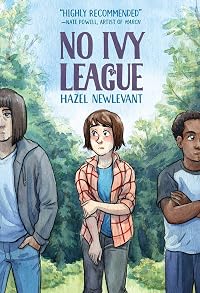
No Ivy League
by Hazel Newlevant
No Ivy League (Collections and Selections — 1-2 and previously unpublished conclusion)
On This Page
Description
When 17-year-old Hazel Newlevant takes a summer job clearing ivy from the forest in her home town of Portland, Oregon, her only expectation is to earn a little money. Homeschooled, affluent, and sheltered, Hazel soon finds her job working side by side with at-risk teens to be an initiation into a new world that she has no skill in navigating. This uncomfortable and compelling memoir is an important story of a girl's awakening to the racial insularity of her life, the power of white show more privilege, and the hidden story of segregation in Portland. show lessTags
Recommendations



Member Reviews
The dawning realization that you inhabit privilege and are responsible for it even when you are ignorant of its origins and causes resonated with me. The book does a good job of accurately representing what it feels like when broadening the envelope of your exposure to the world, in all its messiness, where it's not clear if someone can be right or wrong in their actions, but that the consequences of their actions is because of systematic oppressions and persecutions you are blind to, or only aware of in tone or texture.
I appreciate the breadth of the representation of childhood in this book. I like that it has room to breath. It has narrative structure, but it is not a children's book, or overly determined. It takes its time between show more acts, in the interstitials, in the fall of light, the socks on the floor, crossed legs, little madeleines, blessings of memory. show less
I appreciate the breadth of the representation of childhood in this book. I like that it has room to breath. It has narrative structure, but it is not a children's book, or overly determined. It takes its time between show more acts, in the interstitials, in the fall of light, the socks on the floor, crossed legs, little madeleines, blessings of memory. show less
A large part of this graphic memoir is about homeschooling, and I must be up front and admit that I have a knee-jerk negative reaction whenever I'm confronted with that subject. I hear homeschooling, and my first thought is of parents who are religious fundamentalists like in the recent book Educated or weirdos like in Glass Castle. This book adds a couple new wrinkles that do not help improve my opinion.
Frankly, the first half of the book is pretty dull as Newlevant slowly establishes her homogenous homeschool friends and the many diverse coworkers at her summer job weeding invasive ivy out of a large Portland, Oregon, municipal park. There's pretty standard coming-of-age stuff like crushes and social anxiety, but in the second half show more there is some sexual harassment that topples dominoes leading to Newlevant having to confront her white privilege and one of the reasons behind her parents' decision to homeschool. This turn elevated the book from ho-hum to worthwhile for me. show less
Frankly, the first half of the book is pretty dull as Newlevant slowly establishes her homogenous homeschool friends and the many diverse coworkers at her summer job weeding invasive ivy out of a large Portland, Oregon, municipal park. There's pretty standard coming-of-age stuff like crushes and social anxiety, but in the second half show more there is some sexual harassment that topples dominoes leading to Newlevant having to confront her white privilege and one of the reasons behind her parents' decision to homeschool. This turn elevated the book from ho-hum to worthwhile for me. show less
Starts slowly, builds into something real, and then ends abruptly and with no resolution.
(Full disclosure: I received a free e-ARC through Edelweiss. Trigger warning for sexual harassment and racism.)
Raised in Portland, Oregon, cartoonist Hazel Newlevant was homeschooled by their* parents (for hippie reasons, not religious ones), resulting in a somewhat sheltered childhood. When they were seventeen, they got a summer job removing English ivy and other invasive plants from the local parks and forests. The youth "No Ivy League" project immersed Newlevant in the high school experience they'd been missing (or slimmed down, summer vaca version of it, anyway). This is Newlevant's memoir, in graphic novel format, of these formative months.
As show more Newlevant works alongside at-risk youths, most of them black and brown, Newlevant becomes increasingly aware of their own privilege - and, by extension, that of all the home-schooling families that make up their social circle. (The scene where Newlevant asks a friend if he knows any black home schoolers is a light bulb moment.) After a co-worker's inappropriate comments to Newlevant result in his dismissal - never mind a similar incident, directed at a black girl, which went unpunished - Newlevant begins the long and never ending process of unpacking their own privilege.
No Ivy League carries the promise of a powerful narrative of allyship, but it never quite reaches its potential. Perhaps this is because I read an early ARC, which I suspect wasn't 100% finished. When some of the panels started lapsing into rough sketches instead of polished illustrations, I initially thought it intentional, as if to convey mental distress. Yet the last few pages are obviously not done, and the story ends rather abruptly, without any real resolution.
http://www.easyvegan.info/img/no-ivy-league-02.jpg
Newlevant's parents' admission that their decision to homeschool was a direct response to integration isn't really followed up on; like, was there ever a confrontation or discussion about it? Likewise, the parallel video contest and #HomeschoolingSoWhite plot lines seemed certain to converge - like, maybe Newlevant uses the win of the former to help educate, protest, or raise awareness of the latter - but nope. Everything just kind of...trails off.
http://www.easyvegan.info/img/no-ivy-league-01.jpg
On the plus side: there's some vegan rep, so yay for that!
* Newlevant's preferred pronouns are they/them.
http://www.easyvegan.info/2019/08/20/no-ivy-league-by-hazel-newlevant/ show less
(Full disclosure: I received a free e-ARC through Edelweiss. Trigger warning for sexual harassment and racism.)
Raised in Portland, Oregon, cartoonist Hazel Newlevant was homeschooled by their* parents (for hippie reasons, not religious ones), resulting in a somewhat sheltered childhood. When they were seventeen, they got a summer job removing English ivy and other invasive plants from the local parks and forests. The youth "No Ivy League" project immersed Newlevant in the high school experience they'd been missing (or slimmed down, summer vaca version of it, anyway). This is Newlevant's memoir, in graphic novel format, of these formative months.
As show more Newlevant works alongside at-risk youths, most of them black and brown, Newlevant becomes increasingly aware of their own privilege - and, by extension, that of all the home-schooling families that make up their social circle. (The scene where Newlevant asks a friend if he knows any black home schoolers is a light bulb moment.) After a co-worker's inappropriate comments to Newlevant result in his dismissal - never mind a similar incident, directed at a black girl, which went unpunished - Newlevant begins the long and never ending process of unpacking their own privilege.
No Ivy League carries the promise of a powerful narrative of allyship, but it never quite reaches its potential. Perhaps this is because I read an early ARC, which I suspect wasn't 100% finished. When some of the panels started lapsing into rough sketches instead of polished illustrations, I initially thought it intentional, as if to convey mental distress. Yet the last few pages are obviously not done, and the story ends rather abruptly, without any real resolution.
http://www.easyvegan.info/img/no-ivy-league-02.jpg
Newlevant's parents' admission that their decision to homeschool was a direct response to integration isn't really followed up on; like, was there ever a confrontation or discussion about it? Likewise, the parallel video contest and #HomeschoolingSoWhite plot lines seemed certain to converge - like, maybe Newlevant uses the win of the former to help educate, protest, or raise awareness of the latter - but nope. Everything just kind of...trails off.
http://www.easyvegan.info/img/no-ivy-league-01.jpg
On the plus side: there's some vegan rep, so yay for that!
* Newlevant's preferred pronouns are they/them.
http://www.easyvegan.info/2019/08/20/no-ivy-league-by-hazel-newlevant/ show less
In her graphic memoir cartoonist Newlevant chronicles her summer job clearing invasive English ivy from the forest around Portland Oregon. She’s seventeen and about to enter community college. Her work crew of fellow teens is much more diverse than the friends she knows who have also been homeschooled. As she writes in her introductory note to the reader “It was a multi-car pileup of race, class, gender, and teen hormones.” And if that isn’t enough to whet your appetite, it’s also an intriguing reflection on the currently trendy topic of white fragility and self-reflection.
Since I read an advance reader copy the art is not final, nor is it in color yet, so it's too soon to comment on the art. Final inks and colors will appear show more in the edition scheduled for publication in August 2019. The story is both poignant and powerful. show less
Since I read an advance reader copy the art is not final, nor is it in color yet, so it's too soon to comment on the art. Final inks and colors will appear show more in the edition scheduled for publication in August 2019. The story is both poignant and powerful. show less
Hazel is a white, home-schooled kid in Portland, Oregon. She's pretty happy with her life - parents, other home-school kid friends and a (younger) boyfriend - but when she takes a summer job clearing ivy from a forest with a much more diverse bunch of kids than she's met before, she's awkward and uncomfortable. Some experiences are the exact ones that Hazel was happy to avoid by not going to a traditional school, like being picked last for a team; others, though equally uncomfortable, force her to face some hard truths ("I was home-schooled...as a counter-reaction to integration? Fuck"). Naturally, Hazel heads to the library to learn more, and excerpts from Chandler's Hidden History of Portland, Oregon and Tatum's Why Are All the Black show more Kids Sitting Together in the Cafeteria? are included. She has a crush on a much-older team leader (nothing much happens there) and reports a teammate for sexual harassment, which leads to his being fired, and some realistic fallout.
Hazel is independent throughout the story, but less sheltered and more aware at the end. show less
Hazel is independent throughout the story, but less sheltered and more aware at the end. show less
When Hazel was a homeschooled high schooler, they joined a "No Ivy" League for a summer job cleaning invasive ivy off trees in a local park. They writes this graphic novel memoir looking back at a more naive self and what they learned that summer working with a diverse group of people. Black and white watercolor and ink illustrations and an honest expression of what they learned over the summer - working with people they hadn't known before and struggling to fit in, as well as coming to terms with why they were homeschooled - this is an insightful expression of one person's experience that many high schoolers will relate to.
No Ivy League is Hazel Newlevant's memoir about first coming to the realization that her life growing up was sheltered and privileged.
The broad point of the memoir is that we are rarely, if ever, fully aware of just how different things are for other people. This is true even for those who went to diverse public schools. More specifically, in this case, it is white privilege as well as class privilege, especially where they overlap and reinforce each other.
While this topic is broad and has far more nuance than any single book, fiction or nonfiction, popular or academic, can cover, Newlevant is not trying to present an analysis of the problem from every perspective, they are presenting one person's coming-of-age/realization. Don't expect show more academic analysis or comprehensive coverage of every nuance. That is not what the book is meant to do, nor would any memoir from any person. To expect that or criticize the memoir for that is both misguided and likely more for posturing than to actually contribute anything to the solution. This is a memoir written with the hope, I am guessing, of showing how easy it is to be blind to other people's plights and how easy it can be to step outside that comfort zone if one chooses.
One of the interesting aspects of the graphic memoir for me was the contrast between what passes for everyday "poking fun" in some settings and how it can be perceived in other settings. We become accustomed to what has long been the "norm" and let things slide way too often. Sexist, racist, heterosexist, and any "othering" of people, especially at the level of teenagers and younger, will not change over night. Unfortunately, that realization makes some people fall into two equally irrational camps. One is the group who continue to let things slide and never speak up because they figure nothing will change immediately so nothing will change at all. Second are the ones who ignore the fact that behavior, especially group behavior, can't change immediately and requires time and attention to change. These people are oblivious to nuance and insist that any error, any misspoken word, any ill-conceived act is a definitive condemnation of the person doing or saying it. Some people are truly hateful and know exactly what they are saying and doing. But many many more are not aware of the backstory, so to speak, of their words and actions. Attacking rather than enlightening these people becomes counter-productive and, for the self-righteous who are more concerned with how they look rather than making progress, it becomes a self-fulfilling prophecy that builds their false sense of moral superiority even higher. memoirs like this allows us to see that not everyone who might have advantages is even aware of it. It also lets us see that some of those will want to make a change, both personally and in their life.
I would recommend this to anyone who likes memoirs about coming-of-age and/or coming to a realization about how the world is currently (mis)functioning.
Reviewed from a copy made available by the publisher via Edelweiss. show less
The broad point of the memoir is that we are rarely, if ever, fully aware of just how different things are for other people. This is true even for those who went to diverse public schools. More specifically, in this case, it is white privilege as well as class privilege, especially where they overlap and reinforce each other.
While this topic is broad and has far more nuance than any single book, fiction or nonfiction, popular or academic, can cover, Newlevant is not trying to present an analysis of the problem from every perspective, they are presenting one person's coming-of-age/realization. Don't expect show more academic analysis or comprehensive coverage of every nuance. That is not what the book is meant to do, nor would any memoir from any person. To expect that or criticize the memoir for that is both misguided and likely more for posturing than to actually contribute anything to the solution. This is a memoir written with the hope, I am guessing, of showing how easy it is to be blind to other people's plights and how easy it can be to step outside that comfort zone if one chooses.
One of the interesting aspects of the graphic memoir for me was the contrast between what passes for everyday "poking fun" in some settings and how it can be perceived in other settings. We become accustomed to what has long been the "norm" and let things slide way too often. Sexist, racist, heterosexist, and any "othering" of people, especially at the level of teenagers and younger, will not change over night. Unfortunately, that realization makes some people fall into two equally irrational camps. One is the group who continue to let things slide and never speak up because they figure nothing will change immediately so nothing will change at all. Second are the ones who ignore the fact that behavior, especially group behavior, can't change immediately and requires time and attention to change. These people are oblivious to nuance and insist that any error, any misspoken word, any ill-conceived act is a definitive condemnation of the person doing or saying it. Some people are truly hateful and know exactly what they are saying and doing. But many many more are not aware of the backstory, so to speak, of their words and actions. Attacking rather than enlightening these people becomes counter-productive and, for the self-righteous who are more concerned with how they look rather than making progress, it becomes a self-fulfilling prophecy that builds their false sense of moral superiority even higher. memoirs like this allows us to see that not everyone who might have advantages is even aware of it. It also lets us see that some of those will want to make a change, both personally and in their life.
I would recommend this to anyone who likes memoirs about coming-of-age and/or coming to a realization about how the world is currently (mis)functioning.
Reviewed from a copy made available by the publisher via Edelweiss. show less
Members
- Recently Added By
Lists

Graphic Memoirs by Women
175 works; 6 members

Main Character is aged 10-19
362 works; 6 members

2010s
241 works; 3 members

Books Read in 2019
4,052 works; 110 members

Best Graphic Novel Nonfiction
199 works; 101 members
Author Information

21+ Works 577 Members
Series

Work Relationships
Contains
Common Knowledge
- People/Characters
- Hazel Newlevant; Anson Saunders; Shane; Eiren Saunders; Captain Homeschool (Anson Saunders); Mrs. Saunders (show all 22); Mr. Newlevant; Mrs. Newlevant; Antonio "Toño"; Gavin; Aisha Huff; Kelsey; Sadie S.; Javier "Javi"; Jayden F.; Obasi M.; Frederick; Pablo S.; Alejandro R.; Dmitri; Yevgeni "Genya" Popov; Pedro
- Important places
- Portland, Oregon, USA; Forest Park, Portland, Oregon, USA
- First words
- Add more calendars!
- Last words
- (Click to show. Warning: May contain spoilers.)If you can stand my dorky moves.
- Blurbers
- Powell, Nate; Taylor, Whit
- Original language
- English
Classifications
- Genres
- Graphic Novels & Comics, Teen, Young Adult
- DDC/MDS
- 741.5 — Arts & recreation Drawing & decorative arts Drawing Comic books, graphic novels, fotonovelas, cartoons, caricatures, comic strips
- LCC
- PN6727 .N4583 .N6 — Language and Literature Literature (General) Literature (General) Collections of general literature Comic books, strips, etc.
- BISAC
Statistics
- Members
- 94
- Popularity
- 342,861
- Reviews
- 14
- Rating
- (3.08)
- Languages
- English
- Media
- Paper, Ebook
- ISBNs
- 3
- ASINs
- 1