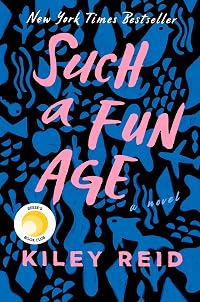
Such a Fun Age
by Kiley Reid
On This Page
Description
Alix Chamberlain is a woman who gets what she wants and has made a living, with her confidence-driven brand, showing other women how to do the same. So she is shocked when her babysitter, Emira Tucker, is confronted while watching the Chamberlains' toddler one night, walking the aisles of their local high-end supermarket. The store's security guard, seeing a young black woman out late with a white child, accuses Emira of kidnapping two-year-old Briar. A small crowd gathers, a bystander films show more everything, and Emira is furious and humiliated. Alix resolves to make things right. But Emira herself is aimless, broke, and wary of Alix's desire to help. At twenty-five, she is about to lose her health insurance and has no idea what to do with her life. When the video of Emira unearths someone from Alix's past, both women find themselves on a crash course that will upend everything they think they know about themselves, and each other. With empathy and piercing social commentary, Such a Fun Age explores the stickiness of transactional relationships, what it means to make someone "family," the complicated reality of being a grown up, and the consequences of doing the right thing for the wrong reason. show lessTags
Recommendations






Member Recommendations


Member Reviews
Emira is a twenty-six-year-old black woman who's still not quite sure what she wants to do with her life. To make ends meet in the meantime, she has a part-time babysitting gig looking after a toddler she really loves. But the kid's mother, Alix, is... really something... and after an incident in which Emira is hassled by a security guard in an upscale grocery store, the dynamics between the two of them change, at least in Alix's mind, then change even further when they discover an unexpected connection between them.
This is one of those surprising novels that I liked a lot even while I can't necessarily say that I always enjoyed it a lot. Truth is, I spent a fair amount of it in a sort of full-body cringe, because that's just the kind show more of reaction that Alix brings out. That's no doubt fully intended for her, though, and I'm really quite impressed by the way she simultaneously feels like a complete stereotype of a certain kind of affluent white woman -- you sort of expect to see her giving a talk about Leaning In while sipping a pumpkin spice latte in expensive yoga pants -- while simultaneously being a psychologically complex human being whose insecurities and cluelessnesses and states of denial are as realistic-feeling as they are infuriating.
And the interaction between this messed-up but supposedly well-meaning person and poor Emira, who's just trying to live her damned life, results in a novel that's about race and class and power dynamics, in a way that arises very naturally out of who these people are and what kind of lives they lead, rather than the author standing up on a soapbox lecturing us about it. It ultimately works very well, and I'm very glad to have read it, no matter how much it kept making me cringe. I would say I'm also happy never to have to spend time with Alix again, except that of course then I remember that there are plenty of other Alixes out there. show less
This is one of those surprising novels that I liked a lot even while I can't necessarily say that I always enjoyed it a lot. Truth is, I spent a fair amount of it in a sort of full-body cringe, because that's just the kind show more of reaction that Alix brings out. That's no doubt fully intended for her, though, and I'm really quite impressed by the way she simultaneously feels like a complete stereotype of a certain kind of affluent white woman -- you sort of expect to see her giving a talk about Leaning In while sipping a pumpkin spice latte in expensive yoga pants -- while simultaneously being a psychologically complex human being whose insecurities and cluelessnesses and states of denial are as realistic-feeling as they are infuriating.
And the interaction between this messed-up but supposedly well-meaning person and poor Emira, who's just trying to live her damned life, results in a novel that's about race and class and power dynamics, in a way that arises very naturally out of who these people are and what kind of lives they lead, rather than the author standing up on a soapbox lecturing us about it. It ultimately works very well, and I'm very glad to have read it, no matter how much it kept making me cringe. I would say I'm also happy never to have to spend time with Alix again, except that of course then I remember that there are plenty of other Alixes out there. show less
Alix and Kelley are absolutely perfect portrayals of how privilege, ignorance, and casual systemic racism shape behavior, in two different ways. Reading Alix's meltdown and the final chapter is terrifying in a way because of how realistic it is. Makes me think of all the Alixs I've come across.
To be honest, this is more of a 3.5/5 than a 4/5 but there's no half star option and I went higher because the story was good even if the writing itself wasn't amazing.
To be honest, this is more of a 3.5/5 than a 4/5 but there's no half star option and I went higher because the story was good even if the writing itself wasn't amazing.
This is an easy, modern novel that has some deep themes of racism and casteism. The juxtaposition of the page-turner feel of the book and the deeper dive into the racism of "nice people" actually worked pretty well for me.
Emira is a 25 year old Black woman who, like many others her age, is trying to find her way in the world. She's done with college, but doesn't have a chosen career path and ends ups babysitting for a wealthy white family. Alix, the mother, is going through her own crisis, trying to develop her career, having two small children, and recently leaving her beloved NYC for Philadelphia. The other main character is Kelley, a white man who begins dating Emira and who we later find out dated Alix in high school.
Right at the show more beginning, racism is highlighted when Emira takes her 3 year old babysitting charge to a fancy grocery store late at night (this is at Alix's behest for reasons I won't get in to). She gets accused by a white woman shopper of possibly kidnapping this white 3 year old child. It's caught on video by Kelley, who she doesn't yet know.
So this event is obvious racism, but more insidious is the underlying racism of Alix as she gets to know Emira. This was a hard look at how wealthy, white, "woke", women sometimes still harbor deep-seated racist attitudes without realizing it and even while thinking they are being "un-racist".
Also present is a look at female friendships. Alix has her group of 4 "best friends" as does Emira. The contrast and similarities between how these friend groups work was also interesting to me.
Overall, I think this is a good "book club discussion" book. It would appeal to a wide variety of readers because it is a page turner, is easy to read, and can be read on the surface, but there is also plenty to think about underneath the main plot line. I found it annoyingly modern at times, and a little unfocused, but I'd definitely recommend it for anyone who wants to keep up with talked about books.
Original publication date: 2020
Author’s nationality: American
Original language: English
Length: 310 pages
Rating: 3.5 stars
Format/where I acquired the book: kindle library
Why I read this: the buzz show less
Emira is a 25 year old Black woman who, like many others her age, is trying to find her way in the world. She's done with college, but doesn't have a chosen career path and ends ups babysitting for a wealthy white family. Alix, the mother, is going through her own crisis, trying to develop her career, having two small children, and recently leaving her beloved NYC for Philadelphia. The other main character is Kelley, a white man who begins dating Emira and who we later find out dated Alix in high school.
Right at the show more beginning, racism is highlighted when Emira takes her 3 year old babysitting charge to a fancy grocery store late at night (this is at Alix's behest for reasons I won't get in to). She gets accused by a white woman shopper of possibly kidnapping this white 3 year old child. It's caught on video by Kelley, who she doesn't yet know.
So this event is obvious racism, but more insidious is the underlying racism of Alix as she gets to know Emira. This was a hard look at how wealthy, white, "woke", women sometimes still harbor deep-seated racist attitudes without realizing it and even while thinking they are being "un-racist".
Also present is a look at female friendships. Alix has her group of 4 "best friends" as does Emira. The contrast and similarities between how these friend groups work was also interesting to me.
Overall, I think this is a good "book club discussion" book. It would appeal to a wide variety of readers because it is a page turner, is easy to read, and can be read on the surface, but there is also plenty to think about underneath the main plot line. I found it annoyingly modern at times, and a little unfocused, but I'd definitely recommend it for anyone who wants to keep up with talked about books.
Original publication date: 2020
Author’s nationality: American
Original language: English
Length: 310 pages
Rating: 3.5 stars
Format/where I acquired the book: kindle library
Why I read this: the buzz show less
Emira, a young black woman in the Philadelphia area, babysits for the Chamberlains, a well-off white family with an adorable toddler, Briar, whom Emira adores. One night, they ask her to come over and take Briar out of the house while the police arrive. While in a grocery store, she and Briar are stopped by a security guard who accuses Emira of kidnapping - and all this is captured on video.
The aftermath of the security guard's accusation is... not what I expected. Rather than an immediate blow up, Emira takes steps to make sure the video doesn't get out, and she wants to keep quiet about it. We get Alix Chamberlain's past and point of view, wanting to cozy up to Emira and make friends, as well as Emira's struggle to figure out what she show more wants to do with her life. At some point, I got frustrated with just about every character except poor Briar, and it was a sudden shock at one point to realize that only one or two characters, at most, were older than me (I wondered if that was some of the source of frustration). We see ways in which the white characters are well-meaning but totally blind to their own racism, and rewrite their own histories to make themselves look better. All this wrapped up in an easy narrative that kept pages turning fast. show less
The aftermath of the security guard's accusation is... not what I expected. Rather than an immediate blow up, Emira takes steps to make sure the video doesn't get out, and she wants to keep quiet about it. We get Alix Chamberlain's past and point of view, wanting to cozy up to Emira and make friends, as well as Emira's struggle to figure out what she show more wants to do with her life. At some point, I got frustrated with just about every character except poor Briar, and it was a sudden shock at one point to realize that only one or two characters, at most, were older than me (I wondered if that was some of the source of frustration). We see ways in which the white characters are well-meaning but totally blind to their own racism, and rewrite their own histories to make themselves look better. All this wrapped up in an easy narrative that kept pages turning fast. show less
At 25, Emira Tucker hasn’t quite figured out what she wants to do with her life, and makes ends meet by babysitting for the Chamberlain family three days a week. One evening, under some unusual circumstances, Emira finds herself the subject of threatening racist accusations about her relationship with 3-year-old Briar Chamberlain. A bystander, Kelley Copeland, captures the incident on video and sends it to Emira in case she wants to take action (she doesn’t).
A few days later Emira runs into Kelley, they have dinner, and their relationship quickly deepens. Meanwhile Alix Chamberlain, Briar’s mother, is mortified by how Emira was treated and takes it upon herself to become Emira’s friend, crossing all sorts of employer/employee show more boundaries. These characters provide a platform to explore issues of race and class through a story that is both complex and believable.
Debut author Kiley Reid masterfully portrays different types of “woke” white people who want so badly not to be racist, and don’t realize the myriad of tiny ways they mistreat or marginalize the black people they interact with. I found this book very thought-provoking, with much that could be unpacked in a discussion group. show less
A few days later Emira runs into Kelley, they have dinner, and their relationship quickly deepens. Meanwhile Alix Chamberlain, Briar’s mother, is mortified by how Emira was treated and takes it upon herself to become Emira’s friend, crossing all sorts of employer/employee show more boundaries. These characters provide a platform to explore issues of race and class through a story that is both complex and believable.
Debut author Kiley Reid masterfully portrays different types of “woke” white people who want so badly not to be racist, and don’t realize the myriad of tiny ways they mistreat or marginalize the black people they interact with. I found this book very thought-provoking, with much that could be unpacked in a discussion group. show less
Points out (among other things) that upper-class white lady culture is so normal that the parts featuring Emira & her friends seems like it was written as a travel piece for white tourists. Just look at these wild black women in their natural environment. It also shows that those same women have to switch from one set of behaviors to another when they’re around white people. Especially when it comes to work environments - the woman who works at Sony probably doesn’t feel a thing when she does it, but Emira switches during conversations with Alix and Alix notices. I suppose whites from unacceptable backgrounds have to do the same.
The whole idea of becoming ‘woke’ is a good one, but it creates weird awkwardness when self-aware show more whites interact with blacks. We have to think about and evaluate everything we do before we do it lest an innocent comment or action be interpreted as racist and insulting. Ingrained and habitualized behavior can quickly become socially taboo and the constant, real-time assessment can come off like the white person wants to distance herself from the situation. Stand-offish and awkward, but coming from a good place that is totally hidden unless the white person explains painfully that she’s monitoring her every moment of time with this black person. That she’s modifying her behavior specially for this encounter. What’s more insulting? It’s a minefield and looking for the mines before you step on them is also an exploding mine.
It’s aggravating that both Kelly & Alix want to save Emira. Immediately infantilizing her as if she can’t decide and take action herself. Reminds me of how women in general were treated and portrayed for centuries. Unfortunately some still are. show less
The whole idea of becoming ‘woke’ is a good one, but it creates weird awkwardness when self-aware show more whites interact with blacks. We have to think about and evaluate everything we do before we do it lest an innocent comment or action be interpreted as racist and insulting. Ingrained and habitualized behavior can quickly become socially taboo and the constant, real-time assessment can come off like the white person wants to distance herself from the situation. Stand-offish and awkward, but coming from a good place that is totally hidden unless the white person explains painfully that she’s monitoring her every moment of time with this black person. That she’s modifying her behavior specially for this encounter. What’s more insulting? It’s a minefield and looking for the mines before you step on them is also an exploding mine.
It’s aggravating that both Kelly & Alix want to save Emira. Immediately infantilizing her as if she can’t decide and take action herself. Reminds me of how women in general were treated and portrayed for centuries. Unfortunately some still are. show less
Here's a Black woman's take on a white woman's take on friendship with Black women, and it's a gem. Many white people see their Black friends as trophies, as proof of how woke they are. In this era, no one would ever say, "Some of my best friends...", but they would be thrilled to say, "My friend Tamika...", because why would any Black woman be friends with a racist? Nu uh, girlfriend! Alix, trending Philadelphia blogger and mother of two, hires Emira to babysit so she can write her book. Emira has been floundering since college graduation, and her three best friends seem to be adulting much better than she. Problem is that she is very attached to little Briar, a very engaging three year old. A combination of incidents, from an on-air show more ill-conceived, racially-charged comment by Alix's newscaster husband to Emira’s confrontation with a security guard in a Whole-Foods-type store, lead to a series of dumb missteps by Alix, who is compelled to win Emira's esteem in the stupidest possible ways. Emira just cannot get revved up until she realizes what Alix is up to. And then there's the Kelley Konnection – he’s the handsome white guy who is Emira's new boyfriend and was also Alex's, sixteen years ago when they were in high school.
Both of the main characters are aggravating in their own ways, Emira with her passivity and Alix with her lack of self-awareness, but together they constitute a wonderful read, filled with humor and astute analysis of white upper middle class entitlement.
Quotes: "Was it a completely inappropriate time to clarify, So you think I'm pretty?" show less
Both of the main characters are aggravating in their own ways, Emira with her passivity and Alix with her lack of self-awareness, but together they constitute a wonderful read, filled with humor and astute analysis of white upper middle class entitlement.
Quotes: "Was it a completely inappropriate time to clarify, So you think I'm pretty?" show less
Members
- Recently Added By
Published Reviews
...as protests against police violence and institutional racism take place all over the world, ignited by the murders of Black Americans including George Floyd, Breonna Taylor, and Ahmaud Arbery, the relevance of this book cannot be overstated. Reid has constructed a complex tale of twenty-first-century millennial life that scrutinizes racism in America today....Reid’s straightforward prose show more and sharp eye for social satire allow her to demonstrate clearly how race and privilege are inseparable from the way we structure our sense of self and our relationships with others. Such a Fun Age deserves a place on every reading list this summer. show less
added by Lemeritus
It’s 2015 and, in a gentrified variation on “driving while black,” 20-something Emira is accosted in the freezer aisle of an upscale Philadelphia supermarket by a security guard accusing her of kidnapping her white charge....Emira is clearly the victim of racially motivated manipulation, but the two white people who profess to care for her shift uncomfortably between the poles of villain show more and hero. Both boss and boyfriend engage in distinct brands of white posturing, defining themselves in part by their relationships to this young woman — an adoring, vocationally lost black woman who must decide whether the benefits of those relationships are outweighed by the cost to her sense of self. Out of Reid’s often cloying vernacular, then, emerge some surprisingly resonant insights into the casual racism in everyday life, especially in the America of the liberal elite. show less
added by Lemeritus
The title of Kiley Reid's debut, Such a Fun Age, works on so many levels it makes me giddy — and, what's better, the title's plurality of meaning is echoed all over the place within the novel, where both plot and dialogue are layered with history, prejudice, expectations, and assumptions.... More broadly, the "fun age" might be our own, prior to the 2016 election — an age that was show more considered by some to be magically post-racist and post-sexist because it was impolite to be these things in public; an age of performative white feminism; an age of social media and virality and armchair activism and online virtue-signaling that ironically requires certain people — often, those already more vulnerable — to exist in specific politically correct ways while letting others — usually, those with power and privilege — off the hook....This is a book that will read, I suspect, quite differently to various audiences — funny to some, deeply uncomfortable and shamefully recognizable to others — but whatever the experience, I urge you to read Such a Fun Age. Let its empathic approach to even the ickiest characters stir you, allow yourself to share Emira's millennial anxieties about adulting, take joy in the innocence of Briar's still-unmarred personhood, and rejoice that Kiley Reid is only just getting started. show less
added by Lemeritus
Lists

Booker Prize
491 works; 62 members

Top Five Books of 2020
982 works; 348 members
The Guardian Books of the Year 2020
126 works; 8 members

Female Author
1,235 works; 64 members

Top Five Books of 2021
604 works; 181 members

Black Authors
384 works; 32 members

Books Read in 2020
4,379 works; 123 members

Indie Next Picks
196 works; 4 members

Books Read in 2022
5,166 works; 114 members

Books Set in Pennsylvania
17 works; 5 members

Books Read in 2021
5,361 works; 113 members

Best Audiobooks
240 works; 114 members

Top Five Books of 2024
795 works; 264 members

Still to Read 2021
7 works; 1 member

BBC World Book Club
265 works; 5 members

Reese Witherspoon Book Club
100 works; 4 members

LIT - Il Bookclub Della McMusa
51 works; 1 member

Reese's Book Club
122 works; 2 members

To Read
29 works; 2 members
Talk Discussions
Past Discussions
2020 Booker Prize Longlist: Such a Fun Age by Kiley Reid in Booker Prize (August 2020)
Author Information

5 Works 5,191 Members
Some Editions
Awards and Honors
Awards
Distinctions
The Guardian Book of the Day (2020-01-02)
Notable Lists
RUSA CODES Listen List (Listen-Alike – Listen-Alike to "“Tiny Imperfections” by Alli Frank and Asha Youmans" – 2021)
Common Knowledge
- Original publication date
- 2019-12-31
- People/Characters
- Alix "Alex" Murphy Chamberlain; Emira Tucker; Briar Louise Chamberlain; Peter Chamberlain; Catherine May Chamberlain; Rachel (show all 25); Jodi; Tamra; Kelley Copeland; Zara; Shaunie; Josefa; Laney Thacker; Paula Christi; Alfie Tucker; Justyne Tucker; Mr. Tucker; Mrs. Tucker; Bella Thacker; Claudette Laurens; Robbie Cormier; Betheny Murphy; Mr. Murphy; Mrs. Murphy; Hillary Rodham Clinton
- Important places
- New York, New York, USA; Philadelphia, Pennsylvania, USA; Allentown, Pennsylvania, USA; Sewell Bridge, Maryland, USA; Boston, Massachusetts, USA; Drexel University, Philadephia, Pennsylvania, USA
- Epigraph
- "We definitely wait for birthdays. Or even ice cream. Like [my daughter] has to earn it. Yesterday we promised her an ice cream, but then she behaved horribly. And I said, 'Then I'm sorry, ice cream is for girls who behave. A... (show all)nd that's not you today. Maybe tomorrow.'"
---RACHEL SHERMAN,
Uneasy Street: The Anxieties of Affluence - Dedication
- For Patricia Adeline Olivier
- First words
- That night, when Mrs. Chamberlain called, Emira could only piece together the words "... take Briar somewhere ..." and "... pay you double."
- Last words
- (Click to show. Warning: May contain spoilers.)Deep into her thirties, Emira would wrestle with what to take from her time at the Chamberlain house. Some days she carried the sweet relief that Briar would learn to become a self-sufficient person. And some days, Emira would carry the dread that if Briar ever struggled to find herself, she'd probably just hire someone to do it for her.
- Publisher's editor
- Kim, Sally
- Blurbers
- Reid, Taylor Jenkins; Moyes, Jojo; Benjamin, Chloe; Walter, Jess; Alam, Rumaan; Greenidge, Kaitlyn (show all 8); Straub, Emma; Thompson-Spires, Nafissa
- Original language
- English
- Canonical DDC/MDS
- 813.6
- Canonical LCC
- PS3618.E5363
Classifications
Statistics
- Members
- 4,539
- Popularity
- 3,225
- Reviews
- 203
- Rating
- (3.79)
- Languages
- 8 — Danish, Dutch, English, German, Polish, Spanish, Swedish, Portuguese (Portugal)
- Media
- Paper, Audiobook, Ebook
- ISBNs
- 39
- ASINs
- 7