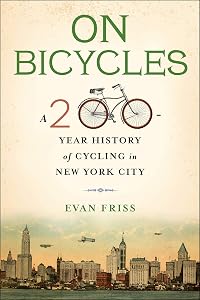
On Bicycles: A 200-Year History of Cycling in New York City
by Evan Friss
On This Page
Description
"In its most recent ranking, Bicycling Magazine named New York the number one American city for cycling. But long before the Citi Bike era, New York has stood out as an important city in the history and development of cycling--as a pastime and a mirror of the city's shifting social, economic, and structural developments. In Bicycles and the Boroughs, Evan Friss traces the storied history of bicycling in the Big Apple, from the bicycle-like "draisine" in 1818 adopted by a small number of show more enthusiasts; to New York's ascent to the capital of the cycling world in the 1890s, which among other things triggered increased female mobility and corresponding conversations about the propriety of women cyclists; to Mayor Koch's bike ban of 1987 after the stock market's collapse, which shed light on the ways bankers, lawyers, and other professionals relied on this labor force and the immediacy of the information they delivered. Finally, the history shifts to Michael Bloomberg's Citi Bike initiative, the largest bike sharing system in the country, in an effort to make New York a "greener" city. But even in the wake of the program's mass adoption, Friss brings to light ongoing public debates over the location of bike lanes, the dangers of biking in certain areas, whether the program's financial model is sustainable, and the ways in which cycling will continue to shape and be shaped by the city"-- show lessTags
Recommendations






























Member Reviews
There is no Wikipedia entry for Evan Friss as September 2024. There are web pages for Evan Friss Ph.D, Associate Professor of History (US, urban and public history), at James Madison University (Harrisonburg, Virginia, United States), and evanfriss.com, the author of 3 books (published 2015-2024).
On Bicycles (2024) is about on cycling in New York City. In part, it t follows up on Prof. Friss's general and academic social history book, The Cycling City: Bicycles and Urban America in the 1890s (2015).
Prof. Friss starts his survey of the social history and of cycling in New York city with the reception of the proto-bicycles invented and manufactured before 1820, and with passage on the velocipedes of the 1860s and the high-mount bicycles show more of the subsequent decades. He mentions the beginning of clubs and associations of cyclists including the national League of American Bicyclists (1880) as the League of American Wheelmen. There were many problems with cycling in America in the 19th century. The proto-bicycles were odd vehicles, due to the limitations of design and manufacturing. The roads were bad, suitable for horse drawn wagons and horses. Bicycles were awkward and dangerous to ride until American mechanics and manufacturers began to build and sell safety bicycles.
The next section of the book covers the boom in bicycle manufacturing and riding in the 1890s. In this section, he uses documents from the era to tell stories about people who embraced cycling. He refers to the bicycling diaries (1892-1896) New York cyclist Arthur P. S. Hyde, later an army captain, and a religious minister. He mentions Violet Ward, active as a cyclist, cycling club organizer, and author of Bicycling for Ladies (1896), later a socialite and feminist pioneer. In this section, he complains that the public came to view the bicycle as a device used by children, athletes, acrobats, and affluent hobbyists. The uses of bicycles as a means of travel for commuting workers, and as a means of delivering letters, telegrams and small parcels may not have been documented by journalists or researched by later historians. He is uncertain about the causes of the end of the boom.
He devotes a chapter to New York urban development and transportation policy which focused on internal combustion automobiles in the 20th century and exclude bicycles from streets and bridges. He appears to accept the trope that New York's position was a personal whim of Robert Moses. He discusses conflicts between the bike couriers and other users of the roads in the later decades of the 20th century. He does not discuss the effective cycling movements that promoted rider education and enforcement of traffic laws over the creation of bike lanes and other infrastructure,
He touches on some details of the bikes use by some couriers in the 1980s - single speed, fixed gear, no brakes. He discusses, and the transitions in New York to to urban systems like bike lanes and bike share rentals in terms of the agency (power and clout) of elected and appointed civic managers (e.g. Mayor Michael R. Bloomberg and Transportation Commissioner Janette Sadiq-Khan. He has tracked the sources of information to individual articles in printed media or episodes of television programs (e.g. National Geographic Explorer). Some of the sources have disappeared as the buyers of media assets have asserted copyright and protested publication on quasi-public internet services (e.g. YouTube).
It is not deep history. It is informative and readable. show less
On Bicycles (2024) is about on cycling in New York City. In part, it t follows up on Prof. Friss's general and academic social history book, The Cycling City: Bicycles and Urban America in the 1890s (2015).
Prof. Friss starts his survey of the social history and of cycling in New York city with the reception of the proto-bicycles invented and manufactured before 1820, and with passage on the velocipedes of the 1860s and the high-mount bicycles show more of the subsequent decades. He mentions the beginning of clubs and associations of cyclists including the national League of American Bicyclists (1880) as the League of American Wheelmen. There were many problems with cycling in America in the 19th century. The proto-bicycles were odd vehicles, due to the limitations of design and manufacturing. The roads were bad, suitable for horse drawn wagons and horses. Bicycles were awkward and dangerous to ride until American mechanics and manufacturers began to build and sell safety bicycles.
The next section of the book covers the boom in bicycle manufacturing and riding in the 1890s. In this section, he uses documents from the era to tell stories about people who embraced cycling. He refers to the bicycling diaries (1892-1896) New York cyclist Arthur P. S. Hyde, later an army captain, and a religious minister. He mentions Violet Ward, active as a cyclist, cycling club organizer, and author of Bicycling for Ladies (1896), later a socialite and feminist pioneer. In this section, he complains that the public came to view the bicycle as a device used by children, athletes, acrobats, and affluent hobbyists. The uses of bicycles as a means of travel for commuting workers, and as a means of delivering letters, telegrams and small parcels may not have been documented by journalists or researched by later historians. He is uncertain about the causes of the end of the boom.
He devotes a chapter to New York urban development and transportation policy which focused on internal combustion automobiles in the 20th century and exclude bicycles from streets and bridges. He appears to accept the trope that New York's position was a personal whim of Robert Moses. He discusses conflicts between the bike couriers and other users of the roads in the later decades of the 20th century. He does not discuss the effective cycling movements that promoted rider education and enforcement of traffic laws over the creation of bike lanes and other infrastructure,
He touches on some details of the bikes use by some couriers in the 1980s - single speed, fixed gear, no brakes. He discusses, and the transitions in New York to to urban systems like bike lanes and bike share rentals in terms of the agency (power and clout) of elected and appointed civic managers (e.g. Mayor Michael R. Bloomberg and Transportation Commissioner Janette Sadiq-Khan. He has tracked the sources of information to individual articles in printed media or episodes of television programs (e.g. National Geographic Explorer). Some of the sources have disappeared as the buyers of media assets have asserted copyright and protested publication on quasi-public internet services (e.g. YouTube).
It is not deep history. It is informative and readable. show less
Members
- Recently Added By
Lists

The War on Cars podcast
108 works; 1 member
Author Information

3 Works 862 Members
Evan Friss is associate professor of history at James Madison University and author of On Bicycles: A 200-Year History of Cycling in New York City.
Classifications
- Genres
- Nonfiction, History, Sports and Leisure, General Nonfiction, Politics and Government
- DDC/MDS
- 796.609747 — Arts & recreation Recreation, sports, and performing arts Athletic and outdoor sports and games Cycling standard subdivisions History, geographic treatment, biography North America
- LCC
- HE5737 .F753 — Social sciences Transportation and communications Transportation and communications
- BISAC
Statistics
- Members
- 20
- Popularity
- 1,283,586
- Reviews
- 1
- Rating
- (4.50)
- Languages
- English
- Media
- Paper, Ebook
- ISBNs
- 3