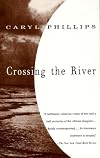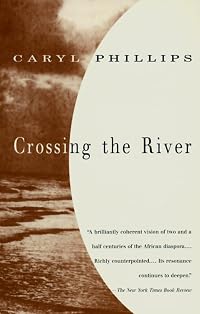
Crossing the River
by Caryl Phillips
On This Page
Description
In a vastly ambitious and intensely moving novel, the author of Cambridge creates a many-tongued chorus of the African diaspora in the complex and riveting story of a desperate father who sells his three children into slavery.Tags
Recommendations













Member Reviews
What a powerful novel! I’d never even heard of this one till it was picked for an online bookgroup I belong to. I couldn't put it down. Really a well conceived and imagined novel.The novel begins with a father explaining how the crops failed and in desperation he sold his three children—Nash, Martha, and Travis—to a slave trader. The four sections that make up the center of the novel focus on each of the children as well as one a young ship’s captain on his first trip to bring slaves from Africa to America—the one who picks up the “2 strong man-boys and a proud girl” from their father. The focus of each section and its language is completely different and appropriate to the content. There is tragedy but also triumph in show more each life. Nash is conceived as an educated American Negro whose master sent him back to Africa in the 1820s—to the new nation of Liberia—to educate his people and to teach them Christianity. We read his letters to the master, increasingly despairing because he doesn’t hear back (his master’s wife has intercepted and destroyed the letters). Martha is a slave, sold away from her husband and daughter when the master of a Virginia plantation dies, who goes first to pre-Civil War Kansas which is not a slave state and then, when her owner intends selling her across the river (into Missouri which is a slave state) she runs away and joins a wagon train of free blacks going to California, but dies on the way, in Colorado. Travis is an American GI in WWII, stationed in England who carries on a delicate courtship with an Englishwoman, fathers a child, comes back to marry her, and then is killed on the beach in Italy. Nash’s and Martha’s voices are appropriate to their time and place; their thoughts are on freedom and on love. Travis is seen through the eyes of June who loves him though she’s never really known love before. There’s also a section focused on the captain of the American slave ship—consisting of excerpts from a ship’s log and letters to his wife.Phillips doesn't handle each section the same way, nor are the voices exclusively those of the African disapora. Captain Hamilton's view point is important because he's not a hardened slave trader, though possibly his father, who captained the ship before him, was. But making the last section from Joyce's point of view was brilliant. Had he made it from Travis's, we might have gone over territory that had already been covered, but that of the woman who loved him brought something new. I loved how Phillips tied it up at the end, in the voice of the distraught father who sold his children, quoting from each of the voices and relating their stories to black soldiers in Vietnam who "had no quarrel with the VietCong”, to Toussaint L'Overature, to those struggling with Papa Doc and other dictators, to Jazz and dance and James Baldwin (who in Paris wrote Nobody Knows My Name) and Martin Luther King's "I have a dream" speech. show less
Crossing the River begins in the 1700’s as an African man is forced to sell his three children - Nash, Martha and Travis - into slavery. The novel then assumes a three part structure - a snapshot in time during the 1820s, the latter part of the 19th century, and finally the late 1930s-early 1940s. The three children from the beginning are symbolically represented throughout the novel with each of their voices distinct and individual as the reader follows the history of blacks from Africa, to the American West, and to Europe.
A slave named Nash Williams is freed from bondage and sent to Liberia to convert native Africans to Christianity in the late-1820s. Narrated partly through Nash’s letters back to his white master, the reader show more gains an appreciation of not only the brutality and desolation of slavery, but the power of freedom even when it means living in poverty.
Martha, an elderly black woman, is abandoned in Colorado while trying to travel with a group of black Pioneers to California. She grieves her lost child, and remembers the love of a man.
Finally, Travis - a black American GI - falls in love with a white English woman named Joyce during WWII. This section is narrated in a non-linear fashion from Joyce’s point of view and exposes the bigotry and obstacles to mixed marriage and relationships during that time in history.
Phillips’ prose is constructed beautifully - haunting and filled with alluring imagery.
'The river wore a rutted frown where their slow progress had disturbed her sleep. To either side the somber banks, cluttered with trees, shrubs and vines, were pressed by a thick, brooding undergrowth that was heavy with years. As dusk approached, the heat still hung low like a ceiling above their heads.' -From Crossing the River, page 66-
The novel’s plot is elusive because the story is not about these three characters really. Instead Nash, Martha and Travis are representative of a people as a whole. Phillips reveals the tortured search for home by a people whose lives were torn from their homeland. He doesn’t spare the reader the horror of slavery or the grief of those whose families were destroyed by it.
'Then the auctioneer slaps hs gavel against a block of wood. I fall to my knees and take Eliza Mae in my arms. I did not suckle this child at the breast, nor did I cradle her in my arms and cover her with what love I have, to see her taken away from me. As the auctioneer begins to bellow, I look into Eliza Mae’s face. He is calling out the date, the place, the time. Master would never have sold any of us. I tell this to my terrified child. Slaves. Farm animals. Household furniture. Farm tools. We are to be sold in this order.' -From Crossing the River, page 76-
Caryl Phillips is a gifted writer and in Crossing the River his talents are clearly on display. The novel is vivid and unique. It is largely symbolic, and so is not always an easy story to understand. This is a book which needs to be read two or three times, I think, to gain full appreciation of its message.
Crossing the River was shortlisted for the Booker Prize in 1993. Phillips has authored numerous other works - his latest in 2007 is a novel titled Foreigners.
Recommended. show less
A slave named Nash Williams is freed from bondage and sent to Liberia to convert native Africans to Christianity in the late-1820s. Narrated partly through Nash’s letters back to his white master, the reader show more gains an appreciation of not only the brutality and desolation of slavery, but the power of freedom even when it means living in poverty.
Martha, an elderly black woman, is abandoned in Colorado while trying to travel with a group of black Pioneers to California. She grieves her lost child, and remembers the love of a man.
Finally, Travis - a black American GI - falls in love with a white English woman named Joyce during WWII. This section is narrated in a non-linear fashion from Joyce’s point of view and exposes the bigotry and obstacles to mixed marriage and relationships during that time in history.
Phillips’ prose is constructed beautifully - haunting and filled with alluring imagery.
'The river wore a rutted frown where their slow progress had disturbed her sleep. To either side the somber banks, cluttered with trees, shrubs and vines, were pressed by a thick, brooding undergrowth that was heavy with years. As dusk approached, the heat still hung low like a ceiling above their heads.' -From Crossing the River, page 66-
The novel’s plot is elusive because the story is not about these three characters really. Instead Nash, Martha and Travis are representative of a people as a whole. Phillips reveals the tortured search for home by a people whose lives were torn from their homeland. He doesn’t spare the reader the horror of slavery or the grief of those whose families were destroyed by it.
'Then the auctioneer slaps hs gavel against a block of wood. I fall to my knees and take Eliza Mae in my arms. I did not suckle this child at the breast, nor did I cradle her in my arms and cover her with what love I have, to see her taken away from me. As the auctioneer begins to bellow, I look into Eliza Mae’s face. He is calling out the date, the place, the time. Master would never have sold any of us. I tell this to my terrified child. Slaves. Farm animals. Household furniture. Farm tools. We are to be sold in this order.' -From Crossing the River, page 76-
Caryl Phillips is a gifted writer and in Crossing the River his talents are clearly on display. The novel is vivid and unique. It is largely symbolic, and so is not always an easy story to understand. This is a book which needs to be read two or three times, I think, to gain full appreciation of its message.
Crossing the River was shortlisted for the Booker Prize in 1993. Phillips has authored numerous other works - his latest in 2007 is a novel titled Foreigners.
Recommended. show less
I read this for a Postcolonial literature class at CU Boulder.
I love the way Phillips has woven history and fiction to give us such an accessible perspective on the African diaspora.
A bit heart-wrenching, but absolutely beautiful.
I love the way Phillips has woven history and fiction to give us such an accessible perspective on the African diaspora.
A bit heart-wrenching, but absolutely beautiful.
I could not follow this story. The story is composed of a number of loosely connected parts, spanning several centuries, with more than 130 pages consisting of fragmented diary entries, of which, on the final 100 pages, mostly half page entries listed in unchronological order, jumping to and fro.
NBD|Biblion recensie:
De structuur van dit boek wordt pas op het eind duidelijk: omdat de oogst is mislukt, verkoopt een Afrikaanse vader in 1752 zijn drie kinderen; hun nakomelingen komen we vervolgens in verschillende landen en door de tijden heen tegen; wat hen bindt is hoop en de strijd voor een menswaardig bestaan. Het boek begint in 1752 met de vader die de verkoop van zijn drie kinderen uitlegt. In 1842 reist Edward Williams zijn vroegere slaaf Nash na naar de kolonie Liberia. Vlak voor de Amerikaanse burgeroorlog ontvlucht de oude Martha haar meester en trekt naar het Westen. Dan keren we met het scheepsjournaal en een paar van diens brieven terug naar de slavenhaler James Hamilton in 1752. Ten slotte vertelt de Engelse Joyce hoe show more zij in de Tweede Wereldoorlog met een zwarte Amerikaanse militair trouwt, weduwe wordt, haar kind af moet staan en dit pas in 1963 terugziet. Juist door de verschillende perspectieven van blank èn zwart, door de verschillende stijlen en door de zakelijke ingetogen beschrijvingen en karaktertekeningen is dit boek zo'n schrijnend en bijzonder document van de diaspora van de Afrikanen. Zie ook a.i. 93-46-063-5.
(Biblion recensie, Catharina B.E. de Koster-Schneider.) show less
De structuur van dit boek wordt pas op het eind duidelijk: omdat de oogst is mislukt, verkoopt een Afrikaanse vader in 1752 zijn drie kinderen; hun nakomelingen komen we vervolgens in verschillende landen en door de tijden heen tegen; wat hen bindt is hoop en de strijd voor een menswaardig bestaan. Het boek begint in 1752 met de vader die de verkoop van zijn drie kinderen uitlegt. In 1842 reist Edward Williams zijn vroegere slaaf Nash na naar de kolonie Liberia. Vlak voor de Amerikaanse burgeroorlog ontvlucht de oude Martha haar meester en trekt naar het Westen. Dan keren we met het scheepsjournaal en een paar van diens brieven terug naar de slavenhaler James Hamilton in 1752. Ten slotte vertelt de Engelse Joyce hoe show more zij in de Tweede Wereldoorlog met een zwarte Amerikaanse militair trouwt, weduwe wordt, haar kind af moet staan en dit pas in 1963 terugziet. Juist door de verschillende perspectieven van blank èn zwart, door de verschillende stijlen en door de zakelijke ingetogen beschrijvingen en karaktertekeningen is dit boek zo'n schrijnend en bijzonder document van de diaspora van de Afrikanen. Zie ook a.i. 93-46-063-5.
(Biblion recensie, Catharina B.E. de Koster-Schneider.) show less
Jun 20, 2009German
Ratings
Members
- Recently Added By
Lists

Booker Prize
491 works; 62 members

Man Booker Prize Longlist 1993
6 works; 2 members

Booker Prize Shortlist: Titles Not Yet Read
161 works; 4 members
Author Information

31+ Works 2,406 Members
Caryl Phillips, 1958 - Author Caryl Phillips was born in St. Kitts on March 13, 1958. He received a B.A. with honors from Oxford University and soon after began his writing career. He is now professor at Yale University and a visiting professor at Barnard College of Columbia University. Phillips has received many awards and fellowships and was show more appointed to the post of chief editor of the Faber and Faber Caribbean writers' series. Phillips' writing explores the challenges of dealing with such divisions as race and heritage, and investigates how they were created in the first place. In "Cambridge," he presents his characters confused identities and frequently compares their personal histories and questions the process of how stories become known as history. He draws links between groups, like the Jews during the Holocaust or Victorian women, to make analogies for the West Indian situation. (Bowker Author Biography) Caryl Phillips is the author of seven previous books. He divides his time between New York City and London. (Publisher Provided) show less
Awards and Honors
Awards
Notable Lists
Common Knowledge
- Original title
- Crossing the River
- Original publication date
- 1993
- People/Characters
- Edward Williams; Nash Williams; Madison Williams; Amelia Williams; York; Sally (show all 26); Nancy; Mabel; Constance Williams; Ellis Thornton Williams; Martha Randolph; Lucy; Eliza Mae; Lucas; Eugene Hoffman; Cleo Hoffman; Chester; Joyce Kitson; Len Kitson; Sandra; Travis; Tommy; Terry; Herbert; Greer; Alan
- Important places
- Liberia; Monrovia, Liberia; Freetown, Sierra Leone; Dodge city, Kansas, USA; Leavenworth, Kansas, USA; Anglesey, Wales, UK (show all 7); London, England, UK
- Important events
- World War II; Slavery in colonial times and after the American Revolution; Slave Trade
- Dedication
- For those who crossed the river
- First words
- A desperate foolishness.
- Last words
- (Click to show. Warning: May contain spoilers.)But they arrived on the far bank of the river, loved.
- Original language
- English
Classifications
- Genres
- Fiction and Literature, General Fiction, Historical Fiction
- DDC/MDS
- 823.914 — Literature & rhetoric English & Old English literatures English fiction 1900- 1901-1999 1945-1999
- LCC
- PR9275 .S263 .P4728 — Language and Literature English English Literature English literature: Provincial, local, etc.
- BISAC
Statistics
- Members
- 433
- Popularity
- 71,464
- Reviews
- 5
- Rating
- (3.51)
- Languages
- 6 — Dutch, English, French, German, Portuguese, Spanish
- Media
- Paper, Ebook
- ISBNs
- 19
- ASINs
- 5