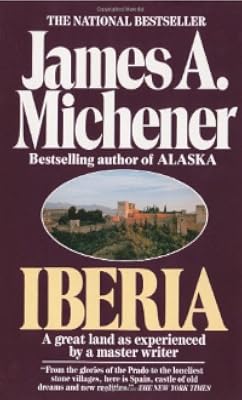
Iberia
by James A. Michener
On This Page
Description
Reference. Travel. Nonfiction. HTML:Spain is an immemorial land like no other, one that James A. Michener, the Pulitzer Prize–winning author and celebrated citizen of the world, came to love as his own. Iberia is Michener’s enduring nonfiction tribute to his cherished second home. In the fresh and vivid prose that is his trademark, he not only reveals the celebrated history of bullfighters and warrior kings, painters and processions, cathedrals and olive orchards, he also shares the show more intimate, often hidden country he came to know, where the congeniality of living souls is thrust against the dark weight of history. Wild, contradictory, passionately beautiful, this is Spain as experienced by a master writer.BONUS: This edition includes an excerpt from James A. Michener's Hawaii.
Praise for Iberia
“From the glories of the Prado to the loneliest stone villages, here is Spain, castle of old dreams and new realities.”—The New York Times
“Massive, beautiful . . . unquestionably some of the best writing on Spain [and] the best that Mr. Michener has ever done on any subject.”—The Wall Street Journal
“A dazzling panorama . . . one of the richest and most satisfying books about Spain in living memory.”—Saturday Review
“Kaleidoscopic . . . This book will make you fall in love with Spain.”—The Houston Post. show less
Tags
Recommendations

































Member Reviews
Whew! It only took me 7 years to finish this book. It is solely my fault, I set it down and didn't pick it up for years, and when I did start it again, it didn't matter that I hadn't read it for a while. Now that I've finished, I feel like reading chunks of it again. It is not a novel, nor is it simply a travel memoir. It is Michener's paean to the country, culture and people of Spain. Michener had travelled in Spain in the 30s, before the Spanish Civil War and then returned 30 years later to explore it again. He delves into everything that makes Spain what it is, and he loves it, every bit of it: the food, the music, the architecture, the legends, the history, the bullfights, the romance and the reality of it. Even though this book is show more now 50 years old, I couldn't recommend a better introduction to both Michener and to the puzzle that is Spain. Though I could have done with a little less about the bulls, he did get me to appreciate that there is a kind of beauty to the barbaric practice. show less
This book is now very dated having been written during the Franco regime. Spain has (obviously) gone through major transitions in the past 45 years. That said, there is no book about Spain that I would more highly recommend than Iberia. Michener does a fantastic job of describing the art, the history, the architecture, the customs and so on that make Spain such a fascinating place.
Michener was a prolific and very successful author. Many of his books, especially the later ones, were historical fiction. Iberia does not fit in that mold. Rather, Iberia is a travelogue. To me, Iberia is more like the dream trip you always intend to take with the world's most knowledgeable travel guide who can walk through the town and regale you with tales show more of the battle fought outside the medieval walls, the history of the cathedral across the street, and the origin of the dish you are having for lunch. Having lived in various parts of Spain, including Andalusia, the real beauty of Spain is in the layers of history and cultures that made their marks, whether in the language or the landscape.
Iberia captures that beauty and brings the richness of Spanish history to life. As an added bonus, the book provides the reader with a wonderful baseline history of Spain. I could not recommend this book any more highly and it has long been one of my favorites. show less
Michener was a prolific and very successful author. Many of his books, especially the later ones, were historical fiction. Iberia does not fit in that mold. Rather, Iberia is a travelogue. To me, Iberia is more like the dream trip you always intend to take with the world's most knowledgeable travel guide who can walk through the town and regale you with tales show more of the battle fought outside the medieval walls, the history of the cathedral across the street, and the origin of the dish you are having for lunch. Having lived in various parts of Spain, including Andalusia, the real beauty of Spain is in the layers of history and cultures that made their marks, whether in the language or the landscape.
Iberia captures that beauty and brings the richness of Spanish history to life. As an added bonus, the book provides the reader with a wonderful baseline history of Spain. I could not recommend this book any more highly and it has long been one of my favorites. show less
There is an intimacy to James Michener's Iberia. The way he lovingly describes Spain from every angle and walk of life is a work of art and the photography, even though it is in black and white, is just gorgeous. Religion, art, history, bullfighting, theater, politics, architecture, education, transportation, tourism, ecology, labor, society, food, weather, dancing, fashion, family. I don't think there is a single subject that Michener doesn't touch upon. Michener is proud to call Iberia: Spanish Travels and Reflections the "book of a tourist". Indeed, he has experience as a world traveler. He spent time in Pakistan and the Soviet Union, to name a couple of places, so he developed a keen understanding of foreign cultures. This is show more demonstrated thoroughly in the pages of Iberia. Be forewarned! The information is extremely dated so it is hard to discern current fact from history. Is the cab situation as bad as it was in the 1960s? Michener's now and then comparisons were humorous considering how old Iberia has become. Here are a few more examples: Madrid used to be dark, but at the time Iberia was written, new streetlights lined the roads. What about now? Fashion prices used to be low. There were few elevators, but there were more newspapers. The drink of choice used to be wine. Now in the 1960s, people drink beer. Indeed, the 1960s seems fashionable, especially when remembering what a good year 1594 was... show less
i'm not sure i can technically count this book as having been actually read because of all the skimming and even scanning that i did throughout.
i am an awfully big fan of michener but have rarely liked his nonfiction stuff nearly as well as his fiction. this nonfiction is billed as his recounting his travels through spain. i love spain. i have spent a decent amount of time there for someone who has never lived anywhere but america. i mostly love michener. i should have loved this book. but no.
i may have liked it better if it had been correctly labeled as history, because that changes my expectations going in. once i really and truly realized that this wasn't about his travels in spain but about spain and spanish history and spanish show more tradition/culture/art/food/folklore/architecture/music/what-have-you (which didn't really happen for me until around 600 pages in) i was able to find more value in it. still, there are large swaths of this book that i couldn't bear to even skim, and found myself scanning for things that might be of interest. (i think that's really a first for me.) there was way way way too much detail about so many things, and then brushing off of other things that could have been really interesting. i couldn't abide the part about bullfighting. i don't care that he believes it is and that he describes it as art not as sport, i just can't read such detail about that kind of senseless killing and stay sane. i couldn't read the more than 10 page description of the cathedral in santiago. i was really looking forward to the last chapter on santiago, hoping he would describe his pilgrimage along the way of st james as he took the walk for the last time 40 years before i did. it was a disappointing revisiting of something i normally love to read about. i wish this was more travel and less history but if you're looking for history, maybe this is the right book, i don't know.
still, i give 1 star instead of .5 because there were some interesting parts.
this made me laugh out loud, as this book itself is 960 pages, and many of his others are tomes around the same size:
"I went back to the cathedral plaza and spent most of one morning writing ten letters, a job I find difficult, for words do not come easily to me."
an example of what made me want to pull my hair out; i can't imagine why he would include something like this:
"The plaza isn't quite a perfect square. One afternoon when I had nothing better to do I stepped it off in all directions, but I forget the results."
there were some other things that i noted for their humor or their insight. this isn't worthless, but it's also not terribly worthwhile, or at least certainly not as a travelogue. and frankly it makes me rethink my excitement in eventually reading his memoir. there is really, really good michener out there but this is not it. show less
i am an awfully big fan of michener but have rarely liked his nonfiction stuff nearly as well as his fiction. this nonfiction is billed as his recounting his travels through spain. i love spain. i have spent a decent amount of time there for someone who has never lived anywhere but america. i mostly love michener. i should have loved this book. but no.
i may have liked it better if it had been correctly labeled as history, because that changes my expectations going in. once i really and truly realized that this wasn't about his travels in spain but about spain and spanish history and spanish show more tradition/culture/art/food/folklore/architecture/music/what-have-you (which didn't really happen for me until around 600 pages in) i was able to find more value in it. still, there are large swaths of this book that i couldn't bear to even skim, and found myself scanning for things that might be of interest. (i think that's really a first for me.) there was way way way too much detail about so many things, and then brushing off of other things that could have been really interesting. i couldn't abide the part about bullfighting. i don't care that he believes it is and that he describes it as art not as sport, i just can't read such detail about that kind of senseless killing and stay sane. i couldn't read the more than 10 page description of the cathedral in santiago. i was really looking forward to the last chapter on santiago, hoping he would describe his pilgrimage along the way of st james as he took the walk for the last time 40 years before i did. it was a disappointing revisiting of something i normally love to read about. i wish this was more travel and less history but if you're looking for history, maybe this is the right book, i don't know.
still, i give 1 star instead of .5 because there were some interesting parts.
this made me laugh out loud, as this book itself is 960 pages, and many of his others are tomes around the same size:
"I went back to the cathedral plaza and spent most of one morning writing ten letters, a job I find difficult, for words do not come easily to me."
an example of what made me want to pull my hair out; i can't imagine why he would include something like this:
"The plaza isn't quite a perfect square. One afternoon when I had nothing better to do I stepped it off in all directions, but I forget the results."
there were some other things that i noted for their humor or their insight. this isn't worthless, but it's also not terribly worthwhile, or at least certainly not as a travelogue. and frankly it makes me rethink my excitement in eventually reading his memoir. there is really, really good michener out there but this is not it. show less
Most James Michener books take a real commitment to finish and this one is no exception. The Trade paperback version is 920 pages. Iberia is the first Michener book I have read, that has photographs throughout the book, though I must confess, for me, they didn’t add to the story in any significant way. Other very long Michener books I have read: Hawaii, Caribbean, Mexico, The Covenant, were all told in a historical fiction format, starting 10,000 years ago up through the time he wrote the book.
That format worked well because there was a logical flow of history up until the book was done being written, and so even if very significant things happened after the book was written it didn’t necessarily affect the book.
Iberia deviates show more from this format and is broken into 13 chapters that are mostly geographical, there is a chapter on bulls and bullfighting, but the problem is that each chapter is part history lesson and part travelogue, based on multiple visits to Spain by the author starting in 1931 and ending presumably in 1967- the book was published in 1968. The problem with this is 2 fold.
The first problem is much of what he describes is no longer accurate or still existing.
The second problem is what he chooses to describe and cover as it relates to his visits is completely random.
As usual the writing is superb and the history is facilitating, but the format doesn’t age well show less
A wonderful book! I read it about 25 years ago, then reread it last month and enjoyed it even more, as in the meantime, I've travelled the length and breadth of Spain. He's just so spot-on about everything concerning the country, and his love for all things Spanish just oozes from every page. He's one of that vanishing breed - travel writers in the mould of Herodotus & Co. He doesn't just breeze in and out of a country, making rapid value judgments and classifying the people into his own mental categories. Michener takes the time and makes the effort to go so deeply into Spanish history, and every little town or village he visits comes to life, proudly reclaiming its past glory. A book to cherish.
An interesting mixture of travel writing, memoir, history and sociology. One of the most challenging books I've read because it is so expansive; at times it is too unfocused and becomes a labor. Still, a fascinating study of the Spanish (and Portuguese) character and social narrative.
Members
- Recently Added By
Lists

Best Sellers / Popular 1968
237 works; 5 members
Author Information

211+ Works 49,443 Members
James A. Michener, 1907 - 1997 James Albert Michener was born on February 3, 1907 in Doylestown, Pa. He earned an A.B. from Swarthmore College, an A.M. from Colorado State College of Education, and an M.A. from Harvard University. He taught for many years and was an editor for Macmillan Publishing Company. His first book, "Tales of the South show more Pacific," derived from Michener's service in the Pacific in World War II, won the 1947 Pulitzer Prize for Fiction and was the basis for the Rodgers and Hammerstein Broadway musical South Pacific, which won the 1950 Pulitzer Prize for Drama. Michener completed close to 40 novels. Some other epic works include "Hawaii," "Centennial," "Space," and "Caribbean." He also wrote a significant amount of nonfiction including his autobiography "The World Is My Home." Among his many other honors, James Michener received the Presidential Medal of Freedom in 1977. He was married to Patti Koon in 1935; they divorced in 1948. He married Vange Nord in 1948 (divorced 1955) and Mari Yoriko Sabusawa in 1955 (deceased 1994). He died in 1997 in Austin, Texas. (Bowker Author Biography) show less
All Editions
Some Editions
Awards and Honors
Distinctions
Work Relationships
Common Knowledge
- Canonical title
- Iberia
- Original title
- Iberia
- Original publication date
- 1968
- Important places
- Badajoz, Extremadura, Spain; Toledo, Castile-La Mancha, Spain; Córdoba, Andalusia, Spain; Guadalquivir Marshes, Andalusia, Spain (Las Marismas); Seville, Andalusia, Spain; Madrid, Spain (show all 11); Salamanca, Castile and Léon, Spain; Pamplona, Navarre, Spain; Barcelona, Catalonia, Spain; Teruel, Aragon, Spain; Santiago de Compostela, Galicia, Spain
- First words
- Intro:
Spain, solid, dark, mysterious, looming out of the gray waves.
Badajoz still lay forty miles to the north. - Last words
- (Click to show. Warning: May contain spoilers.)It was a dazzling moment, as rich in pageantry and as filled with the spirit of Spain as any that I had witnessed, and there I hid in the darkness as if an interloper with no proper role in the ceremonial except that I had completed my vow of pilgrimage and stood at last with my arms about the stone cold shoulder of Santiago, my patron saint and Spain's.
Classifications
Statistics
- Members
- 1,238
- Popularity
- 20,004
- Reviews
- 20
- Rating
- (3.75)
- Languages
- English, German, Spanish
- Media
- Paper, Audiobook, Ebook
- ISBNs
- 20
- UPCs
- 1
- ASINs
- 17