On This Page
Description
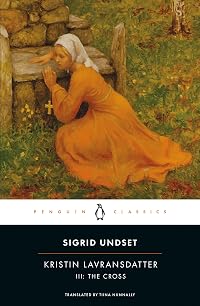
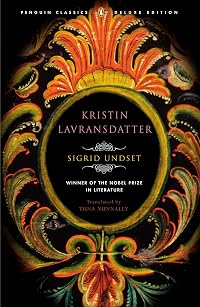
The Cross' is the third in the trilogy of historical novels called Kristin Lavransdatter by Sigrid Undset.Tags
Recommendations














Member Reviews
The concluding part of the iconic Norwegian medieval trilogy, opening with Kristin already entering her own middle age. She's the mother of seven sons ranging from toddler to near-adult and is managing a large farm. But there are still all sorts of unresolved problems from her past to deal with, and it's not long before her relative happiness starts unravelling. Also, we're heading into the mid-14th century, and we all know what that means in plot terms...
I think this is the part of the trilogy where Kristin's character gets most interesting, as Undset reshapes some rather 20th-century ways of looking at the problems of marriage and motherhood into terms that fit together (apparently) seamlessly with very medieval approaches to law, show more custom and Christian belief. At times it comes uncomfortably close to being Freud in a wimple, but it just about manages to remain plausible, whilst making us see the absurdity of a lot of romantic ideas about medieval life. Nowadays we're quite used to thinking of the Middle Ages as a time of mud, smells, frightening diseases and sudden, arbitrary violence between men who went around fully armed all the time, where unhappy marriages cannot have been any less common than they are now. But in 1922, if you'd grown up on Walter Scott, that must have been quite a shocking thought. show less
I think this is the part of the trilogy where Kristin's character gets most interesting, as Undset reshapes some rather 20th-century ways of looking at the problems of marriage and motherhood into terms that fit together (apparently) seamlessly with very medieval approaches to law, show more custom and Christian belief. At times it comes uncomfortably close to being Freud in a wimple, but it just about manages to remain plausible, whilst making us see the absurdity of a lot of romantic ideas about medieval life. Nowadays we're quite used to thinking of the Middle Ages as a time of mud, smells, frightening diseases and sudden, arbitrary violence between men who went around fully armed all the time, where unhappy marriages cannot have been any less common than they are now. But in 1922, if you'd grown up on Walter Scott, that must have been quite a shocking thought. show less
Kristin Lavaransdatter is a trilogy set in 14th century Norway, and follows the life of a strong, independent woman. The first volume covered Kristin’s childhood and marriage; the second, her life as a mother, bearing seven sons and managing a large agricultural estate. The Cross is the third and final volume in this epic work. Kristin is in her late 30s, and considered beyond reproductive age. In the previous book, her husband Erlend lost his land holdings, and they now live on Kristin’s family estate. Her oldest sons are in their late teens, and ready to assume the responsibilities of grown men, but will not enjoy the inheritance they might have once expected.
This novel sees Kristin coping with tensions in her relationship with show more Erlend, and with the prospect of “losing” her sons to marriage and families of their own. Simon Darre, once betrothed to Kristin but now married to her younger sister, is always waiting in the wings to provide Kristin support when needed. It’s clear his feelings for Kristin have never gone away, and while Kristin can’t help thinking of the life that might have been, she also knows her rather unstable life with Erlend has suited her better than a life with steady but rather boring Simon.
The church figures prominently during this time period, and people are often judged harshly for what is seen as “immoral” conduct. Kristin herself was a victim of this, having defied her father’s choice for a husband, sleeping with Erlend before marriage, and deceiving everyone with a lavish wedding even though she knew she was pregnant. Now, while she is respected in the community, her morals are always suspect.
As the book progresses, the lives of all principal characters play out in interesting and unexpected ways. Kristin’s inner strength kept her going through hardship and personal tragedy, despite pressure to conform to church and community norms. Her story ends in a way that surprised me, but which on reflection seems fitting. Kristin Lavransdatter will stay with me for some time. show less
This novel sees Kristin coping with tensions in her relationship with show more Erlend, and with the prospect of “losing” her sons to marriage and families of their own. Simon Darre, once betrothed to Kristin but now married to her younger sister, is always waiting in the wings to provide Kristin support when needed. It’s clear his feelings for Kristin have never gone away, and while Kristin can’t help thinking of the life that might have been, she also knows her rather unstable life with Erlend has suited her better than a life with steady but rather boring Simon.
The church figures prominently during this time period, and people are often judged harshly for what is seen as “immoral” conduct. Kristin herself was a victim of this, having defied her father’s choice for a husband, sleeping with Erlend before marriage, and deceiving everyone with a lavish wedding even though she knew she was pregnant. Now, while she is respected in the community, her morals are always suspect.
As the book progresses, the lives of all principal characters play out in interesting and unexpected ways. Kristin’s inner strength kept her going through hardship and personal tragedy, despite pressure to conform to church and community norms. Her story ends in a way that surprised me, but which on reflection seems fitting. Kristin Lavransdatter will stay with me for some time. show less
[This is my review of all three volumes, not simply the last]
Kristin Lavransdatter is the epic story (over 1,100 pages) of a woman from birth to death in early 14th century Norway. The title character wrestles throughout the work with pride and passion; she is extraordinarily determined, but her determination is often expressed as willful pigheadedness. She marries for love, defying her parents, and raises a large family of sons. The work addresses—in highly detailed, completely believable descriptions—her relationships: with her parents and siblings, with her husband, and with her sons. The level of detail is astonishing—Undset’s depictions of everything from daily life to customs to religious practices have understandably won show more admiration from scholars. I found that one of the great successes of the work is its wholly believable setting: Undset creates a universe and her writing is so accessible that the reader is completely absorbed very early on. Characters are fully developed, completely human, and their relationships thoroughly convincing.
The other major theme of the work is Kristin Lavransdatter’s relationship to her church and her religion; the work is saturated in Undset’s own crisis of faith that resulted in her conversion to Catholicism in 1924 (the book came out in three volumes between 1920 and 1927). (Undset had a largely secular upbringing in Norway, a overwhelmingly Lutheran country.) There was occasionally too much emphasis on this aspect of the story for me (portions can read as if a sermon was being preached) and it seemed to reflect a bit too vividly Undset’s own struggles, but she succeeds in tying everything together in the end. Considering Undset was in her late 30s and early 40s when she wrote this, there is a remarkable perceptiveness, a “worldly” wisdom, that wouldn’t be expected of a writer so young. No doubt her own personal circumstances heavily influenced much of the writing, but the work is exceptional under any circumstances. show less
Kristin Lavransdatter is the epic story (over 1,100 pages) of a woman from birth to death in early 14th century Norway. The title character wrestles throughout the work with pride and passion; she is extraordinarily determined, but her determination is often expressed as willful pigheadedness. She marries for love, defying her parents, and raises a large family of sons. The work addresses—in highly detailed, completely believable descriptions—her relationships: with her parents and siblings, with her husband, and with her sons. The level of detail is astonishing—Undset’s depictions of everything from daily life to customs to religious practices have understandably won show more admiration from scholars. I found that one of the great successes of the work is its wholly believable setting: Undset creates a universe and her writing is so accessible that the reader is completely absorbed very early on. Characters are fully developed, completely human, and their relationships thoroughly convincing.
The other major theme of the work is Kristin Lavransdatter’s relationship to her church and her religion; the work is saturated in Undset’s own crisis of faith that resulted in her conversion to Catholicism in 1924 (the book came out in three volumes between 1920 and 1927). (Undset had a largely secular upbringing in Norway, a overwhelmingly Lutheran country.) There was occasionally too much emphasis on this aspect of the story for me (portions can read as if a sermon was being preached) and it seemed to reflect a bit too vividly Undset’s own struggles, but she succeeds in tying everything together in the end. Considering Undset was in her late 30s and early 40s when she wrote this, there is a remarkable perceptiveness, a “worldly” wisdom, that wouldn’t be expected of a writer so young. No doubt her own personal circumstances heavily influenced much of the writing, but the work is exceptional under any circumstances. show less
With [b:The Cross|6219|The Cross (Kristin Lavransdatter, #3)|Sigrid Undset|https://i.gr-assets.com/images/S/compressed.photo.goodreads.com/books/1446567677l/6219._SY75_.jpg|1069914], I have now completed the Kristin Lavransdatter trilogy of [a:Sigrid Undset|4203|Sigrid Undset|https://images.gr-assets.com/authors/1352776655p2/4203.jpg], and my reaction to the end of this book was to want to pick up book one and start all over again. What an amazing story this turned out to be. By the time I reached the final section of this installment, I felt I knew Kristen intimately. Along the way, I fell in love with her father, Lavrens; her jilted lover, Simon; her reckless and charming husband, Erlend; several of her sons, a couple of priests, and show more numerous smaller characters.
This is a book about self-realization, about relationships and how they shape us, and about our relationship with God and how He carries and sustains us.
Then had it been the burden of her burning prayer, that might this poor, unhappy child but be made whole in body and in wits, she would crave for naught more...She thought of Gaute, sitting his great iron-grey, a brave and goodly horseman. And she herself--not many women of her age night to half a hundred years, were blessed with such health; she had marked it well on her journey across the mountains. Lord, give me but this and this and this--then will I thank Thee and crave no more than this and this and this--
Never, it seemed to her, had she prayed to God for aught else than that He might grant her her own will. And she had got always what she wished--most. And now she sat here with a bruised spirit--not because she had sinned against God, but because she was miscontent that it had been granted her to follow the devices of her own heart to the journey’s end.
How many of us are guilty of this? Always wanting our own way, always promising God not to ask any other boon if he grants us this one.
These books are religious in the finest kind of way, because they explore the spiritual side of man and his need for God and because, in this historical context, they are perfectly accurate. There was law and religious law, both imposed on the people and often completely overlapping, religious leaders sitting in judgement of both civil and moral trespasses.
Think you, woman, child that you still are in your old age, that ‘tis God punishing for the sin, when you must reap sorrow and humiliation because you followed your lusts and your overweening pride over paths that God has forbidden His children to tread? Would you say that you had punished your children if they scalded their hands when they took up the boiling kettle you had forbidden them to touch, or if the slippery ice broke under them that you had warned them not to go upon? Have you not understood, when the brittle ice broke beneath you--that you were drawn under each time you let go of God’s hand, and you were saved from out the deep each time you called on Him?
This tale of Kristen’s stepping on the ice and being saved time and again, is one of the most gripping I have ever encountered. If you don’t mind a book that breaks your heart to the extent that you have to take breaks to wash away the tears, this might be a book for you. show less
This is a book about self-realization, about relationships and how they shape us, and about our relationship with God and how He carries and sustains us.
Then had it been the burden of her burning prayer, that might this poor, unhappy child but be made whole in body and in wits, she would crave for naught more...She thought of Gaute, sitting his great iron-grey, a brave and goodly horseman. And she herself--not many women of her age night to half a hundred years, were blessed with such health; she had marked it well on her journey across the mountains. Lord, give me but this and this and this--then will I thank Thee and crave no more than this and this and this--
Never, it seemed to her, had she prayed to God for aught else than that He might grant her her own will. And she had got always what she wished--most. And now she sat here with a bruised spirit--not because she had sinned against God, but because she was miscontent that it had been granted her to follow the devices of her own heart to the journey’s end.
How many of us are guilty of this? Always wanting our own way, always promising God not to ask any other boon if he grants us this one.
These books are religious in the finest kind of way, because they explore the spiritual side of man and his need for God and because, in this historical context, they are perfectly accurate. There was law and religious law, both imposed on the people and often completely overlapping, religious leaders sitting in judgement of both civil and moral trespasses.
Think you, woman, child that you still are in your old age, that ‘tis God punishing for the sin, when you must reap sorrow and humiliation because you followed your lusts and your overweening pride over paths that God has forbidden His children to tread? Would you say that you had punished your children if they scalded their hands when they took up the boiling kettle you had forbidden them to touch, or if the slippery ice broke under them that you had warned them not to go upon? Have you not understood, when the brittle ice broke beneath you--that you were drawn under each time you let go of God’s hand, and you were saved from out the deep each time you called on Him?
This tale of Kristen’s stepping on the ice and being saved time and again, is one of the most gripping I have ever encountered. If you don’t mind a book that breaks your heart to the extent that you have to take breaks to wash away the tears, this might be a book for you. show less
I spent about two months reading these Nobel Prize winning books about the life of Kristin Lavransdatter. Then I totally failed to get round to writing my review, and now it feels overwhelming to try and pull together the great scope of the books. In some ways they are a standard romance - headstrong noblewoman decides she won't marry the man her family want her to, and runs off with the handsome man she fancies. In some ways they are the inversion of that - Kristin is married by the end of book I, books II and III are the consequences of her choices.
For me, it is the side characters and their very very human feelings that make these books. Simon, noble and loyal and loving to the end. Kristin's little sister, hating living her life in show more Kristin's shadow.
And the wheel comes full circle, and Kristin cedes her space to another bright, pushy woman who knows what she wants and how to get it in her new daughter-in-law. show less
For me, it is the side characters and their very very human feelings that make these books. Simon, noble and loyal and loving to the end. Kristin's little sister, hating living her life in show more Kristin's shadow.
And the wheel comes full circle, and Kristin cedes her space to another bright, pushy woman who knows what she wants and how to get it in her new daughter-in-law. show less
Kristin is finally showing some growth in this last book of the Kristin Lavransdatter trilogy. She epitomizes all colors of the spectrum of emotion, from the red of her fury and bitterness toward Erlend to the violet of finally finding God's redemption. Her love/hate relationship with Erlend set alongside her quest for God's peace and forgiveness are the ruling forces in Kristin's life.
Undset remarkably melds the strict hold of the Church on this medieval society with the pagan ways of their ancestors which still factored into their daily lives. These are complex times in the history of Norway with strong political and religous influences, but Norway's struggles are no match for the pains and triumphs of Kristin and Erlend's show more relationship over the years that Undset relates so ardently.
If you enjoy historical sagas and want to get to know some unforgettable characters, then this trilogy is for you. show less
Undset remarkably melds the strict hold of the Church on this medieval society with the pagan ways of their ancestors which still factored into their daily lives. These are complex times in the history of Norway with strong political and religous influences, but Norway's struggles are no match for the pains and triumphs of Kristin and Erlend's show more relationship over the years that Undset relates so ardently.
If you enjoy historical sagas and want to get to know some unforgettable characters, then this trilogy is for you. show less
In The Cross, Sigrid Undset draws the sweeping narrative of Kristin Lavransdatter and life in mediaeval Norway to a close. Following on from The Wife, Kristin and Erlend return to Jørundgård as the couple become estranged and Kristin worries about the prospects of her sons. This volume definitely contains some of the more emotional moments in the series, particularly the deaths of Erlend Nikulaussøn and Simon Darre; the final chapter devoted to the effects of the plague on the convent to which Kristin moved is also powerful.
This final volume, perhaps more than any other, is replete with a strong Christian ethos and as it chronicles the hardships Kristin bears and how she endures them, Sigrid Undset concurs with the mediaeval belief show more of the primacy of the spiritual realm over this material one. Undset infuses the whole novel with Christianity, reflecting the permeation of mediaeval life with the same, and although hard-going sometimes, these passages dealing with penance, forgiveness, and religion in general provide a rich insight not only into the mediaeval mind but into Undset's also, particularly as she converted to Roman Catholicism shortly after these books were published.
As in the previous two novels, Undset has richly recreated daily life in mediaeval Norway and brought this far-off time to life with detailed and sympathetic characters. Undset's prose is aided herein by Tiina Nunnally's translation that vividly brings this world to life.
This trilogy is demonstrable proof of the worthiness of Undset's Nobel Prize award and as whole merits five stars. I look forward greatly to reading more of Undset's works, particularly the Master of Hestviken series. show less
This final volume, perhaps more than any other, is replete with a strong Christian ethos and as it chronicles the hardships Kristin bears and how she endures them, Sigrid Undset concurs with the mediaeval belief show more of the primacy of the spiritual realm over this material one. Undset infuses the whole novel with Christianity, reflecting the permeation of mediaeval life with the same, and although hard-going sometimes, these passages dealing with penance, forgiveness, and religion in general provide a rich insight not only into the mediaeval mind but into Undset's also, particularly as she converted to Roman Catholicism shortly after these books were published.
As in the previous two novels, Undset has richly recreated daily life in mediaeval Norway and brought this far-off time to life with detailed and sympathetic characters. Undset's prose is aided herein by Tiina Nunnally's translation that vividly brings this world to life.
This trilogy is demonstrable proof of the worthiness of Undset's Nobel Prize award and as whole merits five stars. I look forward greatly to reading more of Undset's works, particularly the Master of Hestviken series. show less
Members
- Recently Added By
Lists

Literature in Translation
113 works; 5 members

Mustich's 1000 Books to Read Before You Die: A Life Changing List
1,001 works; 19 members
Author Information

165+ Works 12,101 Members
Sigrid Undset was the daughter of archeologist Ingvald Undset. Cultural, autobiographical, and religious topics constitute a large and interesting portion of her fiction, which in Norway is categorized according to the time of action: medieval or modern. Jenny (1911), an idealistic and tragic love story, is one of the latter novels. Undset's show more comprehensive knowledge of medieval Scandinavian culture has its literary monuments in Kristin Lavransdatter (1920--22) and The Master of Hestviken (1925--27), historical novels that depict life in the Norwegian Middle Ages. She was awarded the Nobel Prize for Literature in 1928. Norwegian criticism of Sigrid Undset's writing centers on her religiosity (she became a conservative, almost reactionary Catholic in Lutheran Norway in the 1920s; she possesses an intensity of belief that is rather naturally expressed in the medieval novels. Yet while she has written religious polemics, the medieval novels are not tendentious. In fact, the central motifs are eroticism, marriage, and family life, in short, the full life of a medieval woman who sees herself in the light of contemporary Christian beliefs. These novels are great, realistic delineations of medieval personalities. During World War II she escaped the German occupation of Norway and fled to America, where she wrote her autobiographical Happy Times in Norway (1942). (Bowker Author Biography) show less
Some Editions
Awards and Honors
Awards
Series

Belongs to Publisher Series
Work Relationships
Is contained in
Common Knowledge
- Canonical title
- Kristin Lavransdatter III: The Cross
- Alternate titles
- The Cross
- Original publication date
- 1922
- People/Characters
- Kristin Lavransdatter
- Important places
- Norway
- Important events
- Black Death; Middle Ages
- First words
- The second year Erlend Nikulausson and Kristin Lavransdatter dwelt on Jorundgaard, the mistress was minded to go herself and lie the summer over at the saeter.
During the second year that Erlend Nikulaussøn and Kristin Lavransdatter lived at Jørundgaard, Kristin decided to spend the summer up in the mountain pastures.
Kristin Lavransdatter is a remarkably durable novel, for at least two reasons that appear to be contradictory. (Introduction) - Last words
- (Click to show. Warning: May contain spoilers.)Unwittingly, both men trod as lightly and charily as they could upon the new-fallen snow.
(Click to show. Warning: May contain spoilers.)Without thinking, they both walked as lightly and carefully as they could in the new snow.
(Click to show. Warning: May contain spoilers.)May this edition of Kristin Lavransdatter keep us "talking about her and her family" for many generations more. (Introduction)
Classifications
- Genres
- Fiction and Literature, General Fiction, Historical Fiction
- DDC/MDS
- 839.82372 — Literature & rhetoric German & related literatures Other Germanic literatures Danish and Norwegian literatures Norwegian literature Norwegian Bokmål fiction 1900–2000 Early 20th century 1900–1945
- LCC
- PT8950 .U5 .K6413 — Language and Literature German, Dutch and Scandinavian literatures Norwegian literature Individual authors or works 1900-1960
- BISAC
Statistics
- Members
- 1,134
- Popularity
- 22,256
- Reviews
- 20
- Rating
- (4.30)
- Languages
- 15 — Arabic, Czech, Danish, Dutch, English, Estonian, Finnish, French, German, Norwegian (Bokmål), Norwegian, Polish, Russian, Spanish, Swedish
- Media
- Paper, Audiobook, Ebook
- ISBNs
- 38
- ASINs
- 24