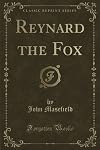
Reynard the Fox
by John Masefield
On This Page
Description
A phenomenal bestseller after its publication in 1919, this work was widely seen as a masterful poetic response to the horrors of World War I. A long narrative poem about a foxhunt, the work also evokes the beauty of English countryside and considers the meaning of courage. The poem was recorded by the author and adapted as a radio play much-beloved by the British public, and although the poem does not overtly criticize foxhunting, it prompted national debate on the subject. Out of print for show more years, the poem is now newly corrected from the original manuscript and presented alongside other pastoral writing by Masefield, including the essay "Fox-Hunting." show lessTags
Recommendations




















Member Reviews
Very poor. It happens to be one of the oldest books I own, quite a bit older than I am, printed in 1921. I'm not sure why anyone bothered.
Turn of the last century poetry in rhyming couplets and uneven meter, varying between 8 and 9 syllables a line without an obvious pattern. The jumps are very disconcerting. The author's habit of mostly ending a verse in a hanging rhyme is also quite annoying, especially because it is only most of the verses not all of them. Some of the rhymes are a bit forced as are the attempts to keep meter. Once (and only once which makes it worse) he resorts to starting a new sentence mid line, and there are a few bracketed expressions which only make sense in terms of trying to abide by the meter. Some of the show more language is archaic or rural dialect (what sort of pet is a pyat?) which adds to the difficulties of the modern reader.
Content wise it isn't much better. It is a short tale set in verse without allegory or illusion, of a grouping of village worthies gathering and then departing on a hunt for the fox of the title. Who isn't in anyway related to any of the famous Reynards, it appears in this case to be a generic name for a generic fox. Pages and pages detail briefly the persons of the hunt and especially their wives and daughters who then don't appear anywhere else in the text.
The actual hunt is told from the fox's point of view, which means that having introduced all the riders we don't actually get to hear anything about any of their exploits. The fox being a dumb brute, doesn't think of very much other than the panic of the chase and isn't exactly clever or full of that renowned foxy cunning. Rather inexplicably it also turns out that all the fox earths in a 10 mile radius appear to have been blocked up! This is just lazy writing. I'm sure that it was normal practise to block those known about from local foxes. But 10miles! that's a vast area of land, with no assurance that the actual fox you are chasing will head in that direction. It does manage to add a little dramatic tension to the story though which raises it from half to one single full star in rating. I won't spoil the ending, suffice to say it's an extremely weak cop-out.
Don't bother ploughing through this drivel.
........................................................................................................................... show less
Turn of the last century poetry in rhyming couplets and uneven meter, varying between 8 and 9 syllables a line without an obvious pattern. The jumps are very disconcerting. The author's habit of mostly ending a verse in a hanging rhyme is also quite annoying, especially because it is only most of the verses not all of them. Some of the rhymes are a bit forced as are the attempts to keep meter. Once (and only once which makes it worse) he resorts to starting a new sentence mid line, and there are a few bracketed expressions which only make sense in terms of trying to abide by the meter. Some of the show more language is archaic or rural dialect (what sort of pet is a pyat?) which adds to the difficulties of the modern reader.
Content wise it isn't much better. It is a short tale set in verse without allegory or illusion, of a grouping of village worthies gathering and then departing on a hunt for the fox of the title. Who isn't in anyway related to any of the famous Reynards, it appears in this case to be a generic name for a generic fox. Pages and pages detail briefly the persons of the hunt and especially their wives and daughters who then don't appear anywhere else in the text.
The actual hunt is told from the fox's point of view, which means that having introduced all the riders we don't actually get to hear anything about any of their exploits. The fox being a dumb brute, doesn't think of very much other than the panic of the chase and isn't exactly clever or full of that renowned foxy cunning. Rather inexplicably it also turns out that all the fox earths in a 10 mile radius appear to have been blocked up! This is just lazy writing. I'm sure that it was normal practise to block those known about from local foxes. But 10miles! that's a vast area of land, with no assurance that the actual fox you are chasing will head in that direction. It does manage to add a little dramatic tension to the story though which raises it from half to one single full star in rating. I won't spoil the ending, suffice to say it's an extremely weak cop-out.
Don't bother ploughing through this drivel.
........................................................................................................................... show less
Ratings
Members
- Recently Added By
Author Information

181+ Works 4,024 Members
Once one of the most popular English poets of the century, Masefield has fallen into undeserved neglect since his death. He was born in a Victorian house with rural vistas, which he later recalled as "living in Paradise." In childhood, he had a series of intense, visionary experiences inspired by both nature and literature, which gave him a show more habitual sense of participation in a greater life. These had weakened by 1891, when he entered training for the merchant naval service. An officer on the White Star Line's Adriatic, he jumped ship in New York in 1895 and roamed across America. He returned to England two years later when a recovery of his intense childhood visions convinced him he could succeed as a writer. Masefield excelled more at narrative than at symbolism. His first book, "Salt Water Poems and Ballads" (1902), displayed the allegiance to outcasts and wanderers that marks his subject matter. The musicality of that volume derives partly from the strong early influence of W. B. Yeats. Increasingly, Masefield experimented with colloquial diction, particularly from the lower classes. His "The Everlasting Mercy" (1911) recounted the conversion of a rural scoundrel in language that astonished many readers. Highly prolific, he produced more than 20 volumes of fiction, 17 plays, and other prose work besides his major volumes of poetry. Masefield still appeals particularly to the common reader. He was appointed poet laureate in 1930. (Bowker Author Biography) show less
Common Knowledge
- Original publication date
- 1919
- People/Characters
- Reynard the Fox
- First words
- The meet was at "The Cock and Pye
By Charles and Martha Enderby," - Last words
- (Click to show. Warning: May contain spoilers.)The long dead leaves on the ground were rimed;
A clock struck twelve and the church-bells chimed. - Disambiguation notice
- Nothing to do with any of the famous tales of Reynard the Fox, this should be known by it's subtitle, Ghost Heath Run, only.
Classifications
Statistics
- Members
- 53
- Popularity
- 575,436
- Reviews
- 1
- Rating
- (3.50)
- Languages
- English, German
- Media
- Paper, Ebook
- ISBNs
- 15
- ASINs
- 12