
On This Page
Description
While hunting with his father, a young polar bear drifts out to sea and ends up in a jungle where a friendly hippopotamus helps him return home.Tags
Recommendations













Member Reviews
Just leaving a review, although all I've read is the Amazon sample and others' reviews. I was trying to decide whether to order the book. The biggest draw for me is the number of languages it has been published in, including (very exciting for my Italian/Canadian grandchildren) bilingual Italian/English. But after looking into it, I'm wondering why it's so popular. It's a little bit weird to have the *father* polar bear teaching his cub to hunt (instead of, more typically, killing it), but I could let that go because positive depictions of fathers in preschool fiction are laudable... right? And the part about drifting to Africa on an ice floe and meeting a hippopotamus is fantasy, and preschoolers can appreciate humorous make-believe. show more But when we get to trying to believe that the hippo, unlike the polar bear, can swim and the bear, unlike the hippo, can climb trees, my brain feels very very unhappy. Polar bears in general are known for their prodigious swimming abilities, and (I researched to make sure when they learn) it's one of the first lessons their mothers teach them when they venture into the world. And since there are no trees in the Arctic, tree climbing is not a skill that polar bears will ever use; and in fact their feet, being adapted for walking on cold slippery ice, simply cannot bend to grip a tree trunk. So this book lost its place on my wishlist, although I will definitely look for a copy in the library to make sure I'm not doing the book a terrible injustice. show less
The theme of the book is that things that don’t go as plan can turn into a learning experience. I enjoyed reading this story because the author incorporated information into the structure of the story. For example, when the little bear washes out to sea and stumbles upon a jungle the bear learns the differences between hot and cold climates, the different animals that live in the jungle (Hippopotamus and chameleon), and the terrain of the jungle (rocks and trees). The author fuses fantasy with information allowing for a young reader to enjoy reading and to learn something through the process. Another reason why I enjoyed the book was the ability to relate the animals to humans but still retain their animal abilities. For example, show more there were things that the bear couldn’t do that the hippo could and vice versa; the bear couldn’t swim but he could climb the tree whereas the hippo could swim but had a hard time climbing. This assigns the characteristics typical of that animal but the inclusion of dialogue between the characters and the bear’s journey to get home gave the animals human like qualities. show less
When Lars the polar bear goes to sleep behind a pile of snow one night, he has no idea that when he wakes up with bit of ice will have separated from the rest, and taken him far from his father. Eventually landing on tropical shores, he meets Henry the hippopotamus and Marcus the eagle, sees how animals in that strange part of the world live, and is then given a ride home on the back of Samson the gray whale.
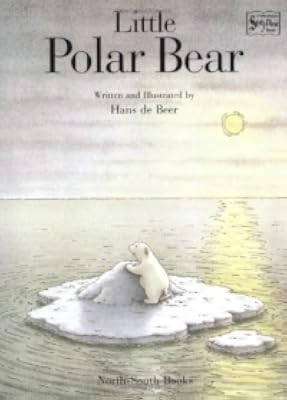
Originally published in Switzerland as Kleiner Eisbär wohin fährst du? (literally: "Little Polar Bear, Where Are You Going?"), this first of many books about little Lars and his adventures offers a sweet, reassuring story, one in which the eponymous ursine protagonist goes out into the world, explores and learns, and then comes show more home. The artwork, which looks to be done in watercolor, is quite lovely. My favorite scene was the one in which Lars rides on his father's back, the snow falling all around them. Recommended to young polar bear lovers, and to any child who has dreamed of going on a voyage of exploration. show less
Originally published in Switzerland as Kleiner Eisbär wohin fährst du? (literally: "Little Polar Bear, Where Are You Going?"), this first of many books about little Lars and his adventures offers a sweet, reassuring story, one in which the eponymous ursine protagonist goes out into the world, explores and learns, and then comes show more home. The artwork, which looks to be done in watercolor, is quite lovely. My favorite scene was the one in which Lars rides on his father's back, the snow falling all around them. Recommended to young polar bear lovers, and to any child who has dreamed of going on a voyage of exploration. show less
I bought this book at a thrift store solely based on the pictures - mostly because the version I have is in Japanese. Not Japanese written in English letters. No, Japanese script. I'm not sure if that counts as having read the book - because I most certainly do not read Japanese. I looked up the book, and it's was originally published in Switzerland, in German. It's been translated into English, so I was able to read a synopsis. Lars the little polar bear gets separated from his father and travels to the jungle. I'm not sure about the other animals (the Hippo's name is Henry) but he does make it back to his father with the help of a Killer Whale. In English, I think this would be a delightful book, given how much I enjoyed just looking show more at the pictures. I like my Japanese copy, but I'm going to try to get my hands on an English one too! show less
A delightful tale, delightfully illustrated.
Whilst Lars' own journey takes him from his Arctic home and his father to the tropics, the tale is a universal one: anyone who has started school, left home, suffered separation, or missed their own pile of snow will feel along with Lars. But don't worry -- the ending is a happy one!
Whilst Lars' own journey takes him from his Arctic home and his father to the tropics, the tale is a universal one: anyone who has started school, left home, suffered separation, or missed their own pile of snow will feel along with Lars. But don't worry -- the ending is a happy one!
Beautiful illustrations, fun story about a polar bear's adventures to a different part of the world and the friendly animals who help him get home.
Lars is a young polar bear who lives in the Arctic and is out hunting with his father. That night, they make piles of snow to protect themselves from the wind. But during the night, the ice begins to crack and Lars’s piece breaks off. When he wakes up, he is all alone in the middle of the sea, and as the temperature grows warmer, his piece of ice is melting. He manages to climb on top of a floating barrel; then a storm hits, and he keeps drifting until he comes to a tropical island where he meets a hippopotamus named Henry and an eagle named Marcus. They are nice, but Lars wants to go home. How can Henry and Marcus help Lars? And will the little polar bear ever see his father again?
Several years ago we rented for our weekly family show more video a full-length 2001 animated Warner Brothers movie The Little Polar Bear based on this book written and illustrated by Dutch author Hans de Beer, who was born in 1957. Of course, the film version is a lot different with many more plot features than are contained in the simple children’s picture book, which is a lovely story for youngsters about going different places and experiencing new things but desiring to get back with family. It is well told with bits of subtle humor and detailed pastel illustrations. A board book edition (1999) is available for toddlers, but be forewarned that it is severely abridged, a fact that is not clearly indicated on the back of the book. Other “Little Polar Bear Adventures” by de Beer are Ahoy There, Little Polar Bear; Little Polar Bear Finds a Friend; Little Polar Bear and the Brave Little Hare; Little Polar Bear and the Husky Pup; Little Polar Bear and the Big Balloon; Little Polar Bear and the Reindeer; and Little Polar Bear and the Whales. show less
Several years ago we rented for our weekly family show more video a full-length 2001 animated Warner Brothers movie The Little Polar Bear based on this book written and illustrated by Dutch author Hans de Beer, who was born in 1957. Of course, the film version is a lot different with many more plot features than are contained in the simple children’s picture book, which is a lovely story for youngsters about going different places and experiencing new things but desiring to get back with family. It is well told with bits of subtle humor and detailed pastel illustrations. A board book edition (1999) is available for toddlers, but be forewarned that it is severely abridged, a fact that is not clearly indicated on the back of the book. Other “Little Polar Bear Adventures” by de Beer are Ahoy There, Little Polar Bear; Little Polar Bear Finds a Friend; Little Polar Bear and the Brave Little Hare; Little Polar Bear and the Husky Pup; Little Polar Bear and the Big Balloon; Little Polar Bear and the Reindeer; and Little Polar Bear and the Whales. show less
Members
- Recently Added By
Author Information

137+ Works 6,622 Members
Illustrator Hans de Beer was born in 1957 in Muiden, the Netherlands. He works as a freelance illustrator for books and children's magazines. He is also the author of the Little Polar Bear series. His books have been published in numerous languages. (Bowker Author Biography)
Awards and Honors
Awards
Series

Belongs to Publisher Series
Work Relationships
Is contained in
Is abridged in
Common Knowledge
- Canonical title
- Little Polar Bear
- Original title
- Een ijsbeer in de tropen
- Alternate titles*
- Wohin fährst du, Lars?
- Original publication date
- 1987
- People/Characters
- Lars [Little Polar Bear series]
- Important places
- North Pole
- First words
- It was a big day for Lars.
- Last words*
- (Click to show. Warning: May contain spoilers.)Vater Eisbär verstand nicht, worüber Lars lachte, aber er war glücklich, Lars wieder bei sich zu haben. (deutsche Erstauflage)
(Click to show. Warning: May contain spoilers.)Vater Eisbär versteht nicht, worüber Lars lacht, aber er ist glücklich, Lars wieder bei sich zu haben. - Original language*
- Niederländisch
*Some information comes from Common Knowledge in other languages. Click "Edit" for more information.
Classifications
Statistics
- Members
- 1,718
- Popularity
- 12,865
- Reviews
- 16
- Rating
- (3.87)
- Languages
- 12 — Arabic, Catalan, Dutch, English, Finnish, French, German, Japanese, Romanian, Spanish, Swedish, Vietnamese
- Media
- Paper, Audiobook
- ISBNs
- 96
- UPCs
- 5
- ASINs
- 4