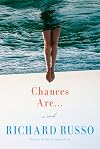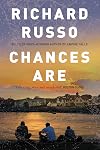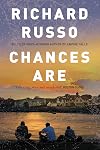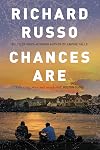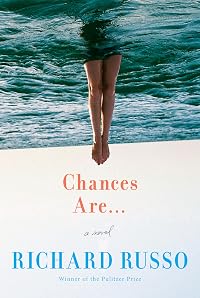
Chances Are…
by Richard Russo
On This Page
Description
"From the Pulitzer Prize-winning Richard Russo--in his first stand-alone novel in a decade--comes a new revelation: a gripping story about the abiding yet complex power of friendship. One beautiful September day, three sixty-six-year old men convene on Martha's Vineyard, friends ever since meeting in college circa the sixties. They couldn't have been more different then, or even today--Lincoln's a commercial real estate broker, Teddy a tiny-press publisher, and Mickey a musician beyond his show more rockin' age. But each man holds his own secrets, in addition to the monumental mystery that none of them has ever stopped puzzling over since a Memorial Day weekend right here on the Vineyard in 1971. Now, forty-four years later, as this new weekend unfolds, three lives and that of a significant other are displayed in their entirety while the distant past confounds the present like a relentless squall of surprise and discovery. Shot through with Russo's trademark comedy and humanity, Chances Are... also introduces a new level of suspense and menace that will quicken the reader's heartbeat throughout this absorbing saga of how friendship's bonds are every bit as constricting and rewarding as those of family or any other community. For both longtime fans and lucky newcomers, Chances Are... is a stunning demonstration of a highly acclaimed author deepening and expanding his remarkable achievement"-- show lessTags
Recommendations

Member Reviews
"We let people keep their secrets but then convince ourselves we know them anyway. Take Jacy. We all were in love with her,, but what did we really know about her? I'd never met anybody like her before, so I had no frame of reference. And if you think about it, she was in the same boat. We must've been as mysterious to her as she was to us." (171)
Three guys and a girl become fast friends during their time at a private eastern college in the early 1970's set against the backdrop of the Vietnam War. Jacy is the rich girl and Lincoln, Mickey, and Teddy all end up in an exclusive private school with her, but Jacy Has never wanted for anything and they are from different backgrounds and on scholarships. In fact, they earn their spending show more money by serving meals at Jacy's sorority house. Russo does an amazing job with male characters. He examines their backgrounds and motives in detail. Female characters are another story. In this case it doesn't matter because Jacy is a mystery character, an enigma that charms her friends and then suddenly disappears.
Forty years after college graduation, the three male friends have a reunion on Martha's Vineyard. Of course, Jacy's disappearance comes up. Russo is a gifted storyteller. While this is not his best work, it is a page-turner. Teddy makes an offhand remark early in the book saying Memory Lane is vastly overrated. I disagree. I'll walk down that lane any day with Mr. Russo as my guide. He simply can't write a bad book. show less
Three guys and a girl become fast friends during their time at a private eastern college in the early 1970's set against the backdrop of the Vietnam War. Jacy is the rich girl and Lincoln, Mickey, and Teddy all end up in an exclusive private school with her, but Jacy Has never wanted for anything and they are from different backgrounds and on scholarships. In fact, they earn their spending show more money by serving meals at Jacy's sorority house. Russo does an amazing job with male characters. He examines their backgrounds and motives in detail. Female characters are another story. In this case it doesn't matter because Jacy is a mystery character, an enigma that charms her friends and then suddenly disappears.
Forty years after college graduation, the three male friends have a reunion on Martha's Vineyard. Of course, Jacy's disappearance comes up. Russo is a gifted storyteller. While this is not his best work, it is a page-turner. Teddy makes an offhand remark early in the book saying Memory Lane is vastly overrated. I disagree. I'll walk down that lane any day with Mr. Russo as my guide. He simply can't write a bad book. show less
Lincoln, Teddy, and Mickey were fast friends during their college days in the 1960s. Now in their mid-60s, life has taken each of them in very different directions. As Lincoln prepares to sell a family vacation home in Martha’s Vineyard, he invites the men to join him for a long weekend “reunion.” Notably absent is Jacy, a woman every one of them was infatuated with in college, who disappeared without a trace after a similar weekend at the Cape shortly after graduation.
Each man comes to Martha's Vineyard with baggage. The most significant moment of their young lives was December 1, 1969: the night the Vietnam draft lottery was broadcast on national television. Mickey, with the lowest number, ultimately went to Canada to avoid show more military service; Teddy spent his life in academia but never found a clear sense of purpose; Lincoln was never at risk of going to Vietnam but is haunted by his father’s dogmatic presence and a sense of failure despite all outward appearances. The novel explores the turns their lives took after the lottery and the men they have become, while also slowly revealing Jacy’s story.
I most enjoyed the character studies in this novel, as well as Russo’s references to modern politics (the weekend reunion takes place in 2015). The mystery of Jacy’s disappearance was sometimes too dominant, and its resolution a little too pat but then this is supposed to be a novel about male friendships, not a “whodunnit.” It’s not a bad book, but it’s not Russo’s best either. show less
Each man comes to Martha's Vineyard with baggage. The most significant moment of their young lives was December 1, 1969: the night the Vietnam draft lottery was broadcast on national television. Mickey, with the lowest number, ultimately went to Canada to avoid show more military service; Teddy spent his life in academia but never found a clear sense of purpose; Lincoln was never at risk of going to Vietnam but is haunted by his father’s dogmatic presence and a sense of failure despite all outward appearances. The novel explores the turns their lives took after the lottery and the men they have become, while also slowly revealing Jacy’s story.
I most enjoyed the character studies in this novel, as well as Russo’s references to modern politics (the weekend reunion takes place in 2015). The mystery of Jacy’s disappearance was sometimes too dominant, and its resolution a little too pat but then this is supposed to be a novel about male friendships, not a “whodunnit.” It’s not a bad book, but it’s not Russo’s best either. show less
'Chances Are' is a book where I found myself admiring the craftsmanship of the storytelling and nodding in agreement with observations on the relationship between memory and truth, the consensual fictions that sustain friendships, the reality of growing old and the distance between who I am now and who I used to be, but without finding myself immersed in the story and caring about the lives of the people. It was as if I stood in the shallows, admiring the beauty of the incoming tide without ever diving in.
I wasn't surprised at the craftsmanship. 'Empire Falls' is one of my favourite books and Sully from 'Nobody's Fool' has taken up permanent residence in my imagination, becoming someone that my wife and I refer to in conversations as if show more he were someone we'd once known and still think of. That Richard Russo is describing in those books a world more alien to me than some of the Science Fiction that I read and yet still brings them to life demonstrates just how good a storyteller he is.
So I've been pondering on why 'Chances Are' isn't joining my list of books that I happily recommend to anyone who'll listen.
I ought to be the target audience for this book. I'm the same age as the three men who, in their sixties, are meeting for the first time in many years in a cabin where they spent a memorable summer together in their youth. And a lot of it rings true to me. I nodded at the descriptions of the small discomforts and indignities of growing old, at the way in which we fail to update the mental image we have of someone we knew decades ago. Even though we accept that we've changed and grown older, we don't apply this knowledge to them until confronted with the evidence and even then we filter what we see through the expectations of our memory, looking for what has stayed the same.
The book also has an interesting mystery which is displayed and resolved with consummate skill as Richard Russo moves effortlessly between the past and the present and overlays the conflicting memories of the participants.
So...?
I think it comes down to two things: firstly the way in which the mystery is delivered means we never get inside the head of Micky, who is the most interesting of the three men and secondly, one of the men whose head we do get inside is so blah that I don't know why he's there or why the other men were ever friends with him. It's not that I dislike him. He's not interesting enough to rouse dislike. He's just someone who seems to rolled through his life, gradually becoming more conservative and more privileged and who seems almost free of the curse of introspection beyond occasional annoyance and some concern about whether other people like him.
If Micky had been at the centre of this book, I'd have dived right in but joining in the mild angst of a realtor from Las Vegas who is much more privileged and much more conservative than he realises, didn't call to me. The most interesting thing about him was the woman he married and we never actually meet her.
'Chances Are' is still a well-above-average read, with some great prose, some interesting reflections and a good mystery in it. It just didn't match my very high expectations.
https://soundcloud.com/penguin-audio/chances-are-by-richard-russo show less
Three sixty-six-year-old men, Teddy, Lincoln, and Mickey, gather on Martha’s Vineyard for a reunion. They have been friends since their college years and spent Memorial Day weekend in the same house forty-four years ago, along with a fourth member of their group, Jacy, a young woman who disappeared afterward. Her unexplained disappearance has haunted each of the men over the years. During their reunion, they discuss what could have happened to her, and one of them pursues the issue with a local detective (now retired) who investigated the original case.
The first gathering took place during the Vietnam War, just after the Selective Service draft. Though they faced different outcomes (based on their draft numbers), they coped with show more their uncertain futures with the optimism of youth. The decades-later reunion portrays the men as seasoned by their life experiences. They are aging and life has not necessarily turned out the way they anticipated. The author excels at portraying the passage of time, particularly the idealistic dreams of youth and the belief that one can change the world. Looking back later, the men see themselves as falling short but still doing the best they can with what life has thrown their way.
This book is a literary mystery. The mystery of what happened to Jacy keeps the reader turning the pages, but it is not fast paced. The characters are deeply drawn and realistic. Each is depicted as a complex person with unique problems, experiences, and relationships, and the narrative delves into each person’s background. The tone is wistful. I found it an engrossing read and particularly enjoyed the ensemble of characters. I definitely plan to read more of Russo’s works. show less
The first gathering took place during the Vietnam War, just after the Selective Service draft. Though they faced different outcomes (based on their draft numbers), they coped with show more their uncertain futures with the optimism of youth. The decades-later reunion portrays the men as seasoned by their life experiences. They are aging and life has not necessarily turned out the way they anticipated. The author excels at portraying the passage of time, particularly the idealistic dreams of youth and the belief that one can change the world. Looking back later, the men see themselves as falling short but still doing the best they can with what life has thrown their way.
This book is a literary mystery. The mystery of what happened to Jacy keeps the reader turning the pages, but it is not fast paced. The characters are deeply drawn and realistic. Each is depicted as a complex person with unique problems, experiences, and relationships, and the narrative delves into each person’s background. The tone is wistful. I found it an engrossing read and particularly enjoyed the ensemble of characters. I definitely plan to read more of Russo’s works. show less
I know all these people, I know this generation, after all it is mine. I remember the night of the draft lottery and its destruction of so many friendships. Russo got so many of the details right, but the story left me wanting, wondering and feeling as if the unraveling was too perfect.
Richard Russo has one again thrown in a thought that left me reeling – “What can’t be true, isn’t, …. , no matter how much you want it to be.”
Richard Russo has one again thrown in a thought that left me reeling – “What can’t be true, isn’t, …. , no matter how much you want it to be.”
Russo has always been one of my favorite authors. Nobody's Fool, Empire Grill, Straight Man are some of my all time favorites. His newest novel Chances Are tells the story of three college buddies who used to work as hashers in a sorority house in a liberal arts college in the northeast. They watched in 1969 as their numbers were called for the draft and as one of them, Mickey, was number nine, meaning you're either going to Vietnam or Canada. Lincoln and Teddy, the main narrators of the story were more fortunate. All three are in love with a girl named Jacy who is out of their league but seems to enjoy their company. At the end of college when they all decide to spend one last weekend at Martha's Vineyard, Lincoln's family getaway, show more Jacy disappeared. Though it was assumed she was running out on a future wedding, her absence was never resolved. Now at 66, forty years later, the three musketeers return to that same summer house and hash out what has happened to their lives. Russo does a nice job with the descriptions of the aging friends, the choices they made and the realizations they have discovered. All three have interesting father figures who have factored into who they have become. " The thing to understand about your father... is that you always have a choice. You can do things his way, or you can wish you had."
As the novel turns a bit into a detective story, family secrets and rekindled animosities take over the narrative and maybe stray away from what Russo does best, but in all this is a pleasant read. The novel has a Big Chill feel to it.
Some lines:
The solid earth beneath his feet had turned to sand, and his parents, the two most familiar people in his life, into strangers. In time he would regain his footing, but he would never again entirely trust it.
By sixteen, sneaking into raunchy New Haven bars and sitting in with older guys whose girlfriends didn’t wear bras and seemed to enjoy revealing this fact by bending over in front of Mickey, who would later joke with Lincoln and Teddy that he had a hard-on for all of 1965.
Maybe this was the unstated purpose of education, to get young people to see the world through the tired eyes of age: disappointment and exhaustion and defeat masquerading as wisdom.
What made the contest between fate and free will so lopsided was that human beings invariably mistook one for the other, hurling themselves furiously against that which is fixed and immutable while ignoring the very things over which they actually had some control.
NYT
The suspense may carry you through the first half of the novel, but what works better is Russo’s depiction of his central characters, with their father issues and insecurities about class and money, their ingrained cluelessness about women and their need to present a certain image to the world, even if they’re pretty sure the world couldn’t care less.
Chances Are…” is, at heart, less a mystery than an evocation of what happens when you subscribe to “the peculiarly male conviction that silence conveyed one’s feelings better than anything else.” When Lincoln, Teddy and Mickey are finally forced to speak about those feelings, they discover that “the membrane separating sympathy from pity could be paper thin.” Is it possible the weekend will be, as Teddy wonders, “a misguided attempt to preserve something already lost”? show less
As the novel turns a bit into a detective story, family secrets and rekindled animosities take over the narrative and maybe stray away from what Russo does best, but in all this is a pleasant read. The novel has a Big Chill feel to it.
Some lines:
The solid earth beneath his feet had turned to sand, and his parents, the two most familiar people in his life, into strangers. In time he would regain his footing, but he would never again entirely trust it.
By sixteen, sneaking into raunchy New Haven bars and sitting in with older guys whose girlfriends didn’t wear bras and seemed to enjoy revealing this fact by bending over in front of Mickey, who would later joke with Lincoln and Teddy that he had a hard-on for all of 1965.
Maybe this was the unstated purpose of education, to get young people to see the world through the tired eyes of age: disappointment and exhaustion and defeat masquerading as wisdom.
What made the contest between fate and free will so lopsided was that human beings invariably mistook one for the other, hurling themselves furiously against that which is fixed and immutable while ignoring the very things over which they actually had some control.
NYT
The suspense may carry you through the first half of the novel, but what works better is Russo’s depiction of his central characters, with their father issues and insecurities about class and money, their ingrained cluelessness about women and their need to present a certain image to the world, even if they’re pretty sure the world couldn’t care less.
Chances Are…” is, at heart, less a mystery than an evocation of what happens when you subscribe to “the peculiarly male conviction that silence conveyed one’s feelings better than anything else.” When Lincoln, Teddy and Mickey are finally forced to speak about those feelings, they discover that “the membrane separating sympathy from pity could be paper thin.” Is it possible the weekend will be, as Teddy wonders, “a misguided attempt to preserve something already lost”? show less
Lincoln, Mickey and Teddy are from working-class backgrounds and have been friends since they first met, as scholarship students, at a Connecticut college in the late 1960s. Although very different in personality, they were initially drawn together when, to help finance their college years, they worked as “hashers” in the sorority house dining hall of Minerva College. Whilst there they met Jacy, a fellow student from a wealthy background who became an integral part of their friendship group, and with whom each of them fell head over heels in love. Although she was engaged to someone from the same social class as her family, she seemed to prefer spending time with them.
On 1st December 1969, midway through their college years, they show more spent the evening glued to a small black and white television in the sorority house, anxiously watching the first draft lottery. That was the evening the fates of approximately 850,000 young men would be decided, dependent on when their date of birth, contained in one of 366 capsules, would be drawn. Everyone wanted as high a number as possible because that would mean a low risk of being called up to serve in Vietnam but a low number meant an early call-up … or making the decision to avoiding that fate by fleeing to Canada. Although two of the young men are lucky enough to get a high enough number to make call-up unlikely, the third gets a very low one so he and his friends know that, as soon as he graduates, he is certain to be called up.
When they finally graduate in 1971 the three friends and Jacy, who is shortly due to get married, decide to spend the Memorial Day long-weekend together on Martha’s Vineyard, at the holiday house owned by Lincoln’s mother. They all enjoy this farewell weekend despite the tension generated by the knowledge that one of the three men will shortly be called up and that Jacy’s wedding was imminent. However, following that weekend Jacy was never seen again and nor was the mystery of her disappearance ever solved. Had one of the three killed her because he was about to lose her to another man? Had a disagreeable neighbour, whose advances she’d rejected, killed her? Or had she hitch-hiked when she left the island and been picked up by a murderer?
Fast-forward to 2015: all three men are sixty-six years old and had last got together ten years earlier. Their disparate personalities are reflected in the many ways in which their lives have taken very different paths:
one of them is a happily married family man who owns a commercial real estate business; another is a bachelor, a complex, introverted man who is a small-firm publisher and struggles with his mental health, and the third is rock musician who rides a motorbike and whose temper has a short fuse. As Lincoln is considering selling the holiday house he inherited when his mother died, the friends agree to meet there for a reunion. It very quickly becomes clear that in the intervening years each of them has remained obsessed with Jacy, and has puzzled over her disappearance. When they reflect on that long-lost weekend they realise that they need to solve the mystery of what happened to the girl none of them has ever stopped loving ... but what secrets and suspicions does each man hold, and will whatever they gradually share make them question how well they truly know one another?
As the timeline moves between past and present and with alternating chapters using the narrative voices of Lincoln and Teddy, a picture gradually emerges of all their backgrounds, the various experiences which have influenced the ways in which they’ve lived their lives, shaped their decision-making, forged their enduring friendship and made them the men they are today. Although Mickey’s narrative voice isn’t heard until two thirds of the way through the book, his story is told through the reminiscences of Lincoln and Teddy, meaning that he is always as “present” in the developing story as they are. Each of the characters feels that the direction his life took after graduating was, in any ways, predicated by the result of the draft lottery and I found their various reflections on this to be very thought-provoking, partly because philosophising on life-choices, on pivotal moments and “roads not taken” during our lives is a tempting self-indulgence for most of us.
Almost immediately I felt completely caught up in the lives of these characters as they struggled to be open with one another, as they faced up to their regrets and remorse, their guilt and their shame, their reflections on how contented, or otherwise, they are with the decisions they have made and the people they have become, as well as with their hopes and expectations for the future. The mystery of what happened to Jacy was a central theme and I felt that the author managed the tension and suspense generated by this in a tightly-controlled way and although I found that the final resolution did require a degree of incredulity, this didn’t detract from my overall satisfaction with the outcome! In addition to creating such credible characters, the author conveyed an impressive sense of time and place, particularly with his evocations of the early 1970s, the influence of the Vietnam war, the music, the drug-culture and the massive social and political changes which were taking place at that time.
This is an elegantly-written, powerful and memorable story, embracing many thought-provoking themes, particularly ones about masculinity, the nature of male friendships, the power of unrequited love, the complexities of family relationships, especially those between fathers and sons, an insidious working-class insecurity which harbours self-doubt, the reverberating effects of the choices people make at various times in their lives, reflections on fate versus freewill and the challenges of aging.
This is the first novel I’ve read by this author but, if Richard Russo’s acute observations of people and their milieu, the essential humanity he brings to his characters, his wry sense of humour and his ironic reflections on life are trademarks of his writing style, I’m sure that I’ll now enjoy working my way through his backlist!
One final reflection … when Mickey invites Lincoln to stay with him after the weekend he offers him the use of his pull-out sofa saying, “the dog won’t like it, but his affection and forgiveness can usually be bought with chocolate.” Would the author please tell Mickey to find another treat for his dog because chocolate can be dangerous, possibly even lethal, for dogs! show less
On 1st December 1969, midway through their college years, they show more spent the evening glued to a small black and white television in the sorority house, anxiously watching the first draft lottery. That was the evening the fates of approximately 850,000 young men would be decided, dependent on when their date of birth, contained in one of 366 capsules, would be drawn. Everyone wanted as high a number as possible because that would mean a low risk of being called up to serve in Vietnam but a low number meant an early call-up … or making the decision to avoiding that fate by fleeing to Canada. Although two of the young men are lucky enough to get a high enough number to make call-up unlikely, the third gets a very low one so he and his friends know that, as soon as he graduates, he is certain to be called up.
When they finally graduate in 1971 the three friends and Jacy, who is shortly due to get married, decide to spend the Memorial Day long-weekend together on Martha’s Vineyard, at the holiday house owned by Lincoln’s mother. They all enjoy this farewell weekend despite the tension generated by the knowledge that one of the three men will shortly be called up and that Jacy’s wedding was imminent. However, following that weekend Jacy was never seen again and nor was the mystery of her disappearance ever solved. Had one of the three killed her because he was about to lose her to another man? Had a disagreeable neighbour, whose advances she’d rejected, killed her? Or had she hitch-hiked when she left the island and been picked up by a murderer?
Fast-forward to 2015: all three men are sixty-six years old and had last got together ten years earlier. Their disparate personalities are reflected in the many ways in which their lives have taken very different paths:
one of them is a happily married family man who owns a commercial real estate business; another is a bachelor, a complex, introverted man who is a small-firm publisher and struggles with his mental health, and the third is rock musician who rides a motorbike and whose temper has a short fuse. As Lincoln is considering selling the holiday house he inherited when his mother died, the friends agree to meet there for a reunion. It very quickly becomes clear that in the intervening years each of them has remained obsessed with Jacy, and has puzzled over her disappearance. When they reflect on that long-lost weekend they realise that they need to solve the mystery of what happened to the girl none of them has ever stopped loving ... but what secrets and suspicions does each man hold, and will whatever they gradually share make them question how well they truly know one another?
As the timeline moves between past and present and with alternating chapters using the narrative voices of Lincoln and Teddy, a picture gradually emerges of all their backgrounds, the various experiences which have influenced the ways in which they’ve lived their lives, shaped their decision-making, forged their enduring friendship and made them the men they are today. Although Mickey’s narrative voice isn’t heard until two thirds of the way through the book, his story is told through the reminiscences of Lincoln and Teddy, meaning that he is always as “present” in the developing story as they are. Each of the characters feels that the direction his life took after graduating was, in any ways, predicated by the result of the draft lottery and I found their various reflections on this to be very thought-provoking, partly because philosophising on life-choices, on pivotal moments and “roads not taken” during our lives is a tempting self-indulgence for most of us.
Almost immediately I felt completely caught up in the lives of these characters as they struggled to be open with one another, as they faced up to their regrets and remorse, their guilt and their shame, their reflections on how contented, or otherwise, they are with the decisions they have made and the people they have become, as well as with their hopes and expectations for the future. The mystery of what happened to Jacy was a central theme and I felt that the author managed the tension and suspense generated by this in a tightly-controlled way and although I found that the final resolution did require a degree of incredulity, this didn’t detract from my overall satisfaction with the outcome! In addition to creating such credible characters, the author conveyed an impressive sense of time and place, particularly with his evocations of the early 1970s, the influence of the Vietnam war, the music, the drug-culture and the massive social and political changes which were taking place at that time.
This is an elegantly-written, powerful and memorable story, embracing many thought-provoking themes, particularly ones about masculinity, the nature of male friendships, the power of unrequited love, the complexities of family relationships, especially those between fathers and sons, an insidious working-class insecurity which harbours self-doubt, the reverberating effects of the choices people make at various times in their lives, reflections on fate versus freewill and the challenges of aging.
This is the first novel I’ve read by this author but, if Richard Russo’s acute observations of people and their milieu, the essential humanity he brings to his characters, his wry sense of humour and his ironic reflections on life are trademarks of his writing style, I’m sure that I’ll now enjoy working my way through his backlist!
One final reflection … when Mickey invites Lincoln to stay with him after the weekend he offers him the use of his pull-out sofa saying, “the dog won’t like it, but his affection and forgiveness can usually be bought with chocolate.” Would the author please tell Mickey to find another treat for his dog because chocolate can be dangerous, possibly even lethal, for dogs! show less
Members
- Recently Added By
Lists

Top Five Books of 2019
387 works; 108 members

Five star books
1,757 works; 108 members

Books Read in 2020
4,379 works; 123 members

Books Read in 2022
5,166 works; 114 members

Books Read in 2019
4,052 works; 110 members

To Read
617 works; 7 members
Author Information

36+ Works 29,045 Members
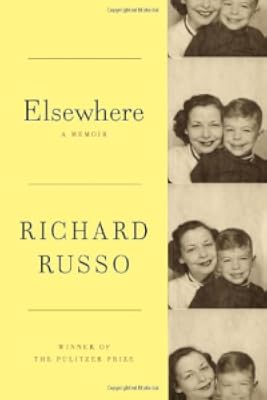
Richard Russo was born in Johnstown, New York on July 15, 1949. He received a Bachelor's degree, a Master of Fine Arts degree, and a Doctor of Philosophy degree from the University of Arizona. He taught at numerous colleges including Southern Illinois University Carbondale and Colby College. He has written numerous books including Mokawk, The Risk show more Pool, Straight Man, Bridge of Sighs, and That Old Cape Magic, as well as a short story collection, The Whore's Child. His novel Empire Falls won the 2002 Pulitzer Prize for Fiction and Nobody's Fool was made into a movie starring Paul Newman, Bruce Willis and Melanie Griffith. His memoir was entitled Elsewhere. He also co-wrote the 1998 film Twilight with director Robert Benton and the teleplay for the HBO adaptation of Empire Falls. (Bowker Author Biography) Richard Russo lives in coastal Maine with his wife & two daughters. (Publisher Fact Sheets) show less
Some Editions
Awards and Honors
Distinctions
The Guardian Book of the Day (2019-12-26)
Series
Belongs to Publisher Series
dumont taschenbücher (6579)
Common Knowledge
- Canonical title
- Chances Are…
- Original publication date
- 2019
- People/Characters
- Lincoln Moser; Teddy Novak; Michael "Mickey" Girardi; Justine "Jacy" Calloway; Anita Moser; Mason Troyer (show all 19); Trudy Moser; Wolfgang Amadeus (W. A.) Moser (W. A.); Joe Coffin; Beverly; Theresa Whittier; Martin; Vance; Donald Calloway; Delia; Vivian Calloway; Michael Girardi, Sr.; Andres "Andy" Demopoules; Tom Ford
- Important places
- Minerva College, Connecticut, USA; Dunbar, Arizona, USA; Las Vegas, Nevada, USA; Syracuse, New York, USA; West Haven, Connecticut, USA; Chilmark, Martha's Vineyard, Cape Cod, Massachusetts, USA (show all 8); Greenwich, Connecticut, USA; Canada
- Epigraph
- For a second there we won.
Yeah, we were innocent and young.
"Miss Atomic Bomb," The Killers - Dedication
- For those whose names are on the wall
- First words
- The three old friends arrived on the island in reverse order, from farthest to nearest: Lincoln, a commercial real estate broker, practically cross-country from Las Vegas; Teddy, a small-press publisher, from Syracuse; Mickey... (show all), a musician and sound engineer, from nearby Cape Cod.
- Quotations
- Because yank out one thread from the fabric of human destiny, and everything unravels. Though it could also be said that things have a tendency to unravel regardless.
The deeper and longer something remained buried, the more power it had when it finally rose to the surface.
What you can't afford to lose is precisely what the world robs you of. How it knew what you needed the most , just so it could deny you that very thing, was a question for the philosophers.
"The thing to understand about your father... is that you always have a choice. You can do things his way, or you can wish you had."
What can't be true, isn't...no matter how much you want it to be.
Why hadn't it occurred to him that asking questions about the past might disturb the present, that in the end he might want to unlearn what he'd found out?
What made the contest between fate and free will so lopsided was that human beings invariably mistook one for the other, hurling themselves furiously against that which is fixed and immutable while ignoring the very things ov... (show all)er which they actually had some control. - Last words
- (Click to show. Warning: May contain spoilers.)But it could be he was wrong.
Classifications
Statistics
- Members
- 955
- Popularity
- 27,725
- Reviews
- 65
- Rating
- (3.84)
- Languages
- 7 — Danish, Dutch, English, French, German, Italian, Korean
- Media
- Paper, Audiobook, Ebook
- ISBNs
- 31
- ASINs
- 9