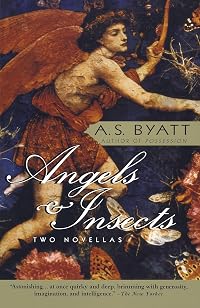
Angels & Insects
by A. S. Byatt
On This Page
Description
These two fascinating novellas, like A.S. Byatt's Booker Prize-winning novel Possession, are set in the mid-nineteenth century, weaving fact and fiction, reality and romance. "Morpho Eugenia" is a lively Gothic fable of the Earthly Paradise, of the Victorian obsession with Darwinian theories of breeding and sexuality and the parallels between insect and human society - the capture and taming of nature, whether it be a young woman in a country house or a rare butterfly, gleaming in the show more forests of the Amazon. "The Conjugial Angel" concerns Tennyson's In Memoriam, published in 1850, mourning the death seventeen years before of his friend Arthur Henry Hallam, who was engaged to Tennyson's sister Emily. A philosophical ghost story, bizarre, comic, and moving, in which fictive mediums meet "real" characters, it explores the contemporary preoccupation with God and life after death. Resonant, magical, entirely original, this is A.S. Byatt at her best. show lessTags
Recommendations








Member Recommendations
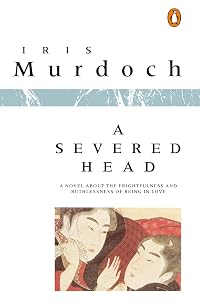
lisanicholas Although it develops different themes than Byatt's Morpho Eugenia (the "insects" novella in Angels & Insects), like Byatt's work Waugh's A Handful of Dust also deals with the bestial crudity that can lie under the veneer of conventional English gentility.
21
Member Reviews
Angels and Insects — Two resplendent novellas as my foray into Byatt’s work. Both stories (Morpho Eugenia and The Conjugial Angel) concern man’s obsessive effort to validate his authority within the cosmos, whether that effort be authoritarian (ie. the Alabasters in Morpho) or grief-stricken (ie. our eccentric round-table in Conjugal Angel) in nature. Ultimately, these loosely tales are bound by an infatuation with the invisible world, angels and insects, as a source of explanation for man’s own mysteriously enduring lives. Darwin is the prominent figure driving their very gothic, very Victorian anxiety surrounding an infinitely random and incomprehensible world. Milton plays Darwin’s divine foil, further fueling the fire of show more disillusionment and grief. Despite the stories’ twists and turns, hope ultimately prevails, proving that there is always something unaccounted for in our reasoning, even as we delude ourselves into thinking we are masters of our own pain.
Though I struggle to choose a favorite of the two, I must admit that Morpho Eugenia’s uncanny eroticism has singularly troubled my thoughts for the past week. Briefly, it is about a Victorian naturalist, William Adamson (the name is a little obvious but moving along), who survives a devastating shipwreck returning from field work in the Amazon and finds refuge as aristocrat Harald Alabaster’s live-in taxonomist. At the sprawling Alabaster estate, he falls in love with Harald’s vacantly gorgeous daughter, Eugenia, and weds her, much to the chagrin of her haughty brother and Matty Compton, the governess (?) to the estate’s inordinate amount of ivory-down offspring. William has achieved divine matrimonial bliss, until it is not bliss, and as the reader discovers, it is horror. Without giving too much away, the story asks: Is the grandeur of man’s loves and pains and desires, from a distance, just the squirming efforts of tiny automaton creatures? William’s desire for Eugenia is inexorable because he seeks to possess a life that is necessarily distant, vapid, a perfect shell — yet, once inside the shell, he sees the decay, the indifference, the Alabasterian dogma of flesh and its consumption; William, ant-like, is reduced to an analogy himself. Meanwhile, Matty stands in the periphery of this swarming estate. She refuses to let her labor for the Alabaster’s be categorized and discarded. Matty is one of the most brilliant female characters I have read in fiction: she is textured and abrasive and surprisingly playful. Her beauty dwells both in her intellect and dignity, the exact antithesis of Eugenia’s inscrutable helplessness (though, after finishing the story, I have deep empathy for her anguish). As William’s marital live expeditiously decays, Matty’s role in the narrative is foregrounded, and the story begins to take on a metatextual element; excerpts of Matty and William’s scientific writing, as well as Matty’s own glorious anthropermorphic fables, interrupt the events allowing us readers to become naturalists ourselves, attempting to delineate truth in an overgrowth of lies (Things Are Not What They Seem!!). The ending, especially that final dramatic scene, is so deeply satisfying and rewards us for following along with all the lengthy academic and religious digressions.
The Conjugal Angel, on the other hand, is an arguably more lovely and pleasant story, though possessed (pun intended) of its own inconsolable darkness. I would also argue that the cast of characters here makes the story: each is quirky and fallible and utterly delightful. You truly find something to love in them all (for the most part). Our main character is Lilias Papagay, a widowed medium, and Sophie Sheehky, her young spiritualist boarder and friend. They arrive at Captain Jesse’s house for a weekly seance at the behest of his wife Emily, who we come to learn is Alfred Lord Tennyson’s sister and the widow to his beloved friend Arthur, dedicatee of Alfred’s seminal In Memoriam. This story is far less plot-driven, and though we come to understand each attendee's motives for communing with the spirit world, the heart of the story resides in the rich interior lives of each character as they ruminate over their grief and longing. There is also a very generous, if not even more generous, helping of intertextual poetry and digressions on divine love, biblical scripture, and Milton (of course). Though I found the lack of sumptuous eroticism to leave me a bit wanting, insight into the life of the Tennysons was captivating, and Byatt’s analysis of the poetry is spot on. And that ENDING!! A perfect way to close the duet.
Byatt writes with a lofty decadence that never neglects her characters and their inner lives. She somehow captures the intricacy of the mind, body, and spirit without losing us in any one direction. She is also clearly a total nerd, as am I. And I must insist, after reading this, one watches the 1995 adaptation of Morpho Eugenia (called Angels and Insects) — one of the most faithful book-to-screen adaptations I’ve ever seen, made all the better by Mark Rylance’s and Kristin Scott Thomas’ superb performances.
Byatt — I’m coming for you (your books, I mean!) show less
Though I struggle to choose a favorite of the two, I must admit that Morpho Eugenia’s uncanny eroticism has singularly troubled my thoughts for the past week. Briefly, it is about a Victorian naturalist, William Adamson (the name is a little obvious but moving along), who survives a devastating shipwreck returning from field work in the Amazon and finds refuge as aristocrat Harald Alabaster’s live-in taxonomist. At the sprawling Alabaster estate, he falls in love with Harald’s vacantly gorgeous daughter, Eugenia, and weds her, much to the chagrin of her haughty brother and Matty Compton, the governess (?) to the estate’s inordinate amount of ivory-down offspring. William has achieved divine matrimonial bliss, until it is not bliss, and as the reader discovers, it is horror. Without giving too much away, the story asks: Is the grandeur of man’s loves and pains and desires, from a distance, just the squirming efforts of tiny automaton creatures? William’s desire for Eugenia is inexorable because he seeks to possess a life that is necessarily distant, vapid, a perfect shell — yet, once inside the shell, he sees the decay, the indifference, the Alabasterian dogma of flesh and its consumption; William, ant-like, is reduced to an analogy himself. Meanwhile, Matty stands in the periphery of this swarming estate. She refuses to let her labor for the Alabaster’s be categorized and discarded. Matty is one of the most brilliant female characters I have read in fiction: she is textured and abrasive and surprisingly playful. Her beauty dwells both in her intellect and dignity, the exact antithesis of Eugenia’s inscrutable helplessness (though, after finishing the story, I have deep empathy for her anguish). As William’s marital live expeditiously decays, Matty’s role in the narrative is foregrounded, and the story begins to take on a metatextual element; excerpts of Matty and William’s scientific writing, as well as Matty’s own glorious anthropermorphic fables, interrupt the events allowing us readers to become naturalists ourselves, attempting to delineate truth in an overgrowth of lies (Things Are Not What They Seem!!). The ending, especially that final dramatic scene, is so deeply satisfying and rewards us for following along with all the lengthy academic and religious digressions.
The Conjugal Angel, on the other hand, is an arguably more lovely and pleasant story, though possessed (pun intended) of its own inconsolable darkness. I would also argue that the cast of characters here makes the story: each is quirky and fallible and utterly delightful. You truly find something to love in them all (for the most part). Our main character is Lilias Papagay, a widowed medium, and Sophie Sheehky, her young spiritualist boarder and friend. They arrive at Captain Jesse’s house for a weekly seance at the behest of his wife Emily, who we come to learn is Alfred Lord Tennyson’s sister and the widow to his beloved friend Arthur, dedicatee of Alfred’s seminal In Memoriam. This story is far less plot-driven, and though we come to understand each attendee's motives for communing with the spirit world, the heart of the story resides in the rich interior lives of each character as they ruminate over their grief and longing. There is also a very generous, if not even more generous, helping of intertextual poetry and digressions on divine love, biblical scripture, and Milton (of course). Though I found the lack of sumptuous eroticism to leave me a bit wanting, insight into the life of the Tennysons was captivating, and Byatt’s analysis of the poetry is spot on. And that ENDING!! A perfect way to close the duet.
Byatt writes with a lofty decadence that never neglects her characters and their inner lives. She somehow captures the intricacy of the mind, body, and spirit without losing us in any one direction. She is also clearly a total nerd, as am I. And I must insist, after reading this, one watches the 1995 adaptation of Morpho Eugenia (called Angels and Insects) — one of the most faithful book-to-screen adaptations I’ve ever seen, made all the better by Mark Rylance’s and Kristin Scott Thomas’ superb performances.
Byatt — I’m coming for you (your books, I mean!) show less
Two novellas by A.S. Byatt, the author of a particular favorite book of mine, Possession. Both stories share some commonalties with that work: an historical setting made real through the use of documents (poems, stories) that signify the date of their creation by their style. Both stories are set in the past, near the turn of the 19th century. “Morpho Eugenia” (the insects of the title) is a little mystery story about a naturalist who has lost all of his specimens during a sea-wreck and is forced to work as a catalogist for a wealthy amateur, working through the amateur’s bought samples. The naturalist is loosely based, it seems, on Alfred David Wallace, the co-discoverer of the theory of natural selection with Charles Darwin. He show more finds that his patron’s family is nearly as interesting as nature, especially one young lady cocooned from the world. But cocoons hide things.
The second story is more like Possession in that it plays revisionistic (or maybe impressionistic) with Alfred, Lord Tennyson, and his sister Emily through the medium of a medium (that is, a clairvoyant). The point around which the story revolves is Arthur Hallem, the subject of Tennyson’s “In Memoriam,” a friend of his youth and the betrothed of his sister, who died on a sea voyage when Hallem was twenty-two. Emily, now married, has lingering doubts about her choice of marriage, wondering, if she should have, as her brother’s poem snidely implies, spent her days in perpetual maidenhood. Are we destined to have only one soul mate, the other being with which we form ‘the conjugal angel’?
Byatt’s style is Byzantine. Her scholarship into literary history has informed her pen to leak the century from its nib, and is not for those married to modernity. Yet her subjects are fresh and vibrant, pictured with painful clarity in the harshest of lights. Her characters ache in-between the lines. show less
The second story is more like Possession in that it plays revisionistic (or maybe impressionistic) with Alfred, Lord Tennyson, and his sister Emily through the medium of a medium (that is, a clairvoyant). The point around which the story revolves is Arthur Hallem, the subject of Tennyson’s “In Memoriam,” a friend of his youth and the betrothed of his sister, who died on a sea voyage when Hallem was twenty-two. Emily, now married, has lingering doubts about her choice of marriage, wondering, if she should have, as her brother’s poem snidely implies, spent her days in perpetual maidenhood. Are we destined to have only one soul mate, the other being with which we form ‘the conjugal angel’?
Byatt’s style is Byzantine. Her scholarship into literary history has informed her pen to leak the century from its nib, and is not for those married to modernity. Yet her subjects are fresh and vibrant, pictured with painful clarity in the harshest of lights. Her characters ache in-between the lines. show less
This was an unread book that has been lurking on my bookshelves for about 25 years. It would have been bought in a charity shop (the pencilled in price on one of the front-piece pages gives the game away) after I had read and enjoyed Byatt's previous book: the much admired Possession published in 1990. This book published two years later is in fact two novellas both classified in the genre historiographic metafiction or in more simple words; in the same style as Possession. The reader is therefore plunged back into a Victorian Britain where Byatt introduces characters who mix with or are inspired by historical figures most commonly from the literary world. I was a little skeptical as to whether I would enjoy the reading experience of show more books written in such a similar fashion, but I needn't have worried both Morpho Eugenia and The Conjugial Angel work their magic despite their "Hollywood Endings."
Morpho Eugenia is the most straightforward of the two novellas in that the completely fictionalised characters operate amongst a background of historical figures. William Adamson has returned from a ten year exploratory trip to the Amazon basin and survived a shipwreck where most of his worldly goods have been destroyed. He had managed to save a couple of extremely rare mounted butterflies and had been welcomed into the rich family of the Alabasters, where Harald as the head of the family invites him to stay to teach his children about the natural world and help him with a book he is in the process of writing. William Adamson falls in love with Eugenia: Alabasters eldest daughter, but dare not approach her because of his lowly social rank and lack of money. Adamson begins a study of the local ant population in an attempt to fine tune his skill as a naturalist, he is encouraged by Matty Crompton who sees the publication of a book as a way out of their financial dependency on the Alabasters. The story takes shape as a romance with many allusions to the workings of the ant colonies that exist in parallel to the numerous staff employed in looking after the Alabaster family. Byatt skilfully draws the reader into the life of the Alabaster household and gives a lecture on the social life of ants at the same time.
While I was entertained by Morpho Eugenia I found the second novella; The Conjugial Angel much more interesting. Here Byatt successfully introduces her characters into the lives of the poet Alfred Tennyson and his family, while also seamlessly providing a mini critique of the poetry. We are in the world of the Victorians enthusiasm for seances as a means of contacting the dead. A medium Sophy Sheekhy and her friend Lilias Papagay arrive at the house of Captain Jess for an arranged seance. Captain Jess's wife Emily is the sister of Alfred Tennyson and she was engaged previously to Arthur Hallam who was also a very close friend of the poet. Arthur died young at 22 and Alfred mourned his death for a number of years and wrote one of his most successful poems "In Memoriam" to the young man who had made such an impression on him. Mrs Emily Jess is hoping that the seance will enable her to communicate with Arthur beyond the grave and Lilias Papagay is also wishing to find out the truth of her husband reported missing at sea some ten years previously. Many prominent Victorians were serious in imagining that they could receive messages from the dead with the aid of a medium and Byatt describes the seance with due reverence to her subject. The seance also allows her to read between the lines of Tennyson famous poem and imagine the relationship between the poet his sister and the handsome young Arthur:
"Alfred had taken Arthur and bound him to himself, blood to blood and bone to bone, leaving no room for her. It was true that late in the poem, reference was made to her love and her loss, but that too was painful, most painful. Alfred had allowed his fantasy to imagine Arthur's future, Arthur's children, Alfreds nephews and nieces , mixing their blood."
Of course there has been speculation about the nature of Alfred and Arthurs relationship: was it a love affair, was it requited? If the example of Byatt's prose sounds a bit like something D H Lawrence might have written then it gets even more so when she speculates about a homosexual relationship.
So from reading theses two novels I have learned more that I need to about ants and have become interested in the thoughts and feelings that inspired one of Tennyson's famous poems. Byatt just about stops short of giving a lecture on either subject and I can forgive her this because of her brilliant evocations of life in Victorian Britain. She tells good stories, romantic stories that fit well with the lives of the characters both historical and imaginary and if she does sound a bit like D H Lawrence in places; well there is nothing wrong with that. When I take down a long unread book from my shelves to read then at the end the decision is: either to put it back on the shelves or put it in the charity book box. This one went back on the shelves and so 4 stars. show less
Morpho Eugenia is the most straightforward of the two novellas in that the completely fictionalised characters operate amongst a background of historical figures. William Adamson has returned from a ten year exploratory trip to the Amazon basin and survived a shipwreck where most of his worldly goods have been destroyed. He had managed to save a couple of extremely rare mounted butterflies and had been welcomed into the rich family of the Alabasters, where Harald as the head of the family invites him to stay to teach his children about the natural world and help him with a book he is in the process of writing. William Adamson falls in love with Eugenia: Alabasters eldest daughter, but dare not approach her because of his lowly social rank and lack of money. Adamson begins a study of the local ant population in an attempt to fine tune his skill as a naturalist, he is encouraged by Matty Crompton who sees the publication of a book as a way out of their financial dependency on the Alabasters. The story takes shape as a romance with many allusions to the workings of the ant colonies that exist in parallel to the numerous staff employed in looking after the Alabaster family. Byatt skilfully draws the reader into the life of the Alabaster household and gives a lecture on the social life of ants at the same time.
While I was entertained by Morpho Eugenia I found the second novella; The Conjugial Angel much more interesting. Here Byatt successfully introduces her characters into the lives of the poet Alfred Tennyson and his family, while also seamlessly providing a mini critique of the poetry. We are in the world of the Victorians enthusiasm for seances as a means of contacting the dead. A medium Sophy Sheekhy and her friend Lilias Papagay arrive at the house of Captain Jess for an arranged seance. Captain Jess's wife Emily is the sister of Alfred Tennyson and she was engaged previously to Arthur Hallam who was also a very close friend of the poet. Arthur died young at 22 and Alfred mourned his death for a number of years and wrote one of his most successful poems "In Memoriam" to the young man who had made such an impression on him. Mrs Emily Jess is hoping that the seance will enable her to communicate with Arthur beyond the grave and Lilias Papagay is also wishing to find out the truth of her husband reported missing at sea some ten years previously. Many prominent Victorians were serious in imagining that they could receive messages from the dead with the aid of a medium and Byatt describes the seance with due reverence to her subject. The seance also allows her to read between the lines of Tennyson famous poem and imagine the relationship between the poet his sister and the handsome young Arthur:
"Alfred had taken Arthur and bound him to himself, blood to blood and bone to bone, leaving no room for her. It was true that late in the poem, reference was made to her love and her loss, but that too was painful, most painful. Alfred had allowed his fantasy to imagine Arthur's future, Arthur's children, Alfreds nephews and nieces , mixing their blood."
Of course there has been speculation about the nature of Alfred and Arthurs relationship: was it a love affair, was it requited? If the example of Byatt's prose sounds a bit like something D H Lawrence might have written then it gets even more so when she speculates about a homosexual relationship.
So from reading theses two novels I have learned more that I need to about ants and have become interested in the thoughts and feelings that inspired one of Tennyson's famous poems. Byatt just about stops short of giving a lecture on either subject and I can forgive her this because of her brilliant evocations of life in Victorian Britain. She tells good stories, romantic stories that fit well with the lives of the characters both historical and imaginary and if she does sound a bit like D H Lawrence in places; well there is nothing wrong with that. When I take down a long unread book from my shelves to read then at the end the decision is: either to put it back on the shelves or put it in the charity book box. This one went back on the shelves and so 4 stars. show less
I find I have contradictory feelings for Byatt's fiction: I strongly admire what she writes, for its stimulating ideas, its in-depth research, its clever structuring and its examination of human nature; but I can't say that I love the handful of her novels that I've read. It's not that they seem preponderantly intellectual -- I don't think that's necessarily a turn-off -- but rather that I don't always believe in, let alone warm to, the characters she depicts.
That certainly is the case with Angels & Insects, a pair of loosely-linked novellas set in the 19th century and infused with some of the obsessions that characterised that age. 'Morpho Eugenia' and 'The Conjugial Angel' deal respectively with the Victorian urge to explore and show more catalogue that gave rise to that era's expansion of knowledge and understanding in the biological sciences and, in an opposite direction, a rush towards spiritualism, séances and beliefs in otherworldly beings. Along the way we encounter lonely individuals ensconced in the bosom of family or among companions, taboos broken in the midst of Christian communities, grief and loss suffered in comfortable surroundings. Readers may feel sympathy for those who suffer in such circumstances but I wonder whether they really know or even care about them?
'Morpho Eugenia' is centred on William Adamson who, after a decade in the Amazon jungle and a disastrous shipwreck, finds himself in the early 1860s cataloguing specimens at the country pile of the Alabaster family. Here he falls in love with Eugenia, one of the daughters of his patron, eventually marrying her. For various reasons -- some defined, others less so -- he's not entirely happy, but he manages to find a kindred mind in the family tutor Matty Crompton. The end of the novella finds him on board Captain Arturo Papagay's ship sailing back over the Atlantic to his beloved Amazon, a happy conclusion of sorts. Adamson deserves to be happy, we feel, but he's a bit of a cold fish -- for all that he's infatuated with Eugenia -- for much of the novel.
'The Conjugial Angel' is set in Margate a few years after 'Morpho Eugenia', in 1875. Here we meet a circle of spiritualists loosely united by Swedenborgian beliefs: Mrs Lilias Papagay, Sophy Sheekhy, Job Hawke, Mrs Hearnshaw, Captain Richard Jesse and Mrs Emily Jesse (née Tennyson). Most of the novella seems to be concerned with the group's belief in angels and with examining one by one their beliefs and concerns. It's not until towards the end that this rambling narrative -- in which little apparently happens -- starts to take shape as closure beckons for one or two of the participants. I found that I felt sorry for the leading participants -- Emily Jesse in particular, but also Lilias Papagay and to some extent Sophy Sheekhy -- but didn't exactly warm to them.
You can see that the bipartite novel Angels and Insects takes its cue from overarching themes in the two novellas. You will also note that both types of the titular creatures are winged. Byatt, as many another author is so tempted, binds her narratives in a web of associative words. In the first story (the second, incidentally, to be written) winged insects -- moths, butterflies, bees and, for a brief moment in summer, ants too -- populate the novel. Morpho Eugenia, a genuine butterfly species, is what William Adamson imagines his bride to be (pretty and, as it turns out, flighty) and he spends a good deal of time logging the activities of the estate's colonies of social insects. The metaphor of Eugenia's resemblance to a breeding insect queen -- Eugenia means 'well-born -- and her allegiance to the Alabaster family -- cold, unfeeling landed gentry, a hive mentality rendering them faithful only to their own -- make it clear that William (and Matty too) doesn't belong to this closed world. William's surname of Adamson underlines the aptness of his decision to return to the primeval Eden of the Amazon forest where, like a second Adam, he can continue to give 'names to all cattle, and to the fowl of the air, and to every beast of the field.'
In the second story the principal winged creatures are clearly the angels, though their nature is not imagined consistently by every character, whether intellectually by Mr Hawke or in a trance state by Sophy Sheekhy. But there are other feathered animals in evidence, from Mrs Jesse's pet raven Aaron to her experiencing dizziness 'as though a cloud of wings beat about her head' or imagining herself pregnant 'like a female Prometheus whose liver was regularly ripped at by a huge, rapacious dark bird'. And we cannot help but note that three of the principals have bird-related names: Mr Hawke most obviously but also Mrs Hearnshaw (the surname Earnshaw or Hearnshaw derives from an Old English compound meaning 'eagle's nook' or similar), and of course there's Mrs Papagay, related to popinjay, an alternative name for a parrot.
It is Mrs Papagay who provides the link with the first tale through her sea captain husband -- missing at sea and presumed drowned. She and her companion, Sophy Sheekhy (from the Greek for 'wise' and the Gaelic sítheach ‘other worldly’) are the two genuine sensitives in the group, one able to receive messages from the dead, the other seeing what the others do not. Mrs Papagay, like the others, is desperate to get communications from loved ones in the group, but her Arturo is strangely absent. Mrs Hearnshaw wants to encounter her lost children, either stillborn or miscarried; Emily Jesse, the sister of Alfred Tennyson, desperately waits to hear from her dead love, Arthur Hallam, for whom her brother wrote In Memoriam. If the ties that bind the group together seem to be loosening in the course of the story, it is Mrs Papagay final encounter that provides the emotional punch to the story, much as William's admiration of the family tutor Matty leads to a kind of resolution for the first tale.
'Morpho Eugenia' is often regarded as the more effective of the two novellas, but I grew to prefer 'The Conjugial Angel'. I didn't warm to the vapid William, more observant of the natural world than of the foibles of human nature, but I did engage more with the cast of characters in the seaside town. I enjoyed Byatt's turns of phrase: Mrs Papagay 'had a warm heart, like a comfortable brown thrush in a soft nest;' she wondered whether 'men were no better than creepy-crawlies, no better than butterflies and blowflies'; Mrs Jesse 'encased herself in her private aura of mixed eccentricity, lingering tragedy, and finicking attention to [her pets] Pug and Aaron'. And Byatt's extensive quoting from In Memoriam anchors her tale in a historical reality that makes one ponder how much may be purely imaginative.
Both tales have an air of melancholia, shot through with occasional moments of optimism and happiness. As Robert Louis Stevenson has it, in another context, 'Home is the sailor, home from the sea,' lines that sprang to my mind when finishing each of the novellas and which suggest both homecoming and quietus.
Perhaps this is my lasting impression of Angels & Insects: Byatt is a species of entomologist, observing her subjects in their native environment, seemingly detached and dispassionate in her descriptions; and yet as entomologist she is passionate about her study, and in her minute observations one can discern, if one looks, a degree of compassion for her subject.
http://wp.me/s2oNj1-morpho show less
That certainly is the case with Angels & Insects, a pair of loosely-linked novellas set in the 19th century and infused with some of the obsessions that characterised that age. 'Morpho Eugenia' and 'The Conjugial Angel' deal respectively with the Victorian urge to explore and show more catalogue that gave rise to that era's expansion of knowledge and understanding in the biological sciences and, in an opposite direction, a rush towards spiritualism, séances and beliefs in otherworldly beings. Along the way we encounter lonely individuals ensconced in the bosom of family or among companions, taboos broken in the midst of Christian communities, grief and loss suffered in comfortable surroundings. Readers may feel sympathy for those who suffer in such circumstances but I wonder whether they really know or even care about them?
'Morpho Eugenia' is centred on William Adamson who, after a decade in the Amazon jungle and a disastrous shipwreck, finds himself in the early 1860s cataloguing specimens at the country pile of the Alabaster family. Here he falls in love with Eugenia, one of the daughters of his patron, eventually marrying her. For various reasons -- some defined, others less so -- he's not entirely happy, but he manages to find a kindred mind in the family tutor Matty Crompton. The end of the novella finds him on board Captain Arturo Papagay's ship sailing back over the Atlantic to his beloved Amazon, a happy conclusion of sorts. Adamson deserves to be happy, we feel, but he's a bit of a cold fish -- for all that he's infatuated with Eugenia -- for much of the novel.
'The Conjugial Angel' is set in Margate a few years after 'Morpho Eugenia', in 1875. Here we meet a circle of spiritualists loosely united by Swedenborgian beliefs: Mrs Lilias Papagay, Sophy Sheekhy, Job Hawke, Mrs Hearnshaw, Captain Richard Jesse and Mrs Emily Jesse (née Tennyson). Most of the novella seems to be concerned with the group's belief in angels and with examining one by one their beliefs and concerns. It's not until towards the end that this rambling narrative -- in which little apparently happens -- starts to take shape as closure beckons for one or two of the participants. I found that I felt sorry for the leading participants -- Emily Jesse in particular, but also Lilias Papagay and to some extent Sophy Sheekhy -- but didn't exactly warm to them.
You can see that the bipartite novel Angels and Insects takes its cue from overarching themes in the two novellas. You will also note that both types of the titular creatures are winged. Byatt, as many another author is so tempted, binds her narratives in a web of associative words. In the first story (the second, incidentally, to be written) winged insects -- moths, butterflies, bees and, for a brief moment in summer, ants too -- populate the novel. Morpho Eugenia, a genuine butterfly species, is what William Adamson imagines his bride to be (pretty and, as it turns out, flighty) and he spends a good deal of time logging the activities of the estate's colonies of social insects. The metaphor of Eugenia's resemblance to a breeding insect queen -- Eugenia means 'well-born -- and her allegiance to the Alabaster family -- cold, unfeeling landed gentry, a hive mentality rendering them faithful only to their own -- make it clear that William (and Matty too) doesn't belong to this closed world. William's surname of Adamson underlines the aptness of his decision to return to the primeval Eden of the Amazon forest where, like a second Adam, he can continue to give 'names to all cattle, and to the fowl of the air, and to every beast of the field.'
In the second story the principal winged creatures are clearly the angels, though their nature is not imagined consistently by every character, whether intellectually by Mr Hawke or in a trance state by Sophy Sheekhy. But there are other feathered animals in evidence, from Mrs Jesse's pet raven Aaron to her experiencing dizziness 'as though a cloud of wings beat about her head' or imagining herself pregnant 'like a female Prometheus whose liver was regularly ripped at by a huge, rapacious dark bird'. And we cannot help but note that three of the principals have bird-related names: Mr Hawke most obviously but also Mrs Hearnshaw (the surname Earnshaw or Hearnshaw derives from an Old English compound meaning 'eagle's nook' or similar), and of course there's Mrs Papagay, related to popinjay, an alternative name for a parrot.
It is Mrs Papagay who provides the link with the first tale through her sea captain husband -- missing at sea and presumed drowned. She and her companion, Sophy Sheekhy (from the Greek for 'wise' and the Gaelic sítheach ‘other worldly’) are the two genuine sensitives in the group, one able to receive messages from the dead, the other seeing what the others do not. Mrs Papagay, like the others, is desperate to get communications from loved ones in the group, but her Arturo is strangely absent. Mrs Hearnshaw wants to encounter her lost children, either stillborn or miscarried; Emily Jesse, the sister of Alfred Tennyson, desperately waits to hear from her dead love, Arthur Hallam, for whom her brother wrote In Memoriam. If the ties that bind the group together seem to be loosening in the course of the story, it is Mrs Papagay final encounter that provides the emotional punch to the story, much as William's admiration of the family tutor Matty leads to a kind of resolution for the first tale.
'Morpho Eugenia' is often regarded as the more effective of the two novellas, but I grew to prefer 'The Conjugial Angel'. I didn't warm to the vapid William, more observant of the natural world than of the foibles of human nature, but I did engage more with the cast of characters in the seaside town. I enjoyed Byatt's turns of phrase: Mrs Papagay 'had a warm heart, like a comfortable brown thrush in a soft nest;' she wondered whether 'men were no better than creepy-crawlies, no better than butterflies and blowflies'; Mrs Jesse 'encased herself in her private aura of mixed eccentricity, lingering tragedy, and finicking attention to [her pets] Pug and Aaron'. And Byatt's extensive quoting from In Memoriam anchors her tale in a historical reality that makes one ponder how much may be purely imaginative.
Both tales have an air of melancholia, shot through with occasional moments of optimism and happiness. As Robert Louis Stevenson has it, in another context, 'Home is the sailor, home from the sea,' lines that sprang to my mind when finishing each of the novellas and which suggest both homecoming and quietus.
Perhaps this is my lasting impression of Angels & Insects: Byatt is a species of entomologist, observing her subjects in their native environment, seemingly detached and dispassionate in her descriptions; and yet as entomologist she is passionate about her study, and in her minute observations one can discern, if one looks, a degree of compassion for her subject.
http://wp.me/s2oNj1-morpho show less
The two novellas of Angels & Insects are linked mostly by the way they refer to Tennyson's In memoriam, the most famous poem of the whole Mid-Victorian period. In "Morpho Eugenia" a young naturalist debates with a clergyman who is trying to resolve the idea of a benevolent creator with Tennyson's "nature red in tooth and claw", whilst his own personal life starts to mirror in odd ways that of the insect communities he is studying; in "The conjugial angel" we are back with spiritualism and Swedenborg, and looking, forty years on, at the consequences of Arthur Hallam's death and literary transfiguration from the point of view of his fiancée, Alfred Tennyson's sister Emily, who is now happily married to Captain Jesse, to the disgust of show more Tennysons, Hallams, and the Victorian public at large. The high point is certainly the chapter where Byatt slips in a complete critical essay on In memoriam in the time it takes the elderly Laureate to button his nightshirt. show less
I just finished the novella collection, ‘Angels & Insects’ by AS Byatt, which is a bind up of two novellas; Morpho Eugenia and Conjugial Angel. Both stories are set in Victorian England (like the poet plot in ‘Possession’) and employ many of the same storytelling devices and themes that I enjoyed so much in ‘Possession’, in new and interesting ways.
Morpho Eugenia focuses a lot on science and the juxtaposition of science and religion. It follows a scientific explorer after his research is destroyed in a shipwreck. He goes to stay with a wealthy family where he catalogues their collection of specimens and he falls in love with the beautiful daughter. While there he helps with the younger children’s lessons and begins show more observing the ant population. It has an almost gothic vibe to it, and deals with a dark revelation. Even though I saw it coming, and you might say it’s “too long”, because like ‘Possession’ it goes off on tangents and quotes poetry and even contains a story within the novella, the atmosphere is just so enjoyable. I love her writing and am happy to experience it, wherever it goes.
Another thing I noticed was that this style she uses reminds me a lot of classics I’ve really enjoyed, like ‘The Picture of Dorian Grey’ or ‘A Room with a View’. There are conversations between characters that explore opposing viewpoints on a theme or ruminate on an idea for multiple pages. Her works have that feeling and it works so well within the setting.
Conjugial Angel is about mediums and seances and connection through death. Full disclosure I thought I would prefer this one, but it didn’t quite hit for me. I still enjoyed her writing and some of the moments, and ideas presented.
As I said in my ‘Possession” review, these just won’t be for everyone… but if it works, I think you’ll really enjoy the time you spend here. The next books I have of AS Byatt’s to work my way through is that Frederica Quartet which is set in the 60s and 70s. So it should be a little different, and I’m excited to see what changes in her style. BUT I’m waiting a bit before I start it, as each book is quite long. show less
Morpho Eugenia focuses a lot on science and the juxtaposition of science and religion. It follows a scientific explorer after his research is destroyed in a shipwreck. He goes to stay with a wealthy family where he catalogues their collection of specimens and he falls in love with the beautiful daughter. While there he helps with the younger children’s lessons and begins show more observing the ant population. It has an almost gothic vibe to it, and deals with a dark revelation. Even though I saw it coming, and you might say it’s “too long”, because like ‘Possession’ it goes off on tangents and quotes poetry and even contains a story within the novella, the atmosphere is just so enjoyable. I love her writing and am happy to experience it, wherever it goes.
Another thing I noticed was that this style she uses reminds me a lot of classics I’ve really enjoyed, like ‘The Picture of Dorian Grey’ or ‘A Room with a View’. There are conversations between characters that explore opposing viewpoints on a theme or ruminate on an idea for multiple pages. Her works have that feeling and it works so well within the setting.
Conjugial Angel is about mediums and seances and connection through death. Full disclosure I thought I would prefer this one, but it didn’t quite hit for me. I still enjoyed her writing and some of the moments, and ideas presented.
As I said in my ‘Possession” review, these just won’t be for everyone… but if it works, I think you’ll really enjoy the time you spend here. The next books I have of AS Byatt’s to work my way through is that Frederica Quartet which is set in the 60s and 70s. So it should be a little different, and I’m excited to see what changes in her style. BUT I’m waiting a bit before I start it, as each book is quite long. show less
Morpho Eugenia - After suffering a shipwreck upon the his return from a research expedition, William Adamson finds himself occupying a tenuous position in the Alabaster house. He has been taken in there because of the patriarch's interest in his studies. He shortly receives a commission to organize Lord Alabaster's collection of nature specimens. The Lord also wishes to pick William's brain about the ongoing debate between evolutionary theorists and religious devotees. Adamson is only mildly interested in these duties, but hopes that the Alabaster's will eventually fund another expedition so that he can continue his studies. While there, he becomes obsessed with Eugenia, the eldest Alabaster daughter. They are shortly married and in show more even quicker succession have five children. Adamson is somewhat stymied by his life in the country. He feels lonely and trapped as his wife doesn't seem to be interested much in him. He begins researching the local ant colonies as a means of distraction and to help educate the house's children. Mattie, one of the nursery staff is eager to help him and very keen and educated herself. Gradually, they form a plan to write a book together combining their research, observations, and moral tales.
Not long after the book is accepted by a publisher, William makes the startling discovery that his wife is carrying out an ongoing affair with her brother. Appalled both by the incest and infidelity, William makes plans to leave the Alabaster estate forever. But soon Mattie confronts him. She has written her own book of tales and has chartered two berths upon a ship sailing to South America. She intends to go with him and assist in his research. She is eager to see the world and wants to go with him. The two leave together.
The Conjugial Angel - A regular séance group gathers in a member's home in order to contact various dead or potentially dead loved ones. The medium, Ms. Papagay, discovered her occult gifts after the her husband's ship went missing several years ago. Potentially a widow now, she has given her life to helping others who are in grief. The central seeker in the circle, Mrs. Emily Jesse, has requested the event in order to contact the spirit of her late fiancée. After mourning his death for eight years, Emily surprised and offended her family by marrying another. This conflict is at the heart of what this novella examines: is love eternal? And if it is, is this eternality a blessing or a curse?
These two novellas are beautiful and rich in literary and historical detail. Byatt is the type of author whose characters and setting are so detailed that one cannot help but believe they were real people. The emotion and action of the plot echo with significance. There is SO MUCH in these stories. They really require multiple readings to fully appreciate them. show less
Not long after the book is accepted by a publisher, William makes the startling discovery that his wife is carrying out an ongoing affair with her brother. Appalled both by the incest and infidelity, William makes plans to leave the Alabaster estate forever. But soon Mattie confronts him. She has written her own book of tales and has chartered two berths upon a ship sailing to South America. She intends to go with him and assist in his research. She is eager to see the world and wants to go with him. The two leave together.
The Conjugial Angel - A regular séance group gathers in a member's home in order to contact various dead or potentially dead loved ones. The medium, Ms. Papagay, discovered her occult gifts after the her husband's ship went missing several years ago. Potentially a widow now, she has given her life to helping others who are in grief. The central seeker in the circle, Mrs. Emily Jesse, has requested the event in order to contact the spirit of her late fiancée. After mourning his death for eight years, Emily surprised and offended her family by marrying another. This conflict is at the heart of what this novella examines: is love eternal? And if it is, is this eternality a blessing or a curse?
These two novellas are beautiful and rich in literary and historical detail. Byatt is the type of author whose characters and setting are so detailed that one cannot help but believe they were real people. The emotion and action of the plot echo with significance. There is SO MUCH in these stories. They really require multiple readings to fully appreciate them. show less
Members
- Recently Added By
Lists

Best Contemporary Literary Fiction (Around the Last 30 Years)
400 works; 124 members

Read the book and saw the movie
1,170 works; 195 members

Best of British Literature
226 works; 41 members

Female Author
1,234 works; 66 members

20th Century Literature
1,161 works; 55 members

Animals in the Title
498 works; 11 members

2024 Christmas Gifts
40 works; 10 members
Author Information

83+ Works 38,399 Members
A.S. Byatt was born on August 24, 1936 in Sheffield, England. She received a B.A. from Newnham College, Cambridge in 1957, did graduate study at Bryn Mawr College from 1957-58, and attended Somerville College, Oxford from 1958-59. She was a staff member in the extra-mural department at the University of London from 1962-71. From 1968-69, she was show more also a part-time lecturer in the liberal studies department of the Central School of Art and Design, London. She was a lecturer at University College from 1972-80 and then senior lecturer from 1981-83. She became a full-time writer in 1983. Her works include The Biographer's Tale, The Virgin in the Garden, Babel Tower, A Whistling Woman, and The Children's Book. She also wrote numerous collections of short stories including Sugar and Other Stories, The Matisse Stories, The Djinn in the Nightingale's Eye, Elementals, and Little Black Book of Stories. Byatt received the English Speaking Union fellowship in 1957-58, the Fellow of the Royal Society of Literature in 1983, the Silver Pen Award for Still Life, and the Booker Prize for Possession: A Romance in 1990. (Bowker Author Biography) show less
Some Editions
Work Relationships
Is contained in
Contains
Has the adaptation
Has as a student's study guide
Common Knowledge
- Canonical title
- Angels & Insects
- Original title
- Angels & Insects; Angels & insects
- Original publication date
- 1992
- People/Characters
- William Adamson; Eugenia Alabaster; Lilias Papagay; Sophy Sheekhy
- Related movies
- Angels and Insects (1995 | IMDb)
- Dedication
- For Jean-Louis Chevalier
- First words
- "You must dance, Mr Adamson", said Lady Alabaster from her sofa.
- Quotations
- `I have made a beautiful display - a kind of quilt, or embroidery almost - out of some of the earlier specimens [of butterflies] you sent my father. I have pinned them out very carefully - they are exquisitely pretty - they g... (show all)ive a little the effect of a scalloped cushion, only their colours are more subtle than any silks could be.'
Alfred had been faithful, as she [Emily] had not.... She believed that in "In Memoriam" she stood accused.... it aimed a burning dart at her very heart, it strove to annihilate her ... Her small ghost appeared from time to ti... (show all)me in the poem ... "Poor child that waitest for thy love!" ... Alfred had passed over her own inconvenient wedding to celebrate that of her sister Cecelia. - Last words
- (Click to show. Warning: May contain spoilers.)A life in death, Sophy Sheekhy thought, turning discreetly away from Mrs Papagay's dishevelled rapture to the inky black of the sky and the sea, beyond the lamplight.
- Original language
- English
- Disambiguation notice
- Contains two novellas: 'Eugenia Morpho' and 'The Conjugal Angel'. Not to be combined with single editions of either story.
Classifications
Statistics
- Members
- 2,317
- Popularity
- 8,616
- Reviews
- 36
- Rating
- (3.57)
- Languages
- 10 — Danish, English, French, Greek, Italian, Norwegian (Bokmål), Portuguese, Romanian, Spanish, Swedish
- Media
- Paper, Audiobook, Ebook
- ISBNs
- 35
- ASINs
- 16