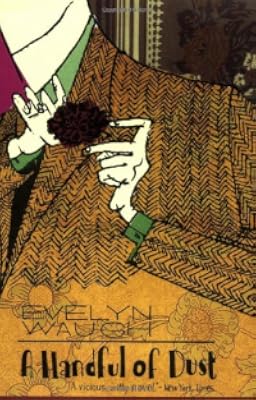
A Handful of Dust
by Evelyn Waugh 
On This Page
Description
Laced with cynicism and truth, "A Handful of Dust" satirizes a certain stratum of English life where all the characters have money, but lack practically every other credential. Murderously urbane, it depicts the breakup of a marriage in the London gentry, where the errant wife suffers from terminal boredom, and becomes enamored of a social parasite and professional luncheon-goer.Tags
Recommendations














Member Recommendations
Member Reviews
A Handful of Dust by Evelyn Waugh at first seemed to be a light, witty and satirical novel that pokes fun at the upper class of Britain during the time between the wars. However, as the story developed into the disintegration of a marriage, the author revealed the cynicism and bleakness that gave this story it’s brilliant edge.
While much of the story has it’s roots in Waugh’s own life, A Handful of Dust is a perfect blend of comedy and tragedy that captures the self-absorption of the English upper class and the total disregard they had for others. It also struck me how cleverly Waugh turned the tables on his characters by making first one than another the “villain” of the piece. For me, however, the character of Brenda was show more the worst of the lot. She is the bored, slightly resentful wife that takes up with a society wastrel whose only purpose seems to be that of being the perfect “extra man” that society hostesses can call upon at the last minute. Brenda’s husband, Tony is overly complacent and seems to be fonder of his home than he is of his wife but the resolution of his story could either be considered good or bad, depending on how one feels about Charles Dickens.
Elegant, sophisticated, lively and chilling, A Handful of Dust was quite the read and has me looking forward to reading more of this author. show less
While much of the story has it’s roots in Waugh’s own life, A Handful of Dust is a perfect blend of comedy and tragedy that captures the self-absorption of the English upper class and the total disregard they had for others. It also struck me how cleverly Waugh turned the tables on his characters by making first one than another the “villain” of the piece. For me, however, the character of Brenda was show more the worst of the lot. She is the bored, slightly resentful wife that takes up with a society wastrel whose only purpose seems to be that of being the perfect “extra man” that society hostesses can call upon at the last minute. Brenda’s husband, Tony is overly complacent and seems to be fonder of his home than he is of his wife but the resolution of his story could either be considered good or bad, depending on how one feels about Charles Dickens.
Elegant, sophisticated, lively and chilling, A Handful of Dust was quite the read and has me looking forward to reading more of this author. show less
Brilliant, but its sparkle is ice cold.
It's clever that the naive and saintly Tony is seamlessly recast as the villain of the piece - not just by his wife Brenda, but by most of their friends too.
But Brenda is the evil one, most dramatically demonstrated by a misplaced "Thank God". It sounds innocuous, but in context, it's one of the most chilling lines I've ever read.
Reading Dickens in the jungle for eternity: would that be heaven or hell?
It's clever that the naive and saintly Tony is seamlessly recast as the villain of the piece - not just by his wife Brenda, but by most of their friends too.
But Brenda is the evil one, most dramatically demonstrated by a misplaced "Thank God". It sounds innocuous, but in context, it's one of the most chilling lines I've ever read.
Reading Dickens in the jungle for eternity: would that be heaven or hell?
A Handful of Dust draws heavily from the collapse of Waugh’s first marriage which might explain why it is unusually bitter even by his standards. It begins jauntily enough, appearing to promise more satirical fun at the expense of the upper classes in the manner of his earlier novels. Gradually, though, it develops into something much darker and more unsettling. Despair is the key word here and the quote from Eliot’s most despairing poem entirely appropriate. But this book is much more than fictionalised autobiography and Waugh’s anguish at the failure of his marriage opens out into a bleak portrait of - as he saw it - a failed society: the landed gentry are going broke and being usurped by the materialistic upper middle class; show more people are facile, amoral, and rarely what they seem; religion, at least in its Anglican form, is a threadbare and meaningless joke. Ugliness is everywhere, in Gothic mansions, chromium-plated soulless flats, and, above all, the human heart. Better perhaps for a good man to be trapped forever in the Amazon than remain free in this godless wasteland.
A vision of Hell disguised as a comedy of manners: short, nasty, and quite brilliant. show less
A vision of Hell disguised as a comedy of manners: short, nasty, and quite brilliant. show less
Tony and Brenda Last seem to have a lovely marriage, living in the English countryside in Tony's ancestral, albeit slightly dreary, estate. But Brenda is easily bored and decides on what can only be described as a whim, to start an affair with a weasely momma's boy from London, whom no one else in society thinks worthy of any social status. The marriage doesn't survive the whim, and some of the characters suffer for it while others continue on their asinine, societal ways.
It sounds grim, and in part it is, but it's also a romp of a satire, and takes some surprising and interesting turns. I loved it, even though not many of the characters are likeable, because the plot and the writing were fantastic.
It sounds grim, and in part it is, but it's also a romp of a satire, and takes some surprising and interesting turns. I loved it, even though not many of the characters are likeable, because the plot and the writing were fantastic.
I first read this book years ago and yet it has stuck with me due to being so completely insane. Everyone in it is a terrible person to one degree or another and its cruel and funny in its depiction of London social life. It then takes a very odd turn and we are suddenly in the Amazon surrounded by madness and Dickens. I did thoroughly enjoy how awful everyone is, especially Brenda.
The first time I read A Handful of Dust, I had only read Brideshead Revisited and Scoop. This struck me as a combination of the two. It starts off as an English country house drama, and ends up as an adventure story in the jungle. Huh? I was entertained but confused.
When I reread it almost 20 years later, I had read Waugh more extensively. I had reread Brideshead yet again. More to the point, I had read many more of his satirical novels and came to appreciate and understand his dark humor. The second time around, I thought Handful was hilarious. I loved it.
When I reread it almost 20 years later, I had read Waugh more extensively. I had reread Brideshead yet again. More to the point, I had read many more of his satirical novels and came to appreciate and understand his dark humor. The second time around, I thought Handful was hilarious. I loved it.
In this dark cold winter of turbo-COVID-induced lockdown number three, while struggling to sleep and starting a new job from my living room, I am finding it very difficult to read or review books. Rather than wholly break the habit of more than seven years, though, I'll phone this one in. I found 'A Handful of Dust' mordantly funny. It started slowly with annoying men, then continued with more interesting and energetic women making dubious decisions. Indeed, everyone's decision making was doubtful. Waugh reminded me of Muriel Spark in his witty depictions of people's foibles, although he throws in more racism and antisemitism, as well as a perceptibly more conservative pre-WWII class sensibility. Nonetheless, the bleak humour and show more arbitrary tragedy are brilliantly sharp. Details and dialogue make it memorable; I particularly loved the economics course as a cover story for marital infidelity. The characters have such convincing flaws that one cannot help suspecting Waugh was inspired by his own circle of unbearable interwar aristocracy. If that was the case, I can imagine a fair bit of offense being taken by those who recognised elements of themselves. No-one comes off well, but I was much amused by their doings. show less
Members
- Recently Added By
Published Reviews
ThingScore 100
The characters of Evelyn Waugh are ... the natives of a highly articulated culture that has no myths, only rituals. ... Dying of manners, they are determined to go on snubbing reality ... The most thoroughly weaned generation in the world, they are discovering that a little money is a dangerous thing. ... There is no comfortable catharsis in Mr. Waugh's comedy of manners.
added by Roycrofter
Lists

1001 Books You Must Read Before You Die
1,448 works; 1,133 members

The Guardian's 1000 Novels Everyone Must Read
1,005 works; 547 members

Classics you know you should have read but probably haven't
421 works; 406 members

Read the book and saw the movie
1,170 works; 195 members

Books With a Twist
69 works; 46 members
Best of British Literature
226 works; 41 members

In or About the 1930s
198 works; 27 members

Time Magazine's "All-Time 100"
113 works; 15 members
20th Century Literature
1,161 works; 54 members

Global Reads: Books Set South and Central America
40 works; 7 members

Harold Bloom - The Western Canon: D. The Chaotic Age
833 works; 24 members
Time's All-Time 100 Novels
100 works; 27 members

A Novel Cure
742 works; 23 members
The Modern Library's 100 Best Novels: The Board's List
85 works; 6 members

A Good Read (Radio 4)
151 works; 1 member

1930s
262 works; 5 members

Books Read in 2015
3,299 works; 126 members

SHOULD Read Books!
354 works; 9 members

Books Read in 2022
5,166 works; 114 members

Recommended Reading : 600 Classics Reviewed, Editors of Salem Press, 2015
634 works; 6 members

Biggest Disappointments
606 works; 168 members

Llibres que he llegit el 2025
81 works; 2 members
Reading LIst
648 works; 1 member

Mensa for Kids Excellence in Reading Award Program (Grades 9-12)
116 works; 3 members
Franklit
95 works; 1 member
My Favourite Books
86 works; 5 members

Books Read in 2018
4,360 works; 110 members
Mensa for Kids Excellence in Reading Award Program (Grades 9-12)
116 works; 5 members

Books Read in 2013
1,630 works; 51 members
Modern Library's 100 Best Novels
100 works; 2 members
Talk Discussions
Past Discussions
Group Read, November 2018: A Handful of Dust in 1001 Books to read before you die (December 2018)
Author Information

132+ Works 56,605 Members
Born in Hampstead and educated at Oxford University, Evelyn Waugh came from a literary family. His elder brother, Alec was a novelist, and his father, Arthur Waugh, was the influential head of a large publishing house. Even in his school days, Waugh showed sings of the profound belief in Catholicism and brilliant wit that were to mark his later show more years. Waugh began publishing his novels in the late 1920's. He joined the Royal Marines at the beginning of World War II and was one of the first to volunteer for commando service. In 1944 he survived a plane crash in Yugoslavia and, while hiding in a cave, corrected the proofs of one of his novels. Waugh's early novels, Decline and Fall (1927), Vile Bodies (1930), and A Handful of Dust (1934), established him as one of the funniest and most brilliant satirists the British had seen in years. He was particularly skillful at poking fun at the scramble for prominence among the upper classes and the struggle between the generations. He lived for a while in Hollywood, about which he wrote The Loved One (1948), a scathing attack on the United States's overly sentimental funeral practices. His greatest works, however, are Brideshead Revisited (1945), which has been made into a highly popular television miniseries, and the trilogy Sword of Honor (1965), composed of Men at Arms (1952), Officers and Gentlemen (1955), and The End of the Battle (1961). (Bowker Author Biography) show less
Evelyn Waugh has a Legacy Library. Legacy libraries are the personal libraries of famous readers, entered by LibraryThing members from the Legacy Libraries group.
Some Editions
Awards and Honors
Notable Lists
Series
Belongs to Publisher Series
New Directions Classics (NC8)
10/18, Domaine étranger (1501)
Penguin English Library, 2012 series (2018-06)
Penguin Modern Classics (822)
Work Relationships
Is contained in
Has the adaptation
Has as a student's study guide
Common Knowledge
- Canonical title
- A Handful of Dust
- Original title
- A Handful of Dust
- Original publication date
- 1934
- People/Characters
- Tony Last; Brenda Last; John Beaver; Mrs. Beaver
- Important places
- London, England, UK
- Related movies
- A Handful of Dust (1988 | IMDb)
- Epigraph
- ...I will show you something different from either
Your shadow at morning striding behind you
Or your shadow at evening rising to meet you;
I will show you fear in a handful of dust.
— The Waste Land... (show all)> - First words
- "Was anyone hurt?"
- Last words
- (Click to show. Warning: May contain spoilers.)It was by means of them that he hoped one day to restore Hetton to the glory that it had enjoyed in the days of his Cousin Tony.
- Blurbers*
- Lezard, Nicholas
- Original language
- English
- Disambiguation notice
- Do not combine with the movie directed by Charles Sturridge.
*Some information comes from Common Knowledge in other languages. Click "Edit" for more information.
Classifications
Statistics
- Members
- 4,831
- Popularity
- 2,933
- Reviews
- 98
- Rating
- (3.81)
- Languages
- 15 — Catalan, Danish, Dutch, English, Estonian, Finnish, French, German, Hungarian, Italian, Korean, Portuguese, Russian, Spanish, Swedish
- Media
- Paper, Audiobook, Ebook
- ISBNs
- 85
- UPCs
- 1
- ASINs
- 58