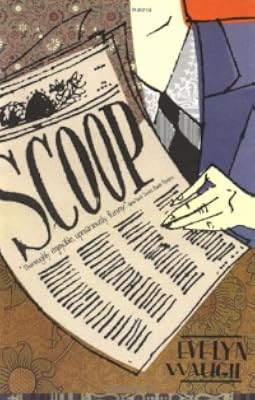
Scoop
by Evelyn Waugh 
On This Page
Description
"Scoop" is a satire of the journalism business. Lord Copper, newspaper magnate and proprietor of the Daily Beast, has always prided himself on his intuitive flair for spotting ace reporters. That is not to say he has not made the odd blunder, however, and may in a moment of weakness make another. Acting on a dinner party tip from Mrs. Algernon Stitch, Lord Copper feels convinced that he has hit on just the chap to cover a promising war in the African Republic of Ishmaelia. So, begins show more "Scoop," Waugh's exuberant comedy of mistaken identity and brilliantly irreverent satire of the hectic pursuit of hot news. show lessTags
Recommendations














Member Recommendations



Member Reviews
John Courtney Boot is a novelist of modest success, having published eight books, each of which sold about fifteen thousand copies and were read by a well-respected type. William Boot is the author of the Beast’s bi-weekly column Lush Places devoted to nature, a champion of “the questing voleand chronicler of the habits of the badger. Uncle Theodore is, well, someone else altogether. Boot, John Courtney not William, is backed by a lady of some repute in a conversation with Lord Copper, editor of the Beast, as a candidate to be the paper’s foreign correspondent in Ishmelia, where a revolution is breaking out. Boot, William not John Courtney, gets the assignment. William descends on the tiny and peaceful, it turns out, nation with show more dozens of other journalists, and they begin wagging the dog. William trips onto the a story while the rest of the foreign correspondents trek to a non-existent war-torn city. William returns to London Boot, John Courtney not William, receives a knighthood for the reporting, while Boot, Uncle Theodore neither John Courtney nor William, is feted by Lord Copper.
When I read [A Handful of Dust], my first exposure to Evelyn Waugh, I found myself chuckling through the tragic story. But [Scoop] had me laughing aloud. Waugh writes with a sharp comic timing and a keen eye for the absurd. Wild twists and crossed signals throughout the story mark Waugh’s smart imagination. And his characters, especially the hapless William, are quirky without being flat, eccentric without being stereotypical.
Waugh, himself a journalist for Mussolini’s invasion of Abyssinia, does not have a very high opinion of journalists and the news media. The send-up of journalists, casting them as manipulative concoctors, makes the novel timeless – the world of news may have changed with the television and the internet but you can see the same kind of entertainment-minded, policy-driven manipulators at work in [Scoop] as must work at Fox News or CNN today.
Bottom Line: Smartly imaginative and very funny send up of journalism – a real comedy of errors.
5 bones!!!!!
A Favorite for the Year. show less
When I read [A Handful of Dust], my first exposure to Evelyn Waugh, I found myself chuckling through the tragic story. But [Scoop] had me laughing aloud. Waugh writes with a sharp comic timing and a keen eye for the absurd. Wild twists and crossed signals throughout the story mark Waugh’s smart imagination. And his characters, especially the hapless William, are quirky without being flat, eccentric without being stereotypical.
Waugh, himself a journalist for Mussolini’s invasion of Abyssinia, does not have a very high opinion of journalists and the news media. The send-up of journalists, casting them as manipulative concoctors, makes the novel timeless – the world of news may have changed with the television and the internet but you can see the same kind of entertainment-minded, policy-driven manipulators at work in [Scoop] as must work at Fox News or CNN today.
Bottom Line: Smartly imaginative and very funny send up of journalism – a real comedy of errors.
5 bones!!!!!
A Favorite for the Year. show less
Well, if I’d thought Black Mischief was racist, it’s almost woke compared to Scoop. And yet Scoop is the Waugh novel which appears on so many best of lists, including “Best British Novels of All Time”. Of course, the people putting together these lists are not the ones who are troubled by the casual everyday racism embedded in them, but things have changed – for the better – and these works really should be re-evaluated in light of present-day sensibilities. And yes, I’m happy to call any right-winger a fascist, even if their views don’t fit the dictionary definition of fascism, let’s not forget taxonomy is a derailing technique and the only people who derail arguments are people who don’t want their views held up to show more public scrutiny. Because they’re probably fascist. Or racist. Like Scoop actually is. Its story is apparently inspired by real events, but it’s still a story about a white man – a hapless white man, it must be said – who goes to an “uncivilised” African country. Because all brown countries are, of course, uncivilised. At least to 1930s white people. But then, to add insult to injury, the text is filled with a number of racial slurs, not just spoken in dialogue, but in the actual descriptive prose. I lost count of them. The big joke is that a newspaper magnate has picked the wrong man – due to some confusion over names – to be his foreign correspondent covering a civil war in the invented African nation of Ishmaelia, but the Ishmaelians are too stupid and indolent to actually fight and all that happens is a series of contradictory communiques by government agencies. It’s a variation on Chesterton’s The Man Who Was Thursday, but written from a British colonialist perspective of the 1930s. Waugh was a terrible snob and a horrible person – it’s well-documented, he was deemed “officer most likely to be shot by his troops” during WWII – but he had a wonderful prose style. It’s a dilemma. His command of English is a joy to behold, but he wrote horribly racist and snobbish books (the latter allegedly presented as “comedy”). Read him and then throw his books away, that’s my strategy. show less
Scoop (London, 1938) by Evelyn Waugh is a satire on journalism. It is based on Waugh's 1935 assignment to cover the conflict between Abyssinia and Italy while working as a war correspondent for the London Daily Mail in Abyssinia (now Ethiopia). Waugh acknowledged that he was not very good at covering wars, but he did keep a close eye on what his fellow reporters were doing. The outcome was a comedic and satirical novel that mocks the newspaper industry and the journalism profession with a playful yet decidedly deadly tone.
The story centers upon a few humorous turns of events. Lord Copper, the conceited and uneducated proprietor of the Daily Beast, inadvertently dispatches William Boot, a naive nature columnist, to cover the conflict in show more the made-up nation of Ishmaelia in East Africa. At least geographically speaking, Ishmaelia and Abyssinia are identical. William learns a few fast lessons on the crafty methods used by journalists, who are constantly attempting to outsmart their peers and break a story. William returns to London as a well-known reporter after receiving many significant scoops on his own thanks to a string of fortunate events. However, all of it is meaningless to him, and he is glad to be going back to his remote and run-down country house, Boot Magna Hall, where his numerous eccentric relatives reside. Overall this is still an entertaining comedic read. show less
The story centers upon a few humorous turns of events. Lord Copper, the conceited and uneducated proprietor of the Daily Beast, inadvertently dispatches William Boot, a naive nature columnist, to cover the conflict in show more the made-up nation of Ishmaelia in East Africa. At least geographically speaking, Ishmaelia and Abyssinia are identical. William learns a few fast lessons on the crafty methods used by journalists, who are constantly attempting to outsmart their peers and break a story. William returns to London as a well-known reporter after receiving many significant scoops on his own thanks to a string of fortunate events. However, all of it is meaningless to him, and he is glad to be going back to his remote and run-down country house, Boot Magna Hall, where his numerous eccentric relatives reside. Overall this is still an entertaining comedic read. show less
While the principal tool in satire is humor, it’s objective, ulitmately, is the dispensing of scorn. And Waugh has some level of contempt and scorn for just about every character in this book in varying degrees, including the central protagonist. You either find that exhilarating, or not so. What a shock that a novel about colonialist hanky pankies in Africa prior to WW2 would appear racially insensitive by today’s standards. Waugh hates everyone; he sees everyone’s shortcomings, no matter who they are. He writes his hilarious poison with an absolutely stunning turn of phrase. For someone who defined themselves as a devout Catholic, his writings can be pretty diabolic.
The whole end sequence of the book after the central show more character's return home, is very funny. show less
The whole end sequence of the book after the central show more character's return home, is very funny. show less
Very smart satire on the world's press as it was apprehended by Waugh in the Nineteen Thirties. Not much has changed ninety years later except that correspondents in war theatres now take themselves so seriously with their vests and silly helmets. The manipulation is even more rampant than it once was.
Anyway, I love Waugh's eviscerating wit, his piercing recognition of idiots on the loose, and a generalising attitude that human behaviour is bumbling at best.
Anyway, I love Waugh's eviscerating wit, his piercing recognition of idiots on the loose, and a generalising attitude that human behaviour is bumbling at best.
I absolutely loved this little book! Ridiculous from start to finish, but in a good way......exposing all of the befuddled disconnectedness of not only Fleet Street press, but upper crust London Society and the landed (but broke) gentry. One blunder after another in the most ridiculous set of circumstances finds our hero(?) William Boot yanked from the comfort of his run-down country estate and plunged headlong into a political war in Africa.....nothing is as it seems....and for once, lack of initiative actually saves the day. I cannot say how many times i chuckled out loud as i read this.....nor can i say when the last time was i read a book that caused me to chuckle out loud over and over! Waugh hits this with a biting wit and allows show more these absolutely ridiculous (yet believable) people to thrive in their self-induced chaos, and we are just along for the ride. So glad to have read this. Thank you Evelyn Waugh! show less
An uproariously funny comedy of errors with some of the wittiest dialogue I have ever read... it's only a shame that Waugh's racism comes to the fore with some less than well-chosen nouns that really, really make the book feel dated.
Members
- Recently Added By
Lists

The Guardian's 1000 Novels Everyone Must Read
1,005 works; 550 members
20th Century Literature
1,161 works; 55 members

Harold Bloom - The Western Canon: D. The Chaotic Age
833 works; 24 members

The Guardian's 100 greatest novels of all time
100 works; 16 members

Classic British Humor
41 works; 8 members

Fish Out of Water: The Perils of Abroad
25 works; 5 members

Books Read in 2023
5,547 works; 145 members

The Guardian's 100 Best Novels Written in English
105 works; 13 members

Books Read in 2017
4,249 works; 130 members

1930s
262 works; 5 members

A Good Read (Radio 4)
221 works; 1 member

Books Read in 2022
5,168 works; 111 members

Books Read in 2021
5,361 works; 114 members

Books I Own But Haven't Read
144 works; 2 members

The League of Extraordinary Gentlemen
87 works; 4 members

Blue Pyramid 1,276 Best Books of All Time
1,248 works; 32 members

Canon de la narrativa universal del s. XX (cicutadry)
499 works; 3 members
Reading LIst
648 works; 1 member
Modern Library's 100 Best Novels
100 works; 2 members

Alphabetical Books
211 works; 3 members
Author Information

131+ Works 56,624 Members
Born in Hampstead and educated at Oxford University, Evelyn Waugh came from a literary family. His elder brother, Alec was a novelist, and his father, Arthur Waugh, was the influential head of a large publishing house. Even in his school days, Waugh showed sings of the profound belief in Catholicism and brilliant wit that were to mark his later show more years. Waugh began publishing his novels in the late 1920's. He joined the Royal Marines at the beginning of World War II and was one of the first to volunteer for commando service. In 1944 he survived a plane crash in Yugoslavia and, while hiding in a cave, corrected the proofs of one of his novels. Waugh's early novels, Decline and Fall (1927), Vile Bodies (1930), and A Handful of Dust (1934), established him as one of the funniest and most brilliant satirists the British had seen in years. He was particularly skillful at poking fun at the scramble for prominence among the upper classes and the struggle between the generations. He lived for a while in Hollywood, about which he wrote The Loved One (1948), a scathing attack on the United States's overly sentimental funeral practices. His greatest works, however, are Brideshead Revisited (1945), which has been made into a highly popular television miniseries, and the trilogy Sword of Honor (1965), composed of Men at Arms (1952), Officers and Gentlemen (1955), and The End of the Battle (1961). (Bowker Author Biography) show less
Evelyn Waugh has a Legacy Library. Legacy libraries are the personal libraries of famous readers, entered by LibraryThing members from the Legacy Libraries group.
Some Editions
Awards and Honors
Notable Lists
Series
Belongs to Publisher Series
Work Relationships
Is contained in
Has the adaptation
Is replied to in
Has as a student's study guide
Common Knowledge
- Canonical title*
- Últimes notícies
- Original title
- Scoop
- Original publication date
- 1938
- People/Characters
- Lord Copper; John Courteney Boot; William Boot; Mr Salter; Uncle Theodore; Dr Benito (show all 11); Mr Baldwin; Corker; Pigge; Shumble; Whelper
- Important places
- Republic of Ishmaelia (fictional); Fleet Street, London, England, UK; London, England, UK; Africa; East Africa
- Related movies
- Scoop (1972 | IMDb); Scoop (1987 | IMDb)
- Dedication
- For
LAURA - First words
- While still a young man, John Courteney Boot had, as his publisher proclaimed, 'achieved an assured and enviable position in contemporary letters'.
- Quotations
- Why, once Jakes went out to cover a revolution in one of the Balkan capitals. He overslept in his carriage, woke up at the wrong station, didn't know any different, got out, went straight to a hotel, and cabled off a thousand... (show all)-word story about barricades in the streets, flaming churches, machine guns answering the rattle of his typewriter as he wrote, a dead child, like a broken doll, spreadeagled in the deserted roadway before his window - you know.
There was something un-English and not quite right about 'the country', with its solitude and self-sufficiency, its bloody recreations, its darkness and silence and sudden, inexplicable noises; the kind of place where you nev... (show all)er know from one minute to the next that you may not be tossed by a bull or pitchforked by a yokel or rolled over and broken up by a pack of hounds.
'Feather-footed through the plashy fen passes the questing vole...'
'Up to a point, Lord Copper.' - Last words
- (Click to show. Warning: May contain spoilers.)Before getting into bed he drew the curtain and threw open the window. Moonlight streamed into the room. Outside the owls hunted maternal rodents and their furry brood.
- Original language*
- Anglais (Royaume-Uni) (Royaume-Uni)
*Some information comes from Common Knowledge in other languages. Click "Edit" for more information.
Classifications
Statistics
- Members
- 4,222
- Popularity
- 3,604
- Reviews
- 93
- Rating
- (3.78)
- Languages
- 14 — Catalan, Dutch, English, Estonian, Finnish, French, German, Hungarian, Italian, Portuguese, Slovenian, Spanish, Swedish, Turkish
- Media
- Paper, Audiobook, Ebook
- ISBNs
- 74
- UPCs
- 1
- ASINs
- 50