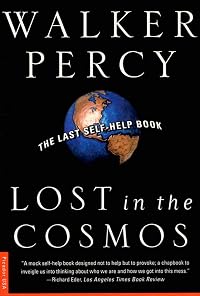
Lost in the Cosmos: The Last Self-Help Book
by Walker Percy 
On This Page
Description
Published at the height of the 1980s self-help boom, Lost in the Cosmos is Percy's unforgettable riff on the trend that swept the nation. Filled with quizzes, essays, short stories, and diagrams, Lost in the Cosmos is a laugh-out-loud spin on a familiar genre that also pushes readers to serious contemplation of life's biggest questions. One part parody and two parts philosophy, Lost in the Cosmos is an enlightening guide to the dilemmas of human existence, and an unrivaled spin on self-help show more manuals by one of modern America's greatest literary masters.T166. show lessTags
Recommendations









Member Reviews
Lost in the Cosmos: the Last Self-Help Book
It would be hard to over-state the effect this well-timed little book had on me when it entered my life at just the right angle. It was the first book to ever introduce me to a whole nexus of questions occasioned by this bizarre phenomenon I am using *right now*-- language; the mystery, as Percy put it in the subtitle of another work, of "How queer man is, how queer language is, and what one has to do with the other." Nor can I know whether I would have been so struck had I discovered it in other circumstances; as it was, it practically jump-started my ability to think about things. Every question suddenly swung 'round into new configurations. I had certainly thought about the traps of show more language, about how it constrains as well as enables thought; but to me this was just a frustrating dead-end. Percy showed me a way out that did not deny the problem but made it fruitful; by introducing me to discussion of the linguistic sign as "triadic," a term from American pragmatist philosopher Charles Peirce’s semiotics, it gave this question someplace to go. Moreover, Percy's very readable and unpretentious discussion made it quite clear that despite its pedigree, this for him was not a matter of recondite academese, but of the most gripping import for understanding and navigating day-to-day existence. This was really a breath of fresh air for a kid of eighteen who was sure that philosophy mattered vitally, but did not want to cut himself off from life.
One aspect of Percy's book is a very familiar-style easy introduction to (without the slightest whiff of "An Introduction To..." about it) philosophy of language; literally the most painless such I can imagine. It is like a subliminal tape to play while you sleep; you just wake up knowing and thinking more. Percy describes a linguistic sign as a "triad": not a dyad in which word stands for object, but a triad in which word stands for object *for somebody.* This very elementary addition proved no mere curlicue but the catalyst that snapped the whole thing into 3-D for me, for instead of locking the inquiry into fruitless debate about whether or how a word, say, "pear," "points to" an object (e.g. that funny shaped fruit which may or may not be ripe) it backs up and asks about how and where and for whom words are used: the hungry man, the orchard-owner, the still-life painter. Percy’s point (and Peirce’s, though one could argue about how faithful Percy was to his teacher) is ultimately one about how of a piece human consciousness is with language itself. Though Heidegger makes somewhat the same claim, had I tried to read Heidegger at this point, he would have seemed impossibly evasive to me (indeed, he still does sometimes); as it was, not only did Percy’s "introduction" help pave the way for this more "heavy" reading to come, but his drawing upon the wholly different American pragmaticist tradition proved a useful inoculation against some of the over-the-top Black Forest pronouncements from the onetime rector of Freiberg.
Another part of Percy's book is a discussion of artistic creativity, or indeed of any experience which takes us (whether momentarily or for an extended trip) outside ordinary experience; and about what happens when we try to "re-enter." Also in this part, Percy presents a series of scenarios exploring the end of the world, interspace travel, and the question of what to do if you encounter an alien life form, and what to do if you do not encounter an alien life form. This section is funny, sometimes the laugh-out-loud, sometimes more the bitter, chuckle-to-yourself type of funny, slightly like Vonnegut but far more humane and less cynical. It’ll also make you think. "Lost in the Cosmos" cannot be read passively. A good chunk of the book is made up of quizzes; you can’t read a quiz passively. In fact, one of Percy’s between-the-lines points seems to be that *no* book, in fact no *word*, can be read passively, because every word invites your response-- it does not neutrally carry its load of significance to your waiting neurons but requires you to reach out and accept it--or else, to contest or reject it. This makes you *responsible*--an important ethical subtext.
One might wonder what these various threads have to do with each other, but in reading Percy the transitions are seamless; I think because he felt with such great clarity the white heat of "re-entry" himself, the "coming down" after a prolonged artistic or other "high." The distinction between the mundane and the "philosophical" did not mean very much to him, I suspect. He walks you through a dozen thought-experiments with so Socratic a hand you hardly notice that you are reading a sort of existential choose-your-own-adventure book… until, too late (or just in time?), it dawns on you: that’s what you are doing *all the time*. show less
It would be hard to over-state the effect this well-timed little book had on me when it entered my life at just the right angle. It was the first book to ever introduce me to a whole nexus of questions occasioned by this bizarre phenomenon I am using *right now*-- language; the mystery, as Percy put it in the subtitle of another work, of "How queer man is, how queer language is, and what one has to do with the other." Nor can I know whether I would have been so struck had I discovered it in other circumstances; as it was, it practically jump-started my ability to think about things. Every question suddenly swung 'round into new configurations. I had certainly thought about the traps of show more language, about how it constrains as well as enables thought; but to me this was just a frustrating dead-end. Percy showed me a way out that did not deny the problem but made it fruitful; by introducing me to discussion of the linguistic sign as "triadic," a term from American pragmatist philosopher Charles Peirce’s semiotics, it gave this question someplace to go. Moreover, Percy's very readable and unpretentious discussion made it quite clear that despite its pedigree, this for him was not a matter of recondite academese, but of the most gripping import for understanding and navigating day-to-day existence. This was really a breath of fresh air for a kid of eighteen who was sure that philosophy mattered vitally, but did not want to cut himself off from life.
One aspect of Percy's book is a very familiar-style easy introduction to (without the slightest whiff of "An Introduction To..." about it) philosophy of language; literally the most painless such I can imagine. It is like a subliminal tape to play while you sleep; you just wake up knowing and thinking more. Percy describes a linguistic sign as a "triad": not a dyad in which word stands for object, but a triad in which word stands for object *for somebody.* This very elementary addition proved no mere curlicue but the catalyst that snapped the whole thing into 3-D for me, for instead of locking the inquiry into fruitless debate about whether or how a word, say, "pear," "points to" an object (e.g. that funny shaped fruit which may or may not be ripe) it backs up and asks about how and where and for whom words are used: the hungry man, the orchard-owner, the still-life painter. Percy’s point (and Peirce’s, though one could argue about how faithful Percy was to his teacher) is ultimately one about how of a piece human consciousness is with language itself. Though Heidegger makes somewhat the same claim, had I tried to read Heidegger at this point, he would have seemed impossibly evasive to me (indeed, he still does sometimes); as it was, not only did Percy’s "introduction" help pave the way for this more "heavy" reading to come, but his drawing upon the wholly different American pragmaticist tradition proved a useful inoculation against some of the over-the-top Black Forest pronouncements from the onetime rector of Freiberg.
Another part of Percy's book is a discussion of artistic creativity, or indeed of any experience which takes us (whether momentarily or for an extended trip) outside ordinary experience; and about what happens when we try to "re-enter." Also in this part, Percy presents a series of scenarios exploring the end of the world, interspace travel, and the question of what to do if you encounter an alien life form, and what to do if you do not encounter an alien life form. This section is funny, sometimes the laugh-out-loud, sometimes more the bitter, chuckle-to-yourself type of funny, slightly like Vonnegut but far more humane and less cynical. It’ll also make you think. "Lost in the Cosmos" cannot be read passively. A good chunk of the book is made up of quizzes; you can’t read a quiz passively. In fact, one of Percy’s between-the-lines points seems to be that *no* book, in fact no *word*, can be read passively, because every word invites your response-- it does not neutrally carry its load of significance to your waiting neurons but requires you to reach out and accept it--or else, to contest or reject it. This makes you *responsible*--an important ethical subtext.
One might wonder what these various threads have to do with each other, but in reading Percy the transitions are seamless; I think because he felt with such great clarity the white heat of "re-entry" himself, the "coming down" after a prolonged artistic or other "high." The distinction between the mundane and the "philosophical" did not mean very much to him, I suspect. He walks you through a dozen thought-experiments with so Socratic a hand you hardly notice that you are reading a sort of existential choose-your-own-adventure book… until, too late (or just in time?), it dawns on you: that’s what you are doing *all the time*. show less
Percy's breezy, glossy magazine format disguises an earnest introduction to a philosophy of the self in the late 20th Century U.S. culture, more accurately an eschatology especially concerned with the linguistic turn in late Continental theory and its relevance for middle class consumers. The initial 11 chapters (short, conversational, often presented in the list-centric or mini-survey trappings favoured by grocery checkout diversions and which Percy implicitly mocks) treat of various summaries of psychology and popular understanding of the Self. In fact, the book provides no traditional chapter structure, rather beginning with a cold open and careering to its termination.
Tom Bartlett in the Chronicle of Higher Education asseverates the show more "source material" for much of Lost in the Cosmos is found in the essays reprinted earlier in Message In A Bottle. While true, Cosmos gives that content different emphases, a slightly different spin. Perhaps he hoped to reach different readers, or make a second effort at reaching the same readers indirectly. Wikipedia pointed me to an online lecture based on the book, and this too is interesting, especially in arguing that Percy extends a tradition followed by C.S. Lewis (That Hideous Strength or The Screwtape Letters) and G.K. Chesterton (Everlasting Man), to "smuggle Christianity back into Christendom" as initially suggested by Kierkegaard. Neither replaces the book itself, unsurprisingly.
That something else is both unsettling and logically untenable. "It is possessed by the spirit of the erotic and the secret love of violence," all the more unsettling in this nuclear age, and logically untenable given that a Self (by definition a knowing subject rather than a known object) cannot know itself by reference to itself, that is to say, know itself as an object. Rather the Self must know itself transcendentally. Necessarily, then, Percy concludes the modern Self is lost. Percy notes the Self feasibly might again become found, but does not pursue that question here. Presumably his answer to that question is evangelical, given his acknowledged beliefs and preferences, to be tested against his other writings. show less
Tom Bartlett in the Chronicle of Higher Education asseverates the show more "source material" for much of Lost in the Cosmos is found in the essays reprinted earlier in Message In A Bottle. While true, Cosmos gives that content different emphases, a slightly different spin. Perhaps he hoped to reach different readers, or make a second effort at reaching the same readers indirectly. Wikipedia pointed me to an online lecture based on the book, and this too is interesting, especially in arguing that Percy extends a tradition followed by C.S. Lewis (That Hideous Strength or The Screwtape Letters) and G.K. Chesterton (Everlasting Man), to "smuggle Christianity back into Christendom" as initially suggested by Kierkegaard. Neither replaces the book itself, unsurprisingly.
Both Kierkegaard and modern semiotics give us leave to speak of the self as being informed -- "possessed," if you like, at certain historical stages of belief and unbelief. It becomes possible, whether one believes in God or not, soul or not, to agree that in an age in which the self is not informed by cosmological myths, by totemism, by belief in God -- whether the God of Christianity, Judaism, or Islam -- it must necessarily and by reason of its own semiotic nature be informed by something else. [178]
That something else is both unsettling and logically untenable. "It is possessed by the spirit of the erotic and the secret love of violence," all the more unsettling in this nuclear age, and logically untenable given that a Self (by definition a knowing subject rather than a known object) cannot know itself by reference to itself, that is to say, know itself as an object. Rather the Self must know itself transcendentally. Necessarily, then, Percy concludes the modern Self is lost. Percy notes the Self feasibly might again become found, but does not pursue that question here. Presumably his answer to that question is evangelical, given his acknowledged beliefs and preferences, to be tested against his other writings. show less
This may be the third time I have read this book. From the first reading I recalled the concept of transcendence from the scene set at the Pueblo corn dance. It really made sense to me to think of how different people from completely different points of view can feel that they have a greater grasp of the situation than others do. It certainly helps explain the appeal of all encompassing systems such as Marxism, Christianity, scientism (not to be confused with science itself) and so forth. I still find this a valuable concept. However I had forgotten, or perhaps not noticed on earlier readings, the author's preoccupation with male homosexuality and rather conventional, though superficially feminist, concepts of female character.
An engaging and thoughtful book about several topics relevant to our contemporary culture. Percy uses an unusual style like a Socratic provocateur challenging the reader to think about aspects of our culture, the nature of language, and the meaning of life. The book is one that, like those of Plato, Marcus Aurelius, or Wittgenstein, requires concentration, demands rereading, and ultimately encourages the reader to think seriously about the nature of the "Cosmos" and his own life.
What a strange, unclassifiable, brilliant book. I can't think of a thing to compare it to. I need some time to sit with it before I declare it the best thing I've ever read, but it blew me away.
re-read/re-skim. I thought this book might be one to send to a friend afflicted with nihilism. But probably not. Sharp and funny, in the Percy style.
Not sure why I chose this a my first Percy book. I guess the cover description and blurbs won me over. The book itself is interesting, but doesn't really sustain your full attention through its length. It is (or is it?) sort of a parody self-help book, except it isn't (or is it?) Perhaps I need to read it again--but I found it a bit tedious at the time.
Members
- Recently Added By
Author Information

34+ Works 13,775 Members
Walker Percy, May 28, 1916 - May 10, 1990 Walker Percy, born in Alabama, raised in Mississippi, and a former resident of Louisiana, was a member of a prominent Southern family who lost his parents at an early age and grew up as the foster son of his father's cousin. Percy graduated from the University of North Carolina and received his M.D. from show more Columbia, but was a nonpracticing physician who devoted much of his life to his writing. Percy's first novel, The Moviegoer (1961), won the 1962 National Book Award, but Charles Poore considers The Last Gentleman (1966) "an even better book." Love in the Ruins (1971) marks a sharp change in method and subject from the first two novels. A doomsday story set "at the end of the Auto Age," it exposes many foibles and abuses in contemporary life through sharp satire and extravagant fantasy. Whereas Love in the Ruins is funny, Percy's next novel, Lancelot (1977) is the rather bleak and pessimistic story of a deranged man who blows up his home when he finds proof of his wife's infidelities and then tells his story in an asylum for the mentally disturbed. Its apocalyptic vision is expressed in a more positive and affirmative way in The Second Coming (1980), which takes its title from the fact that it resurrects the character of Will Barret from The Last Gentleman and locates him, a quarter-century older, finding love and meaning in a cave. (Bowker Author Biography) show less
Walker Percy has a Legacy Library. Legacy libraries are the personal libraries of famous readers, entered by LibraryThing members from the Legacy Libraries group.
Awards and Honors
Work Relationships
Is contained in
Common Knowledge
- Original title
- Lost in the Cosmos: The Last Self-Help Book
- Original publication date
- 1983
- People/Characters
- Carl Sagan; Phil Donahue; Bill; Penny; Dr. Joyce Friday; Allen (show all 20); John Calvin (1509-1564); John Pelham (Colonel, CSA); Cosmic Stranger; Søren Kierkegaard; Dr. Betty; a Chicken; Washoe; Captain Marcus Aerelius Schuyler; Tifanny; Kimberly; Dr. Jane Smith; Abbot Liebowitz; Aristarchus Jones; Charles S. Peirce
- Important places
- Bonneville, Utah, USA; Burbank, California, USA; Europa, a moon of Jupiter; Proxima Centauri 3; Taos, New Mexico, USA
- Epigraph
- We are unknown, we knowers, to ourselves … Of necessity we remain strangers to ourselves, we understand ourselves not, in our selves we are bound to be mistaken, for each of us holds good to all eternity the motto, "Each is... (show all) the farthest away from himself"—as far as ourselves are concerned we are not knowers.-- Friedrich Nietzche, On The Genealogy of Morals (1887)
- Dedication
- For my fellow space travelers, John Walker, Robert, David, Jack
- First words
- Imagine you are reading a book about the Cosmos. You find it so interesting that you go out and buy a telescope.
- Last words
- (Click to show. Warning: May contain spoilers.)Repeat. Do you read? Do you read? Are you in trouble? How did you get in trouble? If you are in trouble, have you sought help? If you did, did help come? If it did, did you accept it? Are you out of trouble? What is the character of your consciousness? Are you conscious? Do you have a self? Do you know who you are? Do you know what you are doing? Do you love? Do you know how to love? Do you know how to hate? Do you read me? Come back. Repeat. Come back. Come back. Come back.
(CHECK ONE)
Classifications
Statistics
- Members
- 1,286
- Popularity
- 19,050
- Reviews
- 13
- Rating
- (3.95)
- Languages
- English, German
- Media
- Paper, Ebook
- ISBNs
- 13
- ASINs
- 13