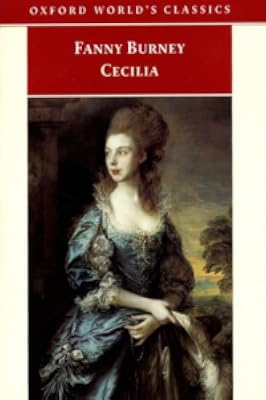
Cecilia, or Memoirs of an Heiress
by Fanny Burney
On This Page
Description
Fans of Jane Austen's work will enjoy the novels of her predecessor Fanny Burney, who many critics and historians agree exerted a profound influence over Austen's evolution as a writer. The sweeping novel Cecilia follows one well-born woman's quest to find a suitable husband who will meet the exacting stipulations set forth by her family..
Tags
Recommendations



















Member Reviews
Cecilia is a young heiress to a massive fortune. But there’s a catch: a large part of her inheritance is contingent on retaining her surname after marriage. And of course, this just wasn’t done in the 1780s, when this book was published. Nor was Cecilia allowed to live an independent life. Her uncle’s will appointed three guardians to manage her affairs, and even though just a few months remain before she turns 21, Cecilia is very much subject to their control. One guardian, Mr Harrel, is the husband of a dear childhood friend, and Cecilia goes to live with them. Her initial delight at being reunited with her friend quickly turns to shock and sadness, when she sees how the Harrels live beyond their means. Cecilia, being both show more good-natured and naive, tries to help, but her generosity goes unrewarded.
Meanwhile, several men are vying for Cecilia’s favor, and as flattering as that may seem most of them are motivated by nothing more than improving their social standing through increased wealth. Cecilia’s “journey” through this novel essentially involves learning that people who appear to have good intentions, even those you have loved or trusted for years, have a dark side especially where money is concerned. Just one man stands out as more noble, and more sincere in his affections, but (no surprise) his family is opposed to him marrying below their social class.
Cecilia inspired Jane Austen; in fact, the phrase “pride and prejudice” was first used here in a similar situation. The book is quite long, with many winding subplots and some over-the-top drama, but it is fairly easy reading and an interesting portrait of women at this time in history. show less
Meanwhile, several men are vying for Cecilia’s favor, and as flattering as that may seem most of them are motivated by nothing more than improving their social standing through increased wealth. Cecilia’s “journey” through this novel essentially involves learning that people who appear to have good intentions, even those you have loved or trusted for years, have a dark side especially where money is concerned. Just one man stands out as more noble, and more sincere in his affections, but (no surprise) his family is opposed to him marrying below their social class.
Cecilia inspired Jane Austen; in fact, the phrase “pride and prejudice” was first used here in a similar situation. The book is quite long, with many winding subplots and some over-the-top drama, but it is fairly easy reading and an interesting portrait of women at this time in history. show less
I had sort of a love/hate relationship with this book. Published in 1782, this is a novel of sensibility, following the young adulthood of Cecilia, an heiress to a large fortune who is also benevolent, honest, and good. A condition of her inheritance is that her future spouse take her last name upon marrying her which will prove to cause all sorts of trouble for the one man she desires to marry out of the many suitors vying for her attention.
Cecilia also is left by her Uncle (who had been caring for her after her parents died) with three guardians, none of whom was chosen very wisely. One is a gambler living well beyond his means who will effectively rob Cecilia of part of her fortune, one is a miserly man with no social skills, and show more one is affected by his excessive pride in his family name.
As a novel of sensibility, there are long scenes in this book of excessive emotion and drama with long-winded speeches where honestly I wished things would just move along already. But there are also several characters who exhibit realistic personalities, showing shades of both good and bad traits. Cecilia herself surprised me, because though she is good through and through, she does "have a spine" and I ended up really liking her and rooting for her as she matured throughout the book.
Overall, I'm very glad I read this and I enjoyed it though it will not rank among my favorites because the over-dramatic nature and wordiness just don't suit my personal taste. I much preferred Burney's [Evelina] which I found had a charming nature that I personally enjoyed more. show less
Cecilia also is left by her Uncle (who had been caring for her after her parents died) with three guardians, none of whom was chosen very wisely. One is a gambler living well beyond his means who will effectively rob Cecilia of part of her fortune, one is a miserly man with no social skills, and show more one is affected by his excessive pride in his family name.
As a novel of sensibility, there are long scenes in this book of excessive emotion and drama with long-winded speeches where honestly I wished things would just move along already. But there are also several characters who exhibit realistic personalities, showing shades of both good and bad traits. Cecilia herself surprised me, because though she is good through and through, she does "have a spine" and I ended up really liking her and rooting for her as she matured throughout the book.
Overall, I'm very glad I read this and I enjoyed it though it will not rank among my favorites because the over-dramatic nature and wordiness just don't suit my personal taste. I much preferred Burney's [Evelina] which I found had a charming nature that I personally enjoyed more. show less
I really liked the premise of this book. After reading Pamela by Samuel Richardson, I was ready for a stronger heroine. The prose and writing is good (for a 18th century novel) but the ending infuriated me.
Granted, Cecilia's uncle's codicil about her husband taking her name or her losing the fortune was weird, but I found it refreshing and hoped that Cecilia would find a man who loved her enough to take on her name. Yes, yes, I know it was the 18th century and men liked being macho and proving their manhood in superficial ways (not too different from today) but in the end, Cecilia loses her fortune when she marries her man since he refuses to take her name.
I'm thinking, for Fuck's sakes! Cecilia is lovely and intelligent and charming show more with a good inheritance. I'm sure that other men would have been more than willing to take on her name, the fact that Devlin wouldn't should have given Cecilia pause. Alas. And this book is over 1000 pages. 1000 pages for a disappointing conclusion... ugh. show less
Granted, Cecilia's uncle's codicil about her husband taking her name or her losing the fortune was weird, but I found it refreshing and hoped that Cecilia would find a man who loved her enough to take on her name. Yes, yes, I know it was the 18th century and men liked being macho and proving their manhood in superficial ways (not too different from today) but in the end, Cecilia loses her fortune when she marries her man since he refuses to take her name.
I'm thinking, for Fuck's sakes! Cecilia is lovely and intelligent and charming show more with a good inheritance. I'm sure that other men would have been more than willing to take on her name, the fact that Devlin wouldn't should have given Cecilia pause. Alas. And this book is over 1000 pages. 1000 pages for a disappointing conclusion... ugh. show less
We need to get a couple of things out of the way before I get to the proper review.
i) This is too long.
ii) This shouldn't be read the way you'd read a Hemingway novel--sitting down and intensely fretting through the intense pages of intensity. This should be read the way you watch a TV series: a few chapters here, a few there, letting the various plots lines wrap themselves up, taking a pause while the next one gets going, all the while keeping in mind that there is an overarching point to the thing, but not expecting that overarching point to be the focus of every chapter, let alone every sentence.
Now, having said all that, this is fabulous stuff. Burney gives you exactly what you want from a late eighteenth century novel: show more heart-rending sentiment, burning satire, and intelligent sociology. The characters are well drawn, and don't 'develop,' because they are people, not characters in a fiction-writing workshop, and people don't develop like that. But they do get entangled in plot, and that's what Burney gives us: incident after incident, all leading us towards a crisis point, whether local (as when Cecilia finally moves out of her first guardian's house) or more general (as at the end of the novel).
Mr. Gosport is an interesting innovation, if you're interested in that kind of thing--he's the intelligent voice of the novel, but he's not particularly involved in anything. In fact, he's really there to let Burney write satirical, sociological essays about the upper class, and they are wonderful things, perhaps the best parts of the book.
Burney was well known to Austen ('Pride and Prejudice' is a phrase from this very book), and that might have skewed some readers' expectations for the worse. Austen is a wonderful novelist, who made genuine advances in the art, but Burney was working in a very different form, from a very different perspective. It's best to know this before diving into this monster of a book; this is not Our Jane. But if you give up looking for Austen, you're likely to find any number of other novelists in there: the Delviles feel like something from late James, for instance, and Mr. Monckton would find himself quite at home in a Trollope novel.
In short, then, Burney was a writer of genius, who had the misfortune to write just before another writer, with a very different genius, changed our expectations of the novel, so that Burney can now feel excessive and even unartistic. But there are real rewards to reading Cecilia. show less
i) This is too long.
ii) This shouldn't be read the way you'd read a Hemingway novel--sitting down and intensely fretting through the intense pages of intensity. This should be read the way you watch a TV series: a few chapters here, a few there, letting the various plots lines wrap themselves up, taking a pause while the next one gets going, all the while keeping in mind that there is an overarching point to the thing, but not expecting that overarching point to be the focus of every chapter, let alone every sentence.
Now, having said all that, this is fabulous stuff. Burney gives you exactly what you want from a late eighteenth century novel: show more heart-rending sentiment, burning satire, and intelligent sociology. The characters are well drawn, and don't 'develop,' because they are people, not characters in a fiction-writing workshop, and people don't develop like that. But they do get entangled in plot, and that's what Burney gives us: incident after incident, all leading us towards a crisis point, whether local (as when Cecilia finally moves out of her first guardian's house) or more general (as at the end of the novel).
Mr. Gosport is an interesting innovation, if you're interested in that kind of thing--he's the intelligent voice of the novel, but he's not particularly involved in anything. In fact, he's really there to let Burney write satirical, sociological essays about the upper class, and they are wonderful things, perhaps the best parts of the book.
Burney was well known to Austen ('Pride and Prejudice' is a phrase from this very book), and that might have skewed some readers' expectations for the worse. Austen is a wonderful novelist, who made genuine advances in the art, but Burney was working in a very different form, from a very different perspective. It's best to know this before diving into this monster of a book; this is not Our Jane. But if you give up looking for Austen, you're likely to find any number of other novelists in there: the Delviles feel like something from late James, for instance, and Mr. Monckton would find himself quite at home in a Trollope novel.
In short, then, Burney was a writer of genius, who had the misfortune to write just before another writer, with a very different genius, changed our expectations of the novel, so that Burney can now feel excessive and even unartistic. But there are real rewards to reading Cecilia. show less
What do you get if you cross Jane Austen with Thackeray? A very long comedy of manners, namely, 'Cecilia'. Fanny Burney was writing a generation before both authors, and her influence is apparent - the title of 'Pride and Prejudice' is actually taken from a line in 'Celilia'! However, in between the bursts of sarcastic social commentary and melodramatic cliffhangers, Burney's novel can be rather tedious.
Cecilia is a paragon of virtue, tested by mercenary suitors, dissolute guardians - she is nearly, but not quite, a woman of very independent means, after inheriting a fortune upon the death of her father and uncle - and beloved by all! Every man she meets falls in love with her, or her fortune. Her three guardians are a grasping show more gambler, an eccentric miser, and a pompous nobleman. She is sent to stay with the first, Mr Harrel, who is the husband of her once closest friend, but falls in love with the son of the third, whom she meets at a masquerade. Yet as with Austen, the course of true love is upset with secret prior engagements and a lack of communication.
I did enjoy the first instalment, particularly the masked ball and the climax, but the pages would have turned faster if Cecilia had learned to stand up for herself sooner! The plot gets stuck in a loop for about two hundred pages: Cecilia is linked with a man, she denies any preference, the man ignores her protests; Cecilia is told not to loan any of her money, she does it anyway (even though she's technically not allowed to touch her fortune yet). Repeat. My favourite character would have to be Mr Briggs, with his wonderfully idiosyncratic speech: 'Never give your heart to a gold-topped cane, nothing but brass gilt over. Cheats every where; fleece you in a year; won't leave you a groat.' He's about as economical with pronouns as he is with money, lives in squalour and cares nothing for society, but Briggs is very droll and perhaps the only honest counsel Cecilia has! Briggs reminds me of Sir Pitt in 'Vanity Fair'. I also pitied the good-hearted Mr Arnott, much-abused brother-in-law of Mr Harrel.
Deep breath, and onto volume two! show less
Cecilia is a paragon of virtue, tested by mercenary suitors, dissolute guardians - she is nearly, but not quite, a woman of very independent means, after inheriting a fortune upon the death of her father and uncle - and beloved by all! Every man she meets falls in love with her, or her fortune. Her three guardians are a grasping show more gambler, an eccentric miser, and a pompous nobleman. She is sent to stay with the first, Mr Harrel, who is the husband of her once closest friend, but falls in love with the son of the third, whom she meets at a masquerade. Yet as with Austen, the course of true love is upset with secret prior engagements and a lack of communication.
I did enjoy the first instalment, particularly the masked ball and the climax, but the pages would have turned faster if Cecilia had learned to stand up for herself sooner! The plot gets stuck in a loop for about two hundred pages: Cecilia is linked with a man, she denies any preference, the man ignores her protests; Cecilia is told not to loan any of her money, she does it anyway (even though she's technically not allowed to touch her fortune yet). Repeat. My favourite character would have to be Mr Briggs, with his wonderfully idiosyncratic speech: 'Never give your heart to a gold-topped cane, nothing but brass gilt over. Cheats every where; fleece you in a year; won't leave you a groat.' He's about as economical with pronouns as he is with money, lives in squalour and cares nothing for society, but Briggs is very droll and perhaps the only honest counsel Cecilia has! Briggs reminds me of Sir Pitt in 'Vanity Fair'. I also pitied the good-hearted Mr Arnott, much-abused brother-in-law of Mr Harrel.
Deep breath, and onto volume two! show less
Cecilia Beverly is a young orphan whose relatives left her with a large fortune, three quarelling trustees, and a mind of unsurpassed delicacy and gentility. The first volume is set during the tumultuous time Cecilia spent with one trustee, who "borrows" huge sums of money from her and eventually kills himself to avoid his debts. Cecilia moves back the country, but her Love Interest, a man of good character but very proud parents, follows her there and begs her to marry him. ALAS! According to her uncle's will, whoever marries Cecilia must either take her surname or relinquish her vast fortune. Since neither is acceptable to either Cecilia or the man who is supposedly desperately in love with her, they languish apart for a year or so. show more Eventually, the Love Interest's mother agrees to allow a secret marriage, and in exchange Cecilia will give up all her money. Cecilia agrees, they are married in the most hurried, unexciting ceremony in literary history (it takes less than a paragraph to describe the entire wedding of two characters who have spent ~900 pages pining for each other), and then Love Interest gallops off to France. (He'd shot a man, again described singularly bloodlessly, and needed to escape the law.) Love Interest returns, accuses Cecilia of betraying him, Cecilia goes mad, Love Interest feels guilty, Love Interest's proud parents feel guilty, Cecilia magically regains her senses and everyone forgives each other. Cecilia and Love Interest live happily ever after, especially after another relative, never before mentioned, decides to give them a fortune to replace the one Cecilia gave up.
This was an infuriating book. Entire plots are forgotten about (what about the lawsuit against Cecilia? Doesn't Love Interest ever get in trouble for shooting Monckton?) and a dozen characters exist only to provide "comic" relief and cautionary tales. Cecilia and Devile are witty characters with a wealth of common sense until they fall in love, at which point the book rapidly devolves into a laughable melodrama.
Here's a randomly chosen sample of Burney's style, complete with sixteen commas in a single sentence: "As she was no longer, as hitherto, repairing to a temporary habitation, which at pleasure she might quit, and to which, at a certain period, she could have no possible claim, but to a house which was her own for ever, or, at least, could solely by her own choice be transferred, she determined, as much as was in her power, in quitting her desultory dwellings, to empty her mind of the transactions which had passed in them, and upon entering a house where she was permanently to reside, to make the expulsion of her past sorrows, the basis upon which to establish her future serenity." Holy crap. show less
This was an infuriating book. Entire plots are forgotten about (what about the lawsuit against Cecilia? Doesn't Love Interest ever get in trouble for shooting Monckton?) and a dozen characters exist only to provide "comic" relief and cautionary tales. Cecilia and Devile are witty characters with a wealth of common sense until they fall in love, at which point the book rapidly devolves into a laughable melodrama.
Here's a randomly chosen sample of Burney's style, complete with sixteen commas in a single sentence: "As she was no longer, as hitherto, repairing to a temporary habitation, which at pleasure she might quit, and to which, at a certain period, she could have no possible claim, but to a house which was her own for ever, or, at least, could solely by her own choice be transferred, she determined, as much as was in her power, in quitting her desultory dwellings, to empty her mind of the transactions which had passed in them, and upon entering a house where she was permanently to reside, to make the expulsion of her past sorrows, the basis upon which to establish her future serenity." Holy crap. show less
In short, Cecilia is an heiress of great fortune who is also blessed with a wealth of beauty, native refinement, and intelligence. She is a year or so from reaching her majority. Until then she must reside with one of her three guardians. These all prove to be a problem. While Jane has told us that an unmarried man of fortune must be in want of a wife, Cecilia's case proves the same for unmarried young ladies. From the minute she is introduced into London society she is beset with the mostly unwanted attentions from convincing suitors and their supporters. The terms of Cecilia's uncle's will does little to dissuade the rank of suitors, expect one. These terms, that her husband must take her surname, seems peculiar to us, but was in fact show more not uncommon in those days.
Cecilia provides 90 part delight to 10 parts vexation. Any reader with knowledge of 18th century tropes can well guess the source of the vexation. Yet, Cecilia is a wonderful story of amorous suspense abetted by Pride and Prejudice. Janeites, get your pinafores out of a twist; it was Cecilia's Dr. Lyster who coined the phrase. Our Jane would be the borrower.
The novel's length, the vacillations of will and fortune might provide fatiguing to the modern reader to say nothing of the comic characters and their humours. Burney was writing in an era in which many popular novels revolved around the exploits of a man of humour, some prevailing fancy, affinity or bigotry. Take the works of Tobias Smollett. Such character were much enjoyed and prevailed as minor characters into the 19th century, heavily relied on by writers such as Dickens. Modern readers however weary of this sort of humor, though seem to love it in short dose in the form of situation comedies. The best advice to those who find characters like Hobson irksome is to skip their bits. They rarely add to the plot, though sometimes to the confusion. Absolutely no one says anything in 5 words when 50 are to be found. Once again, this is something modern readers often scorn.
Cecilia, Mrs. Devile and Mortimer's vexing vacillations are more understandable when the 18th century context is given full weight. Yes, the end stoops to a bit of melodrama, but for all this, all 1000 pages of Cecilia are a worthy delight, if you like this sort of thing, and I do. It is hard to pinpoint why this doorstop of a novel is as appealing as it is. The themes of self-knowledge and remaining true to ones own code are part of the allure. The feeling of being so thoroughly drawn into the ethos of another era--the era just, as in absolutely just, after the colonies that became these United States had won their liberty is another. Cecilia's sense of self direction in an era where most women had little is yet another. Then there is the humor, though more sprightly in the first volume which helps to propel one onward. Mr. Gosport's unfailing guidance of Cecilia as she navigates her new social circles is especially fun. Other of the characters added for comic relief are also enjoyable - Lady Honoria, Mr. Meadows. The suspense of Cecilia's romantic dealings is quite intriguing as well. The modern reader might be annoyed with the depiction of Cecilia as a paragon of perfection, but please be kind here. Some of us just can't help being practically perfect. Don't judge.
My favorite character aside from the beleaguered Cecilia is Mr. Albany. At first, he figures as a cypher, then becomes instrumental to the denouement. There are many delightful characters that I will not soon forget. show less
Cecilia provides 90 part delight to 10 parts vexation. Any reader with knowledge of 18th century tropes can well guess the source of the vexation. Yet, Cecilia is a wonderful story of amorous suspense abetted by Pride and Prejudice. Janeites, get your pinafores out of a twist; it was Cecilia's Dr. Lyster who coined the phrase. Our Jane would be the borrower.
The novel's length, the vacillations of will and fortune might provide fatiguing to the modern reader to say nothing of the comic characters and their humours. Burney was writing in an era in which many popular novels revolved around the exploits of a man of humour, some prevailing fancy, affinity or bigotry. Take the works of Tobias Smollett. Such character were much enjoyed and prevailed as minor characters into the 19th century, heavily relied on by writers such as Dickens. Modern readers however weary of this sort of humor, though seem to love it in short dose in the form of situation comedies. The best advice to those who find characters like Hobson irksome is to skip their bits. They rarely add to the plot, though sometimes to the confusion. Absolutely no one says anything in 5 words when 50 are to be found. Once again, this is something modern readers often scorn.
Cecilia, Mrs. Devile and Mortimer's vexing vacillations are more understandable when the 18th century context is given full weight. Yes, the end stoops to a bit of melodrama, but for all this, all 1000 pages of Cecilia are a worthy delight, if you like this sort of thing, and I do. It is hard to pinpoint why this doorstop of a novel is as appealing as it is. The themes of self-knowledge and remaining true to ones own code are part of the allure. The feeling of being so thoroughly drawn into the ethos of another era--the era just, as in absolutely just, after the colonies that became these United States had won their liberty is another. Cecilia's sense of self direction in an era where most women had little is yet another. Then there is the humor, though more sprightly in the first volume which helps to propel one onward. Mr. Gosport's unfailing guidance of Cecilia as she navigates her new social circles is especially fun. Other of the characters added for comic relief are also enjoyable - Lady Honoria, Mr. Meadows. The suspense of Cecilia's romantic dealings is quite intriguing as well. The modern reader might be annoyed with the depiction of Cecilia as a paragon of perfection, but please be kind here. Some of us just can't help being practically perfect. Don't judge.
My favorite character aside from the beleaguered Cecilia is Mr. Albany. At first, he figures as a cypher, then becomes instrumental to the denouement. There are many delightful characters that I will not soon forget. show less
Members
- Recently Added By
Lists

1001 Books You Must Read Before You Die
1,448 works; 1,134 members

18th Century
42 works; 12 members

Favourite Virago Modern Classics
183 works; 38 members

Set in the 18th century
13 works; 4 members

My TBR
371 works; 3 members

Books Featured in Jane Austen's Bookshelf
37 works; 7 members
Talk Discussions
Past Discussions
Group read: Cecilia by Fanny Burney in Virago Modern Classics (January 2016)
Author Information

98+ Works 5,616 Members
Frances ("Fanny") Burney 1752 - 1840 Frances Burney also known as Fanny Burney and, after her marriage, as Madame d'Arblay, was an English novelist, diarist and playwright. She was born on June 13, 1752 and wrote four novels (Evelina, Cecilia, Camilla and The Wanderer). Her first novel was written anonymously in 1778, without her father¿s show more knowledge or permission. After it became a literary success, she admitted to her father that she was the author. Her novels were read by many, including Jane Austen whose title Pride and Prejudice was formed from reading the last pages of Burney's novel, Cecilia. Burney is more well known for her journals. She kept a diary for 72 years. In these diaries she recounts a first-hand look at English society in the 18th Century. In 1810 when she suffered from breast pain, it was believed that she had breast cancer; she elected to have a mastectomy performed. This procedure is retold in her journals, and as there was no anesthesia at the time and she was conscious throughout, the entries for this mastectomy are very compelling. In 1793 Burney married General Alexandre d'Arblay, a French general to Lafayette. They had one child, Alexander. In her later years, Burney lived in Bath, England. She is buried there in Walcot Cemetery with her husband and son. Burney died on January 6, 1840 at 87 years of age. (Bowker Author Biography) show less
Some Editions
Awards and Honors
Series
Belongs to Publisher Series
Work Relationships
Is contained in
Common Knowledge
- Canonical title
- Cecilia, or Memoirs of an Heiress
- Original title
- Cecilia, or, Memoirs of an Heiress
- Original publication date
- 1782
- People/Characters
- Cecilia Beverley; Mr. Delvile (haughty guardian); Mrs. Delvile (friend); Mortimer Delvile (Delvile heir); Mr. Harrel (feckless guardian); Mrs. Harrel (childhood friend, Priscilla Arnott) (show all 34); Mr. Monckton (suitor); Margaret Monckton (hostile neighbor); Mrs. Charlton (CB's friend); Mr. Briggs (CB's miser guardian); Robert Floyer, Sir Robert (unwanted suitor); Mr. Belfield (impoverished social climber); Henrietta Belfield (sister); Mrs. Belfield (mother); Mr. Albany (18th century Jeremiah); Captain Aresby (frivolous soldier); Mr. Morrice (rising lawyer); Mrs. Mears (friend of Mrs. Harrel); Mr. Gosport (social critic); Mr. Meadows (fashionably bored); Miss LaRolles (chatterbox); Miss Leeson (nothing to say); Honoria Pemberton, Lady Honoria (unwelcome guest); Lord Derford (suitor); Lord Enolf (scheming father of Lord D.); Mrs. Hill (cheated widow); Miss Bennet (companion of Mrs. Monckton); Mr. Arnott (Exploited brother of Mrs. Harrel); Mr. Hobson (Creditor of Harrell & Landlord of Belfields); Mr. Simkins (Creditor of Harrell's); Mr. Biddulph (Friend of M. Delvile); Mr. Marriot (Suitor); Dr. Lyster (Physician); Mr. Eggleston (heir)
- Important places
- London, England, UK; Bury St. Edmunds, Suffolk, England, UK
- First words
- "Peace to the spirits of my honoured parents, respected be their remains, and immortalized their virtues! may time, while it moulders their frail relicks to dust, commit to tradition the record of their goodness; and Oh may t... (show all)heir orphan-descendant be influenced through life by the remembrance of their purity, and in death be solaced, that by her it was unsullied!"
Classifications
Statistics
- Members
- 847
- Popularity
- 32,400
- Reviews
- 19
- Rating
- (3.86)
- Languages
- English, French
- Media
- Paper, Audiobook, Ebook
- ISBNs
- 47
- ASINs
- 12